
Doe Castle is worth visiting if you want a short, scenic heritage stop in County Donegal with real medieval history and easy ground access. It suits day-trippers, families, road-trippers on Sheephaven Bay and anyone building an Ireland castles itinerary, but manage your expectations: the grounds are open freely, while keep access is by appointment only.
The big draw is the setting and the story. Doe Castle stands on Sheephaven Bay near Creeslough, associated for centuries with the MacSweeney chiefs, with links to the Spanish Armada, Red Hugh O’Donnell and the wider upheavals of early modern Ulster. If you want a long indoor museum visit, this is not that. If you want a compact stop with strong atmosphere, it works very well.
Search by castle, county or nearby town, then click a marker to open the complete IrelandWide visitor guide.
Doe Castle stands on Sheephaven Bay near Creeslough in north County Donegal, off the R245 between Carrigart and Creeslough. Discover Ireland places it about 1.5 kilometres off the Carrigart to Creeslough road, which helps when your map signal starts acting up.
For trip planning, this stop makes most sense as part of a wider Donegal day. It pairs naturally with routes around Creeslough, Carrigart, Downings and Dunfanaghy, and it also fits broader county itineraries through County Donegal in the wider Ireland map.
Doe Castle was the stronghold of the MacSweeney chiefs for almost 200 years and served as home, refuge and defensive base for at least 13 chiefs, according to Heritage Ireland. That alone makes it one of the more important Gaelic castle sites in Donegal.
The site also connects to a wider Irish story. Heritage Ireland says Eoghan Og II MacSweeney sheltered survivors of the 1588 Spanish Armada here. The last chief of Doe, Maolmhuire an Bhata Bhui, marched with Red Hugh O’Donnell to the Battle of Kinsale in 1601. Those are not small footnotes. They place Doe Castle inside some of the biggest political and military events of the period.
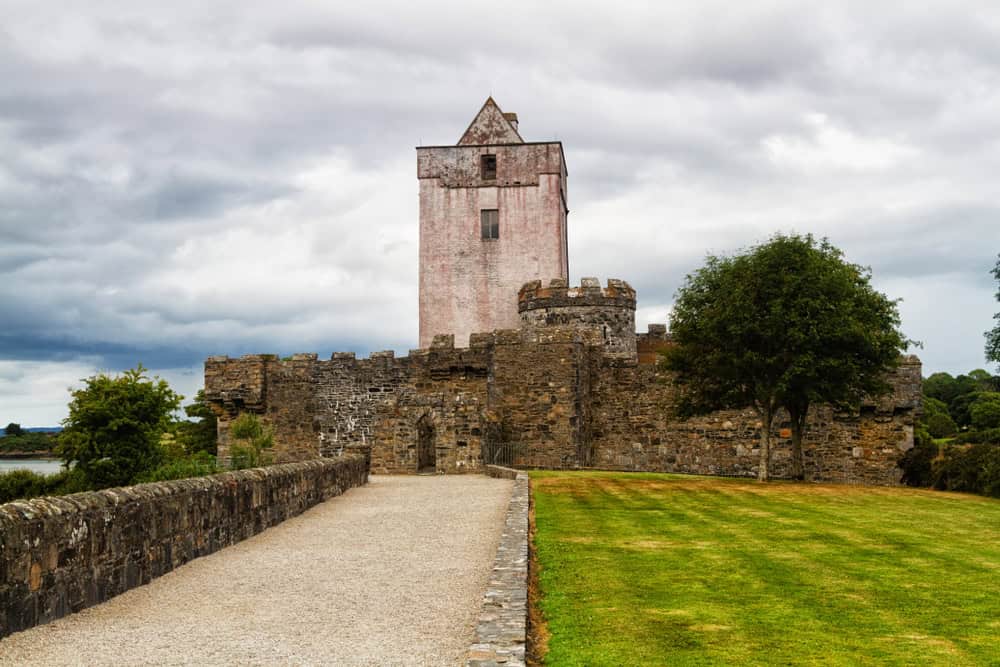
The broad timeline is fairly clear even where the earliest details vary between accounts. Most sources place the castle’s origins in the early to mid-15th century, with the fortress generally said to have been built in the 1420s and the central keep likely dating from the mid-15th century.
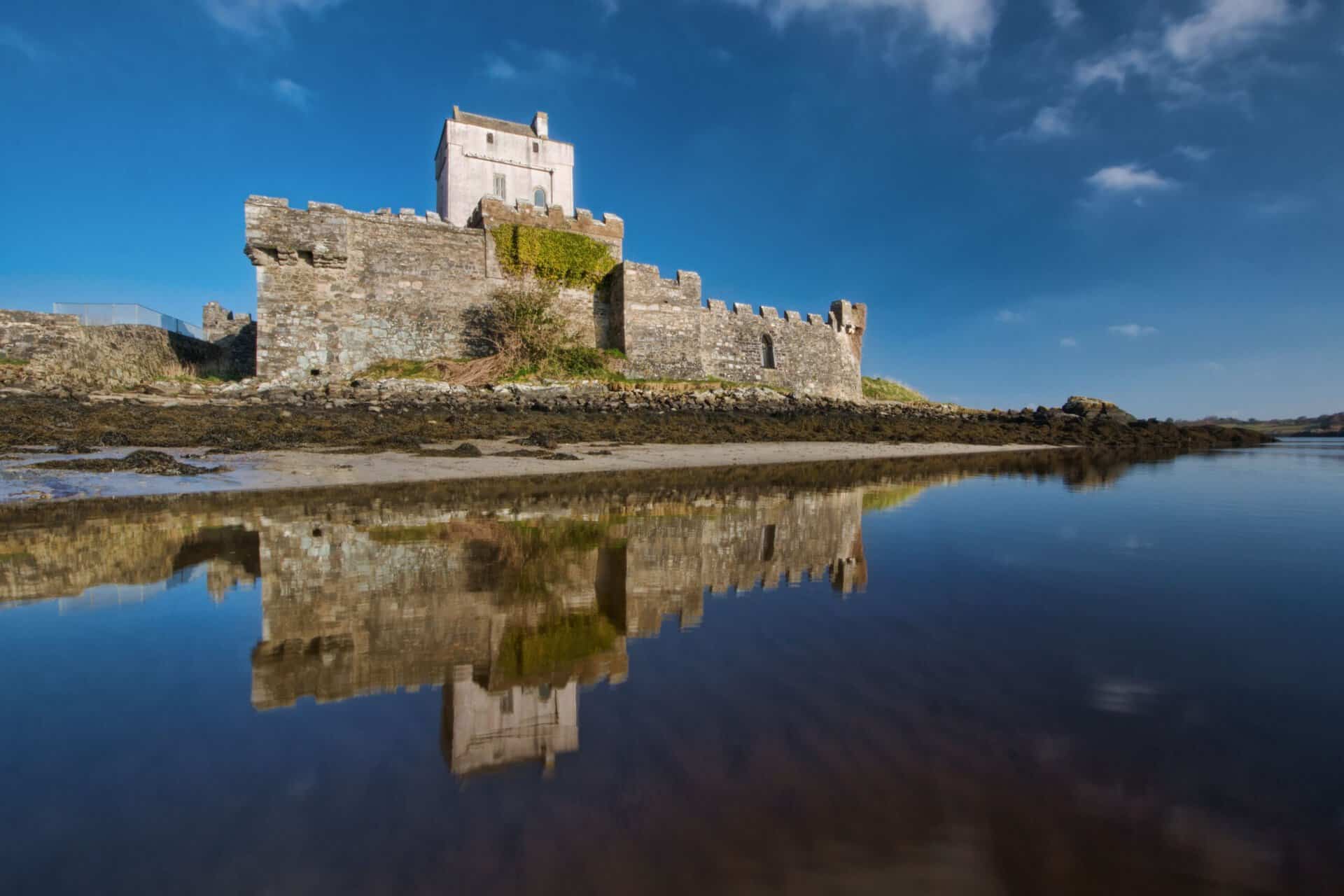
Discover Ireland describes Doe as a MacSuibhne castle protected by the sea on three sides and a rock-cut moat on the landward side. It also notes that the keep was later enclosed by a bawn wall with flanker and gun loops, showing how the site adapted as warfare changed.
In the 17th century, the castle changed hands repeatedly during the conflicts that reshaped Ulster. Discover Ireland notes that it survived siege and cannon fire. A later chapter followed in the early 19th century, when General George Vaughan Hart restored and extended the building into a country manor, adding crenellated battlements. His initials are said to remain visible above the doorway on the east side of the keep.
According to Discover Ireland, the site came under state protection in 1934, and further restoration work was carried out in the late 1990s.
The surviving complex includes the tower house or keep, the bawn walls and the defensive layout created by water on three sides and a deep rock-cut moat on the landward approach. Even without going inside, the shape of the site is easy to read, which is part of its appeal.
Heritage Ireland says there are display panels onsite explaining the castle’s history. Inside the tower house, where access is arranged, there is also a carved MacSweeney grave-slab dated 1544.
This is a good site for people who like defensive architecture. You can see how the keep, enclosure and natural shoreline worked together. It feels purposeful, not decorative. Medieval builders were not aiming for romance. They were aiming for survival.
The practical point is simple: the grounds are open daily all year, but there is no OPW visitor centre at the site, according to Heritage Ireland. If you want to go into the keep, you need to arrange a guided tour by appointment.
Heritage Ireland directs enquiries to doecastlecreeslough@outlook.com and states that cancellations must be advised 48 hours in advance. Because access arrangements can change, always confirm on the official operator page before you set out.
If you are building a wider castle route, this stop fits neatly with our guide to the best castles in Ireland, and it makes an especially good pairing with the nearby Glenveagh Castle visitor guide.
Heritage Ireland lists a car park, and most people visit by car. The site is on a short detour off the R245, so it works well as a quick stop while crossing between the Rosguill side of the peninsula and the Creeslough side of Sheephaven Bay.
Give yourself a few extra minutes just to walk around the perimeter and look back from different angles. The first view is good. The side and shoreline views are usually better.
Doe Castle photographs best from a slight distance, where you can frame the keep, walls and water together. Close-up shots are useful for stone detail, but the real character of the place comes from the way the building sits against Sheephaven Bay.
If the weather is shifting, stay with it for a few minutes. Donegal light can change the mood of the stone very quickly. Cloud, reflection and wet ground usually make the scene more interesting, not less.
For anyone with children, the shoreline setting is lovely but not forgiving. Keep a close eye near edges, stones and water while you line up photos.
Heritage Ireland lists limited access, which is the right expectation to carry into the visit. This is a historic site with uneven surfaces and a defensive layout, not a fully adapted indoor attraction.
For families, the castle works best as a short outdoor stop. Children who like towers, walls and boats-in-the-distance scenery will probably enjoy it. Children expecting an interactive centre, costume displays and a café-heavy afternoon may move on faster than the adults.
Glebe Gallery and Garden is listed by Heritage Ireland as about 14.8 km away. It is a useful contrast stop if you want art and gardens after medieval stonework.
Newmills Corn and Flax Mills is listed at about 23.2 km from Doe Castle. If you enjoy industrial heritage as much as defensive sites, it is a smart addition.
Donegal Castle is farther away at about 55.7 km, according to Heritage Ireland, so it is better for a broader county itinerary than the same local loop.
Discover Ireland also points people toward Glenveagh National Park and Castle, plus landmarks such as Errigal, Lough Beagh and Muckish. Those are larger outings, but they make sense if Doe Castle is one stop in a full Donegal day. If you’re comparing castle stops around Ireland, the mood here is very different from places like Dunluce Castle, which is grander and more dramatic, while Doe feels quieter and more intimate.
The documented part of Doe Castle’s story is strong enough that it does not need embellishment. The key facts supported by official heritage sources are the castle’s MacSweeney association, its 15th-century origins, the defensive setting, the Spanish Armada connection, the Kinsale link, later 19th-century restoration and 20th-century state care.
I have not included local legends or ghost tales here because the official and primary destination sources do not present them as core interpretive material. On a site like this, the real history is already dramatic.
Yes, for the right kind of stop. Doe Castle is worth it if you enjoy historic places, coastal settings and a brief but memorable detour. It is less suited to people looking for a full-service attraction with indoor exhibits, facilities and guaranteed tower access on arrival.
The visit works best when you treat it as a 30-minute heritage stop with excellent context, not a half-day attraction. Seen that way, it does its job very well. If you’re sketching out a longer route, it slips easily into a 7 day Ireland itinerary that gives Donegal enough breathing room.
Yes, but only by appointment. Heritage Ireland says guided tours of the keep may be accommodated by prior arrangement, while the grounds are open daily.
Access to the grounds is free, according to Heritage Ireland. Keep visits are handled separately by appointment, so confirm any tour details directly when booking.
Most people need 20 to 45 minutes to walk the grounds, read the panels and take photos. Allow longer if you have arranged a guided keep visit.
Yes. Heritage Ireland lists a car park at the site, and driving is the simplest way to visit.
Yes, for a short stop. Families who enjoy outdoor heritage sites should find it rewarding, but children need close supervision because of uneven ground and water nearby.
Access is limited. Heritage Ireland uses that wording, so expect a historic site with uneven surfaces rather than step-free museum-style access throughout.
You only need to book in advance if you want a guided keep visit. Walking the grounds does not require an appointment.

Dan is the founder and editor of Ireland Wide. Born and raised in Ireland, he researches the country’s history, mythology and cultural traditions using museum collections, heritage authorities and historical sources. He leads the site’s editorial team, with a particular focus on distinguishing documented history from later folklore and modern interpretations.
At Ireland Wide, our aim is to bring authentically Irish insights to you, wherever you are.
Whether you have some feedback or would like to offer some of your own insights for everyone else to explore, don't hesitate to get in touch with us!