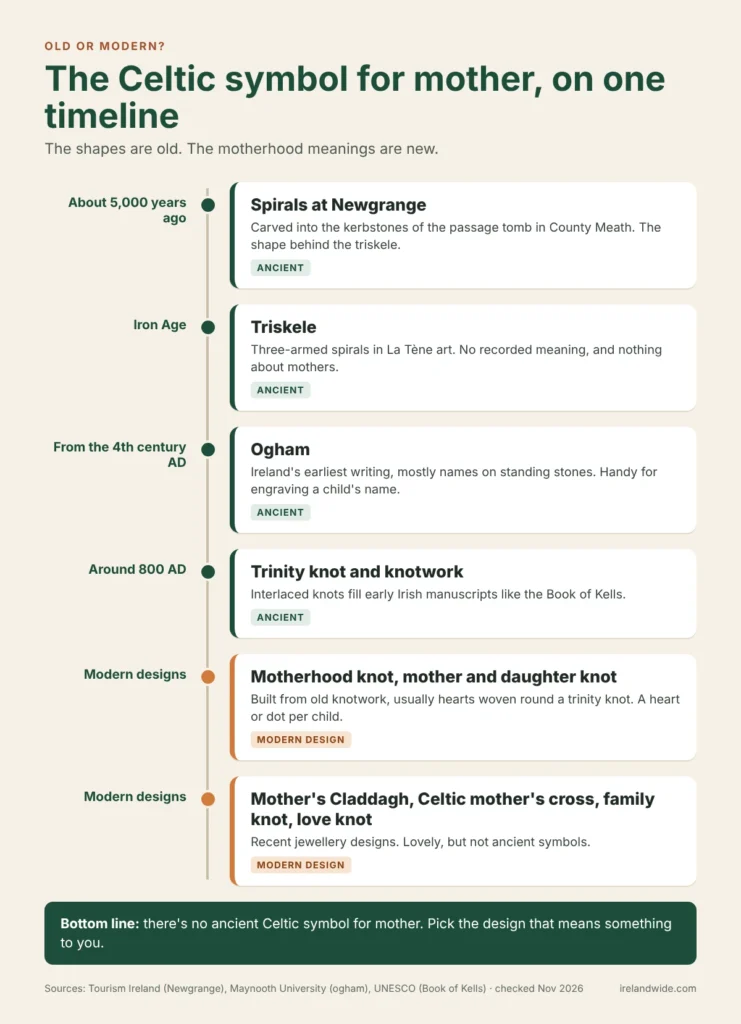
Quick answer: there’s no ancient Celtic symbol for mother. The symbols people use for a mother today, like the Celtic motherhood knot and the mother and daughter knot, are modern designs built from much older shapes such as the trinity knot and the triskele, which have a long history in Irish art but no recorded link to motherhood.
| Symbol | What it’s used for | Old or modern? |
|---|---|---|
| Celtic mother and daughter knot | One mother and one daughter | Modern design |
| Celtic motherhood knot | A mother and her children, often a heart or dot per child | Modern design |
| Trinity knot (triquetra) | The base of many mother knots | Old: early medieval Irish art |
| Triskele (triple spiral) | Growth, cycles, three generations | Old shape, modern motherhood meaning |
| Mother’s Claddagh and Celtic mother’s cross | A mother’s love, sometimes with faith | Modern designs |
| Celtic love knot | Love in general, including a mother’s | Modern design in an old style |
| Ogham | Writing a child’s or mother’s name | Old: inscriptions from around the 4th century |
Of all the Celtic Symbols used for motherhood-inspired tattoos, the Celtic Motherhood Knot is arguably one of the most popular and for good reason. It’s beautiful and conveys the everlasting love a mother has for their child.
However, did you know that the Celtic Motherhood Knot is a modern creation and isn’t Celtic of origin? That’s right, the motherhood knot isn’t an ancient Celtic symbol but is a stylized, inspired-by Celtic design type of knot.
However, this should not stop you from considering using one of the many motherhood knot designs there are out there for a tattoo or a piece of jewelry.
Although it may not originate from our ancient Celtic ancestors, it still encapsulates the Celtic culture, and it’s a beautiful design that symbolizes the unbreakable bond between a mother and child.
Keep reading to find out everything you need to know about the Celtic Mother Knot symbol, where it may have come from, and even some other symbols that represent motherhood.
What is the Celtic Symbol for Motherhood?
The trinity knot, also known as the Triquetra, is one of the most popular ancient Celtic symbols. It features a three-pointed design that symbolizes the power of three with its continuous knot.
The trinity knot is an ancient symbol that is believed to have inspired the first motherhood knot design.
So, although the Celtic motherhood knot isn’t a symbol created by the ancient celts it has been beautifully inspired by their traditional Celtic knots, such as the trinity knot.
The Celtic trinity knot itself has a proper history: knotwork like it fills early Irish manuscripts such as the Book of Kells, which the UNESCO Book of Kells nomination dates to around 800. The motherhood meaning is the new part.
These days there are many variations of the motherhood knot, each one as beautiful as the last. However, most will feature at least two hearts that are interlaced. The simplest depiction is just two unending knots in the shape of hearts that have been weaved together.
The addition of extra hearts will often be used to incorporate the arrival of each additional child added to the family.
What is the Celtic Symbol for Mother and Child?
We know we have said this a lot already, but there are so many blogs and articles you can find online claiming that the Celtic mother’s knot is some sort of ancient Celtic symbol when it is a modern-inspired design. There isn’t any Celtic knot that symbolizes a mother and her child that we know of yet.
That doesn’t mean the Celtic Motherhood knot is any less meaningful. Symbols themselves garner their meaning from us, so if the Celtic mother knot resonates with you, don’t let its inspired connection to Celtic culture stop you from enjoying it.
Even though there is no ancient symbol for a mother and her child, there are many stylized forms of the Celtic Motherhood knot that symbolize a mother and her daughter or son.
Mother and Daughter / Mother and Son
Although there is no Celtic symbol for a mother and daughter or son, there are many Celtic knot designs inspired by Celtic art used to symbolize the eternal love held between a mother and her child.
This mother-and-child knot symbolizes the eternal bond they share and a mother’s love for her child. Some even use it to inspire tattoos that commemorate children they have lost.
The mother and daughter version is usually two hearts woven into one knot. Our guide to the Celtic mother and daughter knot covers the designs and what to check before you buy one. Mother and son knots are sold too, and the designs vary just as much, so there’s no single correct version to hunt for.
Many people who use this stylized version of the trinity knot will often engrave or tattoo the Irish words ‘Grá Máthar’ (graw MAW-har), which means a mother’s love, or ‘Grá Mo Chroí’ (graw muh KREE), which means love of my heart, to personalize their Celtic motherhood knot tattoos and give them an even deeper connection to Irish culture and their Celtic heritage. Watch the spelling on the first one: máthar is the possessive form of máthair, as the Teanglann dictionary entry for máthair shows, and plenty of tattoos get it wrong.
Other Celtic Mother and Child Symbolism
The Celtic Motherhood knot isn’t the only design inspired by Irish culture that you can use to celebrate your journey as a mother. Some are a little less loved but no less beautiful.
Their reduced popularity means they can also be a little more unique, perfect for someone looking to give a thoughtful mother’s day gift or craft tattoos that few others have.
Here are some of the best Celtic symbols that represent Celtic motherhood.
Triskele (Triple Spiral)
The triskele is three spirals turning out from one centre, and it’s one of the few symbols on this list with ancient roots. Spirals are carved into the kerbstones at Newgrange passage tomb in County Meath, which is about 5,000 years old, so the shape is older than Celtic culture in Ireland by a long way. Three-armed triskeles turn up much later, as the triskelion in Iron Age La Tène art.
There’s a catch, of course. Nobody wrote down what the spirals meant to the people who carved them. Reading the three arms as mother, child and grandmother (or maiden, mother and crone) is a modern idea, so it suits someone who wants an old shape and is happy to choose the meaning themselves.
Mothers Claddagh Symbol
You may have heard of the Claddagh ring, the popular Irish ring that features two hands holding a heart and is often given as a gift from a loved one to another but have you heard of the mother’s Claddagh design?
This variation of the classic Claddagh design is slowly becoming a popular sign symbolizing motherhood.
Another modern creation, the Claddagh mother’s symbol, features the traditional hands and heart design, but it flows upwards into what looks like a mother’s face looking lovingly down at the heart she holds. It symbolizes her loyalty, maternal love, and support as a mother.
It may not have taken off as a popular tattoo design just yet, but you can find it in many Irish jewelers as necklaces, rings, and even bracelets.
Mothers Claddagh Cross
Much like the Mother’s Claddagh sign, the Mother’s Celtic cross also features the same stylized version of the traditional Claddagh but overlays it onto a Christian cross.
It has been designed to not only symbolize the strong bond a mother has with her child and the way she supports and holds them up, but it also represents their connection to their Christian faith.
This beautiful and unique design bridges the gap between a mother and her faith, representing the Madonna and child.
Celtic Mothers Knot Cross
The Celtic Mother’s cross is very similar to the Mother’s Claddagh cross. It features a traditional Christian cross and the stylized mother. However, instead of the traditional Claddagh hands and heart, the mother design flows into a triquetra design.
Many believe the Triple knot represents the holy trinity, the father, the son, and the holy spirit. So this particular design has an even more beautiful connection to a mother’s Christian faith.
This design is beautifully simple and works perfectly engraved on a gift, as a jewelry piece, or as a Celtic Motherhood tattoo.
Celtic Family Knot
Another one of our modern Celtic symbols, the Celtic family knot, is relatively new but shares some design features with both the Claddagh mother designs and the Mother’s Celtic cross.
The top of the design features what looks like a mother’s face and another face just under her chin. This can represent a partner, the other parent of their children or the eldest of their children. Many Celtic family knots will come specifically designed for the number of children or family members you have.
If you look closely, you can also see a traditional trinity design woven into the unending Celtic knot design.
The Celtic family knot symbolizes the strong bond a family holds, the way they support one another, and how they are always connected.
Ogham
Ogham is the earliest writing in Ireland, an alphabet used to carve early Irish onto standing stones from around the 4th century AD. It’s a unique alphabet that uses one long line that is then peppered with smaller lines to spell out whatever word was needed.

Most surviving Ogham inscriptions are simply a person’s name, often with a father’s or ancestor’s name, and there are only around 400 surviving ogham stones, about 360 of them in Ireland.
Suppose you are looking for something that symbolizes your children or your beginnings as an Irish mother that isn’t a motherhood knot. In that case, there really isn’t anything else as unique and meaningful as the ancient alphabet of Ireland.
Perfect for engraving onto jewelry, Ogham has become more and more popular as a simple and delicate Celtic tattoo idea.
Celtic Love Knot
Another Celtic symbol people choose for motherhood is the Celtic love knot. The interlaced style it borrows goes back to early medieval Irish art, but the two-heart love knot itself is a modern design. Often thought of as a knot for lovers, the love knot can also symbolize a mother’s unbreakable love for her children.

This design features two interlocking hearts, similar to the modern Celtic Motherhood knot. It is often used as an engraving on jewelry, such as wedding rings or even as a Celtic-inspired tattoo. The Celtic heart knot meaning is close to it, if you’d rather a single heart.
Although the original meaning for this Celtic knot isn’t known, it has come to symbolize love in its many forms in recent decades.
Motherhood and its Ancient Celtic Symbols
Although there is no ancient Celtic symbol for motherhood, many of the more modern designs still provide us with a beautiful connection to our Irish heritage and our maternal love for our family.
If you are looking for a Celtic motherhood knot symbol, be aware that most Celtic knots that represent motherhood will feature a triple knot because that’s where its first inspiration came from.
But, there is no right or wrong choice when it comes to your Celtic motherhood knot. It is just what symbolizes your motherhood and your child to you.
Celtic Symbol for Mother FAQs
Is there a Celtic symbol for grandmother?
Not an ancient one. You can adapt a motherhood knot with an extra heart or dot for each grandchild, or pick the Celtic tree of life knot to show three generations. A triskele also works if you like the idea of three arms for three generations.
What is the Irish word for mother?
The Irish word for mother is máthair (MAW-her), and “my mother” is mo mháthair (muh WAH-her). In everyday speech in Ireland it’s usually Mam or Mammy, so an engraving in Irish reads as a bit more formal.