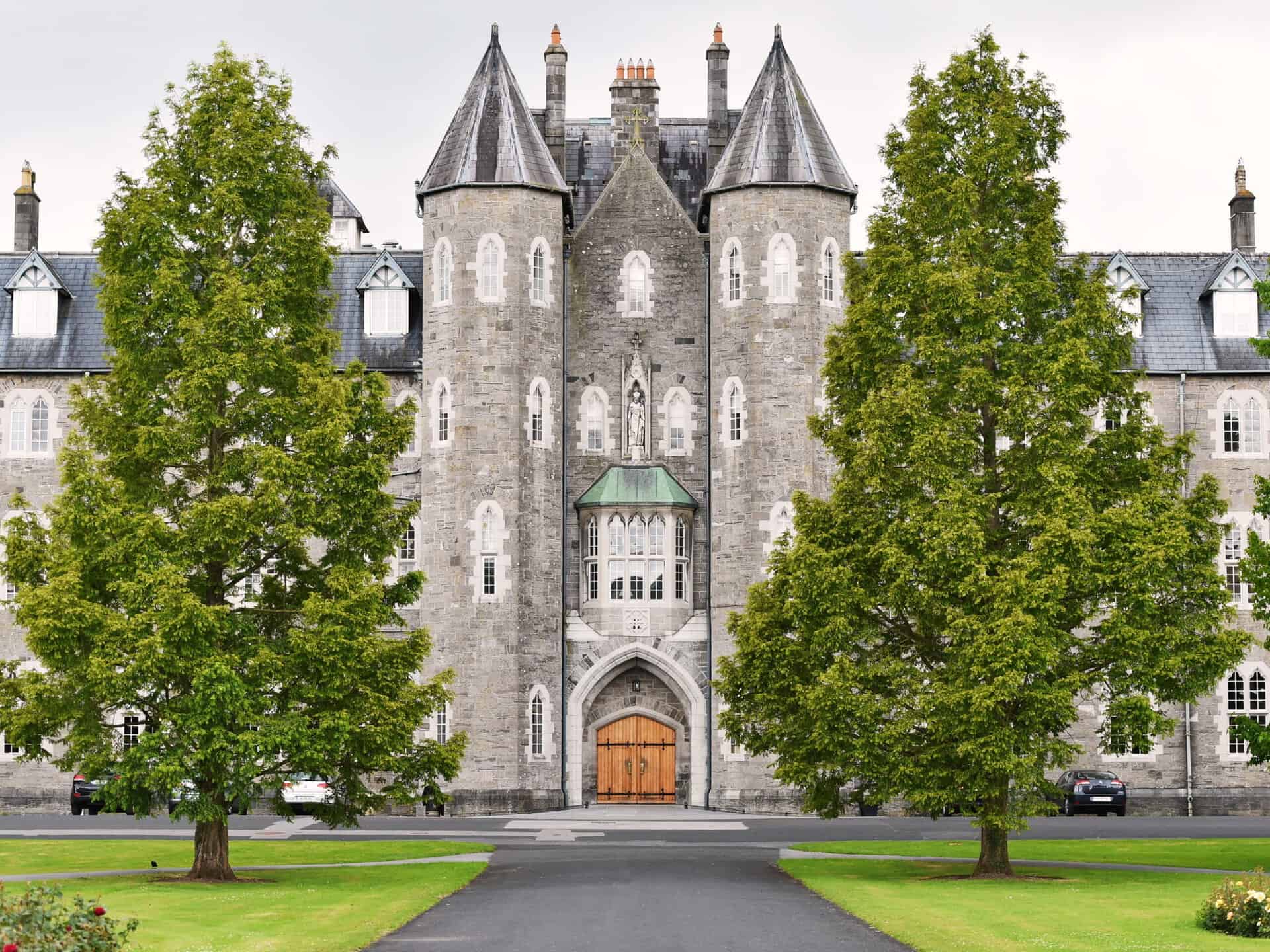
Maynooth Castle is worth visiting if you want an easy, history-heavy castle stop in County Kildare, especially on a day trip from Dublin or while exploring Maynooth. It suits people who like ruined castles, short self-guided visits, and clear historical context more than anyone looking for a fully furnished stately-home experience.
The practical appeal is simple: admission is free, the site sits in the middle of town, and the surviving keep includes an exhibition on the FitzGerald family who made Maynooth one of the most important power bases in medieval and early modern Ireland. If you are comparing options, our guide to the best castles in Ireland helps place it in the wider picture.
Maynooth Castle stands in the centre of Maynooth, County Kildare, about 30 kilometres west of Dublin according to the Office of Public Works. That makes it one of the simpler castle visits near the capital. You do not need a long detour, a mountain road, or a full-day commitment.
People come for two reasons. First, the castle was the seat of the FitzGeralds, Earls of Kildare, one of the most powerful families in Irish history. Second, the surviving keep gives you a strong sense of scale without demanding hours of walking. If you are building a wider trip, our best castles in Ireland guide and 3 day itinerary for visiting Dublin are useful next reads.
Maynooth Castle was founded in the early 13th century and developed into the principal residence of the Kildare branch of the FitzGerald family. The keep, started around 1200, is repeatedly described by official and tourism sources as one of the largest of its kind in Ireland.
The family’s political weight peaked under Garret Mór FitzGerald, the Great Earl of Kildare, who governed Ireland in the king’s name from 1487 to 1513 according to the Office of Public Works. By that stage, Maynooth was far more than a defensive tower. It was a working centre of lordship, administration, and display.
Later centuries brought change, damage, and remodelling. By the early 17th century, the focus of the complex had shifted eastward from the original keep. What most people see now is a fragment of a much larger residence, not the whole machine.
You are not visiting a complete castle with furnished rooms and roofed halls. What survives best is the keep, plus the main southern entrance gateway and surrounding ruined fabric identified by tourism sources. The keep contains the exhibition, while the upper level preserves remains of the Great Hall.
That split gives the site its best quality. On one level, you get explanation and context. On the next, you are looking at bare stone, broken walls, and the scale of a place that once sat at the centre of power. It feels archaeological rather than theatrical, which some people will love and some will not.
The documented story is strong enough that there is no need to pad it out. The key facts are the castle’s 13th-century foundation, its role as the seat of the Earls of Kildare, the 1535 siege, and its later decline, survival, and restoration under state care.
No specific folklore or local legend is included here because the strongest material attached to Maynooth Castle is historical rather than mythical. If you hear a dramatic tale on a walk around town, treat it as local storytelling unless you can trace it to a reliable historical source.
According to the official Heritage Ireland listing, admission is free. The same page lists the 2026 season as 23 April to 23 September, daily from 10:00 to 17:45, with last admission at 17:15.
Groups of 10 or more must pre-book. The official site also notes limited access for visitors with disabilities and confirms no toilet facilities. Those are the details most likely to affect your plan, so check them before leaving home, especially if anyone in your group needs step-free access.
Guided tours are sometimes mentioned in older listings and reviews, but schedules can shift with staffing and the season. Treat the official operator as the final word, and plan on a self-guided visit first so you are not disappointed if no tour is running that day.
By road, Maynooth is on the Dublin side of Kildare and is usually approached via the N4 corridor. The official location description places it in Maynooth village, roughly 30 km west of Dublin city centre.
By public transport, the easiest plan is to travel into Maynooth town by train or bus and walk from there. The castle sits near Maynooth University and St Patrick’s College, so it is not a remote site once you arrive. If you are mapping out a short capital-based trip, it fits neatly into an ultimate 3 day Ireland itinerary from the USA or a longer 7 day Ireland itinerary for first timers.
For most people, 45 to 90 minutes is enough. Self-guided visitors often spend that time between the undercroft exhibition, the upper remains of the Great Hall, and a walk around the grounds.
If you like reading every panel and taking photographs, stretch it to two hours and pair it with a coffee stop in town. If you are rushing between larger Kildare attractions, a shorter stop still works.
The castle works best in photos from a slight distance, where you can show the mass of the keep against the surrounding greenery. Mid-morning or late afternoon light usually gives ruined stone more shape than flat midday sun.
Inside, expect lower light and rough stone textures rather than polished interiors. A phone camera is usually enough, but a small daypack helps if you are carrying a separate camera, water, and a layer for Irish weather that can change its mind halfway through lunch.
The official operator warns of limited accessibility, so anyone with mobility needs should confirm conditions directly before visiting. This is a ruin with historic fabric, not a modern barrier-free museum.
For families, the site is manageable because it is compact and free. The weak points are the lack of toilets and the likely challenge for buggies. Older children who like towers, battlements, and stories about medieval power usually get more from it than toddlers do.
Castletown House and Parklands is the nearest major heritage stop named by the Office of Public Works, at about 5.5 km away. It is a very different visit from Maynooth Castle, with Palladian architecture rather than a medieval ruin.
Farmleigh House and Gardens is listed at roughly 15.7 km away, while the Phoenix Park Visitor Centre, Ashtown Castle and Biodiversity Centre is about 17.6 km away. If you are heading east toward Dublin after Maynooth, that pairing makes sense geographically.
For more castle-focused planning, see our Dunguaire Castle visitor guide and Ross Castle visitor guide. They are very different kinds of visits, but useful comparisons if you are deciding how much ruin versus restoration you want.
Yes, for the right kind of stop. Maynooth Castle is a good pick if you want a free, historically important castle near Dublin that you can see in under two hours. It is less compelling if your ideal castle day means grand interiors, extensive grounds, or lots of family facilities.
The real strength here is context. You are looking at the remains of a place that mattered in Irish politics for centuries, and the exhibition helps you understand why the FitzGerald connection still gives the site weight.
Admission is free, according to the Office of Public Works listing for Maynooth Castle.
The official 2026 listing shows 23 April to 23 September, daily from 10:00 to 17:45, with last admission at 17:15. Seasonal sites can change, so confirm before you go.
Most people need 45 minutes to 1.5 hours. Add extra time if you want to read the exhibition carefully or combine the stop with a longer walk around Maynooth.
Yes. The castle is about 30 km from Dublin and sits in the centre of Maynooth, which makes it a straightforward day trip by car or public transport.
Yes, in a short-visit way. The ruined keep and grounds are interesting for school-age children, but the lack of toilets and limited accessibility make planning more important for families with very young kids.
Partly. You can access the keep and exhibition spaces, but this is still a ruin, so do not expect a fully intact castle interior.

Dan is the founder and editor of Ireland Wide. Born and raised in Ireland, he researches the country’s history, mythology and cultural traditions using museum collections, heritage authorities and historical sources. He leads the site’s editorial team, with a particular focus on distinguishing documented history from later folklore and modern interpretations.
At Ireland Wide, our aim is to bring authentically Irish insights to you, wherever you are.
Whether you have some feedback or would like to offer some of your own insights for everyone else to explore, don't hesitate to get in touch with us!