An Irish blessing is a short prayer or good wish for someone, usually asking for an easy road, kind weather, good friends or God’s protection. The most famous Irish blessing is “May the road rise up to meet you,” but there are blessings for every occasion, from Christmas cards to weddings, farewells and a new home.
Irish blessings have been inspiring hope and offering spiritual protection for centuries.
Some grew out of Irish-language prayers and sayings, but many of the best-known ones were written in English, a fair few of them in the 20th century.
According to some, they lost some of their meaning in the process, but they still play a significant role in wedding ceremonies and other special occasions.
Need one in a hurry? Here’s the short version, and the full blessings (with what they mean) are below.
- Most famous Irish blessing: “May the road rise up to meet you.” Its Irish opening, “Go n-éirí an bóthar leat,” is closer to “May you succeed on the road.”
- For a wedding: “May you see your children’s children” (blessing #4).
- For a new home: “May your neighbors respect you, trouble neglect you” (blessing #3).
- Short enough for a card: “May your blessings outnumber the shamrocks that grow, and may trouble avoid you wherever you go” (blessing #2).
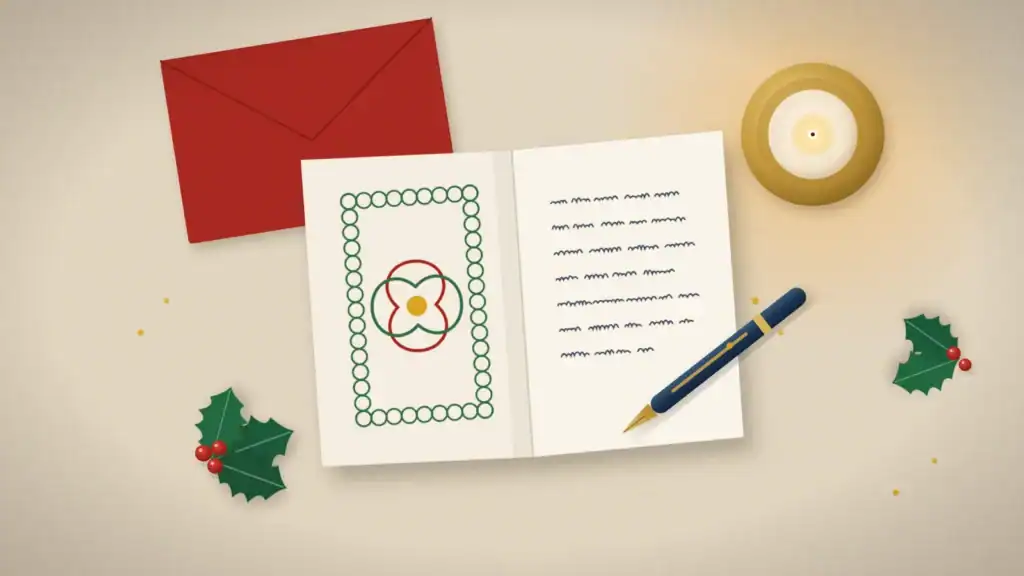
- For a Christmas card: “May peace and plenty be the first to lift the latch on your door” (blessing #18), or “Nollaig shona duit” (Happy Christmas to you) in Irish.
- For someone who has died: “Ar dheis Dé go raibh a anam,” the Irish way of saying “May he rest in peace.”
Facts, dates and Irish phrases checked in November 2026.
What is the Irish Blessing?
The most famous Irish blessing is “May the road rise up to meet you.” It’s often sold as an ancient Celtic prayer, although the full English version is a lot younger than that (more on that below):
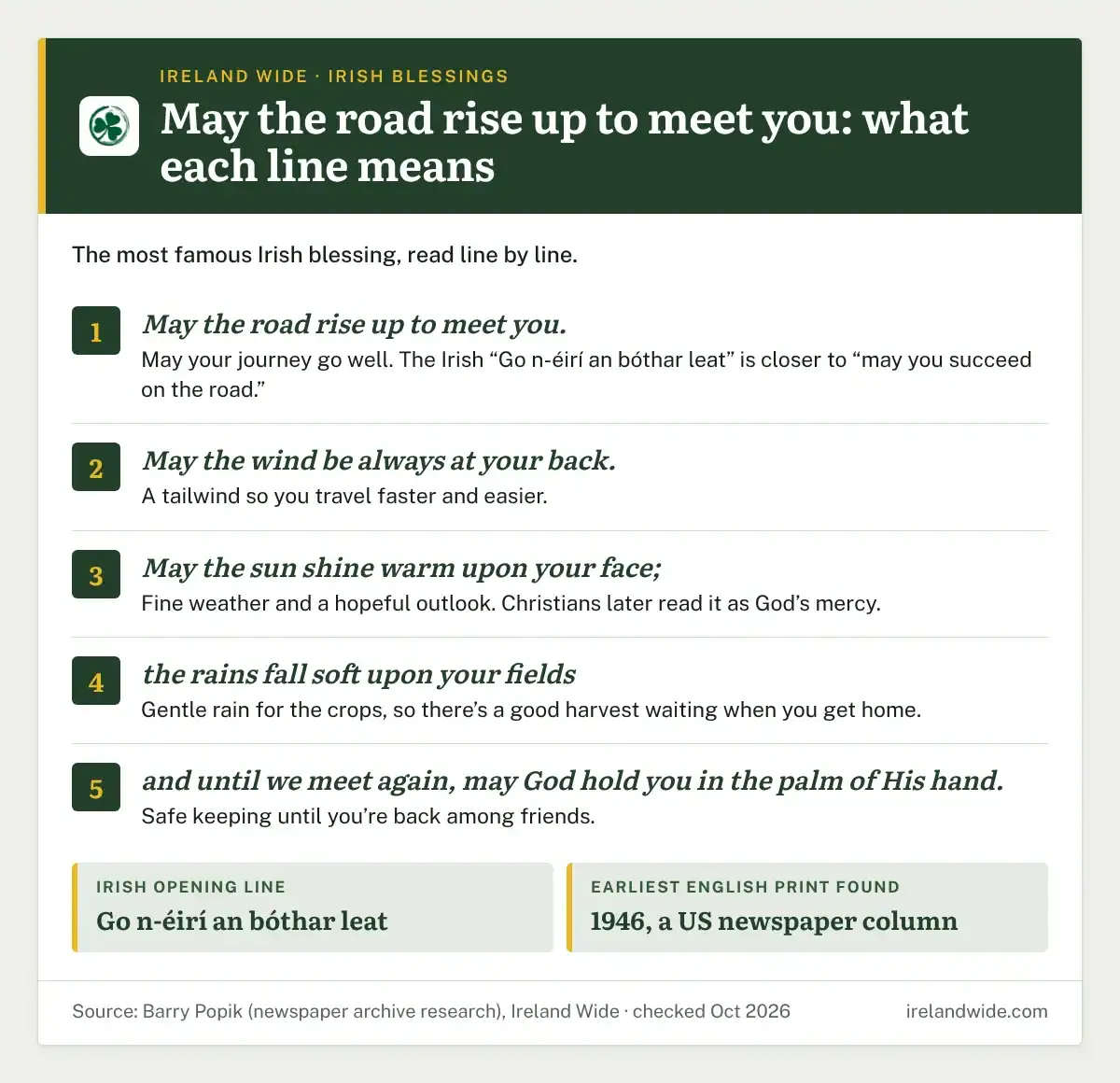
May the road rise up to meet you.
May the wind be always at your back.
May the sun shine warm upon your face;
the rains fall soft upon your fields and until we meet again,
may God hold you in the palm of His hand.
In essence, the poem is wishing you a pleasant journey and praying that the weather will remain fine and favorable as you travel.
The first line of the English version is rather troublesome as it makes little sense. A road rising up to meet you sounds like something out of a B-list horror movie!
The Irish phrase behind it reads, “Go n-éirí an bóthar leat,” a more literal translation of which is: “May you succeed on the road.”
The rest of the poem focuses on the notoriously unpredictable Irish weather, praying for the wind at your back so that you travel faster and the sun to shine on your face, giving you an optimistic outlook on your future.
Meanwhile, the “rains fall soft upon your fields,” watering your crops and ensuring there’ll be a good harvest and plentiful food waiting on your return.
The traditional Irish blessing was reinterpreted by the Christians, who turned the wind into the Holy Spirit, “who came as a “mighty wind” at Pentecost.”
Similarly, the sun “warm upon your face” came to mean God’s Mercy, and the rain “thought to be symbolic of God’s provision.”
Here’s the whole Irish blessing broken down line by line, if you want to save it for later:
(Very) Short History of the Irish Blessing
Irish blessings date back to ancient Celtic times when traveling poets would offer blessings to the communities they passed through.
These blessings took their inspiration from nature and the environment, but many were re-interpreted according to the Christian religion.
The traditional Irish blessing is often thought to be one of the blessings of St Patrick as it shares similarities with his other writings, but many believe it was written long before his arrival on the Irish shores.
Here’s the catch: nobody has found the full English version in print before 1946. Researcher Barry Popik traced its earliest known appearance to a St Patrick’s Day newspaper column in Pittsburgh in March 1946, where it was introduced as “an old-fashioned Irish prayer.” The opening phrase is genuine Irish, but no older Irish-language text of the whole poem has turned up, so it’s likely the rhyming version grew from Irish sayings rather than being translated word for word.
The same goes for many of the rhyming blessings you’ll see on cards, plaques and tea towels. They’re Irish in spirit, even if a fair few were written in English much more recently.
Which Irish Blessings Are Traditional and Which Are Modern?
The Irish-language greetings are the genuinely old part. Most of the rhyming English blessings, the famous one included, can’t be traced back further than the 20th century, and nobody knows who wrote them. That doesn’t make them any less lovely in a card. It just means “ancient Celtic prayer” on the packaging is doing a bit of heavy lifting.
| Blessing | Where it comes from | Our verdict |
|---|---|---|
| “May the road rise up to meet you” | The opening is a real Irish phrase; the full English poem first turns up in print in 1946 | Part traditional, mostly modern |
| St Patrick’s Day blessing (#17) | Adapted from St Patrick’s Breastplate, an Old Irish prayer credited to Patrick since at least the late 7th century | Traditional (adapted) |
| Safe journey blessing (#7) | Adapted from a Gaelic prayer collected in the Scottish Highlands and Islands | Traditional, but Scottish |
| Irish-language greetings (Nollaig shona, Beannacht Dé leat, Bail ó Dhia ar an obair) | Everyday Irish, listed in the standard Irish-English dictionary | Traditional and still used |
| New Year toast (“may your right hand always be stretched out in friendship”) | In print in a book of Irish toasts by 1987 | Modern |
| Luck of the Irish (#15) | Built on a phrase from the 19th-century American gold and silver rushes | Modern |
| The other rhyming English blessings (#1 to #6, #8 to #14, #16, #18) | No known author and no older Irish-language original that we could trace | Irish in spirit, author unknown |
18 Irish Blessings and Their Meanings
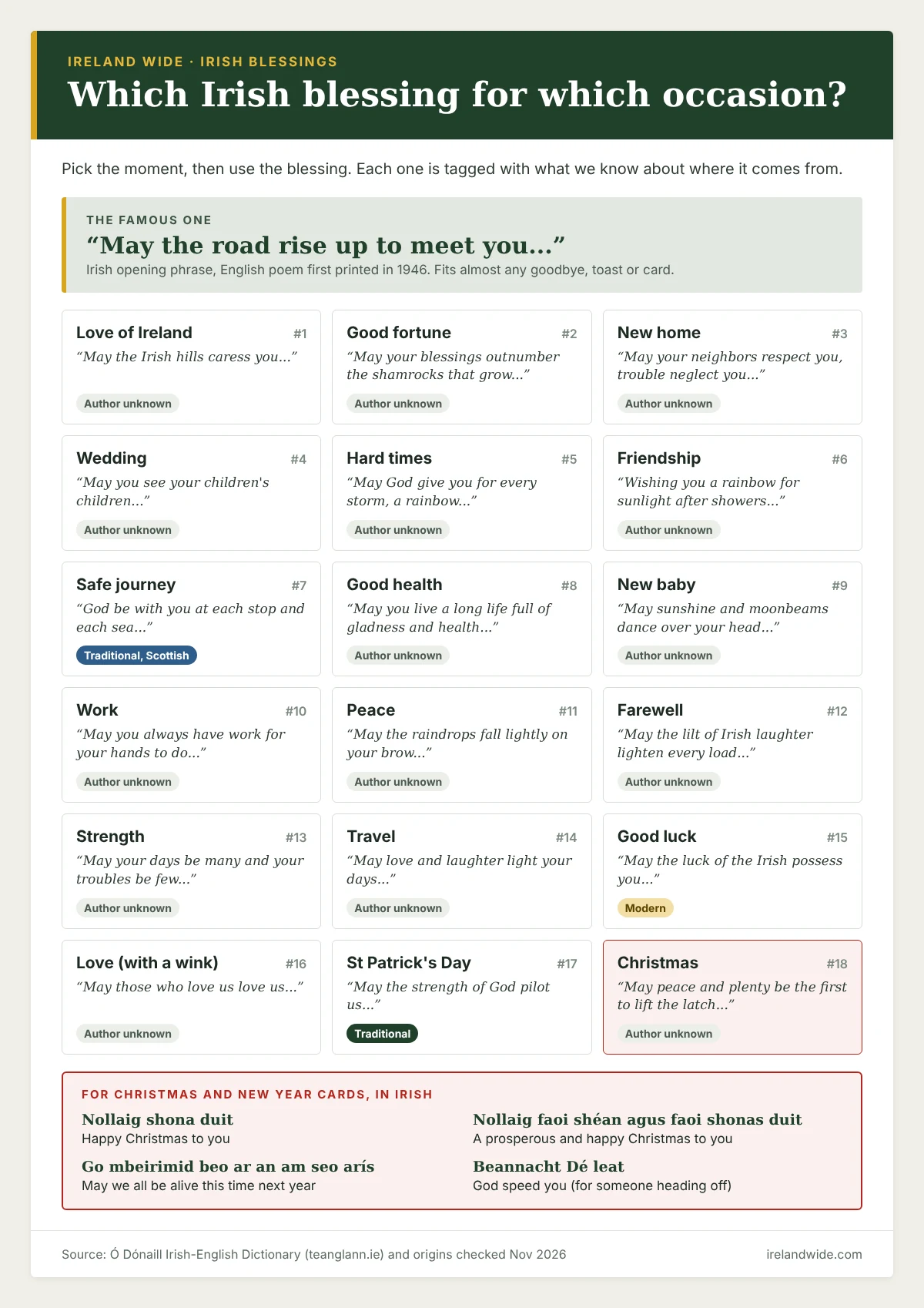
Short on time? This cheat sheet matches every blessing below to the moment it suits best, and flags the genuinely traditional ones:
#1 Blessing about Ireland
Most Irish sayings and blessings focus on nature and the beauty of the Irish landscape. One of the most beautiful blessings for Ireland is:
May the Irish hills caress you.
May her lakes and rivers bless you.
May the luck of the Irish enfold you.
May the blessings of Saint Patrick behold you.
These words evoke a landscape that cares for its people, caressing them and blessing them with its natural features.
The luck of the Irish refers to the resilience of the Irish people. Despite the struggles and tragedies affecting them as a nation, the Irish have always remained hardworking, optimistic, and courageous in the face of adversity.
#2 Shamrock Blessing
Although “May the road rise up to meet you” is the most famous traditional Irish blessing, it’s by no means the only one.
This short rhyming blessing is designed to bring you the luck of the shamrock and offer some level of protection as you travel:
May your blessings outnumber
The Shamrocks that grow
And may trouble avoid you
Wherever you go
The shamrock is a young clover sprig and a symbol of Ireland. It’s believed that the ancient Celts associated the three-leaved plant with the triple gods and goddesses they worshipped.
Later on, it’s said that St Patrick used the leaf to explain the Holy Trinity to Irish non-believers.
#3 Blessing for a New Home
This Irish blessing is often read at weddings but is just as appropriate for a friend or family member moving into a new home:
May joy and peace surround you, contentment latch your door.
And happiness be with you now and bless you evermore.
A more specific blessing for a new home is:
May your neighbors respect you,
Trouble neglect you,
The angels protect you,
And heaven accept you.
This blessing emphasizes the importance of having good neighbors, which in Ireland could be Sue and Jim over the road or Dagda and Dana of the underground fairy folk.
Either way, you need to behave in a certain way to earn your neighbors’ respect. That means not encroaching on their land and returning anything you borrow.
These are great rules to live by, especially if you’ve fairies living close by.
#4 Blessing for a Wedding
This is one of the most beautiful Irish wedding blessings:
May God be with you and bless you.
May you see your children’s children.
May you be poor in misfortune, rich in blessings.
May you know nothing but happiness.
From this day forward.
This blessing emphasizes the importance of the extended family, which in ancient rural Ireland, was integral to the success of any farming venture. Without sons and daughters to continue working the land, the crops would fail, bringing the family into destitution.
Blessings were only one of the many ancient Irish wedding traditions, which included the bride carrying a horseshoe with her as she walked down the aisle.
The groom would then affix the horseshoe to the matrimonial home to bring good luck to those inside.
#5 Blessing for Hard Times
This blessing for hard times promises a rainbow for every storm, which is why it also turns up in so many birthday and get-well cards:
May God give you for every storm, a rainbow.
For every tear, a smile.
For every care, a promise.
And a blessing in each trial.
For every problem life may send,
may he send a faithful friend.
For every sigh, a sweet song.
And an answer for every prayer.
It is a prayer that asks for comfort in the face of adversity and friends to assist when problems arise.
Want more for the card? We’ve gathered our favorite Irish birthday blessings and toasts in one place.
#6 Blessing for Friendship
This blessing for friendship conjures up a bucolic existence of sunshine and smiles, where your friends bring you luck and happiness.
Wishing you a rainbow for sunlight after showers,
Miles and miles of Irish smiles for golden happy hours,
Shamrocks at your doorway for luck and laughter too,
And a host of friends that never ends, each day your whole life through.
According to Celtic tradition, it’s possible to have an anam cara, or soul friend, with whom you can share your most intimate thoughts. This friendship is an ancient union or soul bond that transcends all society’s rules and boundaries.
#7 Blessing for a Safe Journey
This poetic blessing compares the troughs and crests of the sea’s waves to the natural rhythms of life.
It calls for God’s protection at the beginning and end of each day and draws on the critical role the sea played in Gaelic life.
God be with you at each stop and each sea;
At each lying down and each rising up;
In the trough of the waves, on the crest of the billows.
Each step of the journey you take.
Strictly speaking, this one is Scottish. The lines are adapted from The Pilgrims’ Aiding, a Gaelic travel prayer, collected in the Scottish Highlands and Islands by Alexander Carmichael. Ireland and Gaelic Scotland share a lot of this tradition, so it’s in good company here.
#8 Blessing for Good Health
In ancient Ireland, illness and disease were unavoidable and associated with the spiritual world, as well as the physical.
Physicians would recommend treatments and surgeries for the physical symptoms, while the clergy would offer prayers “to bring balance to the body.”
May you live a long life full of gladness and health,
With a pocket full of gold as the least of your wealth.
May the dreams you hold dearest, be those which come true,
The kindness you spread, keep returning to you.
#9 Blessing for a New Baby
Welcoming a new baby into the world is a stressful yet wonderful experience in any culture, but in Ireland, these newborns faced an additional danger.
Many believed that the fairies would steal away a healthy newborn, replacing it with a changeling.
To protect their babies, the ancient Celts would keep them close to a fire to ward off the fairies or place a pair of iron scissors or tongs close to the cot to keep them at bay.
Blessings like this one also offered protection:
May sunshine and moonbeams dance over your head
As you quietly slumber in your bed
May good luck be with you wherever you go
And your blessings outnumber the shamrocks that grow.
#10 Blessing for Work
May you always have work for your hands to do.
May your pockets hold always a coin or two.
May the sun shine bright on your windowpane.
May the rainbow be certain to follow each rain.
The Irish are known for being hard workers who will work long hours and perform almost any task.
This blessing combines that notion with the proverb, “idle hands are the devil’s tools.”
It suggests that we’re likely to get into trouble unless we have something productive to do, which is a recurring theme in Irish mythology.
#11 Blessing for Peace
Ireland has seen little peace in its tumultuous past, with battles between supernatural races and religions tarring its history.
In recent times, that’s changed, and Ireland is consistently ranked among the most peaceful countries in the world.
According to the 2022 Global Peace Index (GPI), Ireland is the third most peaceful country in the world.
It’s held its place near the top since then, too. The Global Peace Index 2026, published in June 2026, ranks Ireland fifth out of 163 countries, behind Iceland, New Zealand, Switzerland and Slovenia.
You can share in a little of that peacefulness by offering this blessing to a loved one:
May the raindrops fall lightly on your brow.
May the soft winds freshen your spirit.
May the sunshine brighten your heart
May the burdens of the day rest lightly upon you.
And may God enfold you in the mantle of His love.
Like many Irish blessings, this one evokes images of an Irish spring day, with gentle rain and soft winds refreshing the spirit.
#12 Farewell Blessing
Despite the existence of this Irish blessing, saying goodbye isn’t something the Irish are particularly good at.
A traditional Irish farewell involves leaving abruptly without bothering to say goodbye at all.
This is because the rituals involving arriving and leaving can be so drawn-out that it takes virtually all day, even if you only popped in for a cup of tea!
However, if someone’s leaving on a long journey or embarking on a new phase in their lives, this blessing sends with them the laughter and magic of Ireland and promises that the friends you leave behind will remember you and everything you’ve ever done for them.
May the lilt of Irish laughter
Lighten every load,
May the mist of Irish magic
Shorten every road,
May you taste the sweetest pleasures
That fortune ere bestowed,
and may all your friends remember.
All the favors you are owed.
#13 Irish Prayer for Strength
We all face hardships at some point in life, whether they’re financial, personal, professional, or even spiritual.
This blessing offers courage, and support, along with the wisdom to know when you’re straying too far from your chosen path.
May your days be many and your troubles be few,
May all God’s blessings descend upon you,
May peace be within you,
May your heart be strong,
May you find what you’re seeking wherever you roam.
And the insight to know when you’re going too far.
#14 Irish Travel Blessing
Once again, this Irish blessing emphasizes friendship and the importance of home.
During the cold winter months, life in rural Ireland revolved around the home and, especially, the hearth, which was the only source of heat.
A warm heart and home also reflect the openness and hospitality that the Irish are known for.
May love and laughter light your days,
And warm your heart and home.
May good and faithful friends be yours,
Wherever you may roam.
May peace and plenty bless your world
With joy that long endures.
May all life’s passing seasons bring the best to you and yours!
#15 Luck of the Irish Prayer (Blessing for Good Luck)
It’s unclear where the concept of the luck of the Irish originated, although some believe its origins lie in the US, rather than Ireland.
The Great Potato Famine occurred between 1845 and 1852, and resulted in roughly a million deaths and over a million people emigrating from Ireland.
Many of these immigrants ended up in America, where, as luck would have it, the Californian Gold Rush was just beginning.
As many immigrants ended up in the US mines, “many of the most prominent and successful miners were of Irish descent.”
Over time, good fortune in the mining industry became inextricably linked to being of Irish descent, giving birth to the phrase “the luck of the Irish.”
It wasn’t always meant kindly, though. Historian Edward T. O’Donnell has argued that the phrase was a jibe from the gold and silver rush years, suggesting Irish miners only struck it rich by sheer luck rather than brains. We dig into the full story in our guide to whether the Irish really are that lucky.
This relatively modern Irish blessing suggests that the luck of the Irish is so powerful that it can frighten off the devil and, with him, all your worries and concerns.
May the luck of the Irish possess you.
May the devil fly off with your worries.
May God bless you forever and ever.
#16 Blessing for Love
In modern-day Ireland, blessings like the one below are often recited at wedding ceremonies, but in ancient times, there was little overlap between marriage and true love.
Runaway lovers like Diarmuid and Grainne turned their backs on social convention and headed into the wilderness with nothing but their love for one another.
In this way, Irish mythology celebrated “lovers that break all conventions and laws to be together.”
These sentiments are reflected in the following blessing, which calls on God to either “turn their hearts” or “turn their ankles.”
Not only would this enable the lovers to recognize their enemies, but it would also make it easier for them to escape.
May those who love us love us.
And those that don’t love us,
May God turn their hearts.
And if He doesn’t turn their hearts,
May he turn their ankles,
So we’ll know them by their limping.
#17 Blessing for St Patrick’s Day
Although the traditional Irish blessing is suitable for St Patricks Day, more modern blessings are also applicable, especially those associated with St Patrick himself.
The following is a popular Irish blessing for St Patricks Day, and is used to celebrate and honor the patron saint of Ireland:
May the strength of God pilot us, may the wisdom of God instruct us.
May the hand of God protect us, may the word of God direct us.
May thy Salvation, O Lord, be always ours this day and for evermore.
This is one of the few blessings here with a properly old pedigree. Its lines are adapted from St Patrick’s Breastplate, an Old Irish prayer that has been credited to Patrick since at least the late 7th century (here’s the history of St Patrick’s Hymn).
Saving this one for March? Here’s when St Patrick’s Day 2027 falls and what’s on around Ireland.
#18 Blessing for Christmas
This short blessing speaks of peace and plenty entering your home and evokes the Irish tradition of placing a candle in the window on Christmas Eve.
This Catholic ritual is said to be an invitation to Christ to enter the home. Schoolchildren recording local customs in the late 1930s described the candle as a guide for the Holy Family, and for anyone else who, like Mary and Joseph, had nowhere to stay that night (see these 1930s Irish Christmas folklore accounts).
The candle is one of several Irish Christmas traditions still celebrated today, and this blessing makes a lovely line for a Christmas card.
May peace and plenty be the first to lift the latch on your door,
and may happiness be guided to your home by the candle of Christmas.
Irish Christmas and New Year Blessings for Cards
Writing Christmas cards? Blessing #18 is the obvious pick in English. If you’d like a line in Irish, or something for the New Year, these are the ones we’d reach for:
- Nollaig shona duit (NUL-ig HUN-a gwitch): Happy Christmas to you. Short, traditional and fits on any card.
- Nollaig faoi shéan agus faoi shonas duit: a prosperous and happy Christmas to you. A bit more formal, and lovely written out in full.
- Go mbeirimid beo ar an am seo arís: may we all be alive this time next year. A traditional wish you’ll still hear around Christmas and New Year.
- For the New Year, in English: “In the New Year, may your right hand always be stretched out in friendship and never in want.” It’s a modern toast rather than an old blessing (it was in print by 1987, according to early newspaper citations of Irish toasts), but it’s a good one.
Midwinter was being marked in Ireland long before Christmas cards, too. If you’re curious, here’s how the Celts celebrated the winter solstice.
Short Irish Blessings in the Irish Language
Want to go one better than the English versions? These short Irish blessings and well wishes are still part of everyday life in Ireland, and they fit neatly into a card, a toast or a text.
| Irish | What it means | When to use it |
|---|---|---|
| Go n-éirí an bóthar leat | May you succeed on the road | Wishing someone a good journey |
| Go n-éirí leat | May you succeed (best of luck to you) | Exams, interviews, a new job |
| Ádh mór ort | Good luck | Any big day |
| Dia duit | Hello (literally “God to you”) | An everyday greeting |
| Dia linn | God bless | When someone sneezes |
| Sláinte | Health | Raising a glass |
| Nollaig shona | Happy Christmas | Christmas cards and greetings |
| Beannacht Dé ort | God bless you | A warm thank you or goodbye |
| Beannacht Dé leat | God speed you | Someone heading off on a journey |
| Bail ó Dhia ar an obair | God bless the work | Greeting someone hard at work |
| Ar dheis Dé go raibh a anam | May he rest in peace (may his soul be at God’s right hand) | Condolences; use “a hanam” for a woman |
If it’s a toast you’re after, there are plenty more ways to say cheers in Irish than a simple sláinte.
Irish Blessings FAQ
What is the most famous Irish blessing?
“May the road rise up to meet you” is the most famous Irish blessing. It wishes someone a safe, easy journey with good weather, and ends with “may God hold you in the palm of His hand.”
What does “May the road rise up to meet you” mean?
It means “may your journey go well.” The Irish phrase it’s based on, “Go n-éirí an bóthar leat,” translates more literally as “May you succeed on the road.”
Is “May the road rise up to meet you” really an ancient blessing?
The opening phrase is genuine Irish, but the full English poem has only been traced back to 1946, when it appeared in a US newspaper column for St Patrick’s Day. No older Irish-language version of the whole blessing has been found.
What is a short Irish blessing for a card?
“May your blessings outnumber the shamrocks that grow, and may trouble avoid you wherever you go” is short, cheerful and works for almost any card. At Christmas, blessing #18 does the job nicely.
What is an Irish blessing for someone who has died?
The most common is “Ar dheis Dé go raibh a anam,” meaning “May he rest in peace” (literally, may his soul be at God’s right hand). For a woman, it’s “Ar dheis Dé go raibh a hanam.”
What is an Irish blessing for Christmas?
A lovely one for cards is “May peace and plenty be the first to lift the latch on your door, and may happiness be guided to your home by the candle of Christmas.” In Irish, keep it simple with “Nollaig shona duit,” which means Happy Christmas to you.
Are Irish blessings really ancient?
Some are. Irish-language greetings like “Bail ó Dhia ar an obair” are old, and the St Patrick’s Day blessing draws on a prayer credited to Patrick since the 7th century. Most rhyming English blessings, though, have no known author and can’t be traced back past the 20th century.
How do you say good luck in Irish?
Say “Go n-éirí leat,” which means “may you succeed,” or “Ádh mór ort.” Use “Go n-éirí libh” when you’re wishing a whole group luck.
Conclusion
There are hundreds of Irish sayings and blessings, many of which have their origins in Irish mythology.
Many Irish blessings conjure up images of Ireland and draw parallels between the natural elements and different aspects of a person’s life.
Irish blessings have recurring themes and frequently refer to faithful friends, warm and happy homes, prosperity, and good health.
Although some Irish blessings have lost some of their meaning along the way, many are just as relevant to modern-day life as they were to the rural Celts.
An Irish blessing is still an essential part of Irish weddings and other ceremonies and events.
Irish blessings offer protection, hope, and courage in the face of adversity, so there’s no reason you shouldn’t incorporate a few into your own life and wish others the luck of the Irish.