What is the minimum age to drink alcohol in Ireland? What are the drinking laws in Ireland? These are questions that many visitors to Ireland ask themselves before they travel to the emerald isle. After all, Ireland is well known for its pints of Guinness and whiskey tipples.
The legal drinking age in Ireland is 18. You have to be 18 or over to buy alcohol or to drink it in a pub, restaurant or any other licensed premises, and the same age applies in Northern Ireland. I checked every rule in this guide against Citizens Information and the Irish Statute Book in October 2026.
Quick answer: drinking laws in Ireland
- Minimum age to buy or drink alcohol: 18, in both the Republic and Northern Ireland
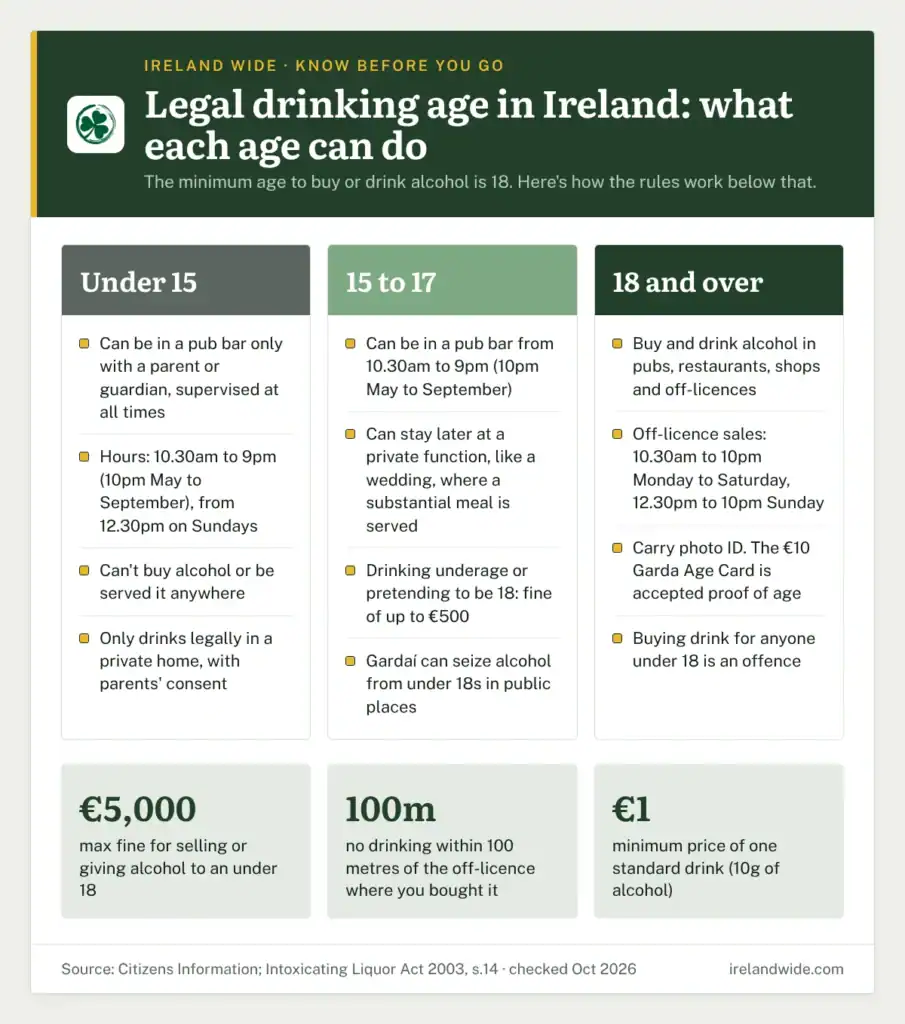
- Under 18s in pubs: allowed in the bar from 10.30 am to 9 pm (10 pm from May to September), and under 15s must be with a parent or guardian
- Under 18s drinking: only legal in a private home with their parents’ consent
- Off-licence hours: 10.30 am to 10 pm Monday to Saturday, 12.30 pm to 10 pm on Sundays
- Drink driving limit: 50mg of alcohol per 100ml of blood, or 20mg for learner, novice and professional drivers
- Biggest fine: up to €5,000 for selling or giving alcohol to someone under 18
If you plan to enjoy an adult beverage or two when you visit Ireland you will need to know the legal drinking age in Ireland. Otherwise, you may land yourself in some hot water with the local Garda (that’s what the police are called in Ireland).
Not long ago there were over 7,000 pubs recorded in Ireland, not including off-licenses, restaurants, and hotels. Closures have brought that down to 6,412 pubs in 2026, according to the Drinks Industry Group of Ireland. So, that is a whole lot of drinking.
If you’re ready to discover the laws and regulations surrounding alcohol in the Republic of Ireland – remember Northern Ireland is a different country and its laws may differ slightly – then keep reading.
What is the Legal Drinking Age in Ireland?
In simple terms, you have to be over the age of 18 to drink alcohol in Ireland. However, there are some variations in these laws depending on where you are drinking.
Although the Irish stereotype, and the number of drinking establishments we have in Ireland, may have you believe otherwise. Ireland actually has one of the strictest drinking laws in Europe. If you want to purchase alcohol in a store or drink in a pub or a restaurant, you must be at least 18.
But surely if I’m under 18 and I don’t drink in an actual pub, that’s fine? Wrong.
Here are the legal drinking age laws in Ireland.
- The minimum drinking age to consume alcohol in a licensed establishment is 18
- Must be over 18 to buy alcohol in Ireland
- It is an offense to pretend to be 18 or over to purchase alcohol
- It is an offense to buy alcohol on behalf of someone who is under 18
- It’s an offense to serve alcohol or supply alcohol to someone under the age of 18

The Irish Drinking Law Further Explained
Although most of the drinking laws relate to prohibiting underage drinking and protecting Ireland’s young people, there is a little wiggle room if you aren’t drinking on licensed premises.
Here are some commonly asked questions regarding the legal drinking age in Ireland and their answers.
When Can You Enter a Bar?
Anyone over the minimum legal drinking age in Ireland of 18 can go into a pub or a bar. Teenagers aren’t completely out of luck though. Under 18s can also be in a pub or bar if they are:
- Supervised at all times by a parent or guardian if they are under 15 (15 to 17 year olds don’t legally need one)
- Only on the premises from 10.30 am to 9 pm (this limit stretches to 10 pm from May to September, and starts at 12.30 pm on Sundays)
- If they are at a private function, such as a wedding, and a substantial meal is served they can stay later than 9 pm
However, the pub or bar owner has the right to refuse entry to any minor if they believe being there is harmful to the child’s safety or wellbeing.
Here’s how it all fits together by age, handy if you’re travelling with teenagers and want something to screenshot before the trip.
What Age Can You Buy Alcohol in a Shop?
You must be over the legal minimum drinking age of 18 to buy alcohol in a shop. This law is strict and there are no changes to it regardless of circumstances or even if a parent has permitted you to buy alcohol.
When Can You Work in a Bar?
A young person can work in a bar or pub from the age of 16, as long as they have their parents’ consent. However, they won’t be able to serve alcohol. So, those under 18 should only be employed in a pub or bar for general responsibilities like cleaning.
Minors can also only work until 10 pm on a school night and 11 pm on a non-school night.
Once you are over 18 you can serve alcohol and work longer, more regular pub-type shifts.
Will They Check IDs in Pubs And Clubs?
Suppose you intend to purchase alcohol in a shop, pub, restaurant, or any other licensed premises. In that case, there is the likelihood that you may have to present a valid form of ID that proves your legal age but don’t be offended if you’re waved on, you’re just mature for your age.
Bouncers and bar persons only tend to ask for IDs if they suspect you are below the minimum legal age for drinking. However, it’s always good to be prepared by carrying a form of photographic ID at all times.
If you live in Ireland, the Garda Age Card costs €10, you can apply for it online, and it’s accepted as proof of age for buying alcohol. Visitors will usually just show a passport or driving licence.
Can You Drink Alcohol With Your Parents?
Even with a parent’s consent, anyone under the legal drinking age in Ireland is not allowed to drink alcohol on licensed premises. I did warn you Ireland’s drinking laws are strict.
However, alcohol consumption is legal for those under the age of 18, if they are in a private residence and they have the explicit consent of their parents or guardians. So if you are visiting Ireland, be aware that any minors will not be able to drink outside of a private residence.
Can You Drink in Public?
Although drinking in public in Ireland isn’t prohibited by law, many city and county councils will have their own local rules that can forbid drinking in some public places. Don’t worry, this doesn’t mean you can’t sit on the beach with a glass of vino. As long as you are responsible, and you double-check the local laws, it can be perfectly legal to consume alcohol outside.
It’s good to be aware that, although outdoor drinking isn’t prohibited, the Garda reserve the right to confiscate any alcohol if it is causing you to behave in a way that could harm you or others. If it is suspected that a minor is drinking alcohol publicly, the Garda will also be able to intervene and confiscate any alcohol present.
Under the Intoxicating Liquor Act 2008, Gardaí can also ask anyone under 18 found with alcohol for their name, address and age, and refusing or giving false details carries a fine of up to €500.
The only other public drinking rule that spans every county of Ireland is that if you purchase alcohol at a shop or off-license you mustn’t consume that alcohol within 100 meters of where you bought it. I know that one is a bit odd but hey, it is what it is.
Can You Be Drunk in Public?
Yes and no. In outdoor areas where it is perfectly legal to drink alcohol, it’s fine to be drunk. This is as long as you aren’t a nuisance, abusive, or causing harm to yourself or others. This behavior is outlined under the Intoxicating Liquor Act 2003.
To put it a bit more plainly, if you are a little merry after one of two alcoholic drinks, that will probably be fine. However, if you are falling about the place, hurting people, and hurling abuse at others, you can probably expect to have the Garda called to check on you.
And if you ever need the Garda in a hurry yourself, here’s how emergency numbers work in Ireland.
This also goes for drunken behavior in pubs, bars, clubs, or other licensed premises. If your drunken behavior and alcohol consumption is considered to be anti-social and harmful, you can be asked to leave.
How Much Can You Drink?
There is no legal regulation for how much alcohol you are allowed to consume, as long as you are over the legal drinking age in Ireland. However, Ireland does have some health guidelines that are supposed to reduce risky drinking habits.
It’s recommended that women have no more than 11 standard drinks spread out over the week, with two to three alcohol-free days. Men are recommended to drink no more than 17 standard drinks a week.
The HSE low risk guidelines also say no more than 6 standard drinks on any one occasion. In Ireland a standard drink is 10g of pure alcohol, which is roughly a half pint of beer, a small 100ml glass of wine or a single 35.5ml measure of spirits. So a pint of stout counts as two.
Even though there is no specific law for how much you can drink, it is your behavior when you consume alcohol that could potentially break the law. That is why it’s always best to consume alcohol in moderation and stay in control of your behavior and actions.
Drinking and Driving
Firstly, drinking and driving is strictly prohibited in Ireland. If you want to read the Road Traffic Act so you can understand every detail, work away.
But here are the basics regarding drinking and driving limits, so you can keep yourself out of trouble when visiting Ireland.
Although there are some maximum levels of alcohol consumption that you can partake in and still be able to drive, it’s difficult to tell when you are ‘over the limit’. This is because your weight, age, and even sex can affect how quickly alcohol builds up in your system and how quickly it gets expelled.
The legal limit for fully licensed drivers is
- 50 milligrams of alcohol per 100ml of blood
- 67 milligrams of alcohol per 100ml urine
- 22 micrograms of alcohol per 100ml of breath
The limit is much lower for learner drivers, anyone in their first two years on a full licence, and professional drivers of buses, lorries and taxis. For them it’s 20mg per 100ml of blood, 27mg per 100ml of urine or 9 micrograms per 100ml of breath, according to Citizens Information.
The biggest problem with this is that it can be hard to know exactly how much alcohol will take a specific person over these limits.
Want to see what each reading means in practice? Pick your licence and test type below and you’ll see exactly where the limit sits and the penalty for every band above it.
Ireland Wide · Data
Drink driving limits and penalties in Ireland
Pick your licence and test type to see where the limit sits and what each reading costs. For learner, novice and professional drivers the limit is less than half the usual one.
Source: Citizens Information, Drink driving offences
As of October 2026 · irelandwide.com
Our Garda force regularly set up road checkpoints randomly around the country to catch drink drivers. If you are pulled over and found to be over the legal limit you could be subject to a fine, losing your license, or even being arrested and facing jail time.
Since October 2018, every driver caught over the limit gets a driving ban, even at the lowest level. The minimum is 3 months off the road and a €200 fine.
So, if you are the designated driver, going booze-free is safer and less stressful. There are so many 0% alcohol options in our pubs and bars now that you won’t feel like you are missing out.
What Fines Are Associated With the Irish Drinking Laws?
There are quite a few fines and penalties that you can receive if you break Irish drinking laws. Alcohol consumption laws in Ireland are strict, and it’s no surprise that our fines and penalties are pretty hefty also.
If you are caught selling, giving, or serving alcohol to a young person under the legal drinking age of 18, you could end up with a €5000 fine and a closure order on the premises.
The following common fines and penalties are the ones you’ll want to be wary of if you are visiting Ireland.
You can be fined up to €500 if you are caught drinking underage, pretending to be over the legal drinking age in Ireland to buy alcohol, or if you, as a parent, allow your child to be on licensed premises without supervision.
If you supply alcohol to a drunk person you can be fined up to €4000 for a first offense and €5000 for any second or subsequent offenses.
If you act disorderly, abusive, or fail to leave a licensed premises when asked to by the owners or the Garda you could end up with a €500 penalty and if you are so drunk in public that you pose a risk to either yourself or others you could be fined up to €500.
Here they are side by side:
| Offence | Maximum penalty |
|---|---|
| Selling or giving alcohol to someone under 18 | Up to €5,000 and a closure order |
| Supplying alcohol to a drunk person | €4,000 (first offence), €5,000 (repeat) |
| Altering a Garda Age Card | Up to €2,500 and/or 12 months in prison |
| Drinking underage | Up to €500 |
| Pretending to be 18 or over to buy alcohol | Up to €500 |
| Letting a child be in a licensed premises unsupervised | Up to €500 |
| Disorderly conduct or refusing to leave a pub | Up to €500 |
| Being drunk in public and a risk to yourself or others | Up to €500 |
What If You Are Just Visiting Ireland as a Tourist?
Even if you only visit Ireland for a few days, you must abide by the Irish drinking laws. Being a tourist doesn’t give you any special treatment and you are expected to respect Irish laws and regulations.
You must be over the minimum drinking age in Ireland, which is 18. You must also ensure you aren’t a danger to yourself or others. If you are planning to drink alcohol publicly, make sure you are legally allowed to in that area and don’t drink and drive.
Heading north? The legal drinking age in Northern Ireland is also 18, and under 18s there can only drink in a private house, so the rules are much the same on both sides of the border. nidirect has the full details.
Drinking laws aren’t the only rules that catch visitors out, so have a look at the Irish laws tourists need to know before you go. Our list of things not to do when visiting Ireland covers the other common slip-ups.
FAQs
What Kind Of Alcohol Can You Get in Ireland?
You can find most types of alcohol in Ireland but we are most famous for our Guinness.
Did you know that Ireland consistently ranks in the top 10 of per capita beer consumption? Whether that’s something to be proud of or not, there’s more than just Guinness.
Before your first pint, it’s worth learning how to say cheers in Irish.
Why Are Ireland’s Drinking Laws So Strict?
In a global study published in 2019, Ireland was found to have the third-highest level of adolescent binge drinking in the world.
A remnant of our past that seems hard to shake, so laws were made stricter to help protect our young adults from alcohol abuse.
Are There Times When You Can’t Buy alcohol?
Yes, in licensed premises such as off-licenses and supermarkets you can only buy alcohol from 10.30 am to 10 pm, Monday to Saturday. On Sundays, the sale of alcohol is limited from 12.30 pm to 10 pm.
St Patrick’s Day follows the Sunday hours in off-licenses. Pubs can serve from 10.30 am to 11.30 pm Monday to Thursday, until 12.30 am on Friday and Saturday, and from 12.30 pm to 11 pm on Sundays. Good Friday used to be dry, but pubs have been allowed to open on it since 2018.
Plans to extend pub and nightclub hours under the Sale of Alcohol Bill still haven’t become law, so these hours still apply in 2026.
Is the Drinking Age 18 or 21 in Ireland?
It’s 18. If you’re visiting from the US, where the drinking age is 21, you can legally drink in Ireland from your 18th birthday, and there’s no separate rule for tourists.
Can a 16 or 17 Year Old Drink With a Meal in Ireland?
No. There’s no exception for drinking with a meal in a pub or restaurant in Ireland, even with a parent at the table. The only place under 18s can legally drink is a private home with their parents’ consent, and Northern Ireland is the same.
Are Happy Hours Legal in Ireland?
No. Happy hours are illegal in Ireland, and so are loyalty card rewards on alcohol and price cuts that last less than three days. Since January 2022, minimum unit pricing also means a standard drink can’t be sold for less than €1.
Will Alcohol in Ireland Have Health Warning Labels?
Yes, but not yet. Cancer and health warnings on alcohol labels were due in May 2026, but the government pushed them back to 2028.