If Irish history keeps circling back to 1916 and you want to know why, the Easter Rising is the place to start. It was an armed rebellion against British rule, launched in Dublin on Easter Monday, 24 April 1916, when roughly 1,200 to 1,400 members of the Irish Volunteers, the Irish Citizen Army and Cumann na mBan seized buildings across the city and Patrick Pearse proclaimed an Irish Republic outside the General Post Office.
It lasted six days. Pearse surrendered on Saturday 29 April, 485 people died during Easter week, more than half of them civilians, and 16 men were later executed. Those executions changed Irish opinion so sharply that within three years the rebels’ party had won most Irish seats at Westminster and set up its own parliament in Dublin.
This guide walks through the Easter Rising explained in plain terms: why it happened, what happened each day, who led it, how many died, and the lasting effects that still shape the island of Ireland.
The Easter Rising at a Glance
- When: Monday 24 April to Saturday 29 April 1916, with the last outposts surrendering on Sunday 30 April.
- Where: Mainly Dublin city centre, with smaller actions in Meath, Wexford and Galway.
- Who fought: The Irish Volunteers, the Irish Citizen Army (ICA), Cumann na mBan, Fianna Éireann and a small group of Hibernian Rifles.
- Who planned it: A secret Military Council of the Irish Republican Brotherhood (IRB), whose seven members signed the Proclamation.
- Deaths: 485, of whom 54% were civilians.
- Executions: 16 men, 14 of them in Kilmainham Gaol between 3 and 12 May 1916.
- Main effect: A swing in nationalist opinion from Home Rule to the republic, shown by Sinn Féin’s win in the December 1918 general election.
Why Did the Easter Rising Happen?
The short answer is Home Rule, the First World War and a small group of revolutionaries who saw the war as their chance. For decades the main Irish nationalist demand had been Home Rule, a parliament in Dublin with limited powers inside the United Kingdom. The Government of Ireland Act finally passed in 1914, but its operation was suspended for the duration of the war, leaving the question of Ulster and partition unresolved.
The Irish Volunteers had been founded in 1913 to make sure Home Rule happened. When John Redmond, leader of the Irish Parliamentary Party, urged Volunteers to join the British Army, the movement split. The vast majority, about 170,000, followed Redmond as the National Volunteers. Around 10,000 stayed in the Irish Volunteers, among them those who wanted a republic or had given up on Home Rule.
Inside that smaller group sat the IRB, a secret oath-bound society. After the war broke out, Tom Clarke and others formed a Military Council that planned the Rising without telling Eoin MacNeill, the Volunteers’ chief of staff. Their bet was that Britain, tied down in France, could be challenged in Ireland with German help.
What Went Wrong Before the Rising Started
The plan unravelled in the last days before Easter. A German ship sailing as the Aud carried 20,000 rifles, 1,000,000 rounds of ammunition and 10 machine guns for the rebels. The Royal Navy intercepted it off the Kerry coast on Good Friday, 21 April, and escorted it towards Cork Harbour, where Captain Karl Spindler’s crew scuttled it on the morning of Saturday 22 April.
Roger Casement, who had tried to raise support in Germany, came ashore from a U-boat at Banna Strand in Kerry the same Friday and was captured within hours. When MacNeill learned what had been planned behind his back and that the guns were lost, he issued a countermanding order cancelling the Volunteers’ Easter Sunday “manoeuvres”. It ran in the Sunday Independent on 23 April.
The Military Council met in Liberty Hall that day and decided to go ahead anyway, postponing the Rising to noon on Easter Monday. The Proclamation was printed on the Liberty Hall press that Sunday. Most Volunteers outside Dublin obeyed MacNeill and stayed at home, which is the main reason the Rising was largely a Dublin event.
Easter Rising Timeline: What Happened Day by Day

Rebel turnout in Dublin on Easter Monday was National Library of Ireland’s chronology of Easter week, which puts the turnout in Dublin on Easter Monday at possibly 1,400 people across all the rebel groups.
Easter Monday, 24 April: The Republic Is Proclaimed
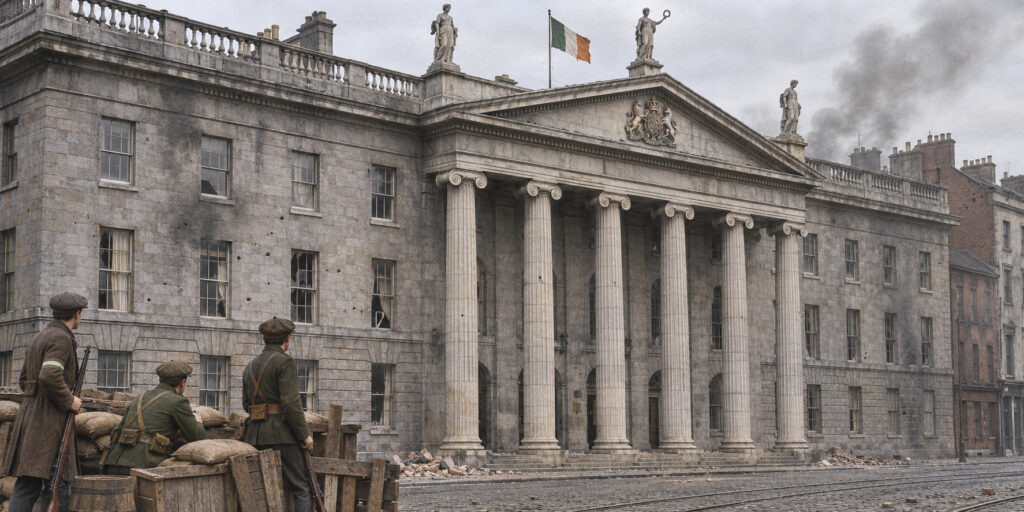
Most of the rebels gathered at Liberty Hall and marched to their positions, which were largely occupied by noon. After the General Post Office (GPO) on Sackville Street, now O’Connell Street, was taken, Pearse read the Proclamation outside and the GPO became headquarters. James Connolly commanded the Dublin forces in theory, but the outlying garrisons were mostly left to fend for themselves.
The British responded that afternoon. City Hall, beside Dublin Castle, came under heavy attack; its commander, Captain Seán Connolly, was shot dead, and the rest of the garrison surrendered that night. The rebels never took Dublin Castle itself, the seat of British administration, or Trinity College.
Tuesday, 25 April: Martial Law
Brigadier General W.H.M. Lowe took command and reinforcements arrived from Belfast, the Curragh, Templemore and Athlone. Machine-gun fire from the Shelbourne Hotel drove Michael Mallin’s men out of St Stephen’s Green and into the Royal College of Surgeons. Looting spread through the city centre, and that evening the Lord Lieutenant, Lord Wimborne, declared martial law in Dublin city and county.
Wednesday, 26 April: Mount Street Bridge
Seán Heuston’s small garrison at the Mendicity Institution surrendered at noon. The gunboat Helga on the Liffey and field guns began shelling Liberty Hall and the area around the GPO.
That afternoon, fresh troops landing at Kingstown (Dún Laoghaire) marched into the city and walked into an ambush at Mount Street Bridge, an outpost of Éamon de Valera’s command. Seventeen Volunteers in houses along Northumberland Road and in Clanwilliam House held up the Sherwood Foresters for hours, and the British Army suffered four officers and 216 other ranks killed or wounded there, the heaviest losses of the week.
Thursday, 27 April: Sackville Street Burns
Artillery set the east side of Sackville Street on fire, including Clery’s. The British attacked Éamonn Ceannt’s garrison at the South Dublin Union, a sprawling workhouse complex, but could not dislodge it. Connolly was badly wounded in the ankle while directing men in Middle Abbey Street, and by now a military cordon had cut the rebels north of the Liffey off from those to the south.
Friday, 28 April: The GPO Is Abandoned
General Sir John Maxwell arrived to take overall command. At Ashbourne in County Meath, Thomas Ashe’s men forced a large body of police to surrender, the rebels’ biggest success of the week. In Dublin the GPO caught fire and the garrison retreated into houses on Moore Street; The O’Rahilly was mortally wounded leading a charge to clear the way. That night there was intense fighting around North King Street, where British troops killed civilians in their homes, killings that turned many Dubliners against the army.
Saturday, 29 April: The Surrender
The five members of the Provisional Government still at Moore Street decided to surrender to prevent more deaths among civilians. Nurse Elizabeth O’Farrell carried Pearse’s message to General Lowe, who accepted only unconditional surrender. Pearse surrendered that afternoon, and the GPO garrison and Ned Daly’s men at the Four Courts followed by nightfall.
Sunday, 30 April: The Last Positions Give Up
O’Farrell and others carried the surrender order to the positions still holding out: the South Dublin Union, Jacob’s biscuit factory, the Royal College of Surgeons and Boland’s bakery. All surrendered, reluctantly. The round-up that followed saw about 3,500 people arrested across the country, around 2,000 of whom were interned.
Where the Rebels Fought: The Main Dublin Positions
The strategy was to hold a ring of strong buildings around the city and wait for the country to rise. This table shows who held what and how each position ended.
| Position | Commander | How it ended |
|---|---|---|
| General Post Office (headquarters) | Patrick Pearse, James Connolly | Burned out and evacuated Friday 28 April; surrender Saturday |
| Four Courts and North King Street | Ned Daly | Surrendered late Saturday 29 April |
| South Dublin Union and Marrowbone Lane | Éamonn Ceannt (Con Colbert at Marrowbone Lane) | Held until ordered to surrender Sunday 30 April |
| Jacob’s biscuit factory | Thomas MacDonagh, with John MacBride and Michael O’Hanrahan | Surrendered Sunday 30 April |
| Boland’s bakery and Mount Street Bridge | Éamon de Valera | Surrendered Sunday 30 April |
| St Stephen’s Green and Royal College of Surgeons | Michael Mallin, with Constance Markievicz | Surrendered Sunday 30 April |
| Mendicity Institution | Seán Heuston | Surrendered noon Wednesday 26 April |
| City Hall | Seán Connolly (killed) | Surrendered Monday night, 24 April |
Did the Rising Happen Outside Dublin?
Only on a small scale. Apart from relatively small numbers in parts of Wexford and Galway, Volunteers around the country obeyed MacNeill’s countermand. Enniscorthy in Wexford was held by local Volunteers, Liam Mellows led men in east Galway, and Ashe’s column fought at Ashbourne, where eight police were killed on 28 April.
Cork stayed quiet, yet it produced one of the 16 executed men. Thomas Kent was shot at Victoria Barracks (now Collins Barracks) in Cork on 9 May after a gunfight with police at his family’s home, even though no rebellion had taken place in the county.
Who Led the Easter Rising? The Seven Signatories
The Proclamation of the Irish Republic carried seven names, the members of the IRB Military Council that planned the Rising. All seven were executed.
- Thomas Clarke (born 1857, Isle of Wight): A veteran Fenian who had served years in English prisons for a dynamite campaign. He returned to Dublin from New York in 1906, ran a tobacconist’s shop on Parnell Street and rebuilt the IRB. His name comes first on the Proclamation. Executed 3 May.
- Seán Mac Diarmada (born 1884, Leitrim): Clarke’s closest ally and the IRB’s chief organiser, who managed its paper Irish Freedom and toured the country recruiting despite being left with a limp by polio. He fought in the GPO. Executed 12 May.
- Patrick Pearse (born 1879, Dublin): A teacher, barrister and Irish language campaigner who founded St Enda’s school. He read the Proclamation, served as president of the Provisional Government and commander-in-chief, and signed the surrender. Executed 3 May.
- James Connolly (born 1868, Edinburgh): A socialist and trade union leader who founded the Irish Citizen Army and wrote Labour in Irish History. He commanded the Dublin forces from the GPO. Too badly wounded to stand, he was the last of the leaders executed, on 12 May.
- Thomas MacDonagh (born 1878, Tipperary): A poet and lecturer in English at University College Dublin who helped Pearse found St Enda’s. He commanded the 2nd Battalion at Jacob’s. Executed 3 May.
- Éamonn Ceannt (born 1881, Galway): A Dublin Corporation clerk, uilleann piper and founding Volunteer who took part in the 1914 Howth gun-running. He commanded the 4th Battalion at the South Dublin Union. Executed 8 May.
- Joseph Mary Plunkett (born 1887, Dublin): The Volunteers’ Director of Military Operations and the main author of the military plan, who met Casement in Germany in 1915. Seriously ill with tuberculosis during the week, he married Grace Gifford in the Kilmainham Gaol chapel hours before his execution on 4 May.
Pearse’s commitment to the language revival is a thread through the whole period; our history of the Irish language and its Gaelic roots covers that movement in more depth.
Other Key Figures of the Rising
- Constance Markievicz: Second in command at St Stephen’s Green and the only female leader of the Rising. Sentenced to death, she was spared because she was a woman, and in 1918 became the first woman elected to the House of Commons, though like the other Sinn Féin MPs she did not take her seat.
- Éamon de Valera: Commandant at Boland’s bakery and Mount Street. Born in New York, he escaped execution partly because of his US citizenship and became the senior surviving leader, later Taoiseach and President.
- Michael Collins: A junior officer who fought in the GPO alongside Pearse and Connolly. He was interned afterwards and became the key organiser of the War of Independence.
- Eoin MacNeill: Chief of staff of the Irish Volunteers, who was kept in the dark and issued the countermand. He was jailed anyway.
- Roger Casement: A former British consular official knighted for exposing abuses in the Congo and Peru, who sought German support. He was hanged for treason at Pentonville Prison in London on 3 August 1916.
- Elizabeth O’Farrell: A Cumann na mBan nurse who carried the surrender messages between Pearse, the British and the garrisons.
How Many People Died in the Easter Rising?

Research by the Glasnevin Trust, published in 2015, put the death toll at 485. Of those, 262 were civilians, so civilians made up more than half of the dead. The breakdown is below, using the percentages from RTÉ’s Century Ireland history project.
| Group | Share of the 485 deaths |
|---|---|
| Civilians | 54% |
| British Army | 26% |
| Rebels | 16% |
| Police (Dublin Metropolitan Police and Royal Irish Constabulary) | 4% |
Among the civilian dead were 40 children, the youngest an 18-month-old girl, Christine Caffrey. Most civilians were killed by gunfire and shelling in crowded streets, and many of the dead are buried at Glasnevin Cemetery, where a memorial wall lists the names. Thousands more were wounded, and much of the central city lay in ruins.
The 1916 Executions: Who Was Shot, When and Where
Under martial law, General Maxwell had the leaders tried by secret court martial. Of the roughly 3,500 people arrested, 183 were tried and 90 sentenced to death; most of those sentences were commuted. The executions were spread over ten days, each one reported in turn, and that slow drip did more than anything else to turn Irish opinion.
Pick a group to see what each leader did in Easter week and what happened to them afterwards.
Fourteen men were shot in the Stonebreakers’ Yard of Kilmainham Gaol between 3 and 12 May 1916. Thomas Kent was shot in Cork and Roger Casement was hanged in London, bringing the total to 16. The table uses the dates from RTÉ’s profiles of the executed men.
| Date | Executed | Place | Role in the Rising |
|---|---|---|---|
| 3 May 1916 | Patrick Pearse | Kilmainham Gaol | Signatory; commander-in-chief, GPO |
| 3 May 1916 | Thomas Clarke | Kilmainham Gaol | Signatory; GPO |
| 3 May 1916 | Thomas MacDonagh | Kilmainham Gaol | Signatory; Jacob’s |
| 4 May 1916 | Joseph Plunkett | Kilmainham Gaol | Signatory; GPO |
| 4 May 1916 | Edward (Ned) Daly | Kilmainham Gaol | Commandant, Four Courts |
| 4 May 1916 | Michael O’Hanrahan | Kilmainham Gaol | Jacob’s |
| 4 May 1916 | William Pearse | Kilmainham Gaol | GPO, beside his brother |
| 5 May 1916 | John MacBride | Kilmainham Gaol | Jacob’s |
| 8 May 1916 | Éamonn Ceannt | Kilmainham Gaol | Signatory; South Dublin Union |
| 8 May 1916 | Michael Mallin | Kilmainham Gaol | ICA commander, St Stephen’s Green |
| 8 May 1916 | Con Colbert | Kilmainham Gaol | Marrowbone Lane |
| 8 May 1916 | Seán Heuston | Kilmainham Gaol | Mendicity Institution |
| 9 May 1916 | Thomas Kent | Victoria Barracks (now Collins Barracks), Cork | Gunfight with police at his Cork home |
| 12 May 1916 | James Connolly | Kilmainham Gaol | Signatory; commandant, Dublin forces |
| 12 May 1916 | Seán Mac Diarmada | Kilmainham Gaol | Signatory; GPO |
| 3 August 1916 | Roger Casement | Pentonville Prison, London | Arms mission; captured at Banna Strand |
Four men were shot on 4 May and four more on 8 May, the heaviest days of the executions. Connolly, badly wounded, had been held at Dublin Castle before he was brought to Kilmainham, and Plunkett’s wedding to Grace Gifford in the prison chapel the night before his death became one of the best-known stories of the week. Condemned men were allowed final visits from family and wrote last letters, many of which survive.
Arrests, Internment and Frongoch
The arrests swept up far more people than had fought. Many had no part in the Rising at all, and the round-up became its own recruiting tool. Hundreds of internees were shipped to a former distillery at Frongoch in north Wales; in July 1916 a minister told the House of Commons there were about 1,400 interned Irish prisoners at Frongoch.
Frongoch became known as a “university of revolution”, where men from all over Ireland met, organised and planned. Collins was among them. Releases came in batches through the year, and by Christmas 1916 some 600 prisoners had arrived back in Ireland in the final weeks, to a far warmer welcome than the jeers some rebels had faced when they were marched away in May.
Lasting Effects of the Easter Rising
The Rising failed as a military operation and was unpopular with many Dubliners at the time, not least because of the deaths and destruction. Its lasting effects came from what followed.
A Collapse in Support for Home Rule
The executions, the mass arrests and martial law, together with the threat of conscription in 1918, drove nationalists away from Redmond’s party. Sinn Féin, wrongly blamed by the British for the Rising, became the political home of the survivors. In the December 1918 general election it won 73 of the 105 Irish seats, while the Irish Parliamentary Party was reduced to six.
The First Dáil and the War of Independence
The new Sinn Féin MPs refused to sit at Westminster. On 21 January 1919 those not in jail met at the Mansion House in Dublin as Dáil Éireann and declared independence, the same day the first shots of the War of Independence were fired at Soloheadbeg in Tipperary. Many of its commanders, Collins and de Valera among them, were 1916 veterans.
The Treaty, Partition and the Civil War
A truce in July 1921 led to the Anglo-Irish Treaty in December 1921, which created the Irish Free State in 1922 and confirmed the partition that left six northern counties in the United Kingdom. Our guide to the Anglo-Irish Treaty negotiations and the terms that split Ireland explains how that deal was struck. The Treaty split the movement, and in the Civil War of 1922 and 1923 both sides claimed to be the true heirs of 1916. The state finally became the Republic of Ireland in 1949.
The Proclamation and the Memory of 1916
The Proclamation’s promise of “equal rights and equal opportunities to all its citizens” and its address to “Irishmen and Irishwomen” are still quoted in Irish politics. Every Easter Sunday, the Defence Forces read it outside the GPO. The memory has never been simple: the 50th anniversary in 1966 was celebrated loudly, the Troubles made later commemorations uneasy, and the 2016 centenary made a deliberate point of remembering the civilian and British dead as well as the rebels. For how the Rising fits into the longer story, see our rundown of the important events in Irish history that shaped modern Ireland.
Where to See Easter Rising History in Dublin
A lot of the Rising can still be traced on foot in a day, and most of the sites sit within walking distance of O’Connell Street. Check opening hours and booking rules on each site’s own page before visiting, as they change through the year.
- The GPO, O’Connell Street: Still a working post office, with bullet marks on the front columns. The GPO Witness History exhibition inside tells the story of Easter week. It features in our three-day itinerary for visiting Dublin.
- Moore Street: The terrace where the leaders spent their last night of freedom and agreed to surrender, a short walk from the GPO.
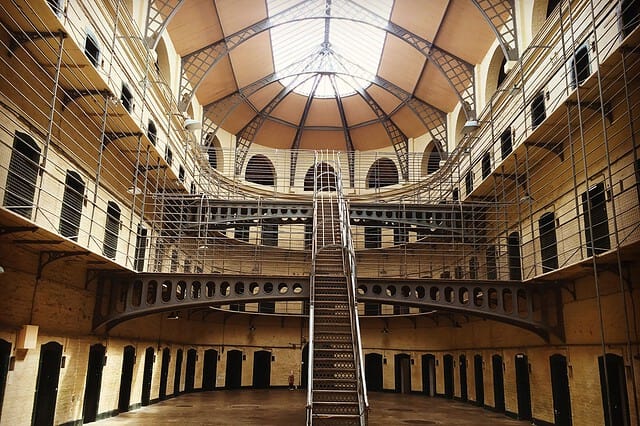
- Kilmainham Gaol, Dublin 8: The prison where 14 men were executed, with the Stonebreakers’ Yard and the chapel where Plunkett married Grace Gifford. Tours are guided and often book out, so plan ahead.
- Mount Street Bridge and Northumberland Road: The canal bridge and the houses the Volunteers held are still recognisable.
- Glasnevin Cemetery: Burial place of many of the civilian dead and home to the memorial wall naming all those killed.
- National Print Museum: It holds an original 1916 Proclamation on loan, beside a working press of the type it was printed on, and general entry is free; it is one of our free museums in Dublin.
Easter Rising FAQ
Why Is It Called the Easter Rising?
The 1916 rebellion is called the Easter Rising because it began on Easter Monday, 24 April 1916. It was first planned for Easter Sunday and pushed back a day after Eoin MacNeill’s countermanding order.
Was the Easter Rising a Success?
The Easter Rising failed as a military rebellion and ended in unconditional surrender after six days. Politically it succeeded in the longer term, because the executions turned opinion towards the republic and led to Sinn Féin’s 1918 election win and the War of Independence.
How Many Leaders of the Easter Rising Were Executed?
Sixteen men were executed for their part in the Easter Rising: 14 at Kilmainham Gaol in Dublin between 3 and 12 May 1916, Thomas Kent in Cork on 9 May and Roger Casement in London on 3 August.
Was Michael Collins in the Easter Rising?
Michael Collins fought in the GPO during the Easter Rising as a junior officer and was interned at Frongoch afterwards. He was not one of the leaders in 1916, but became the central organiser of the War of Independence that followed.