
Dublin Castle is worth visiting for anyone interested in Irish history, Georgian interiors and the handover of political power in 1922, but it is not open to the public during Ireland’s EU Council Presidency programme. It suits first-time Dublin trips, history-minded families and architecture fans planning a return visit after public access resumes, and fits neatly into a three-day Dublin itinerary.
The castle is a working State complex off Dame Street, not a fully preserved medieval fortress. That distinction helps set expectations: come for the layers of the site, including a surviving medieval tower, ceremonial rooms and archaeological remains, not for ramparts and a drawbridge.
Check out our Best Castles in Ireland where Dublin Castle of course makes the list!
The official Dublin Castle operator says the campus is closed to the public until January 2027 while it hosts more than 100 Presidency-related events, including conferences, meetings, dinners, cultural events and receptions.
The clock is ticking
| Location | Dame Street, Dublin 2, County Dublin, Ireland |
|---|---|
| Jurisdiction | Ireland |
| Castle type | Medieval administrative and defensive castle, substantially rebuilt as a State and ceremonial complex |
| Date built | Early 13th century. A castle has stood on the site since 1204; much of the visible complex was rebuilt over later centuries. |
| Associated authority | Built for the Norman administration under King John’s lordship of Ireland; later used by English and British administrations. |
| Present role | Irish government complex and venue for State ceremony |
| Interior access | Normally includes the State Apartments and other visitor areas, but the campus is closed until January 2027. Access can change because it is a working government building. |
| Typical visit time | About 30 minutes for a self-guided visit or one hour for a guided tour when public visits operate. |
| Coordinates | 53.3429, -6.2675 |
| Public transport and walking | Central Dublin location off Dame Street, about a five-minute walk from Trinity College. |
| Parking | No dedicated visitor parking information is confirmed here. Plan on walking or public transport when the site reopens. |
| Accessibility | The State Apartments, Chapel Royal, Coach House Gallery and Dubh Linn Gardens are listed as accessible. The Viking Excavation requires stairs, and the Upper Courtyard has uneven surfaces. |
| Toilets and food | Facilities may be unavailable during the closure. Confirm arrangements with the operator before a future visit. |
| Family suitability | Suitable for families when open, especially for its compact central location and free admission for children under 12 under the previously published tariff. Reconfirm all admission terms before travel. |
| Official information | dublincastle.ie |
Access details checked July 2026: the official operator states that Dublin Castle is closed to the public until January 2027. A Makeshift Art Bar event is scheduled at Dublin Castle on 21 October 2026, but an event listing does not indicate general public access to the visitor areas. Earlier published opening hours, ticket prices and tour arrangements should not be treated as available during that period.
Dublin Castle was constructed in the early 13th century on the site of a Viking settlement. For roughly seven centuries, it served as the headquarters of English administration and later British administration in Ireland. The site was used as a fortress, prison, treasury and law court as well as a seat of government.
Its political importance did not end with independence. The complex was transferred to the new Irish government in 1922, and it remains a major government venue. It hosts presidential inaugurations and State receptions, which explains why public access can be altered with little notice.
The name Dublin is linked to the Irish Dubh Linn, or Black Pool, associated with the pool on the River Poddle beside the site. The Poddle now runs beneath the complex, while the Dubh Linn Gardens preserve the name above ground.
Search by castle, county or nearby town, then click a marker to open the complete IrelandWide visitor guide.
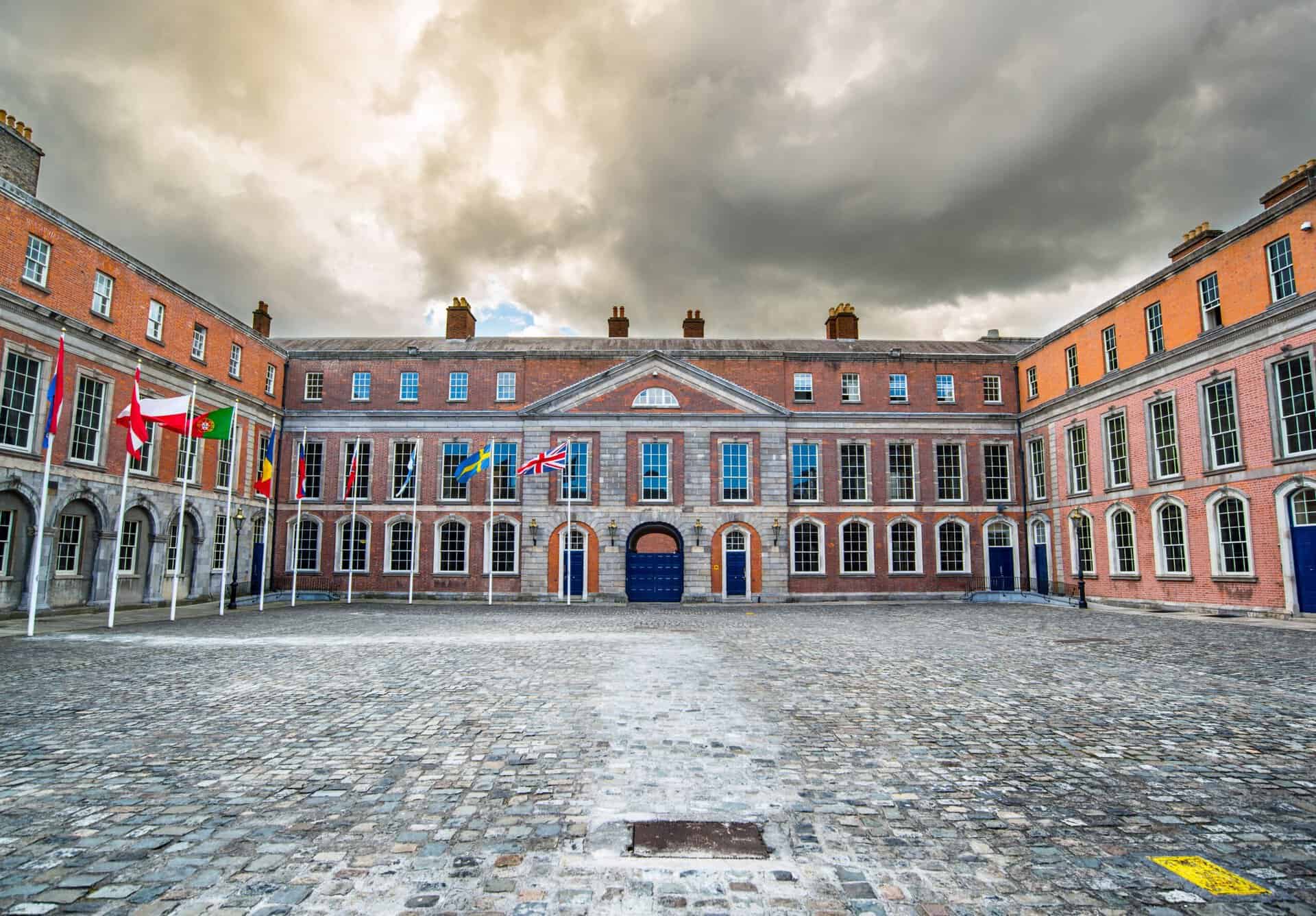
The castle is best read as a changing complex rather than a single medieval building. Major rebuilding across the 17th, 18th, 19th and 20th centuries created the appearance many people associate with the site today: Georgian-scale ceremonial spaces gathered around courtyards, with medieval remnants still present.
The State Apartments are the principal interior draw when the castle is open. Their best-known rooms include St Patrick’s Hall, the State Drawing Room, the Throne Room, the State Corridor and the Battleaxe Staircase. These spaces show the castle’s later ceremonial identity more clearly than its medieval beginnings.
The Chapel Royal is part of the usual visitor offer and is listed as universally accessible. Its inclusion makes Dublin Castle a useful stop for people interested in 19th-century decorative interiors as well as medieval and Georgian history.
The undercroft and archaeological areas are where the older site becomes easier to picture. The Viking Excavation has stair-only access, so anyone who needs step-free movement should plan around that limitation. The surviving Record Tower is the most prominent medieval element, a useful corrective to the idea that the entire complex is Georgian.
Dublin Castle needs no invented legends to hold attention. Its documented story includes Norman rule, centuries of colonial administration, the transfer of power after independence and its continuing role in Irish State life.
The Black Pool and the buried River Poddle are often repeated in stories about the city’s name. The connection is grounded in the site’s recorded geography, but the physical pool is not an attraction to seek out. The gardens offer the clearest public reference to it through their name.
When public visits resume, confirm the day’s opening hours, ticket types, security requirements and room access before setting out. A published schedule is only a starting point at a functioning State venue.
For exterior photographs, the courtyards and the view toward the surviving medieval tower show the contrast between old fortification and later rebuilding. The Dubh Linn Gardens are a strong place to frame the castle from outside its formal interiors.
Photography rules inside State rooms may change with security and events. Do not assume that access to a room also means permission to photograph it, particularly during ceremonial use.
Trinity College is about a five-minute walk away, making Dublin Castle easy to pair with a walk through central Dublin. The short distance is useful if you are building a day around several indoor stops and want to avoid unnecessary transport.
St Audoen’s Church and Visitor Centre is about 0.4 kilometres from Dublin Castle. It offers a medieval counterpoint to the castle’s State history and sits close enough to combine with the castle area on foot.
St Mary’s Abbey Chapter House, roughly 0.5 kilometres away, preserves part of a Cistercian monastery that was once among the city’s most important religious foundations. It works well for people who want to continue the medieval thread after seeing the castle’s undercroft and tower, or to build a wider day around free museums in Dublin.
Yes, Dublin Castle is one of central Dublin’s most useful historic stops when it is open, especially for people who want Ireland’s political history alongside architecture and archaeology. It is less satisfying if you only want a large, intact medieval castle, because the site’s later rebuilding is a major part of what you see.
For July 2026 travel plans, treat the exterior and surrounding historic quarter as the available experience and save the interiors for a future trip after the operator confirms reopening. Dame Street also leaves you well placed for things to do in Dublin at night once the daytime sightseeing is done.
No. The official operator says Dublin Castle is closed to the public until January 2027 for Ireland’s hosting of the Presidency of the Council of the European Union.
A castle has stood on the site since 1204, and the present complex includes major rebuilding from later centuries. The oldest history is medieval, while many visible interiors and buildings are later in date.
Previously published visitor guidance allowed about 30 minutes for a self-guided visit and about one hour for a guided tour. Allow extra time if the Chapel Royal, undercroft and gardens are all accessible on the day.
The State Apartments, Chapel Royal, Coach House Gallery and Dubh Linn Gardens are listed as accessible. The Viking Excavation is accessible only by stairs, and the Upper Courtyard has uneven ground.
Yes. The complex sits off Dame Street in central Dublin, and its exterior, courtyards and the nearby Dubh Linn Gardens can be appreciated as part of a walk through the historic centre. Public access boundaries can change during official events.

Matt Hook is a Canadian writer of Scottish and Irish heritage. He built his writing career creating detailed gaming guides, turning complex mechanics, history and lore into useful information for readers. Matt brings that same research-focused approach to Ireland Wide, where he writes about Irish travel, heritage, history and culture. He also holds CMA and CPA designations as a professional accountant, giving him a strong background in research, accuracy and attention to detail.
At Ireland Wide, our aim is to bring authentically Irish insights to you, wherever you are.
Whether you have some feedback or would like to offer some of your own insights for everyone else to explore, don't hesitate to get in touch with us!