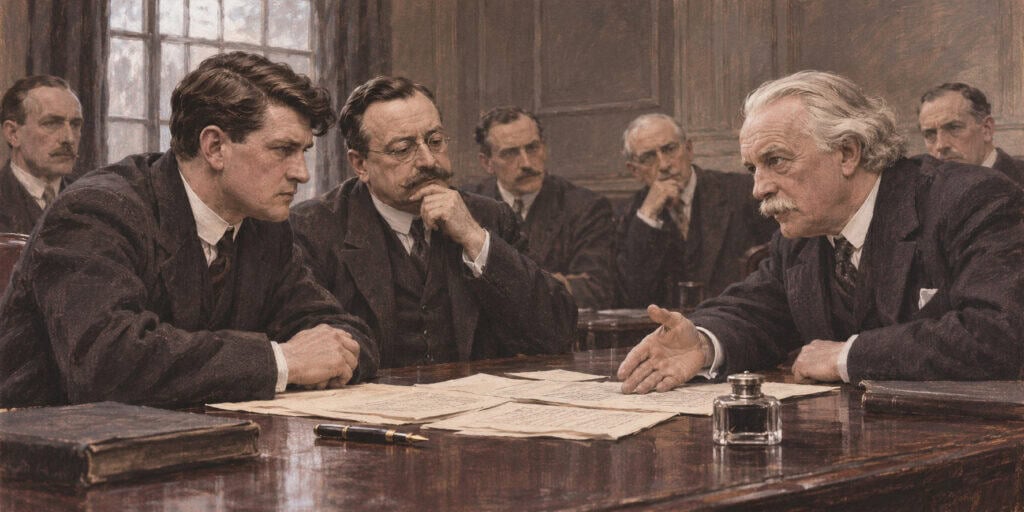
If you’re trying to understand why a treaty signed in London split Irish nationalism down the middle, the Anglo-Irish Treaty negotiations are where the answer sits. Over eight weeks in late 1921, five Irish delegates and seven British ministers bargained over the Crown, an oath, the defence of Irish ports and the future of Ulster, and the Irish side signed the 18 Articles of Agreement dated 6 December 1921 without first getting the approval of their own cabinet in Dublin.
Almost every quarrel that followed traces back to those weeks. The Dáil approved the Treaty by 64 votes to 57, the anti-Treaty side walked out, and within six months the country was at war with itself. This guide covers who was in the room, the terms that caused the most argument, why the delegates signed, and what each disputed clause led to over the next 17 years, using the Treaty text and the cabinet’s own instructions as the starting point.
Anglo-Irish Treaty Negotiations: Key Facts
- Dates: talks opened in London on 11 October 1921 and the Treaty was signed in the early hours of 6 December 1921.
- Irish signatories: Arthur Griffith, Michael Collins, Robert Barton, Eamonn Duggan and George Gavan Duffy.
- British signatories: David Lloyd George, Austen Chamberlain, Lord Birkenhead, Winston Churchill, Laming Worthington-Evans, Hamar Greenwood and Gordon Hewart.
- Main disputes: the Crown and dominion status, the oath, Ulster and the Boundary Commission, British use of Irish ports, and how much power the delegates actually had.
- Ratification: the Dáil voted 64 to 57 in favour on 7 January 1922.
- Consequences: the Civil War of 1922 to 1923, an unchanged border after 1925, the oath’s removal in 1933 and the return of the Treaty Ports in 1938.
Who Were the Delegates at the Anglo-Irish Treaty Negotiations?
The Irish team was led by Arthur Griffith, the founder of Sinn Féin and Minister for Foreign Affairs, with Michael Collins as the other heavyweight. Robert Barton, Eamonn Duggan and George Gavan Duffy made up the five plenipotentiaries. Erskine Childers went as the delegation’s chief secretary, a role that put him close to every document passing between London and Dublin.
The letter of accreditation dated 7 October 1921, signed by Éamon de Valera, named the five as envoy plenipotentiaries. One of the original copies is now held by the Little Museum of Dublin.
Britain fielded its strongest possible side. Prime Minister David Lloyd George led, with Austen Chamberlain, Lord Birkenhead (the Lord Chancellor) and Winston Churchill (the Colonial Secretary) doing most of the heavy lifting. Laming Worthington-Evans, Hamar Greenwood and the Attorney General Gordon Hewart also signed. Tom Jones, secretary to the British delegation, kept a detailed record of the talks.
| Delegate | Side | Role in 1921 |
|---|---|---|
| Arthur Griffith | Irish | Chairman of the delegation |
| Michael Collins | Irish | Minister for Finance |
| Robert Barton | Irish | Minister for Economic Affairs |
| Eamonn Duggan | Irish | Solicitor and Dáil TD |
| George Gavan Duffy | Irish | Barrister and Dáil envoy |
| Erskine Childers | Irish | Chief secretary (did not sign) |
| David Lloyd George | British | Prime Minister |
| Austen Chamberlain | British | Lord Privy Seal and Conservative leader |
| Lord Birkenhead | British | Lord Chancellor |
| Winston Churchill | British | Colonial Secretary |
Why De Valera Stayed in Dublin
The most argued-over absence was de Valera’s own. As President of the Dáil he chose to remain at home, keeping himself free to judge whatever the delegates brought back. Supporters saw it as tactical sense; critics, then and since, saw a leader avoiding responsibility for a compromise he knew was coming. Either way, it left the two most powerful men in the delegation, Griffith and Collins, bargaining with the British cabinet while the final word sat in Dublin.
Full Powers or Refer Back? The Plenipotentiary Dispute
The delegates went to London with a contradiction built in. Their credentials described them as plenipotentiaries, a word that normally means full authority to conclude a treaty. Yet the cabinet’s instructions of 7 October 1921 told them to send any decision on a main question to Dublin and await a reply, and to submit the complete text of the draft treaty to Dublin before signing.
The strain showed early. On 26 October the delegates wrote to de Valera objecting to “interference with our powers” after he pushed back on their handling of the Crown question. That letter warned that responsibility for any breakdown should not rest on the plenipotentiaries. When the Treaty came home signed, opponents argued the delegates had broken their instructions; supporters replied that the Dáil, not the cabinet, had given them their powers, and that the instructions could not cancel those powers.
How the Talks Unfolded, October to December 1921
Talks opened at 10 Downing Street on 11 October 1921, three months after the Truce of July ended the fighting of the War of Independence. Full sessions of both delegations ran until 24 October, then the work moved into smaller sub-conferences, which suited Lloyd George: it let him deal with Griffith and Collins on their own. The Irish delegation based itself at Hans Place in Knightsbridge.
- 11 to 24 October: plenary sessions in Downing Street, followed by committees on defence, finance and the truce.
- Mid-November: the shape of a deal is clear. Britain offers dominion status, keeps bases for defence, and proposes giving Northern Ireland the choice to opt out, with a boundary commission to follow.
- 2 and 3 December: the delegates return to Dublin for a tense cabinet meeting that ends without agreement on a draft.
- 5 December: back in London, Lloyd George insists on an answer, warning of war within three days if the Irish refuse.
- 6 December, 2.10am: the Irish delegates sign.
The Disputed Terms of the Anglo-Irish Treaty
The table below sets each argued-over clause against what the Irish side was seeking and what eventually happened to it. The article numbers refer to the Treaty text as signed.
Pick a clause to see what the Irish side wanted, what the Treaty said and how it played out.
| Issue | Irish aim in 1921 | What the Treaty said | What happened |
|---|---|---|---|
| Status (Articles 1 and 2) | External association: outside the Empire, linked to it for shared matters | Dominion status, the same as Canada, inside the British Empire | Irish Free State created on 6 December 1922; Republic of Ireland Act took effect in 1949 |
| The oath (Article 4) | No oath to the King | Members swear allegiance to the Free State constitution and to be faithful to the King | Removed by the Oireachtas in 1933 |
| Ulster (Articles 11 and 12) | A united Ireland | Northern Ireland may opt out; a three-member Boundary Commission sets the border | Northern Ireland opted out in December 1922; border left unchanged on 3 December 1925 |
| Defence (Articles 6 and 7) | Full control of Irish coasts | British forces keep facilities at Berehaven, Queenstown, Belfast Lough and Lough Swilly | Southern ports handed back in 1938; Spike Island on 11 July 1938 |
| Debt (Article 5) | No liability for British debt | A fair share of UK public debt and war pensions, subject to arbitration | A large part waived in the 1925 agreement |
The Crown and Dominion Status
De Valera’s answer to British offers was external association: an Ireland outside the Empire but associated with it on matters of common concern such as defence. Britain would not accept it. Article 1 gave the new Irish Free State “the same constitutional status” as Canada, Australia, New Zealand and South Africa, with a Governor-General representing the Crown. For republicans who had sworn to the Republic declared in 1919, that was the heart of the problem.
The Oath of Allegiance
Article 4 set out the oath for members of the new parliament. They would swear “true faith and allegiance to the Constitution of the Irish Free State as by law established” and that they would be “faithful to H.M. King George V, his heirs and successors by law”, in virtue of the common citizenship of Ireland with Great Britain. The wording was itself a compromise, since allegiance went to the Irish constitution and only faithfulness to the King, but in the Dáil debates it became the single most emotive objection.
Ulster and the Boundary Commission
Partition already existed under the Government of Ireland Act 1920. Article 11 gave Northern Ireland a month to decide, and Article 12 said that if it opted out, a commission of three would draw the border “in accordance with the wishes of the inhabitants, so far as may be compatible with economic and geographic conditions”. Collins and Griffith expected large areas of Tyrone and Fermanagh, plus Newry and south Armagh, to transfer. The vague wording left room for a very different result, and that is what came.
Defence and the Treaty Ports
Articles 6 and 7 left coastal defence with the Royal Navy and gave British forces harbour facilities in an annex listing Berehaven, Queenstown (Cobh), Belfast Lough and Lough Swilly, plus oil storage at Haulbowline and Rathmullen. It drew less heat in 1921 than the oath, but it meant British troops stayed on Irish soil for another 17 years.
Why the Irish Delegates Signed
By 5 December the delegation was exhausted and divided. Tom Jones recorded that Griffith was “labouring under a deep sense of the crisis”, and Lloyd George threatened war within three days if the answer was no. Griffith had already promised not to break on the Crown alone if Ulster was handled through a boundary commission, and Lloyd George held him to it.
The delegates signed at ten minutes past two on the morning of 6 December without referring the final text to Dublin, which broke the letter of the 7 October instructions. Barton and Gavan Duffy signed with the most reluctance. Collins saw the Treaty as a foundation the country could build on; his critics saw a surrender of the Republic.
The Treaty Debates and the Dáil Vote
The Dáil debated the Treaty from 14 December 1921 into the new year, meeting in the Council Chamber of University College Dublin at Earlsfort Terrace, now the National Concert Hall. On Saturday 7 January 1922 it approved the Treaty by 64 votes to 57. A shift of four votes would have sunk it.
De Valera resigned as President and led the anti-Treaty TDs out of the chamber. He then lost a vote to be re-elected by 60 to 58, and Griffith became President of the Dáil. Within days Collins, as chairman of the new Provisional Government, took over Dublin Castle from the Lord Lieutenant in a short, closed-door ceremony.
Historical Consequences of the Anglo-Irish Treaty
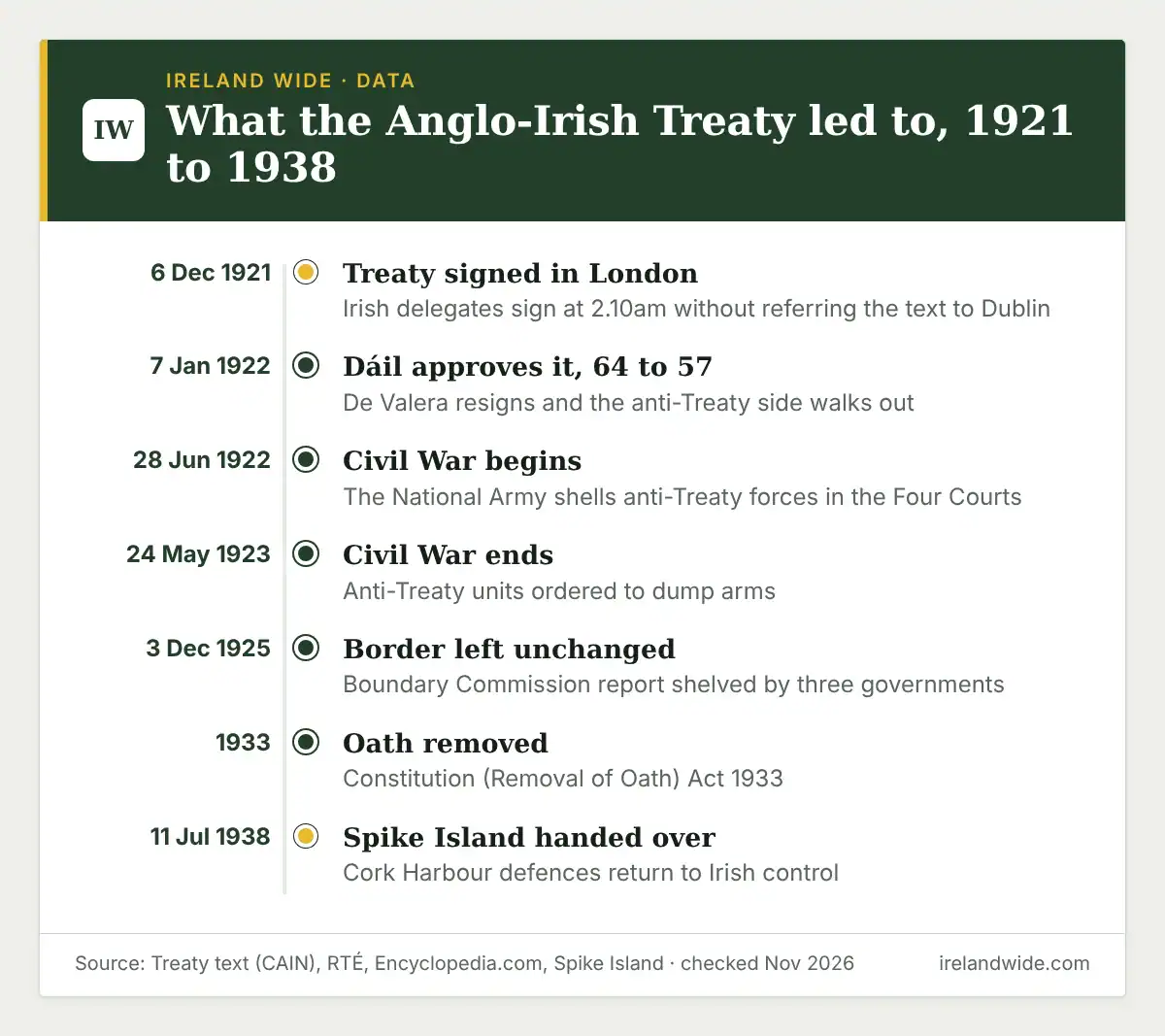
The Treaty’s consequences played out over almost two decades, and several of its disputed clauses were undone or rewritten by later governments. Our overview of events that shaped modern Ireland puts partition and the Treaty alongside the Famine and the Easter Rising for good reason.
The Civil War, 1922 to 1923
The split in the Dáil became a split in the army. The Civil War began on 28 June 1922, when the National Army shelled anti-Treaty forces in the Four Courts in Dublin. Griffith died suddenly on 12 August 1922, and Collins was killed in an ambush at Béal na Bláth in west Cork ten days later, on 22 August. Childers was executed by the Free State that November. The war ended without a formal surrender: Frank Aiken, the anti-Treaty chief of staff, ordered his units to dump arms, and on 24 May 1923 de Valera told them the Republic could no longer be defended by force.
The Boundary Commission, 1924 to 1925
The commission first met in November 1924, chaired by the South African judge Richard Feetham, with Eoin MacNeill for the Free State and J. R. Fisher for Northern Ireland. A leak in the Morning Post on 7 November 1925 showed only minor transfers, some of them from the Free State to the North. MacNeill resigned on 20 November.
At a London conference with Stanley Baldwin, W. T. Cosgrave argued that the commission should not issue its award “either now or at any time”. The three governments agreed on 3 December 1925 to shelve the report and keep the 1920 border, and Britain waived much of the Free State’s Article 5 debt. The report stayed secret until 1968. The practical gap between the two jurisdictions that resulted is covered in our guide to the differences between Northern Ireland and Ireland.
The Oath Removed, 1933
De Valera returned to the Dáil with Fianna Fáil in 1927, taking the oath as what he called an empty formula, and won power in 1932. The Constitution (Removal of Oath) Act 1933 deleted the oath from the Free State constitution, and the 1937 Constitution replaced the 1922 settlement altogether.
The Treaty Ports Returned, 1938
The Anglo-Irish agreements of April 1938 ended the economic war and returned Berehaven, Cobh and Lough Swilly. The handover of Spike Island took place on 11 July 1938, on the 17th anniversary of the Truce. Belfast Lough, in Northern Ireland, stayed British. The state therefore controlled its own coast when it declared neutrality in the Second World War a year later.
Where To See the Treaty Story in Ireland Today
A few places let you stand where this history happened. The National Concert Hall at Earlsfort Terrace occupies the building where the Dáil voted. Spike Island in Cork Harbour, reached by ferry from Cobh, tells the story of the 1938 handover. The Little Museum of Dublin on St Stephen’s Green holds one of the original accreditation letters. Dublin Castle, where Collins took over in 1922, is closed to the public until January 2027, so check before visiting.
Frequently Asked Questions
How Long Did the Anglo-Irish Treaty Negotiations Last?
The negotiations ran from 11 October 1921, when talks opened at 10 Downing Street, to the signing in the early hours of 6 December 1921, a little under eight weeks.
Did Michael Collins Want To Sign the Treaty?
Collins signed willingly but without enthusiasm. He argued the Treaty gave Ireland a base from which fuller independence could be won, and he was killed in the Civil War that followed in August 1922.
Was Partition Created by the Anglo-Irish Treaty?
No. Partition was set up by the Government of Ireland Act 1920. The Treaty let Northern Ireland opt out of the Irish Free State, which it did, and promised a Boundary Commission that left the border unchanged in 1925.
Is the Original Anglo-Irish Treaty Document in Ireland?
Yes. The Irish copy of the signed Articles of Agreement is held by the National Archives of Ireland in Dublin, and the Irish delegates signed it using the Irish forms of their names.