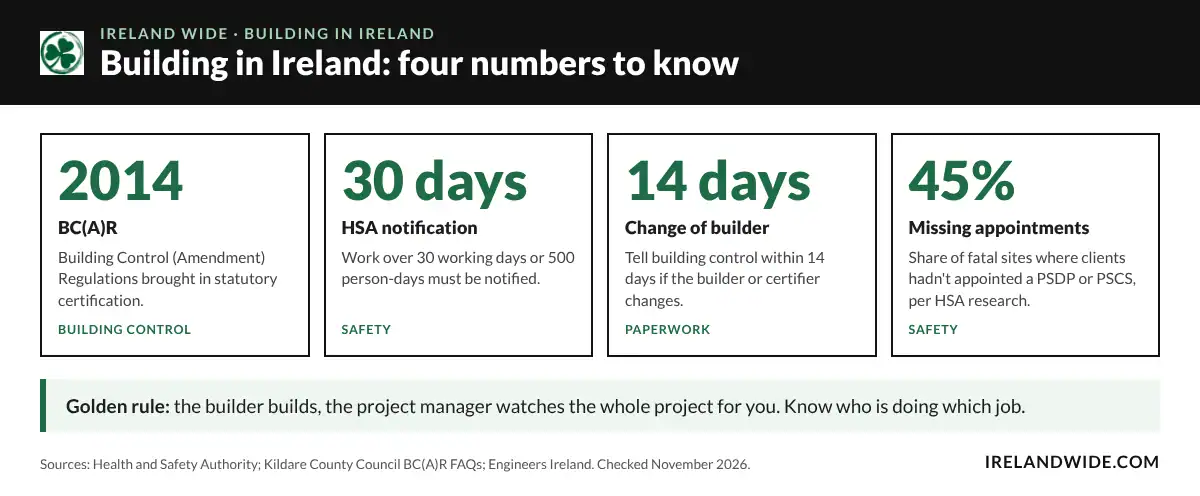
If you’re building a house or extension in Ireland, it helps to know who is doing which job. Health and Safety Authority research found that on 45 per cent of construction sites where a fatality occurred, clients had failed to appoint the safety roles the law requires.
Here’s how a construction project manager differs from your builder, the roles Irish rules ask you to fill, how the two split cost, programme and quality, and when an independent project manager is worth paying for.
What Does a Project Manager Do That a Builder Doesn’t?
A builder (or main contractor) physically builds the works to the agreed design and specification. A construction project manager acts for you, the client, and coordinates design, procurement and delivery across the whole project, including the parts that happen away from site.
| Area | Project manager | Builder |
|---|---|---|
| Who they work for | You, the client | Their own contract with you |
| Main focus | The whole project, from brief to handover | The construction works in their contract |
| Programme | Design, approvals, procurement and site | Their own site activities |
| Cost | Total budget, including fees and client-side costs | The price and variations in their contract |
| Quality | Independent checks before work is accepted | Their own quality control |
The two roles can overlap on small jobs, but treating one as a substitute for the other can leave gaps in oversight. A builder reporting on its own progress and cost isn’t an independent check, however good the builder is.

Which Roles Do Irish Rules Ask You to Fill?
In the Republic of Ireland, a homeowner having work done is the client, and that comes with legal duties. The rules north of the border are different, which is one of the many differences between Northern Ireland and Ireland.
Building control: builder and Assigned Certifier
Under the Building Control (Amendment) Regulations, known as BC(A)R, each party on a project, including the owner, designer, builder and Assigned Certifier, must register with the Building Control Management System before the commencement notice goes in.
Owners of new single houses and domestic extensions can opt out of statutory certification instead. That still means submitting a commencement notice with plans and a Notice of Assignment of Builder, and the work must still meet the Building Regulations. If you change your builder or Assigned Certifier during the build, you must tell the building control authority within 14 days.
Safety: PSDP and PSCS
Under the Safety, Health and Welfare at Work (Construction) Regulations 2013, the HSA’s duties for clients include employing competent designers and contractors. Where the duty applies, for example when more than one contractor is involved, you must appoint a Project Supervisor for the Design Process (PSDP) before design starts and a Project Supervisor for the Construction Stage (PSCS) before building begins.
Work likely to take more than 30 working days or 500 person-days must also be notified to the HSA. On a typical house, the HSA homeowner guidance is that the architect or engineer acts as PSDP and the builder as PSCS.
A project manager doesn’t replace any of these statutory roles, but can help you appoint the right people and keep the paperwork in order.
Why Does Independence From the Builder Matter?
An independent project manager represents your interests and can raise concerns about cost or progress without the conflict of interest that comes from managing your own work. That gives you an objective view of how the job is going, rather than a version shaped by a wish to report good news.
This is the role consultancies such as Mitchell McDermott provide. The Dublin-headquartered firm describes itself as an independent construction consultancy, and its project management service runs from feasibility and design team selection through to programme, risk and cost management, contract administration and handover.
How Do Programme, Cost and Quality Differ Between the Two Roles?
- Programme: a project manager tracks design approvals, procurement lead times and regulatory steps as well as site activity. That catches problems off site, such as a late planning decision or a delayed delivery, before they hit the build. Irish winters can add their own delays too, as the recent icy roads and polar vortex warning showed.
- Cost: a builder manages the cost and risk within its own contract. A project manager watches the full budget, including consultant fees, planning costs and anything you buy directly.
- Quality: independent checks before work is accepted and paid for add a layer of assurance on top of the builder’s own quality control, which matters most where defects are expensive to put right later.
- Coordination: architects, engineers, specialists and contractors all need consistent information. A project manager runs that communication centrally, which cuts the risk of conflicting instructions.
When Is an Independent Project Manager Worth It?
For a small extension with one builder and a good architect, many homeowners manage the project themselves. The case for an independent project manager grows with the project’s size and complexity:
| Project | Typical set-up | Independent project manager? |
|---|---|---|
| Small renovation, one builder | Builder plus architect or engineer | Often not needed |
| Domestic extension | Builder, designer and possibly an Assigned Certifier | Worth pricing on larger extensions |
| New one-off house | Full design team, builder, PSDP and PSCS | Worth serious consideration |
| Commercial or multi-unit build | Several contractors and consultants | Usually recommended |
Use the checker below to see which roles usually apply to your project.
 Who Do You Need on Your Irish Build?
Answer four quick questions about your project in the Republic of Ireland. The checker lists the roles and paperwork that usually apply, and whether an independent project manager is worth considering.
Independent project manager?
Roles and paperwork to check
Whoever you hire, check their credentials. Builders are being brought onto the statutory Construction Industry Register Ireland, so ask any builder about their registration, and check that your architect, engineer or surveyor belongs to the relevant professional body.
Project Manager vs Builder FAQ
Is a construction project manager the same as a builder?
No. A builder carries out the construction works. A project manager acts for the client, coordinating design, procurement, cost and programme across the whole project.
Do I need a project manager to build a house in Ireland?
It isn’t a legal requirement. You do need to appoint a builder and, depending on the project, a PSDP, a PSCS and an Assigned Certifier unless you opt out of statutory certification.
Can my builder also be the PSCS?
Yes. On many domestic projects the builder is appointed as PSCS, while the architect or engineer acts as PSDP.
What happens if I change builder halfway through?
You must notify the building control authority within 14 days if your builder or Assigned Certifier changes.
When do I need to notify the HSA?
When construction work is likely to take more than 30 working days or 500 person-days.
A builder and a project manager do different jobs, and on bigger projects you’ll want both. Fill the statutory roles first, then decide whether an independent eye on cost, programme and quality is worth the fee for your build.
This article is general information and not legal or professional advice. Check your obligations with your local authority, the HSA and a qualified professional.