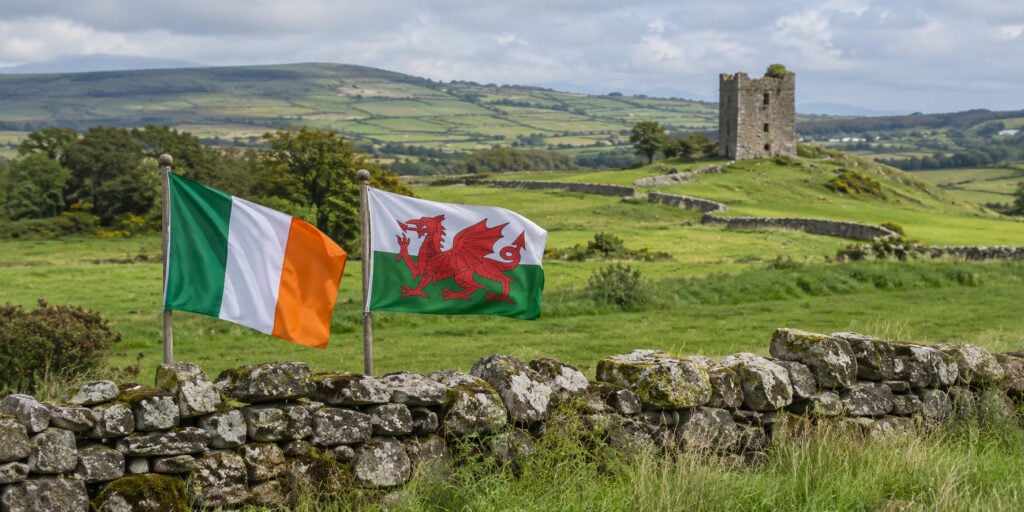
If your surname is Walsh, Joyce, Taaffe or Wogan, there is a good chance it started life in Wales. Walsh is the clearest case: its Irish form, Breatnach, simply means “Welshman”, and it is now the fourth most common surname in Ireland. A whole group of other surnames found in Ireland with documented Welsh origins arrived the same way, with the Welsh soldiers, settlers and Cambro-Norman lords who crossed the Irish Sea after 1169.
This guide covers 15 of them, from Welsh personal names such as Rhys, Hywel and Madog to family names taken from Pembrokeshire, plus four Mayo names whose Welsh label is shakier than it looks. For each one you get the Irish form, the Welsh root, where the family first settled and how solid the evidence is. One point runs through all of it: a surname’s origin and your own ancestry are two different questions.
Surnames Found in Ireland With Documented Welsh Origins at a Glance
The table gives each name’s Irish form, Welsh root, first base in Ireland and how strong the evidence is. “Strong” means the Welsh root is stated plainly by the main reference works; “mixed” means the same English spelling also covers a native Irish name or the derivation is argued over.
Filter the names by the kind of Welsh link the surname dictionaries record.
| Surname | Irish form | Welsh root | Early base in Ireland | Evidence |
|---|---|---|---|---|
| Walsh, Welsh, Brannagh | Breatnach | “Welshman” | Kilkenny, Kildare, Mayo and across the south | Strong |
| Wallace, Wallis | Bhailis | Anglo-Norman le Waleis, “Welshman” | Wexford, Cork, Limerick | Strong |
| Joyce | Seoighe | Family from Wales | Joyce Country, Co. Galway | Strong |
| Taaffe | Táth | Dafydd (“son of David”) | Co. Louth | Mixed (two derivations) |
| Wogan | Úgán | Gwgan | Rathcoffey, Co. Kildare | Strong |
| MacHale, Howell | Mac Héil | Hywel | Tirawley, Co. Mayo; Kilkenny; Wexford | Mixed (native Mac Céile) |
| Merrick | Meibhric | Meurug | Co. Mayo | Strong |
| Rice | Rís | ap Rhys | Limerick, Dingle, Kilkenny | Mixed (native Ó Maolchraoibhe) |
| Price | Prís | ap Rhys | Co. Wexford | Mixed |
| Maddock | Madóg | Madog | Laois, Kilkenny, Louth, Cork, Limerick | Strong |
| Griffin | Grífin | Gruffin, Gruffudd | Anglo-Norman colony | Mixed (native Ó Gríobhtha) |
| Roche | de Róiste | Pembrokeshire family | Cork, Wexford, Limerick | Strong (Welsh base, Norman name) |
| Barry | de Barra | Manorbier, Pembrokeshire family | Co. Cork | Strong (Welsh base, Norman name) |
| Pembroke | Feamróg | Penfro (Pembroke) | Cork, Waterford, Wexford | Strong |
| Prendergast | de Priondragás | Prendergast, Pembrokeshire | Co. Wexford | Strong (Flemish family via Wales) |
How Welsh Names Reached Ireland
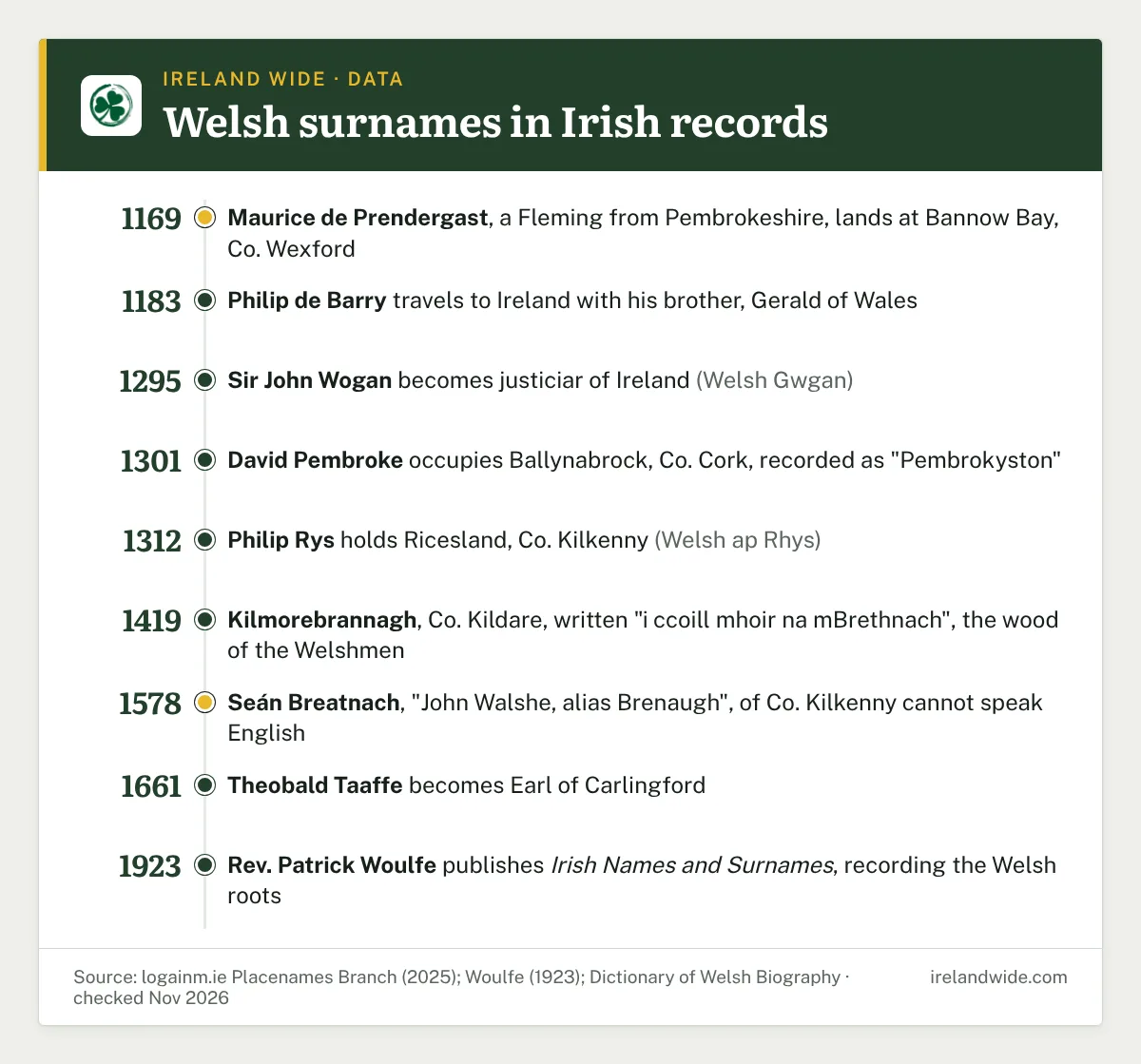
Most of these names came with the Anglo-Norman invasion that began in 1169. Many of the knights who led it were based in south Wales, especially Pembrokeshire, and their armies were full of Welsh archers, foot soldiers and settlers. Maurice de Prendergast, a Fleming from Pembrokeshire, landed at Bannow Bay in Co. Wexford on 2 May 1169 with about ten men-at-arms and 200 archers.
Surnames were settling into use in Ireland while five vernacular languages were in operation: Irish, English, Norse, Welsh and Norman French. That mix explains why Welsh names turn up in such different shapes. Some are Welsh first names that became surnames (Rhys, Hywel, Madog). Some are labels the Irish gave to newcomers (Breatnach). Others are the names of Pembrokeshire places carried over by Norman families.
There is a twist with the Welsh themselves. At the time, Welsh people usually went by patronymics (a man was “ap Rhys”, son of Rhys) with no fixed family surname, so many settlers got their surname in Ireland. Within a few generations a lot of them spoke Irish too: even in heavily settled Kilkenny, the colony had become Irish-speaking, which is why so many of these names survive in Gaelicised forms on the townland map.
1. Walsh, Welsh and Brannagh (Breatnach): The Irish Word for a Welshman
Walsh is the biggest Welsh-origin surname in Ireland by a distance. Breatnach meant “Welshman”, and earlier “Welsh-speaker”, and the 1923 dictionary of Irish surnames by Rev. Patrick Woulfe describes it as a descriptive name applied generically to the early Anglo-Norman invaders who came from Wales. In records it was written as Brannagh, Brennagh and Walshe as well as Walsh.
The name is spread across the townland map. The Walsh Mountains in Co. Kilkenny are Sliabh Breatnach in Irish, Kilmorebrannagh in Co. Kildare, the great wood of the Welshmen, is recorded as “i ccoill mhoir na mBrethnach” in 1419, and Walshpool in Co. Mayo was home to Edmond Boy McWalter Brenagh in 1609. In 1578 Seán Breatnach of Co. Kilkenny, written down as “John Walshe, alias Brenaugh”, made a submission to the Lord Justice through a third party because he could not speak English.
Ireland Wide’s guide to the Walsh surname’s meaning, origin and history covers its spread and famous bearers in more detail.
2. Wallace and Wallis (Bhailis): The Anglo-Norman Version
Wallace comes from the Anglo-Norman French le Waleis, which also meant “Welshman”. In Irish it became Bailis or Bhailis, and the two names were often used interchangeably, especially when clerks translated from English. Nicholas Walsh, Bishop of Ossory, appears as Nicolás Bhailis in the introduction to a 16th-century Irish New Testament.
Look for it in Wexford, where Scarawalsh is Scairbh Bhailis, and in Cork and Limerick, where townlands called Baile an Bhailisigh preserve the name. If your family records switch between Walsh and Wallace, that may reflect this old overlap and not a change of family.
3. Joyce (Seoighe): The Welsh Family Behind Joyce Country, Galway
The Joyces are the best-known Welsh-origin family in the west. Woulfe records that the family seems to have come to Ireland from Wales and that the surname is on record since the end of the 12th century. Citing the Galway historian Hardiman, he places their arrival in the reign of Edward I.
The family took over so much of the mountainous part of Iar-Connacht that it became Duthaigh Seoghach, Joyce Country, now the barony of Ross in Co. Galway. The name itself may come from a Norman personal name, Joie or Joye, so this is a Welsh-based family carrying a French-derived name. Woulfe adds that the spelling Joy is almost peculiar to Kerry. There’s more on the name in our list of Irish last names that start with J.
4. Taaffe (Táth): A Welsh Name in Co. Louth
Woulfe reads Taaffe as “son of David”, comparing it with the Welsh Taffy, and calls it the name of a distinguished family of Welsh origin who settled early in Co. Louth. The other derivation ties it to the River Taf or Taff in south Wales. Both put the source in Wales.
The Louth family rose fast. Sir Nicholas Taaffe was a Justice of the Common Pleas in the late 13th century and his son John became Archbishop of Armagh. In 1628 John Taaffe was made Baron of Ballymote and Viscount Corren, and in 1661 Theobald Taaffe became Earl of Carlingford. The family backed the Stuarts and lost most of what it held: the second earl, Nicholas, died at the Boyne.
5. Wogan (Úgán): From the Welsh Gwgan to Rathcoffey, Co. Kildare
Wogan is one of the most transparent Welsh names on the list. It comes from the Welsh personal name Gwgan, built on gwg, a frown or scowl, and turns up in Irish records as Ugan, Ougan, Ogan and Wogan. The family settled soon after the invasion, with its chief seat at Rathcoffey in Co. Kildare.
In Wales, the Wogans of Pembrokeshire claimed descent from Gwgan ap Bleddyn, lord of Brecknock. Sir John Wogan, of the Picton branch, became justiciar of Ireland in 1295 and is recorded serving again from 1308 to 1313 (possibly a son of the same name), building up considerable Irish estates before his death in 1321.
6. MacHale and Howell (Mac Héil): The Welsh Hywel in Mayo and Kilkenny
The Welsh personal name Hywel became Héil in Irish and Howell in English. Its surname form, Mac Héil, is most common in Co. Mayo, where Woulfe describes a family apparently of Welsh origin who settled in Tirawley, the north Mayo barony, in the 12th or 13th century. The same Hywel sits inside Ballyhale (Baile Héil) in Co. Kilkenny, Courthoyle (Cúirt Héil) in Co. Wexford and the castle at Rossenarra Demesne in Kilkenny, Caisleán Héil.
The catch: MacHale was probably confused with the native Mayo name Mac Céile. A Mayo MacHale could descend from either family. For the Mac prefix itself, see our explainer on what Mc and Mac mean in Irish surnames.
7. Merrick (Meibhric): The Welsh Meurug in Co. Mayo
Merrick, Meyrick and Mayrick come from Meurug, a Welsh personal name, by way of its Norman form Merick. Woulfe gives the Irish as Meibhric, with Mac Meibhric and Mac Míbhric for the “son of” forms, and records that the family settled at an early period in Co. Mayo.
Merrick also appears among the “Welshmen of Tirawley” in the Books of the Clann Firbis (see the weaker-evidence section below), so two independent sources point the same way. That makes it one of the better-documented Welsh names in Connacht.
8. Rice (ap Rhys): Limerick, Dingle and Kilkenny
Rice is an anglicised form of the Welsh ap Rhys, “son of Rhys”, and was originally pronounced “Reece”. Rice families were well established among the early colonists in the southern half of Ireland and prominent in Limerick City and in Dingle, Co. Kerry, where the ruined Caisleán na Ríseach stands near the town.
The townlands give dates. At Ricesland in Co. Kilkenny, Philip Rys held the land in 1312 as part of the manor of Knocktopher, and at Ricetown in Co. Meath, Richard Rys was given land by his father Eustace in 1340. One caution: Rice sometimes stands for the native surname Ó Maolchraoibhe (Mulcreevy, Mulgrew), so not every Irish Rice has a Welsh line.
9. Price (ap Rhys): The Same Rhys, a Different Spelling
Price comes from the same ap Rhys, with the “ap” fused onto the name, and was meant to be pronounced “Preece”. Its Irish footprint is smaller than Rice’s. The best-known example is Priesthaggard in Co. Wexford, Agard an Phrísigh in Irish, “Price’s haggard” (a haggard is a farmyard enclosure for stacking hay and corn).
Price also has other possible origins, and an Irish Price family could just as easily descend from a later arrival from Wales or England, so this is a name where a family tree tells you more than the dictionary.
10. Maddock (Madóg): Welsh Madog on the Townland Map
Madog was a common Welsh first name and became Madóg in Irish and Maddock or Maddox in English. It left more townland names than almost any other Welsh name: two Ballymaddocks in Co. Laois, Maddockstown in Co. Kilkenny, Ballymadog in Co. Cork, two Ballyvaddocks in Co. Limerick and Maddoxland in Co. Louth, recorded as “Madoxland” in 1655 and “Ferrunmadocke” around 1661.
Those places all mean “Madog’s town”, “Madog’s field” or “Madog’s land”, so they mark where a settler called Madog held ground. The surname is far less common today than the placenames suggest.
11. Griffin (Grífin): A Welsh Name Sharing a Spelling With a Clare Family
Woulfe gives the Anglo-Norman Griffin as a Welsh name, “son of Gruffin”, from Latin Rufinus. The Welsh equivalent, Gruffudd or Gruffydd, also produced Griffith and Griffiths. He notes that Griffin is very common in early Anglo-Irish records and that the family settled around the time of the invasion.
The same spelling is also the usual English form of Ó Gríobhtha, a native Dalcassian family who were chiefs of Cineal Cuallachta in Co. Clare, with a castle at Ballygriffy. If your Griffins come from Clare, the Gaelic origin is a real possibility. Woulfe also notes that the Welsh form Gruffudd rarely appears in Irish records, while Griffin is everywhere in them.
12. Roche (de Róiste): A Pembrokeshire Family in Cork and Wexford
Roche is a Norman name, but the family that brought it flourished in Pembrokeshire before crossing to Ireland in the 12th century, mainly to Munster and Wexford. In Irish a Roche was An Róisteach, and the genitive, an Róistigh, sits inside dozens of placenames.
Rochestown near Douglas in Co. Cork appears as “Rochestoun” in 1385, and there are Rochestowns in Kilkenny, Limerick and Tipperary too. In Wexford the Roches of Newbay were thoroughly Gaelicised by 1600: Alexander fitz Phillip Roche was placed in fosterage in the early 1600s with the Gaelic Mac Dáibhí Mhóir sept of north-east Wexford.
13. Barry (de Barra): The Manorbier Family of Gerald of Wales
The de Barri family were Pembrokeshire lords before they were Irish ones. Their best-known member, the writer Gerald of Wales, was born at Manorbier, Pembrokeshire, around 1146, son of William de Barri and Angharad, a granddaughter of the Welsh king Rhys ap Tewdwr through her mother Nest. Angharad’s brothers and half-brothers were among the conquerors of Ireland.
Gerald’s brother Philip travelled to Ireland with him in 1183, and Gerald gathered the material for his books on Ireland, the Topographia Hibernica and Expugnatio Hibernica, on a visit in 1185. The Welsh link in Barry runs through the family’s Pembrokeshire base and Welsh royal ancestry. The surname itself is Norman in form.
14. Pembroke (Feamróg): Named After the Welsh County
Pembroke is the anglicised form of the Welsh Penfro, and in Irish a man from there was An Feamrógach. The name is rare today, but it left clear traces. David Pembroke was the occupant of Ballynabrock in Co. Cork in 1301, when the place was recorded as “Pembrokyston”, and Pembrokestown in Co. Waterford appears as “Ballemembroke” in 1567.
There are also two Pembrokestowns in south Co. Wexford, the county where the first invaders landed.
15. Prendergast (de Priondragás): From a Pembrokeshire Village to Co. Wexford
Prendergast takes its name from Prendergast, beside Haverfordwest in Pembrokeshire. Maurice de Prendergast, whose 1169 landing at Bannow Bay is described above, stayed on after the fighting and was granted land in Co. Wexford by Strongbow.
Maurice was a Fleming, one of the Flemish settlers established in Pembrokeshire, so Prendergast is Welsh by place and Flemish by family. That double origin is typical of the Pembrokeshire knights who led the invasion.
Names Sometimes Called Welsh on Weaker Evidence
The Books of the Clann Firbis, the Mac Firbhisigh family of hereditary historians in Co. Sligo, list families they called the Welshmen of Tirawley in north Mayo. John O’Hart reprinted the list in 1892, and it includes Barrett, Hosty, Joyce, Lawless, Lynott, Merrick and Walsh. Several of those names, though, have English or Norman roots in the dictionaries:
- Lynott (Lionóid): Woulfe derives it from Lionot, a pet form of Leonard, and says the Lynotts settled early in Tirawley. The family may have come from Wales; the name is not Welsh.
- Lawless and Lillis (Laighléis): from Middle English “laghles”, the outlaw. The family came in around the time of the invasion and settled in Leinster and Munster, with a branch in Tirawley.
- Hosty (Mac Hoiste): “son of Hodge”, an English pet form of Roger. The family’s name survives in Glenhest, near Newport, Co. Mayo.
- Barrett: generally treated as an Anglo-Norman name, written Baróideach in Munster and Baireadeach in Connacht.
These families plausibly arrived with the Welsh and Cambro-Norman wave into Mayo. Calling the surnames Welsh, though, overstates what the evidence shows.
Does a Welsh-Origin Surname Mean Your Family Came From Wales?
Not necessarily, and the Walsh story shows why. Breatnach was a label Irish speakers gave to outsiders, so it was applied to many unrelated newcomers from Britain, not only people from Wales. The genealogist John Grenham has pointed out that many old Irish surnames began as Gaelic labels for outsiders, Walsh among them. A label like that records how the first bearer was seen by the neighbours. It says nothing certain about where every later Walsh came from.
Three other things break the link between a name and a bloodline. Several of these spellings also cover native names (Rice for Ó Maolchraoibhe, MacHale for Mac Céile, Griffin for Ó Gríobhtha). Surnames were sometimes adopted by tenants, followers or people taking a local lord’s name. And a surname follows only one line, your father’s father’s father, out of thousands of ancestors in the same number of generations.
Our advice: treat the surname as a lead. If your family’s earliest records sit in Joyce Country, north Mayo, south Kilkenny or south Wexford, the Welsh story is more likely to apply to you. A DNA test of the male line, compared with others of the same surname, is the only way to test it directly.
How We Chose These Surnames
We included a name only when a standard reference states its Welsh link. The main sources are Woulfe’s Irish Names and Surnames (1923), the 2025 series on Welsh names in Irish placenames by the Placenames Branch at logainm.ie, which draws on the 2021 Oxford Dictionary of Family Names in Ireland, and the Dictionary of Welsh Biography for the Wogan and de Barri families. Names whose only Welsh evidence is the Tirawley list went into the weaker-evidence section. Popular lists that call Glynn or Hughes Welsh were left out, because no standard reference we checked backs the claim.
Frequently Asked Questions
What Is the Most Common Irish Surname of Welsh Origin?
Walsh is the most common Irish surname of Welsh origin and ranks as the fourth most common surname in Ireland overall. Its Irish form, Breatnach, means “Welshman”.
Is Kenneth Branagh’s Surname Welsh?
Branagh is one of the anglicised forms of Breatnach, the Irish surname meaning “Welshman”, so it shares its origin with Walsh. It was recorded in older documents as Brannagh and Brennagh.
Is Griffiths an Irish Surname?
Griffith and Griffiths come from the Welsh personal name Gruffudd, so the surname is Welsh in origin. In early Irish records the related name usually appears as Griffin, which can also stand for the native Clare surname Ó Gríobhtha.
Is Wallace an Irish or Scottish Surname?
Wallace is found in both countries, and in Ireland it comes from the Anglo-Norman le Waleis, meaning “Welshman”. Irish speakers rendered it Bailis or Bhailis and often used it interchangeably with Breatnach, the Irish form of Walsh.