Quick answer: Ryan is an Irish surname most often linked to the Gaelic Ó Riain, usually understood as “descendant of Rian.” The hard part is that the personal name Rian is very old, and its original meaning is not settled by scholars.
That is why you will often see Ryan explained as “little king,” “kingly,” or “illustrious,” but those glosses are better treated as popular interpretations than firm historical fact. In Ireland, the name has long been strongly associated with County Tipperary and also with parts of Limerick, Kilkenny, and Cork.
For American families tracing Irish roots, Ryan is a good reminder that one familiar English surname can hide several Gaelic forms, several branches, and a very long paper trail. It is a common name, but not a simple one, and it still turns up regularly on lists of common Irish surnames.
If you are building a family tree, the safest short version is this: Ryan is Irish, usually from Ó Riain or Ó Maoilriain, and the deeper meaning of Rian is unclear.
The surname Ryan is usually traced to the Irish Ó Riain, which means “descendant of Rian.” That part is straightforward enough. The trouble begins with the name Rian itself.
Many popular name guides say Ryan means “little king”, often by connecting it to the Irish word rí, meaning king. Others lean toward “illustrious.” Those ideas are widespread, and you will see them repeated in genealogy circles, surname lists, and baby-name sites. They are easy to remember, which probably helps.
But older-name research is not always tidy. The personal name Rian appears to be so old that its original meaning was already obscure before good written records began. Some writers have linked it with old words for water or ocean, and others with royal language, but those tidy explanations have not won broad scholarly acceptance.
So if you want the careful version for family history, use this wording: Ryan comes from Ó Riain, meaning descendant of Rian, and the meaning of Rian is uncertain.
That answer may feel less satisfying than “little king,” but it is more honest. Irish surnames often reward patience over neat slogans, especially when you compare Ryan with other Celtic Irish surnames whose older personal names also resist tidy translation.
Ryan in English is usually pronounced RYE-an.
The Irish form Ó Riain is commonly given as something close to oh REE-in or oh REE-an, depending on regional speech and how closely the speaker is following Irish pronunciation. If you are saying it in a simple, respectful way at an archive desk or on a heritage visit, oh REE-in will be understood.
Here is a plain guide:
Irish surnames shift a bit between formal Irish, everyday English, and local accent. If your family has used Ryan for generations in the United States, that pronunciation is no less real. It just belongs to a different stage of the name’s history.
Ryan has more than one historical pathway, which is common in Irish surnames. In some cases, the modern surname reflects the Gaelic Ó Riain. In others, it is a shortened English form of Ó Maoilriain, which also gave the form Mulryan. That older name is often understood as meaning “descendant of the follower or devotee of Rian.”
This is one reason Ryan family history can get messy fast. Two people named Ryan may share a surname without sharing the same branch, sept history, or exact Gaelic form. That does not make the trail impossible. It just means you need place names, parish records, and dates, not just the surname on its own.
The surname is especially tied to Munster, and above all to County Tipperary. Historical surveys of landholding and surname distribution place a very large concentration of Ryan households there in the nineteenth century. Griffith’s Valuation, carried out between 1847 and 1864, recorded 8,939 Ryan households across Ireland, with nearly half in Tipperary. County Limerick was the next major center, followed by places including Kilkenny and Cork.
That pattern matters for genealogy. If your Ryan ancestors left Ireland in the famine period or in the later nineteenth century and the family only remembered “somewhere in Ireland,” Tipperary is often the first county worth testing against church records, civil registration, and valuation records.
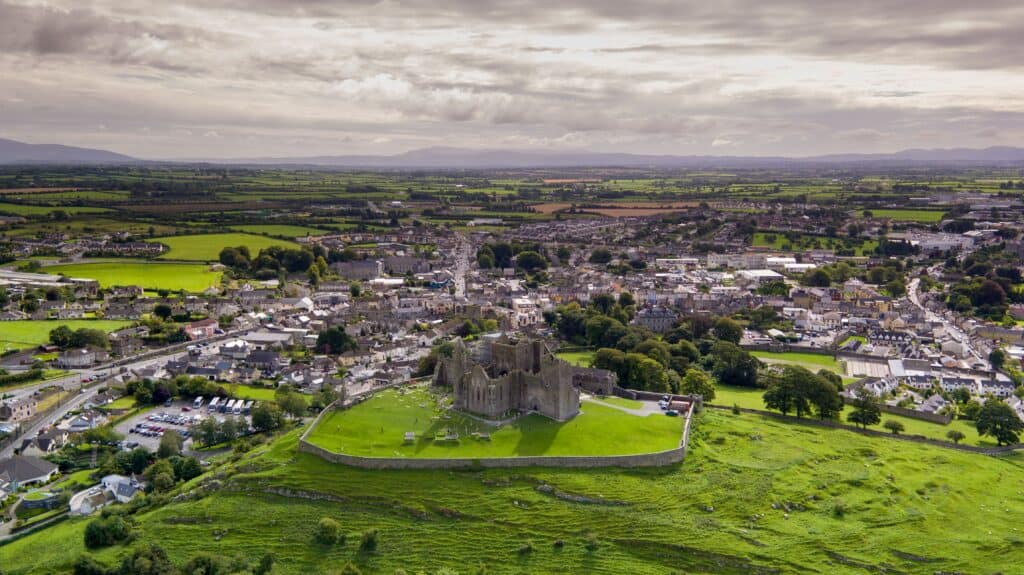
There are also old Ryan associations in the built landscape of Tipperary. Two ruined sites often mentioned in connection with the Ryan sept are Castle Cully in the parish of Kilnarath and Gortkelly Castle near Thurles. Neither solves anyone’s lineage on the spot, of course. Castles rarely volunteer paperwork. But these place-links show how tightly the surname became woven into the county’s local history.
Ryan was also one of the most common surnames in Ireland in modern surveys. It ranked 8th in one surname survey covering the 1990s, and it held the same top-ten position in older historical counts. That helps explain why the name traveled so strongly into the United States, Britain, Australia, and beyond.
If you are looking for the surname on an Irish map, start with County Tipperary. That is the county most consistently associated with Ryan in surname history and family memory.
Limerick is the next county that repeatedly turns up in older records and surname summaries. After that, Kilkenny and Cork appear as important neighboring concentrations. This does not mean every Irish Ryan came from one small patch of ground, but it does give you a practical starting zone in the south and southeast.
For a research trip, the county focus matters more than the broad label “Irish.” A Ryan family from near Thurles in Tipperary may leave a very different records trail from a Ryan family rooted in a different province. Parish boundaries, landlord records, graveyards, and local naming patterns all get easier once the county is known.
If your interest is surname geography as much as ancestry, this is also where the name feels most grounded. Ryan is common across the Irish diaspora, but in Ireland itself, Tipperary is the county most people will associate with the surname first.
One reason Ryan research stalls is that the surname can appear in several Irish and anglicized forms. A family may shift between them over time, or a clerk may have made a one-off spelling that stuck for a generation.
Common forms and related surnames include:
Not every variant belongs in every family tree. That is the key caution. Ryan is sometimes a shortening of Mulryan, but not every Ryan was formerly Mulryan. The same goes for O’Ryan. In records, one household may appear under different forms across decades.
If you are searching passenger lists, baptism records, or headstone inscriptions, try broad searches with Ryan, O’Ryan, Mulryan, and Ó Riain. Irish family history rewards flexible spelling and strong coffee. If you are sorting out related forms, it also helps to understand what the O means in Irish surnames.
The Ryan surname shows up across politics, sports, literature, film, and public life, which is no surprise given how common it is in Ireland and the Irish diaspora.
A few notable examples include Amy Ryan, the American actress, and Archie Ryan, the Irish professional cyclist. In Irish history, the surname also appears in revolutionary and political contexts, including Bernard Ryan, a member of the IRA who was executed in Dublin in 1921.
You can also see how the surname moved from family name to first name. Ryan as a given name became highly popular in the English-speaking world, especially in the United States. In U.S. baby-name data, Ryan spent years near the top of boys’ name charts in the late twentieth century before easing back, which helps explain why many people now meet it first as a first name rather than a surname.
The tricky part is that famous bearers do not usually help prove kinship. A shared surname may hint at broad Irish roots, but it is not evidence of direct relation. Ryan is common enough that coincidence is usually more likely than a long-lost branch of celebrity cousins.
For American readers, Ryan is one of those surnames that almost instantly signals Irish heritage. It traveled widely during the great eras of emigration, and by the 2000 U.S. Census it ranked among the more common Irish-origin surnames in America.
Still, the name alone tells you only so much. It can point to Ireland with confidence, but it rarely tells you the exact county without backup records. That is why good Ryan research usually moves in this order:

Because Ryan is so common, DNA can be helpful, but only when paired with records. A DNA match named Ryan may be meaningful. It may also be like finding another Smith at a baseball game. You need the paper trail. That is especially true for families tracing branches through the broader story of the Irish in the USA, where repeated surnames can blur together fast.
The phrase “little king” is probably the single most repeated meaning attached to Ryan. It is catchy, flattering, and easy to share at family reunions. It may also reflect an old association people tried to make with rí, the Irish word for king.
But this is exactly the kind of surname meaning that gets polished smooth over time. The safest way to handle it is to say that “little king” is a popular modern interpretation, not a settled scholarly fact.
If you are writing a family history, engraving a gift, or making a heritage print, that distinction is worth keeping. There is nothing wrong with mentioning the popular meaning. Just do not present it as beyond dispute.
If one county deserves its own section here, it is Tipperary. Ryan has deep roots there, and many surname summaries point to the county as the historic stronghold of the name.
The county also gives you real places to anchor the story. Thurles is often mentioned in Ryan discussions because of nearby Gortkelly Castle, one of the ruined sites linked with the Ryan sept. Kilnarath and Castle Cully also appear in that local historical orbit. These are the kinds of place names worth writing down when you are moving from abstract surname interest into actual genealogy.
For many families, “our Ryans were from Tipperary” turns out to be more than a vague old saying. It is often the right county to investigate first.
Yes. Ryan is widely recognized as an Irish surname, usually from Ó Riain and in some cases also from Ó Maoilriain. There are rare cases where Ryan can reflect a non-Irish surname after anglicization or Americanization, but the main historical identity of the name is Irish.
The careful answer is “descendant of Rian.” The meaning of Rian itself is uncertain. “Little king” is a popular interpretation, not a settled fact.
A practical pronunciation is oh REE-in.
Often, yes. The surname is especially associated with County Tipperary, which had a very large concentration of Ryan households in nineteenth-century records.
Sometimes. Some Ryans descend from the Gaelic Ó Maoilriain, which also produced the anglicized surname Mulryan. But not every Ryan line comes through Mulryan.
Yes. Ryan became a widely used given name in the English-speaking world after long use as a surname.
Ryan is one of the most recognizable Irish surnames, but its history is more layered than the polished one-line meanings suggest. The safest summary is that it comes from Ó Riain, sometimes overlaps with Ó Maoilriain, and is strongly tied to Tipperary and neighboring counties such as Limerick, Kilkenny, and Cork.
If your family name is Ryan, the best next step is not chasing a romantic slogan about kings. It is finding the county, the parish, and the record set that matches your line. Irish surname history gets much more useful once it lands on a real map.
The Irelandwide Editorial Team is a group of travel writers, researchers, and content creators dedicated to publishing accurate, up-to-date information about Ireland. Our content covers travel guides, castles, attractions, Irish culture, tourism news, and official data to help visitors and locals alike. We prioritize reliable research, clear writing, and trusted sources to create practical resources for exploring Ireland with confidence.
At Ireland Wide, our aim is to bring authentically Irish insights to you, wherever you are.
Whether you have some feedback or would like to offer some of your own insights for everyone else to explore, don't hesitate to get in touch with us!