If you’re flying over from the US for the first time and wondering how many days you need in Ireland, our answer is 7 to 10 nights. Seven nights is enough for Dublin and one region of the west coast at a sensible pace. Ten nights lets you add a third area, usually Kerry, Galway or the Causeway Coast, without spending most of each day behind the wheel.
The nights on your booking and the days you actually spend exploring are two different numbers. A direct flight from New York to Dublin takes around 6 hours 45 minutes, so you land tired, and the last morning goes on getting to the airport. Below we work out how many full days each trip length really gives you, how long the drives between the main bases take, and how many hotel changes each trip can handle.
How Many Days Do You Need in Ireland? Trip Lengths at a Glance
This table counts nights on the ground in Ireland. The arrival day after an overnight flight and the departure morning are treated as partial days, so a trip gives you roughly one fewer full touring day than nights booked.
Pick your number of nights, how you’ll get around and when you’re travelling to see the days and bases that fit.
| Nights in Ireland | Full touring days | Overnight bases | What it covers well |
|---|---|---|---|
| 3 to 4 | 2 to 3 | 1 | Dublin plus one day trip, or a single west coast base |
| 5 to 6 | 4 to 5 | 2 | Dublin and one region (Galway or Kerry) |
| 7 | 6 | 2 to 3 | Dublin and the west coast, or Belfast and the north coast |
| 8 to 10 | 7 to 9 | 3 | Dublin, Kerry and Galway or Clare |
| 11 to 13 | 10 to 12 | 4 | The three above plus Northern Ireland or Cork |
| 14 or more | 13 or more | 4 to 5 | A loop of most of the island |
The base count follows a simple rule: give each base at least two nights, and three where you can. Every move costs you a morning of packing, checking out and driving.
How Many Full Days a Trip Really Gives You
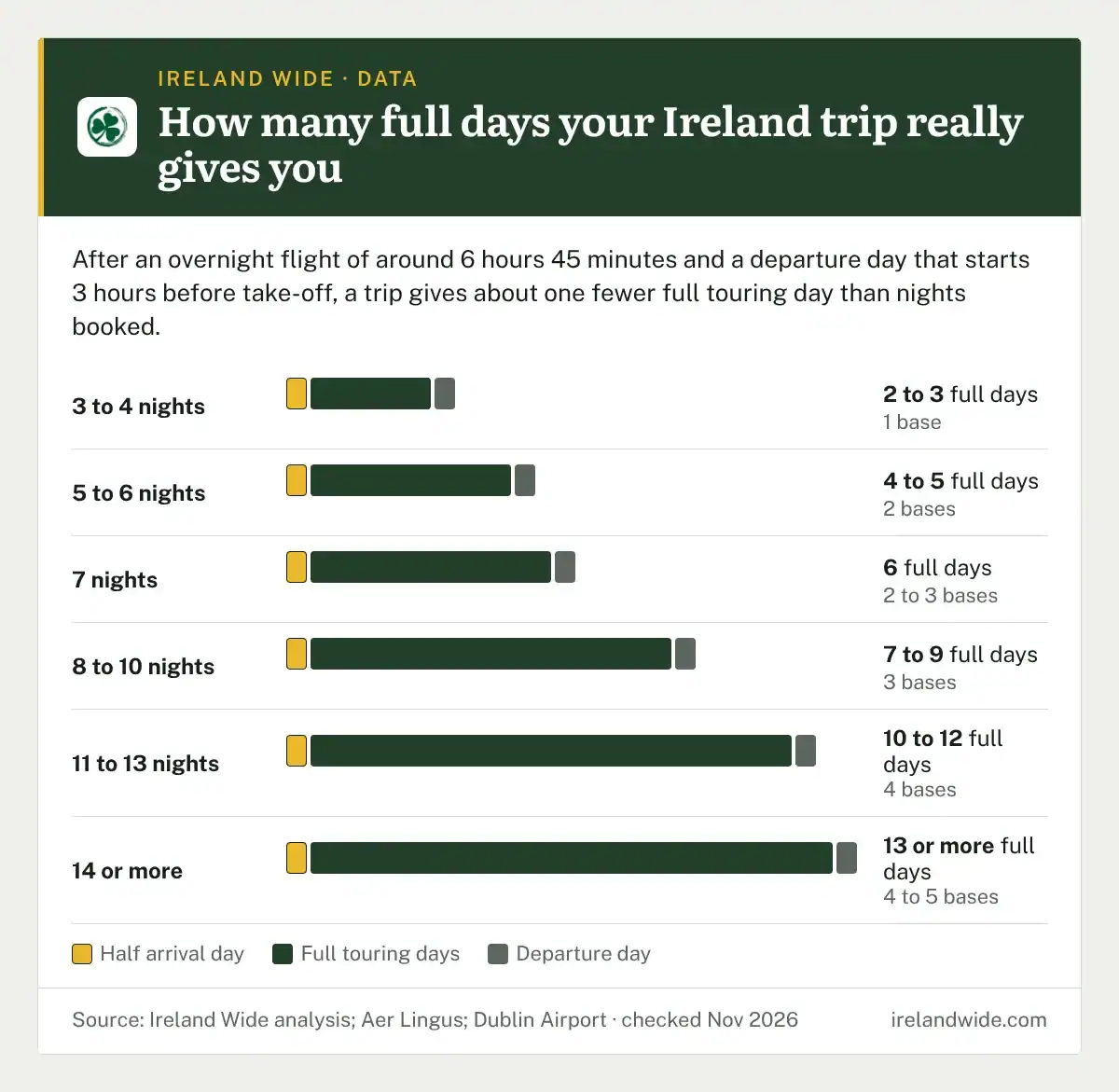
Most flights from the US East Coast leave in the evening and arrive in Ireland the next morning. Hotel rooms are rarely ready that early, and after a night in an economy seat few people are at their best. Treat the arrival day as half a day: a walk, an early dinner, and nothing that involves a long drive on the left-hand side of the road.
The departure day is shorter still. Dublin Airport suggests arriving 3 hours before a long-haul flight, with more time if you’re checking bags. Most direct flights to the US from Terminal 2 include US Preclearance, so you clear American immigration and customs in Dublin before you board. That saves time when you land at home, but it is part of why you need to be at the airport early.
Put those together and a 7-night trip gives you about 6 full days, plus a tired arrival afternoon. If your plan only works with seven full days, it’s a plan for eight nights.
The other hidden cost is moving between bases. Checking out, loading the car and driving two or three hours to the next town takes most of a morning, even before you stop for anything. Three bases in a week means two of your six full days start with a drive.
Travel Times Between the Main Bases
Ireland looks small on a map, and the motorways linking Dublin to the other cities are quick. The trouble starts once you leave them. Here are the journey times for the routes most first itineraries use.
| Route | Typical journey time | How |
|---|---|---|
| Dublin to Galway | About 2 hours 20 minutes | Motorway drive |
| Dublin to Galway | 2 hours 10 minutes to 2 hours 30 minutes | Bus |
| Dublin to Cork | About 2 hours 30 minutes | Train |
| Cork to Killarney | About 1 hour 35 minutes | Bus or car |
| Cork Airport to Killarney | About 1 hour 20 minutes | Car |
| Cork to Galway | About 3 hours 5 minutes | Bus or car |
The motorway between Dublin and Galway makes it a drive of around 2 hours 20 minutes, and buses do it in a similar time. Those figures assume no stops. Add a coffee, a castle and a wrong turn, and a two-hour transfer becomes a half-day.
Off the motorways, speeds drop. On many rural local roads, the default limit fell from 80 km/h to 60 km/h on 7 February 2025, while national secondary roads were set to drop from 100 km/h to 80 km/h later that year. The scenic routes most visitors come for, such as the Ring of Kerry, Connemara and the Wild Atlantic Way, run largely on these smaller roads, often behind a tractor. Phone estimates there tend to be optimistic.
How Many Overnight Bases Should You Plan?
The number of bases matters more than the number of places on your wish list. A base is where you sleep for two or more nights and take day trips from, so you only unpack once in each area.
Our advice for a first trip:
- One base for 3 or 4 nights. Dublin works without a car; Galway or Killarney work with one.
- Two bases for 5 to 7 nights. Dublin plus one region of the west is the classic pairing.
- Three bases for 8 to 10 nights, usually Dublin, Kerry and Galway or Clare.
- Four bases for 11 to 13 nights, adding Northern Ireland or Cork.
- Four or five bases for two weeks or more.
A single base for the whole country doesn’t work: Dublin to Kerry and back is too long for a day trip. Our guide to exploring Ireland from one base with day trips covers when it does make sense, mainly for short trips that stay in one region.
Choosing where you land helps too. Flying into Shannon puts you near Clare and Galway, and Cork or Kerry airports put you close to the southwest. Our guide to which Irish airport to fly into for each region matches airports to routes, and flying into one airport and home from another saves a long backtrack.
What Fits in Each Trip Length
3 to 4 Nights: One Base
With two or three full days, stay in one place. Dublin is the obvious choice for a first visit, with Trinity College, the city’s museums and pubs on the doorstep, and Howth or Wicklow within reach for a day out. Two full days covers the main city sights; with a third, you can add that day trip without cutting Dublin short. Our 3-day Ireland itinerary from the USA shows how a long weekend of Dublin and Wicklow fits together.
If the west appeals more, fly into Shannon and base yourself in Galway. The Connemara and Cliffs of Moher itinerary is built for exactly this length. What doesn’t work is trying to do Dublin and the west coast in four nights; you’d spend a full day of three getting across the country and back.
5 to 6 Nights: Two Bases
Five or six nights is where two bases start to make sense. A typical split is 2 nights in Dublin and 3 or 4 in Galway, with day trips to Connemara and the Cliffs of Moher. Swap Galway for Killarney if the Ring of Kerry and Killarney National Park appeal more.
Pick one region of the west. Kerry sits south of the Shannon estuary and Galway lies north of it beyond County Clare, and the drive between them takes up a large part of a day you don’t have spare on a trip this length.
7 Nights: The Usual First Trip
A week is the most common first trip from the US, and it gives you about six full days. You can keep it to two bases, Dublin and one western region, and travel at an easy pace. Or you can use three bases: 2 nights in Dublin, 3 in Killarney and 2 in Galway, which covers the Ring of Kerry, the Cliffs of Moher and Galway city, but puts a long drive on each move, starting with the cross-country run from Dublin to Kerry. Flying home from Shannon saves the final drive back to Dublin.
The north is a good alternative for a week: Belfast, the Causeway Coastal Route and Donegal make a compact loop with shorter drives than a Dublin to Kerry run. Our 7-day Ireland itinerary for first-time visitors sets out a full route day by day.
8 to 10 Nights: Three Regions Without Rushing
This is our recommended length for a first visit if you can get the time off. With seven to nine full days you can give Dublin, Kerry and Galway or Clare about three nights each, which leaves room for a slow morning, a rainy day or a detour you hadn’t planned.
Ten nights also gives you enough slack to fly into Dublin and out of Shannon, so the trip runs in one direction across the country. The 10-day Ireland itinerary for American travellers follows that shape. Without a car, the 10-day Ireland by train itinerary works around the rail network.
11 to 13 Nights: Adding the North or the South Coast
Eleven to thirteen nights supports a fourth base. The two usual additions are Belfast with the Causeway Coast, or Cork and Kinsale before heading west to Kerry. Either one adds variety without turning the trip into a driving holiday.
At this length you can also give the Wild Atlantic Way some real time. The full route runs about 2,500 km along the west coast between Malin Head in Donegal and Kinsale in Cork, so even two weeks covers only part of it. Pick a stretch, such as Kerry to Clare or Galway to Mayo, and drive it properly.
Two Weeks or More: A Loop of the Island
Two weeks is enough to circle most of the island at a comfortable pace. A 12-day loop around Ireland covers 1,038 km, taking in Wicklow, Kilkenny, Cork, the Ring of Kerry, Galway, Connemara, Donegal, Belfast and the Boyne Valley. Its longest leg, Kinsale to the Ring of Kerry, is 221 km in a single day.
With 14 nights or more, put the extra time into longer stays. Four or five bases of three nights each will feel more like a holiday than seven bases of two.
How the Season Changes the Number of Days You Need
Daylight is the factor most US visitors overlook. In Dublin on 21 June 2026, the sun rises at 4:56am and sets at 9:56pm, giving 17 hours of daylight. On 21 December 2026, sunrise is at 8:38am and sunset at 4:08pm, about 7 hours 29 minutes of light, and the west coast is darker later in the morning still.
In summer, a long drive and a full afternoon of sightseeing fit in one day. Between November and February they don’t, and narrow rural roads are no fun after dark. For a winter trip, plan one fewer base than the table suggests or add a couple of nights. Our guide to visiting Ireland in winter covers weather, daylight and travel planning.
Summer has its own catch: it is peak season, and the best-known stops get crowded in the middle of the day. An early start helps more than an extra day.
Do You Need More Days Without a Car?
Yes, usually one or two. Trains and buses connect the main cities well, but they run on fixed timetables and don’t reach much of the coast. Without a car, base yourself in towns with good connections, such as Dublin, Cork, Killarney, Galway and Belfast, and use organised day tours for the Cliffs of Moher, Connemara or the Ring of Kerry.
If you do hire a car, factor in that many US visitors are driving on the left and changing gear with the left hand for the first time. A gentle first day helps. Our advice for first-time visitors to Ireland covers car hire, licences and road rules in more detail.
Which Ireland Trip Length Should You Choose?
- You may not come back for years: 10 nights or more, with three or four bases.
- You have one week of annual leave: 7 nights, two bases, and leave the north or the south for next time.
- You’re adding Ireland to a European trip: 4 or 5 nights in one or two bases works well.
- You’re travelling in winter: add a night or drop a base, and keep driving to the daylight hours.
Once you’ve settled on a length, our Ireland trip planner walks through flights, transport, accommodation and packing in order, and our tips on booking accommodation in Ireland help with choosing each base.
Frequently Asked Questions
How Many Days Do You Need in Dublin?
Two days in Dublin covers the city’s main sights, and a third day adds a day trip to Howth or Wicklow. On a 7-night trip, two nights in Dublin leaves the rest of the week for the west.
Can You See Ireland and Northern Ireland in One Week?
You can visit both in a week, but not the whole of both. A route such as Dublin, Belfast and the Causeway Coast fits seven nights; adding Kerry or Galway as well means too many long drives.
Do US Citizens Need a Visa for a Short Trip to Ireland?
US citizens do not need a visa for a short tourist visit to Ireland, but they need a valid passport and must meet the entry conditions at the border. Our guide on whether US citizens need a visa for Ireland covers the current rules.
Is It Better to Fly Into Shannon or Dublin?
Dublin has the widest choice of flights from the US, while Shannon is closer to Clare, Galway and Kerry. Flying into one and out of the other saves the cross-country drive back.