If you’re sitting down to your first menu in Ireland, most traditional Irish foods come down to a short list of ingredients: potatoes, butter and buttermilk, pork, lamb, oats and Atlantic seafood. What makes the menu harder to read is that many dish names belong to one county or city. A blaa is a Waterford roll, coddle is a Dublin pot, drisheen is sold in Cork, and a soda farl means you’re probably north of the border.
This guide covers 19 traditional Irish dishes, grouped by the part of the island they come from, with what each one is, what goes into it, and where you are most likely to find it. Several carry legal protection: Ireland had ten registered protected food names by January 2024, and Northern Ireland has four more of its own.
Traditional Irish Foods by Region at a Glance
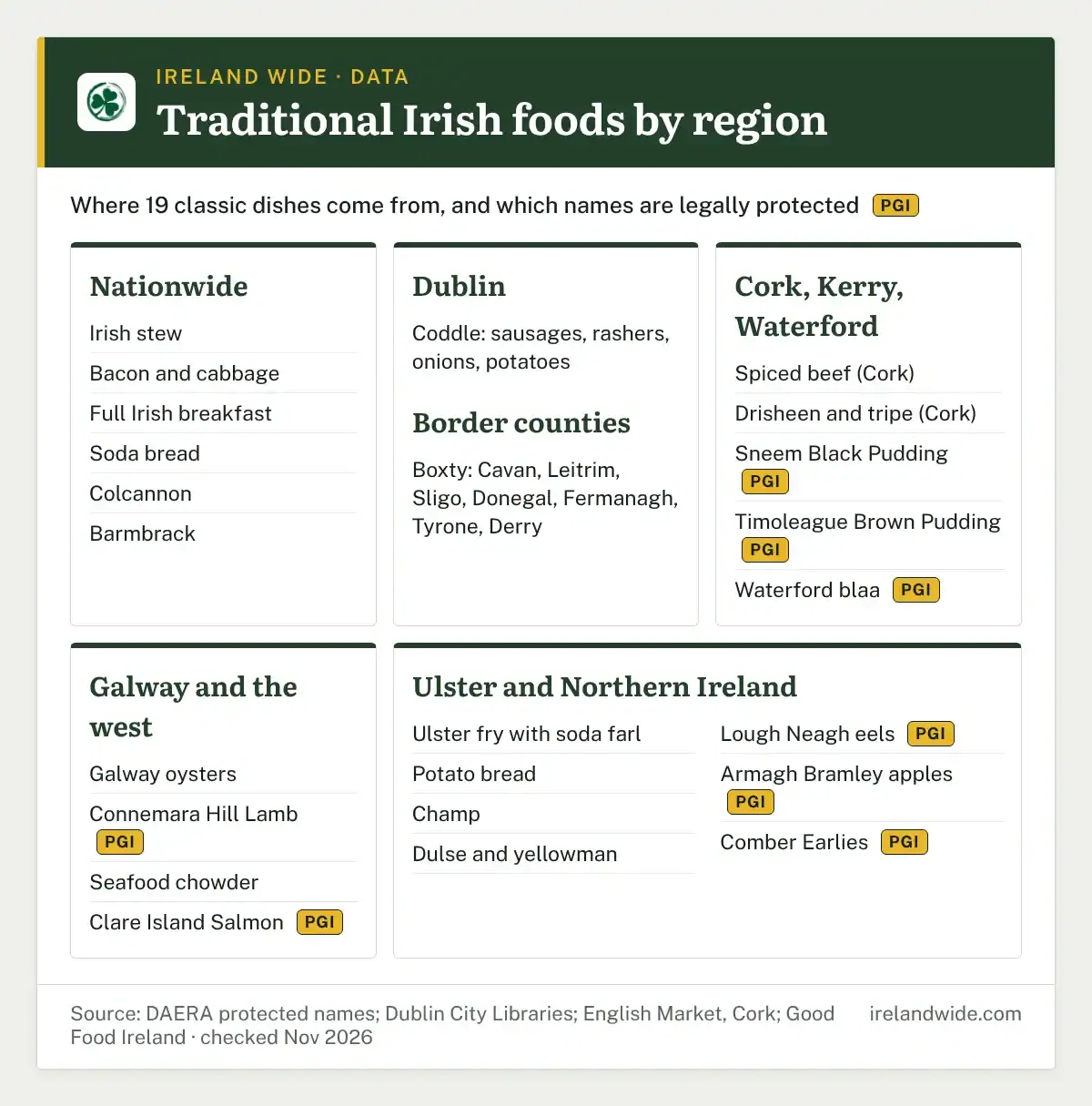
The table below maps each dish to its regional roots and the occasion it is tied to. The last column shows whether the name is legally protected, which tells you the product can only carry that name when it comes from that place. For a refresher on where each county sits, our guide to Ireland’s 32 counties by province and region is a useful companion.
Pick a region and a course to see which traditional Irish foods belong there and which carry a protected name.
| Dish | Regional roots | What it is | When or where you find it | Protected name |
|---|---|---|---|---|
| Irish stew | Nationwide | Mutton or lamb, potatoes, onions | Pubs and home cooking, all year | No |
| Bacon and cabbage | Nationwide | Boiled salted pork with cabbage | Family dinners, pub lunches | No |
| Full Irish breakfast | Nationwide | Rashers, sausages, eggs, puddings | Hotels, B&Bs, cafés | No |
| Soda bread | Nationwide | Yeast-free bread raised with bread soda | Served with soups and seafood | No |
| Colcannon | Nationwide | Mash with cabbage or kale | Halloween, side dish all year | No |
| Seafood chowder and smoked salmon | Coast, especially the west | Creamy fish soup; cured salmon | Coastal pubs and restaurants | Clare Island Salmon (PGI) |
| Coddle | Dublin | Sausages, rashers, potatoes, onions | Home cooking, some Dublin pubs | No |
| Spiced beef | Cork | Beef cured with salt and spices | Christmas, English Market | No |
| Drisheen and tripe | Cork | Blood sausage; braised tripe | English Market, Cork | No |
| Sneem and Timoleague puddings | Kerry and Cork | Black and brown puddings | Breakfast plates | Both PGI |
| Waterford blaa | Waterford | Soft, floury white roll | Breakfast rolls with bacon | PGI |
| Oysters | Galway and the west coast | Native and rock oysters | Galway oyster festival in September | No |
| Connemara Hill Lamb | Connemara, Co. Galway | Lamb from hill-reared Blackface sheep | Western restaurants | PGI |
| Boxty | Cavan, Leitrim, Sligo, Donegal borders, Fermanagh, Tyrone, Derry | Potato pancake or bread | Halloween and New Year, now all year | No |
| Ulster fry | Northern Ireland | Fry with soda farl and potato bread | Cafés and hotels in the north | No |
| Champ | Ulster | Mash with scallions and butter | With sausages or boiled ham | No |
| Dulse and yellowman | Antrim coast | Dried seaweed; honeycomb toffee | Ballycastle’s annual fair | No |
| Lough Neagh eels, Armagh Bramleys, Comber Earlies | Antrim, Armagh, Down | Eels, cooking apples, new potatoes | Seasonal menus in the north | All PGI |
| Barmbrack | Nationwide | Fruit loaf with a ring baked in | Halloween | No |
The Core Ingredients of Traditional Irish Food
Irish cooking grew out of a farming country with mild, wet weather, so grass and the animals that eat it shape most of the plate. Butter and buttermilk turn up everywhere, from mashed potato to soda bread, and pork was the meat most households could cure and keep. Lamb and mutton came from hill farms, especially in the west. Oats gave porridge and the filler in puddings, and the coast supplied oysters, mussels, salmon and seaweed.
The potato sits at the centre of a whole family of dishes: colcannon, champ, boxty and potato bread all start with it, and each region tends to favour its own version. Grass-fed beef has the newest protected status: Irish Grass-Fed Beef cattle must graze fresh pasture for at least 90% of the year to use the name, which joined Achill Island Sea Salt, Connemara Hill Lamb and Waterford Blaa on the register of ten Irish protected food names, alongside three spirits shared with Northern Ireland.
Nationwide Classics You Will See on Most Menus
These dishes are cooked in every county. They are the ones most likely to appear on a pub menu, and the ones Irish families still make at home.
1. Irish Stew: Mutton or Lamb, Potatoes and Onions
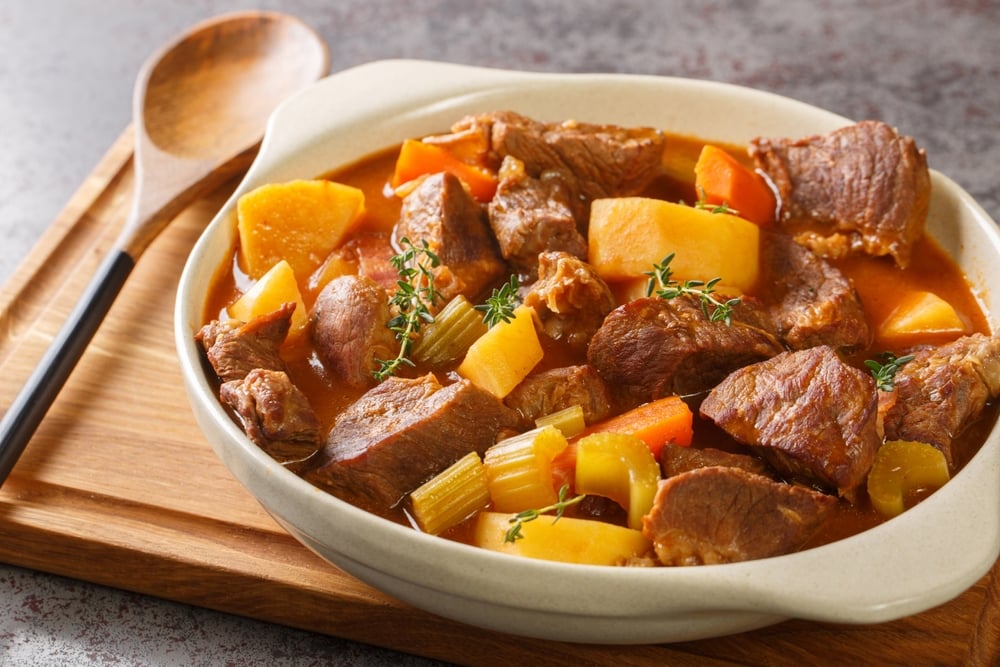
Irish stew is the best-known dish on this list and the one with the oldest argument attached. The plainest version is mutton, potatoes and onions, simmered slowly in water or stock until the potatoes break down and thicken the liquid. Mutton made sense on farms, where older sheep were the animals that went into the pot.
Most restaurants now use lamb, and many add carrots, barley or a splash of stout. Purists object to the carrots in particular, while some households would never make it without them. If a menu lists beef stew with Guinness, expect a richer, darker dish that sits closer to a modern pub classic than the white farmhouse stew.
2. Bacon and Cabbage, the Original Behind Corned Beef
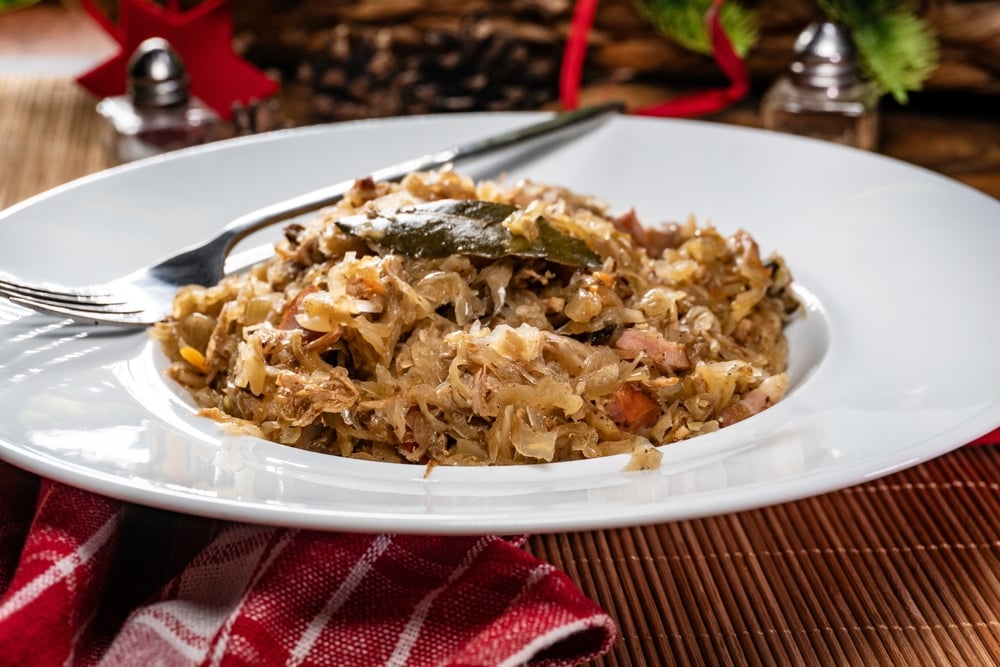
Bacon and cabbage is a boiled dinner of salted pork shoulder or loin, with cabbage cooked in the same water near the end and potatoes on the side. It is usually finished with a white parsley sauce. In Ireland “bacon” here means a joint of cured pork, closer to a ham than to breakfast strips.
Irish emigrants in American cities often swapped the bacon for corned beef, which was cheaper and easier to find there, and corned beef and cabbage became the St Patrick’s Day meal of the Irish in the USA. In Ireland itself, bacon and cabbage remains the home version, and you will see it on lunch menus in country pubs.
3. Full Irish Breakfast with Black and White Pudding
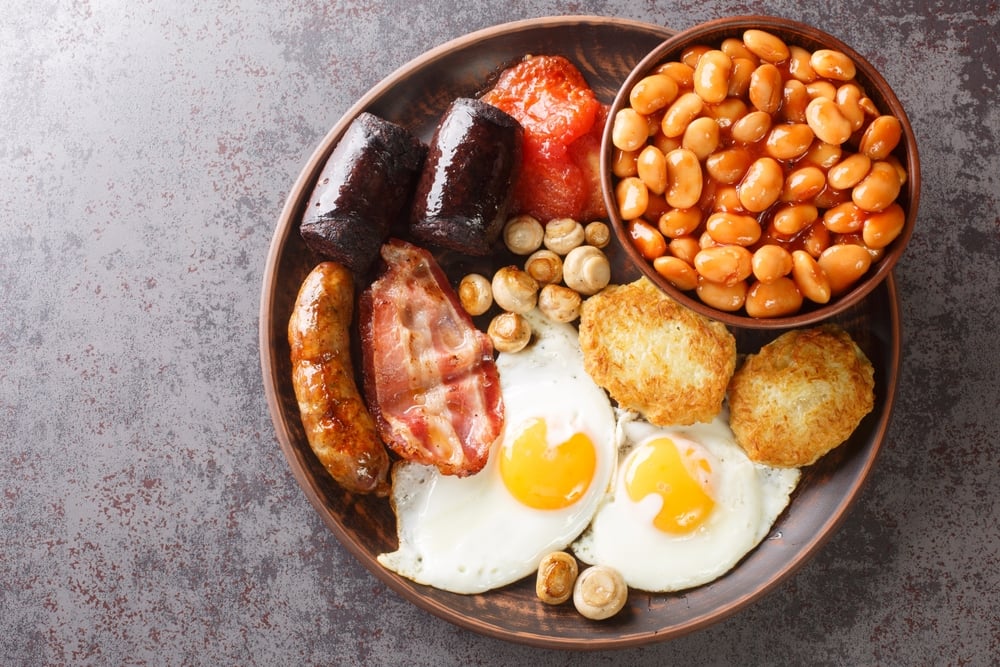
A full Irish is a cooked breakfast of rashers (back bacon), sausages, fried eggs, black pudding and white pudding, often with grilled tomato, mushrooms and toast or brown bread. Hotels and B&Bs serve it as standard, and many cafés offer it all day.
The puddings confuse first-time visitors. Black pudding is a sausage of pork fat, oatmeal and blood; white pudding is the same idea without the blood. Two puddings have protected names: Sneem Black Pudding from Kerry and Timoleague Brown Pudding from west Cork, both registered as PGIs (Protected Geographical Indications).
4. Soda Bread and Brown Bread
Soda bread uses bicarbonate of soda (bread soda) and buttermilk in place of yeast. The acid in the buttermilk reacts with the soda and lifts the dough, so it needs no proving and goes straight into the oven. Irish wheat was soft and low in gluten, which suited this method better than yeast baking.
On menus, “brown bread” usually means a wholemeal soda bread, served in thick slices with butter beside soup, chowder or smoked salmon. In Northern Ireland, you’ll usually see it called wheaten bread. White soda bread is often baked as a round with a cross cut in the top. In the north, the same dough is rolled flat, cut into quarters and cooked on a griddle as soda farls (see the Ulster fry below).
5. Colcannon: Mash with Cabbage or Kale
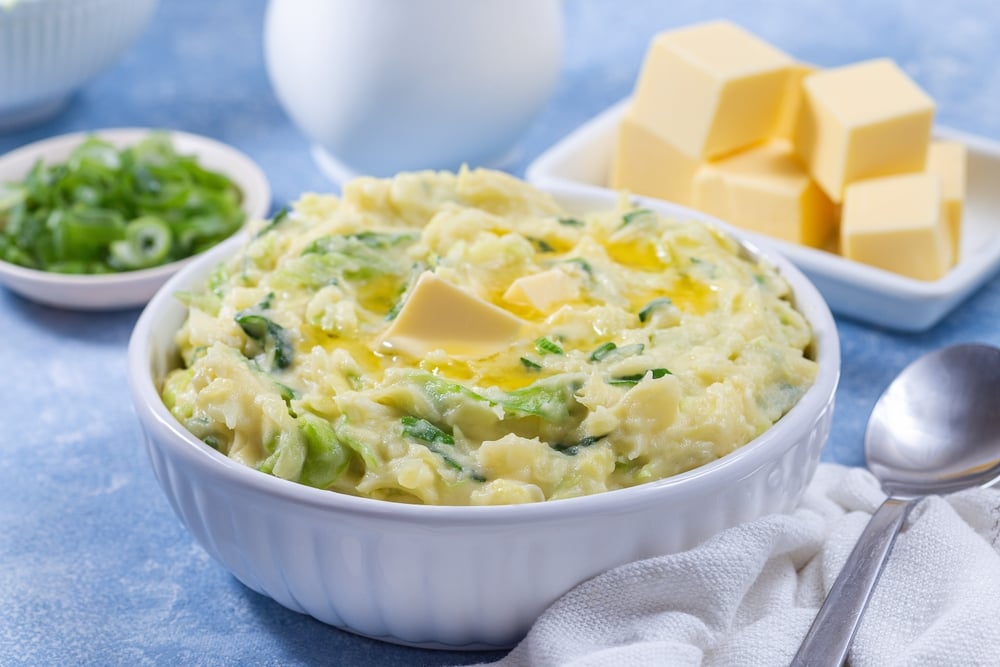
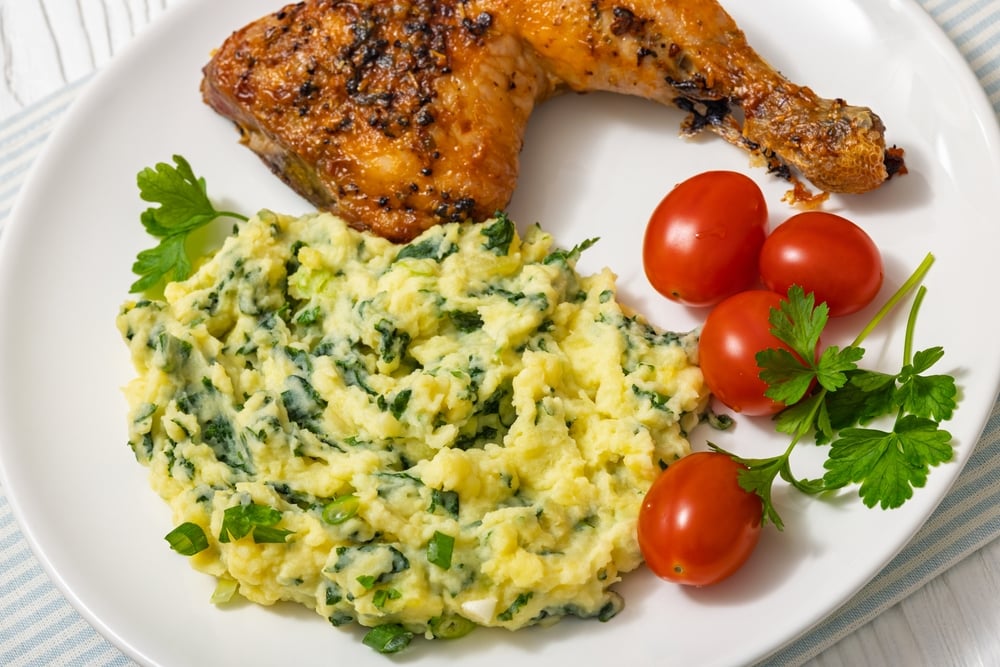
Colcannon is mashed potato mixed with cooked cabbage or kale, plenty of butter, and often milk or cream and scallions. It turns up as a side dish with bacon, sausages or ham, and it is the potato dish most closely tied to Halloween.
At Halloween, charms such as a coin, a stick or a rag were hidden in the mash to tell fortunes. In one custom the first and last spoonfuls of colcannon went into a girl’s stocking hung by the door, and the first man through it would be her husband. Champ, its northern cousin, comes up in the Ulster section.
6. Seafood Chowder and Smoked Salmon
Irish seafood chowder is a thick, creamy soup of white fish, smoked fish and salmon, often with mussels or prawns, served with brown bread. Almost every coastal pub has its own version, and it is one of the easiest ways to eat local fish on a budget.
Smoked salmon is served cold with brown soda bread and butter, sometimes with a squeeze of lemon. In County Clare, the Burren Smokehouse in Lisdoonvarna hot-smokes and cold-smokes salmon , and you can taste it at The Roadside Tavern next door. Clare Island Salmon, farmed off the Mayo coast, is one of Ireland’s protected food names.
Dublin’s Traditional Food: Coddle
7. Dublin Coddle
Coddle is Dublin’s own dish: sausages, rashers, sliced onions and roughly cut potatoes layered in a pot and simmered slowly in stock. A traditional coddle did not use carrots, and because it was a way of using up leftovers, every family’s version was a little different. The name comes from the French caudle, to boil gently.
Coddle was working-class food, often cooked early in the day and reheated for supper, and it was reputedly a favourite of Jonathan Swift and Seán O’Casey. Dubliners still argue about whether it should be pale or browned. It is mostly home cooking, so look for it on the menus of older city pubs, usually with soda bread to soak up the juices.
Cork, Kerry and Waterford: Munster’s Regional Dishes
The south has the strongest set of local specialities, and Cork city’s English Market is the easiest place to find them together. The covered market has traded officially since 1788 and still sells drisheen, tripe, spiced beef, buttered eggs and battlebord, a dried, salted ling.
8. Spiced Beef, Cork’s Christmas Cure
Spiced beef is beef cured in a salt and spice brine, then boiled, cooled in its liquid and sliced thin, usually cold. It grew out of Cork’s trade as a port provisioning ships with salted beef; half of Ireland’s beef exports in the mid-17th century left Cork as salt beef.
Today it is a Christmas food across the country and a year-round one in Cork. Tom Durcan, who has run a stall in the English Market since 1995, uses eye of round for his. It sits on Christmas tables beside turkey and ham, one of several Irish Christmas traditions still celebrated today.
9. Drisheen and Tripe, Cork
Drisheen is Cork’s blood sausage, but it is made differently from black pudding: it uses the serum, the clear liquid part of the blood, with about 1% salt, piped into casings and poached. The result is soft and smooth, more like a set custard than a crumbly pudding. Traditionally it was eaten with tripe braised in milk and onions.
A. O’Reilly’s stall in the English Market has sold drisheen for more than a century, and in 2022 Donagh O’Reilly described himself as the only person in Ireland still making it. If you want to try it, the market is the place to go.
10. Sneem Black Pudding and Timoleague Brown Pudding
Two small southern towns have given their names to protected puddings. Sneem, on the Ring of Kerry, makes a black pudding registered as a PGI, and Timoleague in west Cork makes a brown pudding with the same status.
You’ll usually meet them as a slice or two on a breakfast plate in Kerry and Cork, and some restaurants serve them as a starter with apple or a poached egg.
11. Waterford Blaa
The blaa is a soft, square white roll dusted with flour, baked in batches so the sides pull apart. Its baking tradition is linked to the French Huguenots who settled in Waterford in the late 17th century, though that origin is a local account more than settled history. The roll was granted EU protection in November 2013, so only Waterford bakers can call their rolls blaas.
The classic way to eat one is split and filled with butter and rashers or a sausage for breakfast. Waterford city cafés and bakeries sell them every morning; outside the county, you will rarely see the name.
Galway, Connemara and the West
The west is lamb and shellfish country. If you are planning four days in Connemara and the Cliffs of Moher, these are the two foods to look for along the way.
12. Galway Bay Oysters
Galway’s oysters are the west coast’s best-known food. Native flat oysters are the traditional autumn and winter catch, and Pacific rock oysters are farmed in bays along the coast. Most pubs serve them raw on ice with brown bread and a pint of stout.
The first Galway oyster festival was held in 1954, organised by hotel manager Brian Collins on the last weekend of September to celebrate the oyster harvest. It still runs on that weekend.
13. Connemara Hill Lamb
Connemara Hill Lamb comes from Blackface sheep grazed on the hills and bogland of west Galway, and it is one of Ireland’s protected names, registered as a PGI.
Restaurants in Connemara and Galway city list it by name when they have it, often roasted or in a stew. More on the region and its food stops is in the site’s travel guide to the west coast of Ireland.
Boxty and the Border Counties
14. Boxty
Boxty is a potato dish made from raw grated potato mixed with mashed potato, flour and buttermilk. It comes as a griddle pancake, a boiled dumpling or a baked loaf, depending on the area. Its home is the north midlands and southern Ulster: boxty was found on the Sligo and Donegal borders and in Cavan, and over the border in Tyrone, Fermanagh and Derry.
Boxty was a Halloween and New Year food, when the main potato crop was plentiful, and was cooked on a griddle over the open fire. It is now an everyday dish, and the pancake form is the one most restaurants serve, folded around a filling of meat or fish.
Ulster and Northern Ireland Food Traditions
Northern Ireland shares most of the island’s dishes but has its own breads, sweets and protected produce. Soda farls are not to be confused with the loaf-shaped soda bread of the south, and that is one of several differences a visitor will notice at breakfast.
15. Ulster Fry with Soda Farls and Potato Bread
The Ulster fry is the northern full breakfast, and the difference is the bread. Alongside bacon, sausages, eggs and pudding, it includes a soda farl and potato bread, both fried until crisp. A farl takes its name from an old word for a quarter: the round of dough is cut into four before it goes on the griddle.
Potato bread is made from mashed potato, flour, butter and salt, rolled thin and cut into triangles. You’ll find the Ulster fry in cafés and hotels across Northern Ireland, and soda farls are sold in most bakeries there.
16. Champ
Champ is mashed potato with chopped scallions (spring onions), butter and milk, served with a well of melted butter in the middle. It is usually eaten with sausages or boiled ham.
It is close to colcannon, which uses cabbage or kale. If a menu lists both, champ is the one with green onions and colcannon the one with greens.
17. Dulse and Yellowman, Ballycastle
Dulse is a red seaweed, dried and eaten as a salty snack or added to cooked dishes. It was harvested by St Columba’s monks more than 1,400 years ago. Yellowman is a hard, honeycomb toffee made from brown sugar, butter, golden syrup and vinegar, broken into chunks.
The two are sold together at the Ould Lammas Fair in Ballycastle, County Antrim, at the end of August, where yellowman is the traditional treat. Dulse is also sold in bags in shops along the Antrim coast.
18. Lough Neagh Eels, Armagh Bramleys and Comber Earlies
Northern Ireland has its own protected produce. Comber New Potatoes, Armagh Bramley Apples and Lough Neagh Eels are PGIs, and Lough Neagh Pollan, a small freshwater fish, is a PDO (Protected Designation of Origin).
Comber Earlies are new potatoes from County Down, first registered with the EU on 21 February 2012 and eaten in early summer with butter. Armagh Bramleys are sharp cooking apples used in tarts and crumbles. Lough Neagh eels are smoked or pan-fried in butter; many are exported, but some restaurants in the north serve them.
Seasonal Irish Foods: Halloween and Christmas
Several traditional Irish foods are tied to the calendar. Halloween grew out of Samhain, one of the ancient pagan Celtic holidays, and its foods carry fortune-telling customs. Christmas brings spiced beef, ham and Christmas cake.
19. Barmbrack
Barmbrack (báirín breac, speckled loaf) is a yeasted fruit loaf with dried fruit soaked in tea, sliced and buttered. It is the Halloween bread, and it was baked with charms: a ring meant marriage, a coin wealth, a pea no marriage that year, a stick an unhappy marriage and a rag poverty.
Shop-bought brack now usually holds a single wrapped ring. Bakeries sell it in the weeks around Halloween, and it is good toasted with butter.
How to Read an Irish Menu
A few words on Irish menus mean something different from American or British usage. These are the ones that trip up first-time visitors most often:
- Rashers: back bacon, cut from the loin, with a round eye of meat and a strip of fat.
- Bacon (as a dinner): a boiled joint of cured pork, served sliced.
- Pudding: a breakfast sausage (black or white), not a dessert.
- Brown bread: wholemeal soda bread.
- Farl: a quarter of a round of griddle bread, soda or potato.
- Blaa: a soft white roll from Waterford.
- Chips: thick-cut fries; “crisps” are potato chips.
- Champ and colcannon: mashed potato with scallions or with cabbage.
Many traditional dishes appear only as daily specials, so ask what is on. For more on everyday Irish life beyond the plate, see the site’s list of 72 traditional Irish things everyone should know about.
How We Chose These Traditional Irish Foods
We started with the dishes that appear most often on Irish menus and in Irish home cooking, then added the regional foods that carry a county or city name, or a protected status under EU or UK rules. Regional roots come from local and official sources: Cork’s English Market, Dublin City Libraries, Northern Ireland’s agriculture department and the UK register of protected names. Dishes that are Irish only in name abroad, such as corned beef and cabbage, are mentioned for context and are not counted.
FAQ
Is Corned Beef and Cabbage a Traditional Irish Food?
Corned beef and cabbage is an Irish-American dish. In Ireland the traditional version is bacon and cabbage, made with boiled cured pork, and that is the dinner most Irish families would recognise as their own.
Where Can You Try Several Traditional Irish Foods in One Place?
Cork’s English Market sells drisheen, tripe, spiced beef and buttered eggs under one roof, and its Farmgate Café cooks local dishes. In Belfast, St George’s Market sells Belfast baps filled with bacon and sausage.
Can You Find Traditional Irish Food Outside Ireland?
Irish pubs and restaurants in cities with large Irish communities serve stew, boxty, soda bread and full breakfasts. New York has several, listed in the site’s guide to the top spots for Irish food in NYC.