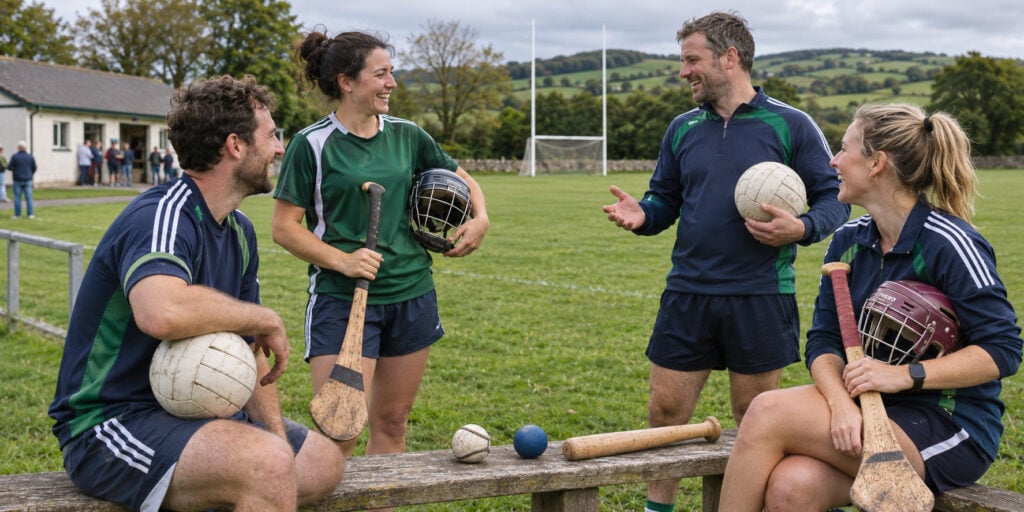
If you have ever wondered what the GAA actually is, or why a whole county empties onto the roads for a match in Dublin, the short answer is this: Gaelic games are a family of six Irish sports, and hurling, Gaelic football, camogie, ladies football, handball and rounders are all part of it. They are amateur, they are run through local clubs, and they have been organised on a national basis since 1884.
The four field games are played by teams of 15, and the main governing body, the Gaelic Athletic Association, has over 2,200 clubs in all 32 counties of the island. This guide covers how each game works, how scoring is counted, where the games came from, and why a local club still sits at the centre of so many Irish parishes.
The Six Gaelic Games at a Glance
Three bodies run the six games. The GAA governs hurling, Gaelic football, handball and rounders, while camogie and ladies football have their own associations.
| Game | Players per side | Played with | Governing body |
|---|---|---|---|
| Hurling | 15 | Hurley (stick) and sliotar (ball) | GAA |
| Camogie | 15 | Hurley and sliotar | Camogie Association |
| Gaelic football | 15 | Round football, hands and feet | GAA |
| Ladies Gaelic football | 15 | Round football, hands and feet | Ladies Gaelic Football Association |
| Handball | 1 or 2 (singles or doubles) | Small ball struck against a wall | GAA Handball |
| Rounders | Up to 9 | Bat and ball, four bases | GAA Rounders |
The field games share a pitch shape and the same H-shaped goals: a crossbar with a net below it and two tall posts above it. Under the GAA rulebook, a pitch must be 130m to 145m long and 80m to 90m wide.
How Scoring Works in Gaelic Games
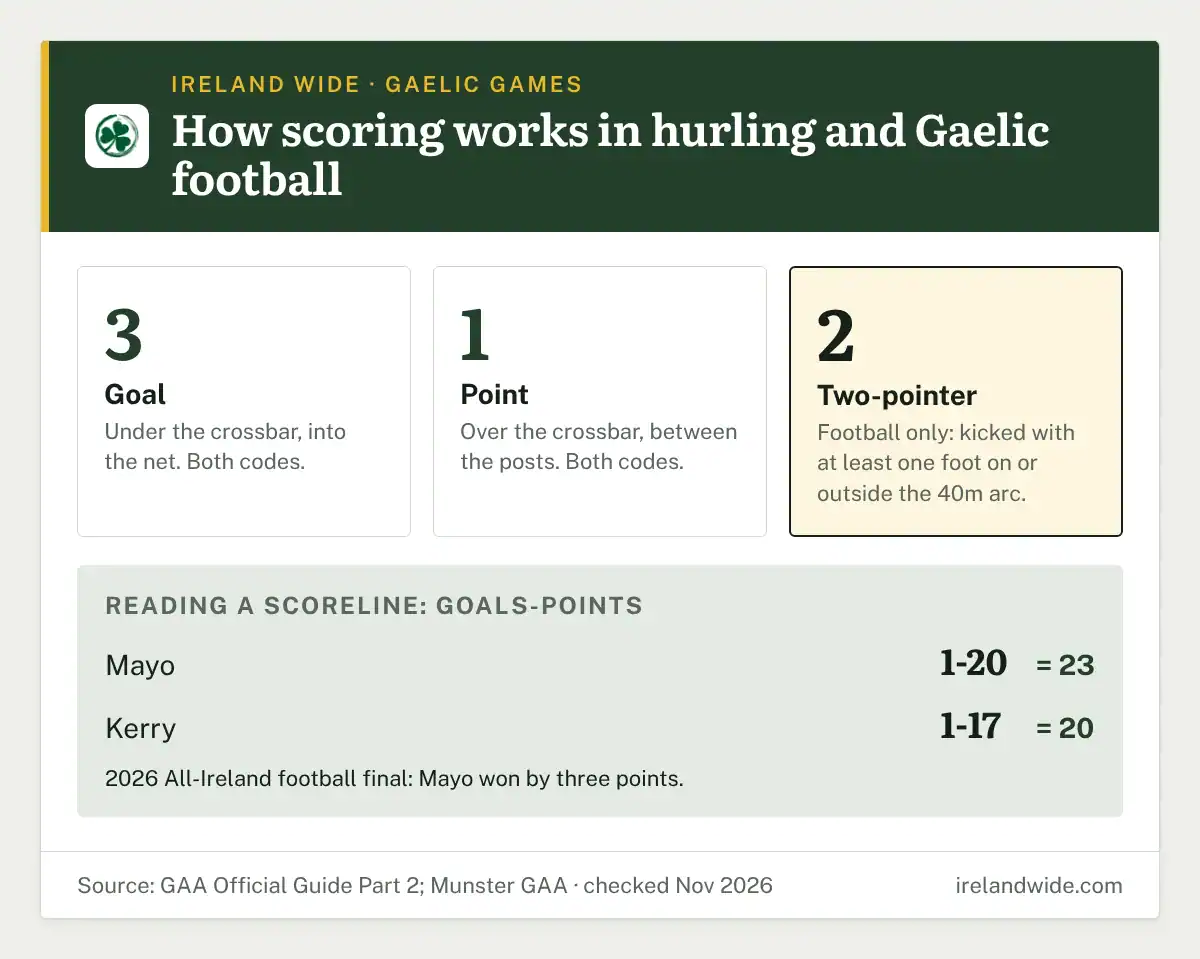
Scoring is the part that confuses newcomers most, so it’s worth getting straight before your first match. In hurling and Gaelic football, the ball goes under the crossbar for a goal or over the crossbar for a point, and a goal is equivalent to three points.
Type in any goals-points scoreline, or load one of the finals mentioned in this guide, to see the totals and the winning margin.
Scores are written as goals, then points. A team on 1-20 has one goal and 20 points, which is 23 in total. When Mayo beat Kerry 1-20 to 1-17 in the 2026 All-Ireland football final, the winning margin was three points, even though both sides scored the same number of goals.
Men’s Gaelic football now has one more wrinkle. A 40m arc is marked around each goal, and a point kicked by a player with at least one foot on or outside the 40m arc counts as two points, provided no teammate touches the ball on its way. A point from a 45 still counts as one. Hurling has no two-point score, and a goal in both codes remains worth three.
Hurling: The Stick-and-Ball Game With 2,000 Years of Story
Hurling is played with a wooden stick called a hurley and a small leather ball called a sliotar. In 2018 UNESCO added it to its Representative List of the Intangible Cultural Heritage of Humanity, describing a game that dates back 2,000 years and features strongly in the saga of Cú Chulainn. You will find more of the gods and heroes of those early stories in our guide to the Celtic gods and goddesses of Ireland.
The modern game is fast and physical. A player can strike the ball on the ground or in the air, run with it balanced or hopping on the hurley, and catch it, though the ball may only be brought back into the hand once after a catch. The adult sliotar weighs 110 to 116 grams and measures 69mm to 72mm across, so it is small, hard and hit at speed.
The top inter-county competition is the All-Ireland Senior Hurling Championship, and the winners lift the Liam MacCarthy Cup. In Clare, where the game shapes local identity strongly, the county’s Banner County nickname turns up on flags at every big game.
Camogie: Hurling Played by Women
UNESCO’s listing describes camogie as a form of hurling played by women, and the game shares hurling’s heritage status. The rules are close to hurling’s, with teams of 15 and the same hurley, but camogie uses a slightly smaller sliotar, games are 10 minutes shorter, shouldering is not allowed and players can hand-pass a score.
The Camogie Association was founded in 1904, and its first All-Ireland championship came in 1932, when ten counties entered and Dublin beat Galway 3-2 to 0-2 in the final. The senior championship trophy is the O’Duffy Cup, donated by Mayo man Seán O’Duffy. Kilkenny, Cork, Dublin, Wexford and Galway are among the counties with a strong record in the game.
Gaelic Football: Hands, Feet and the Four-Step Rule
Gaelic football looks like a mix of soccer and rugby the first time you see it, but its handling rules are its own. A player in possession can carry the ball for a maximum of four steps, then has to bounce it, toe-tap it (kick it from foot back to hand), pass it or shoot. A player cannot bounce the ball twice in a row after catching it, and passes are made with a fist or an open hand, never thrown.
The football weighs 480g to 500g. You can score a point with a kick or a fist, but a goal can’t be fisted or carried over the line by the attacking team. Matches last two halves of 30 minutes at most levels, rising to two halves of 35 minutes in inter-county senior championship and league games.
The Football Review Committee rule changes introduced in 2025 brought in the two-point arc, a “solo and go” option that lets a fouled player play on quickly without stopping for a free kick, a rule keeping a minimum number of players in each half of the pitch, and a new kick-out regime. The All-Ireland Senior Football Championship winners receive the Sam Maguire Cup.
Ladies Gaelic Football
Ladies football follows the same broad shape as the men’s game and is run by the Ladies Gaelic Football Association. The association was established on 18 July 1974 at Hayes Hotel in Thurles, the same building where the GAA was founded 90 years earlier.
Eight counties contested that first championship, and Tipperary beat Offaly 2-03 to 2-02 in the final. The winning captain, Kitty Ryan, was presented with the Brendan Martin Cup.
Handball and Rounders: The Smaller Gaelic Games
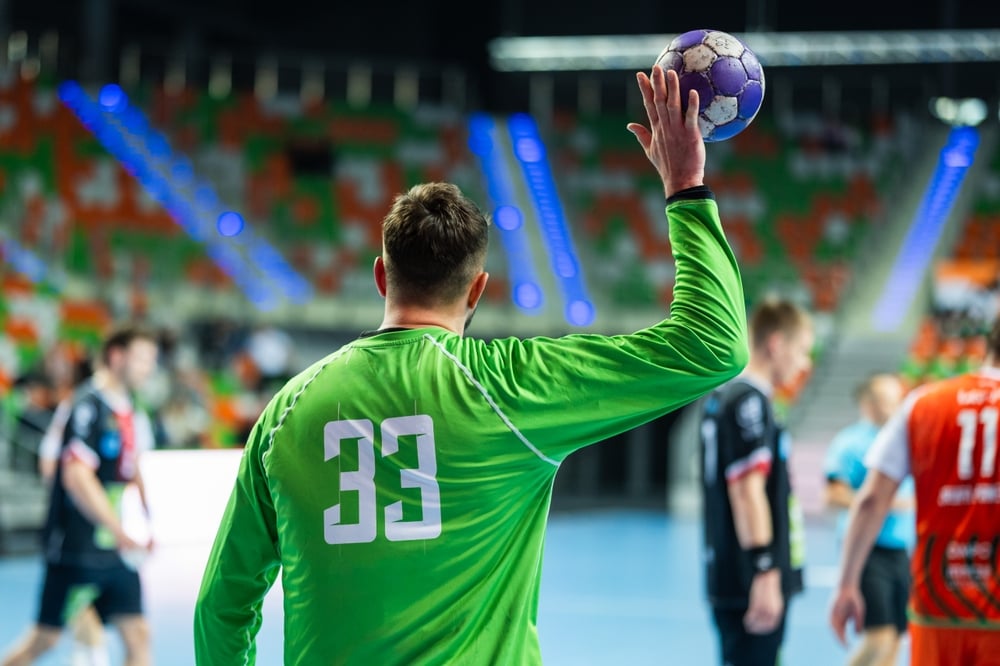
Gaelic handball is a court game for singles or doubles in which players strike a small ball against a wall with the hand. It has a long paper trail: the 1527 Statute of Galway banned ball games against the town walls, and a court in Ballinrobe, County Mayo, is dated to 1776. Handball was among the sports the GAA set out to promote in 1884, and GAA-sponsored championships began in 1923.
Today the game is played in four codes: Softball and Hardball on the traditional 60×30 court, 4-Wall on a 40×20 court (the first American-style court in Ireland was built in 1969), and One-Wall, also called Wallball, which needs just a single wall.
Rounders is a bat-and-ball game with four bases. Under the rules of GAA Rounders, teams have no more than nine players, the pitcher delivers underarm from 12 metres (11 metres for ladies and minor pitchers), and a standard game runs to five innings. It is the one Gaelic game where men and women play on the same team: GAA Rounders runs a mixed championship alongside its men’s and ladies’ competitions. The code has grown quickly, from 13 registered clubs to over 60 in 2024, with 19 counties playing it in some form.
How the GAA Began: Thurles, 1884
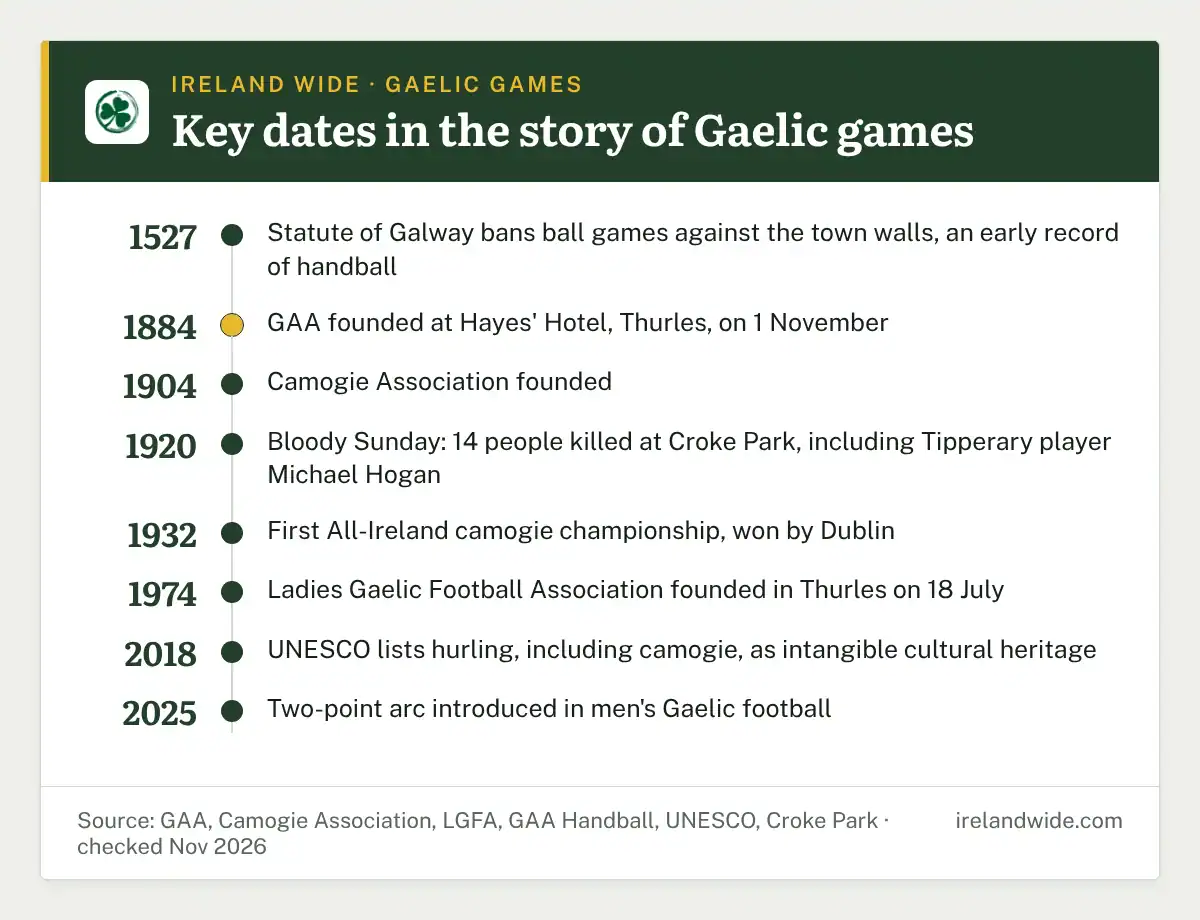
On Saturday 1 November 1884, a small group of men met in the billiard room of Hayes’ Hotel in Thurles, County Tipperary, and founded the Gaelic Athletic Association. The driving force was Michael Cusack, and he was joined by Maurice Davin, one of the best-known Irish athletes of the day, who worked on codifying the rules.
The aim was to put Irish sport into the hands of ordinary people and to revive hurling and native football, which had lost ground to imported games. Cusack announced that Charles Stewart Parnell, Michael Davitt and Archbishop Thomas Croke had agreed to act as patrons. The idea spread fast. A GAA athletics meeting in Tralee on 17 June 1885 drew 464 athletes and an estimated crowd of 10,000, and by 1889 the association had at least 777 affiliated clubs.
The GAA was always about more than sport. Its founders linked the games to a wider cultural revival, and the association still promotes Irish music, song, dance and the Irish language. Our piece on Irish language history and modern usage covers the other side of that revival.
Bloody Sunday 1920 and Croke Park
The most painful day in GAA history came during the War of Independence. On 21 November 1920, Dublin were playing Tipperary in a challenge match at Croke Park when Crown forces raided the ground and opened fire, and 14 people, including Tipperary player Michael Hogan, lost their lives.
In 1925 the GAA’s Central Council decided to name a stand at Croke Park after Michael Hogan, and the Hogan Stand still carries his name. The day is one reason the stadium means far more to many Irish families than a venue for big matches.
Parish, County and Community: Why Gaelic Games Matter Locally
The club is the basic unit of the GAA, and clubs are organised around traditional parishes. You play for the club where you live, and the best club players are picked for their county. That structure is why rivalries are so local, and why a county’s colours are worn by people who have never kicked a ball.
The games are also strictly amateur. The GAA has remained an amateur association since its founding, so even players in an All-Ireland final in front of up to 82,300 people at Croke Park are not paid to play. Clubs depend on volunteers, and the GAA counts that volunteer ethos among the most important parts of the association.
That loyalty can run for generations. Mayo’s 2026 All-Ireland football title was the county’s first since 1951, ending a 75-year wait. In Limerick, the hurlers and footballers are known as the Treaty men and women, a nod covered in our guide to what Limerick is famous for.
The games also travel with the diaspora. Emigrants set up GAA units in the United States, Australia, Britain, Canada, China and mainland Europe, and around 400 clubs promote the games outside Ireland. For one long-standing example, see our guide to the Irish in New York, where New York GAA keeps hurling and football going for the Irish community.
Will the Women’s Games Merge With the GAA?
Camogie and ladies football are still run by separate associations, but the three bodies have been working towards a single organisation, originally with 2027 as the target date. At its December 2025 meeting, the GAA’s Management Committee conceded that the 2027 integration deadline was unrealistic and favoured a phased approach, while the steering group chaired by Mary McAleese continued to work towards 2027. The timing remains unsettled, so expect the structure described in this guide to change in the next few years.
How to See Gaelic Games in Ireland
For a first taste, a local club match is the easiest and cheapest option: check the county board’s website for fixtures in the area you’re staying. Inter-county championship matches run through the summer, with the 2026 senior football final played on 26 July. Big championship games sell out, so plan ahead for tickets.
If you can’t make a match, the Croke Park Stadium Tour costs €18 for adults in 2026, €14.50 for students and seniors, and €12 for children aged 3 to 12, with family tickets from €48. Admission includes the GAA Museum. Tours can run on an adjusted schedule on match days, so check before you travel.
Our advice: start with a local club game, then add a championship match at Croke Park if your dates line up. Bring a waterproof either way, because an Irish summer forecast is more of a suggestion than a promise.
FAQs About Gaelic Games
What Does GAA Stand For?
GAA stands for the Gaelic Athletic Association, or Cumann Lúthchleas Gael in Irish. It was founded in Thurles, County Tipperary, on 1 November 1884 and governs hurling, Gaelic football, handball and rounders.
Are Gaelic Football and Hurling Played on the Same Pitch?
Yes. Hurling and Gaelic football use the same pitch, 130m to 145m long and 80m to 90m wide, with the same H-shaped goals.
Do GAA Players Get Paid?
No. The GAA has been an amateur association since 1884, so club and county players, including those in All-Ireland finals, are not paid to play.
Can Men and Women Play Gaelic Games Together?
In rounders they can. GAA Rounders runs a mixed championship in which men and women play on the same team. The other Gaelic games have separate men’s and women’s competitions.