If you’re planning a first trip and wondering what Ireland’s weather is really like for visitors, the honest answer is mild, damp and changeable, but rarely extreme. At Dublin Airport the average July high is 19.5°C (67°F) and the average January high is 8°C (46°F), so you’ll seldom be sweltering or freezing.
Rain is the part that needs managing. It falls on about 137 days a year in Dublin and over 200 days a year on the Kerry coast, yet a lot of it comes as passing showers with bright spells in between. Where you go matters as much as when you go, and the west and east of the island can feel like different countries on the same afternoon.
Below we break down temperatures, rain, regional differences, daylight, wind and snow using the official 1991 to 2020 climate averages, then show what each season is like on the ground and how to plan your days around it.
Ireland’s Weather at a Glance
- Summer highs: about 17°C to 19.7°C (63°F to 68°F) in July at the main weather stations.
- Winter highs: about 8°C to 10°C (46°F to 50°F) in January, with frost far more common inland than on the coast.
- Rain: roughly 770 mm a year in Dublin against more than 1,600 mm at Valentia in County Kerry.
- Daylight: about 17 hours on the longest day in Dublin and about 7.5 hours on the shortest.
- Sunniest months: May and June, with the southeast the brightest corner of the island.
How Warm Does Ireland Get?
Ireland sits in the path of mild Atlantic air, so temperatures stay in a narrow band all year. Away from the hills, mean annual temperatures range between 9°C and 12°C, rising as you move from the northeast to the southwest.
Summer days inland normally reach 18°C to 20°C, and a run of days in the mid-20s gets talked about for weeks. Winter daytime highs sit around 8°C inland. Coastal places stay milder in winter and cooler in summer, so Valentia’s January high of 9.8°C beats Dublin’s 8°C, while its July high of 17.8°C falls short of Dublin’s 19.5°C.
Nights are where packing goes wrong. Even in July, the average low at Dublin Airport is 11.3°C (52°F), which feels chilly on a pub walk home or an evening boat trip. Inland, the temperature drops below freezing on about 40 nights a year, against fewer than 10 in most coastal areas.
| Weather station | January high / low | July high / low |
|---|---|---|
| Dublin Airport, Co. Dublin | 8.0°C / 2.3°C | 19.5°C / 11.3°C |
| Belfast Newforge, Co. Antrim | 8.2°C / 2.2°C | 19.7°C / 11.6°C |
| Shannon Airport, Co. Clare | 8.9°C / 3.3°C | 19.5°C / 12.6°C |
| Cork Airport, Co. Cork | 8.2°C / 3.2°C | 18.6°C / 11.7°C |
| Valentia, Co. Kerry | 9.8°C / 5.1°C | 17.8°C / 12.9°C |
| Belmullet, Co. Mayo | 8.9°C / 3.9°C | 17.6°C / 12.3°C |
| Malin Head, Co. Donegal | 8.2°C / 3.7°C | 17.0°C / 12.1°C |
Figures are 1991 to 2020 averages from Met Éireann, with Belfast from the Met Office long-term averages for Belfast Newforge.
How Often Does It Rain in Ireland?
Often, but usually not for long. Ireland’s reputation comes from how many days see some rain, and most of those days are far from washouts. On lowland ground, only one in five hourly observations reports measurable rain, so a “rain day” in the climate tables (any day with at least 1 mm) often means a shower or two and a dry afternoon.
Most of the eastern half of the country gets between 750 mm and 1,000 mm of rain a year. The west generally averages 1,000 mm to 1,400 mm, and many mountain districts top 2,000 mm. For comparison, Dublin’s annual total of about 772.5 mm (30.4 inches) is lower than many people expect.
Across the 1991 to 2020 period, October, November, December and January are the wettest months. Spring is usually the driest stretch: Dublin Airport averages 51.4 mm in March, and Shannon drops to 62.3 mm in April. Summer is not reliably dry, though, and August is wetter than June at every station in this guide.
West vs East: How Ireland’s Weather Changes by Region
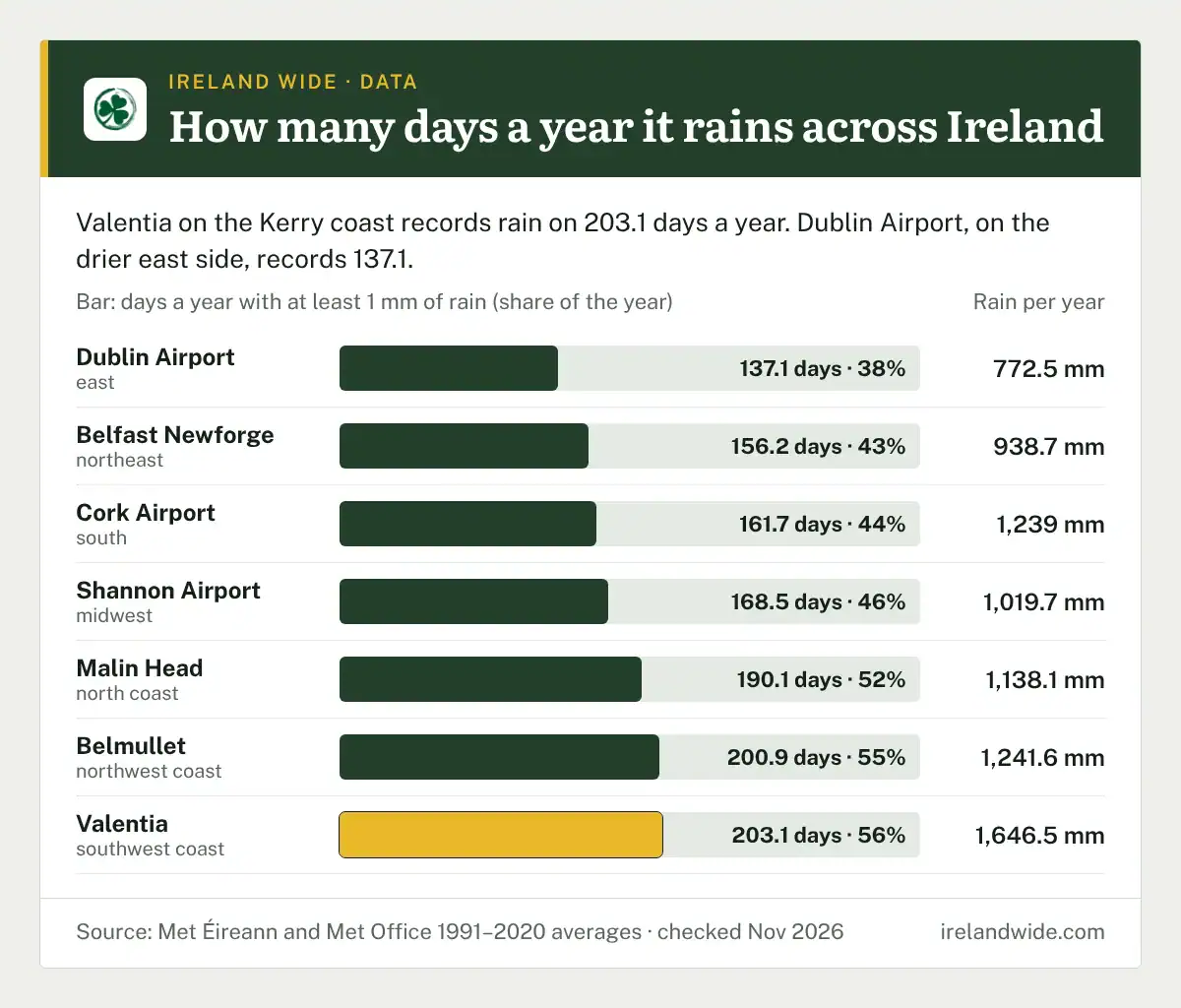
The biggest weather decision on an Ireland trip is often where you base yourself. Atlantic fronts reach the west coast first, drop most of their rain over the hills of Kerry, Connemara, Mayo and Donegal, and arrive in Dublin and the east with much less left.
The table below shows how many days a year each station records at least 1 mm of rain, and what share of the year that is. It is the clearest single way to compare regions before you book.
| Weather station | Rain per year | Rain days per year | Share of days with rain |
|---|---|---|---|
| Dublin Airport (east) | 772.5 mm | 137.1 | 38% |
| Belfast Newforge (northeast) | 938.7 mm | 156.2 | 43% |
| Cork Airport (south) | 1,239 mm | 161.7 | 44% |
| Shannon Airport (midwest) | 1,019.7 mm | 168.5 | 46% |
| Malin Head (north coast) | 1,138.1 mm | 190.1 | 52% |
| Belmullet (northwest coast) | 1,241.6 mm | 200.9 | 55% |
| Valentia (southwest coast) | 1,646.5 mm | 203.1 | 56% |
In practice, Dublin and the east are the safest bet for dry sightseeing days, and the Atlantic coast trades more showers for the scenery most people come for. Cork Airport is a useful oddity: its rain days are close to Belfast’s, but its annual total is much higher, because when it rains there it tends to rain harder.
The southeast is the sunniest part of the island. Rosslare in County Wexford averages about 6.1 hours of bright sunshine a day in summer, and the extreme southeast averages over 7 hours a day in early summer. The north and northwest are the windiest and the dullest in winter.
Northern Ireland’s weather follows the same pattern as the rest of the island, with Belfast close to Dublin on temperature and a little wetter. Wet spells can be severe there too: January 2026 brought 195.6 mm of rain to Northern Ireland, 170% of the 1991 to 2020 average and the wettest January in 149 years. If you are touring both, our Northern Ireland packing list for cities and countryside covers what changes north of the border.
Daylight in Ireland Through the Year
Daylight shapes a trip more than temperature does, and the swing is large for a country this far north. In Dublin on 21 June 2026, the sun rises at 4:56am and sets at 9:56pm, giving about 17 hours of daylight. On 21 December 2026 it rises at 8:38am and sets at 4:08pm, which leaves just under 7.5 hours.
That difference changes how much you can do in a day. A summer road trip can fit a long drive, a coastal walk and an evening at a viewpoint before dark. A winter one needs early starts and less driving, because narrow rural roads are slower after 4pm. Our guide to visiting Ireland in winter, with weather, daylight and travel planning goes into that in more detail.
Daylight and sunshine are not the same thing, though. May and June are the sunniest months, with 5 to 6.5 hours of bright sunshine a day over most of the country. December is the dullest, at about 1 hour a day in the north and almost 2 hours in the southeast. Long June evenings also mean the sky never gets properly dark in the north, so seeing the Northern Lights in Ireland is a September to April project.
Wind, Atlantic Storms and Coastal Weather
Wind is the part of Ireland’s weather that visitors talk about afterwards. Annual average wind speeds range from about 3 m/s in parts of south Leinster to over 8 m/s in the far north, and Malin Head in Donegal records gales on more than 50 days a year. Some inland spots, such as Carlow, see fewer than two gale days a year.
Wind matters most on cliff walks, ferries and island trips. Boat trips to places like the Skelligs, the Aran Islands or the Blaskets can be cancelled at short notice in rough seas, so build a spare day into any plan that depends on a crossing. Autumn and winter storms are named and come with colour-coded warnings from Met Éireann and, in Northern Ireland, the Met Office.
Does It Snow in Ireland?
Rarely, and not for long at low levels. Snow on the mountains is a regular winter sight, but most towns go years without snow that settles for more than a day or two. Air temperatures that stay below freezing all day happen on about one day a year or less on average.
Ice is the bigger winter risk for drivers, especially on minor roads inland and on higher routes such as mountain passes in Kerry and Wicklow. If you’re hiring a car between December and February, allow extra time on cold mornings and check the forecast the night before.
Ireland’s Weather by Season for Visitors
The averages make more sense split by season. The figures below are for Dublin Airport unless we say otherwise, and the west coast runs wetter and slightly milder in winter.
Pick a measure and a weather station to see how its year plays out month by month.
Spring (March to May)
Spring is cool and often the driest time of year in the east, with Dublin averaging 51.4 mm of rain in March and 57 mm in May. Highs climb from 10.1°C in March to 14.8°C in May, and May brings 6.4 hours of sunshine a day in Dublin, the most of any month there. It’s a good time for walking and gardens, though March can still feel wintry.
Summer (June to August)
Summer is mild, with July highs of 19.5°C in Dublin and 17.8°C at Valentia. Rain doesn’t take the summer off: Valentia averages 16 rain days in July and Dublin about 12. Long evenings make up for it, and this is peak season for crowds and prices. Our guide to the weather in Ireland in July has the detail for the busiest month.
Autumn (September to November)
September is one of the best months to visit, with an average high of 16.9°C in Dublin and rain close to summer levels. October brings the turn: Valentia’s rainfall jumps to 173 mm and Cork Airport’s to 131.2 mm, and by November highs are down to about 10°C to 12°C across the stations.
Winter (December to February)
Winter is mild by northern European standards but dark, wet and windy. Dublin’s December high is 8.3°C, while Valentia averages 179.4 mm of rain and more than 20 rain days. Short days are the real limit, so plan city breaks, museums and pubs, with outdoor plans kept flexible. For a single-month view, see our December weather guide for Ireland.
If you already know when you’re travelling, our month-by-month weather in Ireland guide breaks every month down in more depth.
How to Plan an Ireland Trip Around the Weather
Ireland’s weather is easier to work with than its reputation suggests, as long as your plans can bend a little.
- Pack layers and a proper waterproof. A light jacket with a hood beats an umbrella in coastal wind. Our list of essentials to pack for rain, walking and daily touring in Ireland covers the rest.
- Keep one flexible day per region. If a boat trip or cliff walk is the highlight, give yourself two chances at it.
- Check the forecast each evening. Weather fronts move through quickly, so a wet morning forecast often clears by lunchtime. The apps in our roundup of useful apps for Ireland travel include the official forecasts.
- Base yourself in the east for drier days, the west for the scenery. Many first-time itineraries split time between Dublin and one western base, which balances both.
- Expect a slightly wetter Ireland than older guidebooks describe. Average national rainfall rose by approximately 60 mm, or 5%, between 1981 and 2010 compared with 1961 to 1990, and temperatures are on average 0.8°C higher than in 1900.
For the wider planning picture, our practical advice for first-time visitors to Ireland covers routes, driving and how much to fit into a week.
FAQs About Ireland’s Weather
Is Ireland Cold in Summer?
Ireland is mild in summer, and properly hot days are uncommon. July highs average 17°C to 19.7°C at the main weather stations, and evenings often drop to 11°C to 13°C, so a warm layer is useful even in July.
Does It Rain Every Day in Ireland?
No. Dublin Airport records at least 1 mm of rain on about 137 days a year, and even the wettest coastal stations such as Valentia see rain on about 203 days. Many rain days are a short shower with dry spells either side.
What Is the Driest Month in Ireland?
Spring is usually the driest season. Nationally, April and May are the driest months, averaging about 82 mm and 79 mm. In Dublin, March is the driest month at 51.4 mm on average, while in the west April and May tend to be the driest, with Shannon averaging 62.3 mm in April.
What Is the Average Temperature in Ireland in Fahrenheit?
Dublin’s average high runs from about 46°F in January to 67°F in July, and its average low from about 36°F in January to 52°F in July.