What’s the weather in Ireland in July like? It’s usually the warmest month of the year, with average highs of 17 to 20°C (63 to 68°F), lows of 11 to 13°C (52 to 55°F), anywhere from about 60 mm of rain in Dublin to almost 120 mm in Kerry, and up to 17 hours of daylight.
In July, Ireland experiences mild to warm temperatures, moderate rainfall, gentle winds, and extended daylight hours, characteristic of its summer season.
Quick answer: July weather in Ireland
- Average high: 17°C (63°F) at Malin Head to 19.5°C (67°F) at Dublin Airport.
- Average low: 11 to 13°C (52 to 55°F), with no frost.
- Rain: driest in the east (61 mm in Dublin), wettest in the west (117 mm at Valentia, Co Kerry).
- Sunshine: about 4.4 to 5.3 hours a day on average.
- Daylight: almost 17 hours on 1 July, about 15 hours 45 minutes by 31 July.
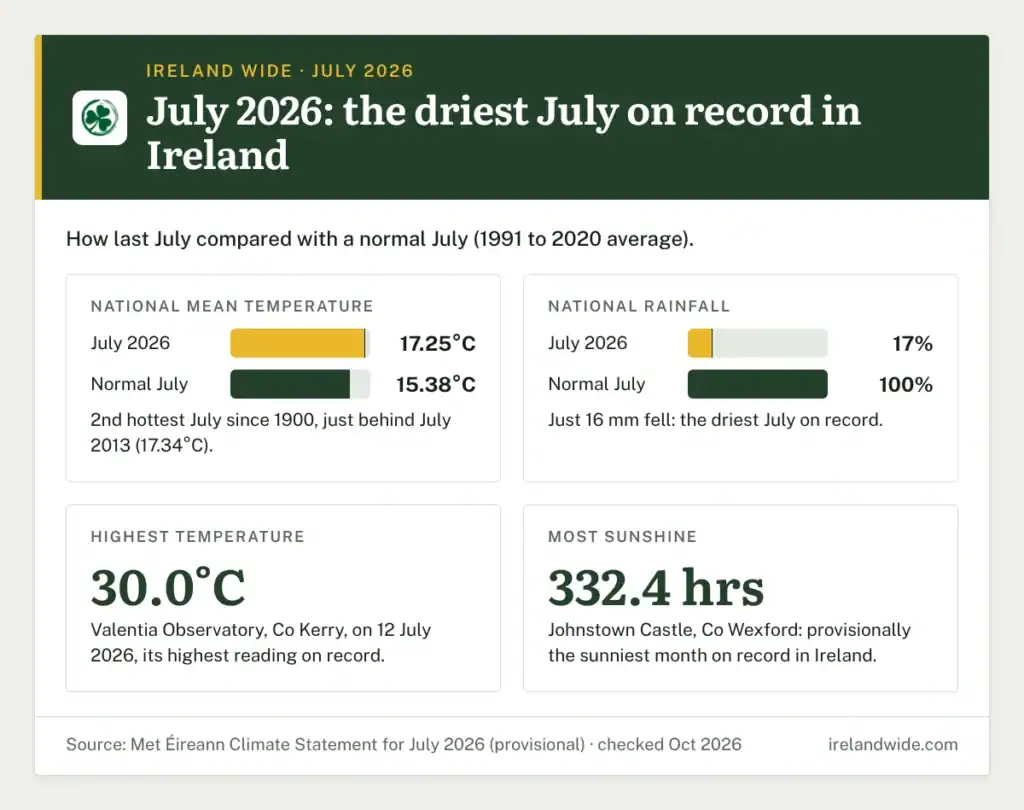
- July 2026: the driest July on record and the second hottest since 1900, according to Met Éireann.
Figures are Met Éireann and Met Office 1991 to 2020 averages, checked in October 2026.
Overview of the Weather in Ireland in July
- Temperature: Average daily temperatures range from lows of 12°C (54°F) to highs of 19°C (66°F).
- Rainfall: Varies by region; for example, Dublin Airport averages 61 mm (2.4 inches), while Valentia in Kerry averages 117 mm (4.6 inches) with 16 days of 1 mm or more.
- Wind Speed: July is among the calmest months, with average wind speeds around 17 km/h (10.6 mph).
- Sunshine: Expect around 4.4 to 5.3 hours of sunshine a day on average, with Cork Airport the sunniest of the main stations.
- Daylight Hours: Approximately 16 to 17 hours per day; sunrise around 5:01 AM, sunset near 9:56 PM.
Here’s how July compares at five weather stations around the island:

July Weather in Ireland: A Closer Look
Temperature
July is typically the warmest month in Ireland, with average temperatures ranging from 12°C (54°F) to 19°C (66°F). Coastal areas, influenced by the Atlantic Ocean, tend to be milder, while inland regions may experience slightly warmer daytime temperatures. On Met Éireann’s 1991 to 2020 averages, Dublin Airport’s July days reach 19.5°C (67°F), while Malin Head in Donegal averages 17.0°C (63°F). Hot spells can push things much higher: Valentia Observatory in Kerry hit 30.0°C (86°F) on 12 July 2026.
Rainfall
Rainfall varies across Ireland in July. Eastern regions like Dublin receive about 61 mm (2.4 inches), making them relatively drier. In contrast, western areas get more frequent rainfall: Valentia in Kerry averages 117 mm (4.6 inches), with 16 days of 1 mm or more during the month.
| Station | Avg high | Avg low | Rainfall | Rain days (1 mm+) | Sunshine per day |
|---|---|---|---|---|---|
| Dublin Airport | 19.5°C (67°F) | 11.3°C (52°F) | 61 mm (2.4 in) | n/a | n/a |
| Cork Airport | 18.6°C (65°F) | 11.7°C (53°F) | 87 mm (3.4 in) | 11.9 | 5.3 hrs |
| Valentia, Co Kerry | 17.8°C (64°F) | 12.9°C (55°F) | 117 mm (4.6 in) | 16.0 | 4.4 hrs |
| Malin Head, Co Donegal | 17.0°C (63°F) | 12.1°C (54°F) | 86 mm (3.4 in) | 15.7 | 4.7 hrs |
| Belfast (Newforge) | 19.7°C (67°F) | 11.6°C (53°F) | 74 mm (2.9 in) | 13.0 | 4.7 hrs |
Wind Speed
July is among the calmest months in Ireland, with average wind speeds around 17 km/h (10.6 mph). Coastal regions, especially along the west, may experience slightly stronger gusts due to Atlantic weather systems. Gales are rare in July: even exposed Malin Head averages less than one gale day in the month.
Daylight Hours
Daylight is abundant in July, with approximately 16 to 17 hours of light daily. The sun typically rises around 5:01 AM and sets near 9:56 PM, providing ample daylight for outdoor activities. Those are Dublin’s times on 1 July; by 31 July it’s closer to 5:40 AM and 9:22 PM.
| City | 1 July | 15 July | 31 July |
|---|---|---|---|
| Dublin | 5:02 AM to 9:56 PM | 5:16 AM to 9:45 PM | 5:40 AM to 9:22 PM |
| Galway | 5:13 AM to 10:06 PM | 5:28 AM to 9:56 PM | 5:51 AM to 9:33 PM |
| Cork | 5:19 AM to 9:56 PM | 5:32 AM to 9:47 PM | 5:54 AM to 9:25 PM |
| Belfast | 4:52 AM to 10:02 PM | 5:07 AM to 9:51 PM | 5:33 AM to 9:27 PM |
July 2026: The Driest July on Record
July 2026 was one for the record books. Met Éireann’s climate statement for July 2026 confirmed it was the driest July on record, with just 16 mm of rain nationally, or 17% of normal. It was also the second hottest July since 1900, with a national mean temperature of 17.25°C, just behind July 2013 (17.34°C).
- Highest temperature: 30.0°C at Valentia Observatory, Co Kerry, on 12 July.
- Sunshine: Johnstown Castle in Wexford provisionally recorded 332.4 hours, the sunniest month on record in Ireland.
- Heatwaves: seven stations recorded heatwaves, and Moore Park in Cork had 13 days in a row, the second longest on record.
- Driest spots: Cork Airport and Moore Park recorded just 1.1 mm all month.
Don’t plan around a repeat, though. A normal July is far wetter, and the averages above are a better guide for packing.
Ireland vs Northern Ireland Weather in July
While both regions share similar climates, subtle differences exist:
- Temperature: Temperatures are very similar. Belfast (Newforge) averages highs of 19.7°C (67°F) and lows of 11.6°C (53°F) in July, close to Dublin Airport’s 19.5°C (67°F) and 11.3°C (52°F).
- Rainfall: Belfast averages 73.6 mm (2.9 inches) in July, a little more than Dublin’s 61 mm (2.4 inches), but well below the west coast of Ireland.
- Wind: Both regions experience gentle winds in July, with coastal areas experiencing higher gusts.
- Daylight: Daylight hours are similar, with both regions experiencing about 16 to 17 hours of daylight during July. Being further north, Belfast gets about 17 hours 10 minutes on 1 July.
In summary, while Ireland and Northern Ireland share comparable July weather patterns, the bigger difference is east versus west: the east coast, including Belfast and Dublin, tends to be drier than the Atlantic-facing west.
Planning a Trip to Ireland in July
Even in the warmest month, Irish weather can change within an hour, so pack layers and a waterproof jacket. Our list of essentials to pack for rain and walking covers the basics.
Those long evenings are perfect for getting outside. Pilgrims climb Croagh Patrick on Reek Sunday, the last Sunday in July, and our guide on how to hike Croagh Patrick has the parking and route details. Long summer days also make it a good month for getting to the Aran Islands by ferry.
On a warm day, head for the coast: these scenic seaside towns in Ireland are at their best in summer. If it’s your first visit, our advice for first-time visitors will help you plan the rest.
FAQs About the Weather in Ireland in July
Is Ireland warm in July?
Mild rather than hot. Average highs are 17 to 20°C (63 to 68°F), and nights drop to about 11 to 13°C (52 to 55°F). Heatwaves do happen: Valentia reached 30.0°C in July 2026.
Does it rain a lot in Ireland in July?
It depends where you are. Dublin Airport averages 61 mm in July, while Valentia in Kerry averages 117 mm with 16 days of 1 mm or more.
How many hours of daylight does Ireland get in July?
Almost 17 hours at the start of the month: Dublin has about 16 hours 54 minutes on 1 July, falling to about 15 hours 43 minutes by 31 July.
What was the hottest July in Ireland?
July 2013 holds the record, with a national mean temperature of 17.34°C. July 2026 came second at 17.25°C, and it was also the driest July on record.
What is the weather like in Dublin in July?
Dublin is one of the driest and warmest parts of Ireland in July, with average highs of 19.5°C (67°F), lows of 11.3°C (52°F) and about 61 mm (2.4 inches) of rain.
Is July a good time to visit Ireland?
For weather, yes: it’s one of the warmest months, with long, bright evenings for sightseeing. It’s also summer holiday season, so popular spots get busy and it pays to book early.