Carlingford Castle is worth visiting if you want a compact historic site with a strong medieval backstory and one of the best harbour views in County Louth. It suits day-trippers, history fans, families with older children, and anyone already exploring Carlingford, but access is by guided tour only, so a little planning helps.
Known locally as King John’s Castle, this is the landmark ruin above Carlingford Lough that appears in just about every photo of the town. If you are comparing it with other fortresses, our best castles in Ireland guide is a useful place to start before you lock in your route.
This Carlingford Castle Guide focuses on the practical stuff first, then the history, folklore, and nearby stops that make the visit more satisfying. For wider trip planning, see our County Louth guide, plus our guides to St Laurence’s Gate in Drogheda and Ardee Castle.
Fact Box
The main thing to know is simple: you cannot just wander in on your own. Carlingford Castle is operated on a guided-entry basis, so you should check the latest tour arrangements before you arrive.
Tours run from March to October, with the site listing a 2pm castle tour from April to October. Admission is listed at €8.50 for adults, €4 for children, and €20 for a family ticket, and OPW Heritage Cards are not accepted because the visitor service is not OPW-managed.
Booking is sensible, especially for groups. Group bookings should be made in advance, and tickets can also be purchased near the site at the Visit Carlingford Tourist Office, Station House. Booking contact details are handled through Carlingford Heritage Centre.
Most people visit Carlingford Castle as part of a half-day or full-day stop in town rather than as a stand-alone drive-and-leave attraction. That makes it useful to look at places to stay nearby if you are combining the castle with the harbour, the Greenway, or a wider County Louth loop. If this stop is part of a bigger route, it fits neatly into a 7 day Ireland itinerary or a slower east-coast detour within a 10 day Ireland itinerary.
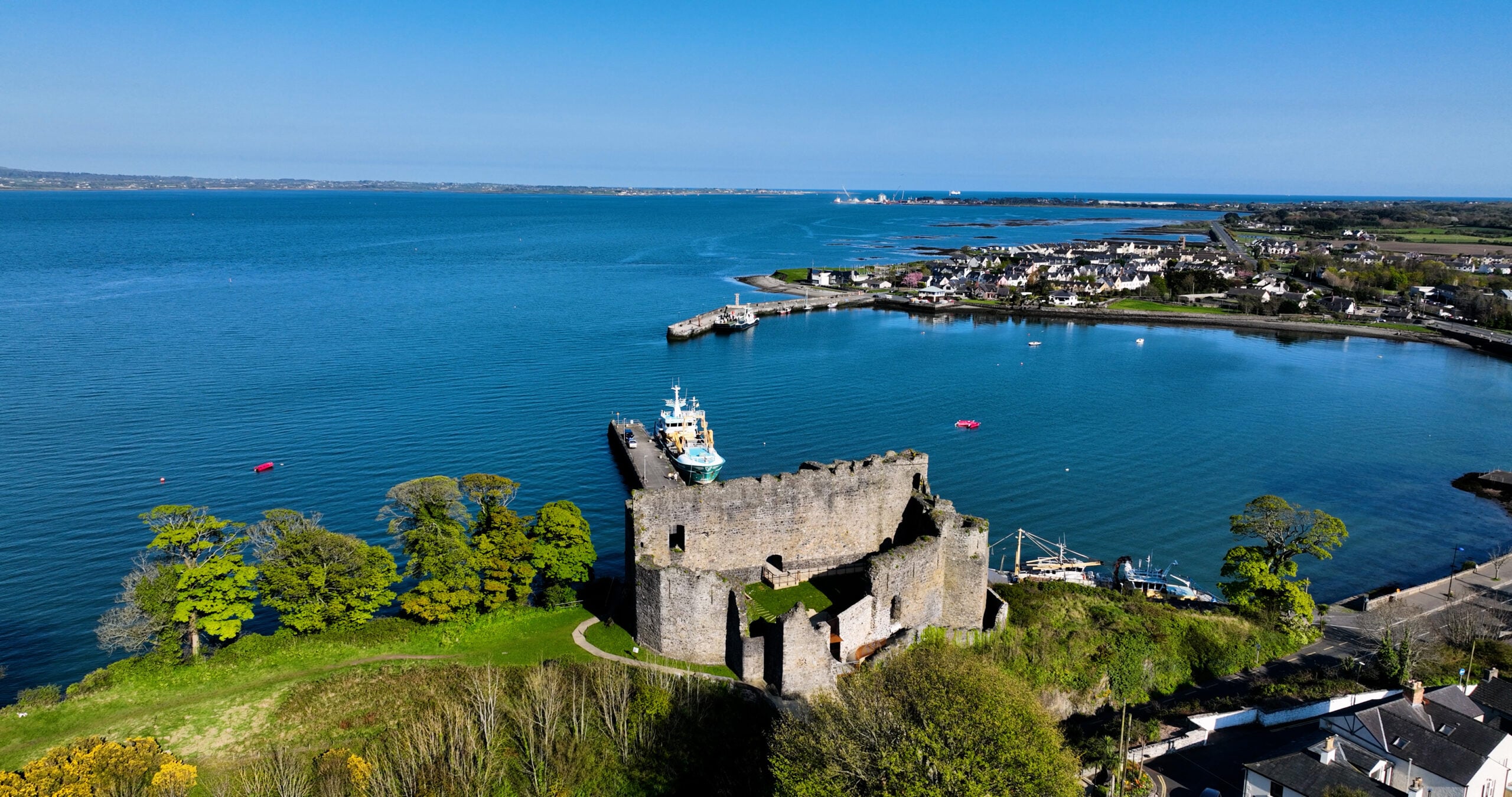
The castle stands above the harbour on the southern shore of Carlingford Lough, with Slieve Foye rising behind the town. The position tells you almost everything about why it was built. It controlled movement on the lough and watched the narrow land route north toward Ulster.
That military logic is also why the site still feels dramatic even as a ruin. You are not visiting a sprawling furnished castle with tapestries and polished banisters. You are visiting a defensive strongpoint in a place where geography did half the work.
The standard starting date is around 1190, and the castle is generally linked with the Norman baron Hugh de Lacy. The broad timeline is consistent across official and local heritage material.
The castle soon became entangled with royal power. King John moved against the de Lacy family in 1210, seized their property, and is said to have stayed in the castle during his Irish campaign. That association stuck, which is why the site is still widely called King John’s Castle.
Local tour material says the site developed in phases. Early fortifications enclosed a defended space for troops, horses, and supplies. In the 1260s, the eastern section was remodelled into a large hall, and in the 1400s the south-east corner was adapted for residential use by the castle constable.
By the mid-16th century, the building was reportedly in poor condition. Local historical material says it was repaired after being granted to Nicholas Bagnel, reflecting its continued strategic value at the edge of the Pale.
The castle was still involved in later conflict. Official site history records that the Jacobites fired on it in 1689, and tradition holds that William of Orange’s wounded soldiers were housed there after the Battle of the Boyne while awaiting transport. By the 18th century, the castle was abandoned and drifted into ruin.
What you see now is a well-kept ruin, not a fully restored interior. The surviving masonry still shows the castle’s defensive shape and its commanding siting above the water.
One of the more interesting details comes from archaeological work discussed by Carlingford’s local heritage material. Evidence of an earlier rath ditch, probably tied to the Irish lord Murchadh O’Carroll, appears to have influenced the Norman layout. That may explain the castle’s curved western side, which is a nice reminder that the Normans were not the first people to spot the value of this headland.
You are also looking for phases rather than a single neat design. The castle changed over time, which is common with long-used military buildings. Hall space, residential elements, and defensive walls were added or reworked as needs changed and budgets allowed, which is a very medieval approach to home improvement.
Documented history covers the Norman foundation around 1190, the connection to Hugh de Lacy, King John’s seizure in 1210, later building phases, and the 1689 attack. Those points appear in official or operator-backed material.
Folklore and local legend enter the picture with the landscape around the town. The story that Slieve Foye resembles the sleeping body of Finn MacCumhaill is part of the atmosphere of Carlingford, but it is not castle history in the same way the medieval and early modern records are.
Yes, if you like compact historic sites with a strong setting. The castle is especially rewarding for people who enjoy medieval history, photography, or old harbour towns where you can do several things on foot.
If you want room after room of furnished interiors, this is not that sort of attraction. The appeal is the setting, the ruins themselves, and the story of a border stronghold that mattered for centuries. If you tend to compare every stop with larger properties, it helps to think of it alongside other atmospheric ruins such as Dunluce Castle or Dunguaire Castle, where the setting does a lot of the talking.
The money shot is the castle above the lough, especially when you can include some of the harbour or the slope of Slieve Foye in the frame. The elevated position gives you good angles outward as well, so do not spend the whole visit photographing only the walls.
Because access is tour-based, you may not get unlimited time to stand in one spot and contemplate your composition like a moody landscape painter. Arrive with your camera or phone ready, and use the walk up for wider exterior views.
Carlingford town centre is the obvious companion stop. The castle is part of the fabric of the old town, not an isolated monument miles from everything else.
The Carlingford Greenway is also close by, with the town acting as one of its key access points. If you want to shift from medieval stonework to lough-side movement, it is an easy pairing.
For more fortified sites in County Louth, St Laurence’s Gate in Drogheda and Ardee Castle are natural follow-ups on a wider county itinerary. They offer a different urban and defensive context from Carlingford’s harbour setting.
The castle tour is listed at €8.50 for adults, €4 for children, and €20 for a family ticket. As these details can change, check the official listing before you travel.
No. Official visitor information says access is by guided tour only.
Most people need 45 to 60 minutes for the guided visit, plus extra time if you want to walk around Carlingford before or after.
The castle is generally attributed to Hugh de Lacy and dated to around 1190. Official and local heritage material both support that broad attribution.
The name comes from King John of England, who seized the castle in 1210 and is associated with a stay there during his campaign in Ireland.
Yes, with a caveat. It is a good short visit for families interested in castles, but the ruin setting and likely uneven access make it better for older children than for buggies.
Carlingford Castle works best when you treat it as the historic anchor of a wider stop in one of Louth’s most enjoyable towns. The tour is short, the history is strong, and the position above the lough does a lot of the heavy lifting.
If your trip is built around major fully restored castles, this may feel like a quick detour. If you like medieval sites that still look tied to the ground they were built to defend, Carlingford Castle earns its place on the route.

Dan is the founder and editor of Ireland Wide. Born and raised in Ireland, he researches the country’s history, mythology and cultural traditions using museum collections, heritage authorities and historical sources. He leads the site’s editorial team, with a particular focus on distinguishing documented history from later folklore and modern interpretations.
At Ireland Wide, our aim is to bring authentically Irish insights to you, wherever you are.
Whether you have some feedback or would like to offer some of your own insights for everyone else to explore, don't hesitate to get in touch with us!