If you’ve heard the phrase “Black and Tans” in an Irish pub song, a history class or a heated family argument, you’ve probably picked up that it still carries real weight in Ireland a century on. The Black and Tans were British recruits, mostly First World War veterans, hired as temporary constables in the Royal Irish Constabulary (RIC) during the Irish War of Independence. Recruitment opened to residents of Britain on 6 January 1920, and over the next two years roughly 10,000 men joined.
They were sent to shore up a police force that was losing men and barracks to IRA attacks, and they quickly became known for reprisals against civilians: burned towns, wrecked shops and killings. This guide covers who joined and why, how the nickname came about, how they differed from the Auxiliaries (the two are often mixed up), the incidents they are remembered for, and what happened to them after 1922.
Why Britain Recruited the Black and Tans in 1920
By the end of 1919 the RIC was in trouble. The force had about 9,500 officers and men spread across 1,397 barracks, many of them small and isolated, and the IRA was picking them off. Eighteen policemen were killed in 1919 and almost 200 by the end of 1920, while resignations ran at twice the rate of the previous decade. By the summer of 1920, a third of police barracks had closed.
Irish recruits were harder to find too, since policemen and anyone seen helping them faced boycotts in their own communities. The British government’s answer was to recruit in Britain, among demobilised soldiers struggling to find work after the war. Authority for the scheme was given in November 1919, and the first recruits were in Ireland by early 1920.
London never treated the conflict as a war. It framed the fight against the IRA as a police job with army support, which is why the reinforcements were sworn in as constables and wore police uniforms (eventually).
How the Black and Tans Got Their Name
The nickname came from a uniform shortage. The RIC could not supply enough of its dark bottle-green uniforms, so the new recruits were kitted out in a mix of khaki army trousers and dark green police tunics or caps. The dark green looked black, and the combination looked like nothing else in Ireland.
Limerick supplied the name. Journalist Christopher O’Sullivan wrote in the Limerick Echo on 25 March 1920 that the patchwork uniforms reminded him of the Scarteen Hunt, a well-known Co. Limerick hunt whose Kerry Beagles were black and tan. The name stuck so firmly that it outlived the problem: by the end of 1920 the recruits were in proper RIC uniform, and everyone still called them Black and Tans.
Who Joined the Black and Tans?
The adverts were aimed squarely at ex-servicemen looking for work. They offered 10 shillings a day, a small weekly bonus for single men (doubled for married men), free subsistence, paid leave and a pension, and a recruit could leave on a month’s notice. In practice the pay worked out at £3 10 shillings a week plus allowances, which was good money for a demobbed soldier in 1920.
Recruits trained for three or four weeks, first at the RIC Depot in Dublin’s Phoenix Park, then from April 1920 at Hare Park Camp on the Curragh, Co. Kildare, and later at Gormanston, Co. Meath, before being sworn in as temporary constables. The RIC’s usual height requirement of 5 feet 9 inches was lowered by four inches to get enough men through the door.
The popular image is of men emptied out of English prisons. Historians who have gone through the recruitment registers have found little to support it. A study of 2,300 registers by historian W.J. Lowe found recruits were mostly young, unmarried, Protestant, working-class men, with an average age of 26½. Over half were unskilled or semi-skilled workers and 36% were skilled manual workers. Very few had criminal records.
Were the Black and Tans Irish?
Mostly not, but more were Irish than people tend to assume. In Lowe’s sample, 78.6% were born in England and 19% in Ireland, with recruits coming mainly from London, Liverpool, Glasgow and Dublin. Historian Jim Herlihy, working from the full list of recruits, puts the Irish-born share lower: 883 of 10,936 men, or about 8%. The gap comes down to the samples used, and either way the force was overwhelmingly English, with smaller numbers of Scots and Welshmen.
How Many Black and Tans Were There?
The honest answer is around 10,000, with the exact figure depending on what you count. These are the main totals, and the reasons they differ:
| Figure | What it counts |
|---|---|
| 7,684 | RIC Special Reserve recruits enlisted by July 1921, the month of the Truce |
| Over 8,000 | Black and Tans who served in Ireland, by Diarmaid Ferriter’s estimate |
| Roughly 10,000 | Men recruited over the whole conflict, the usual round figure |
| 10,936 | Every man recruited, including those who joined after the Truce, in Jim Herlihy’s complete list |
| Never more than 2,263 | The Auxiliary Division at its peak, counted separately |
Recruitment kept going after the fighting stopped, which is why the highest totals are well above the number in Ireland at the Truce. More than 1,100 men joined in October 1920 alone, at the height of the violence.
What the Black and Tans Did in Ireland
On paper, the Black and Tans were ordinary constables. They were posted to RIC barracks around the country, wore police uniform (once it arrived), and did police work: patrols, raids, searches, guarding barracks and escorting prisoners. They gave the hard-pressed RIC extra numbers and a tougher edge.
They were concentrated where the IRA was most active. Most served in Cork, Tipperary, Galway, Clare, Limerick and Kerry.
In practice, ex-soldiers with three or four weeks of police training, living under constant threat of ambush in barracks they could barely leave, did not behave like village policemen. After the Restoration of Order in Ireland Act in August 1920, an unofficial system of reprisals took hold: when the IRA killed a policeman, the police often hit back at the nearest town or farmhouse suspected of sympathising.
Black and Tans vs Auxiliaries: The Key Differences
The Auxiliaries are the other half of the story, and many of the worst acts blamed on “the Tans” were carried out by them. The Auxiliary Division of the RIC (ADRIC, or “Auxies”) was a separate force of ex-army officers, recruited from July 1920, trained for six weeks at the Curragh and operational from September 1920.
| Black and Tans | Auxiliaries (ADRIC) | |
|---|---|---|
| Recruited from | January 1920 | July 1920 |
| Who joined | Ex-soldiers, mostly from the ranks | Ex-officers, many from the RAF and the army |
| Average age | 26 | 29 |
| Numbers | Roughly 10,000 recruited | Never more than 2,263 |
| Pay | £3 10s a week plus allowances | £1 a day (about £7 a week) |
| Role | Constables posted to existing RIC barracks | Mobile counter-insurgency companies of about 100 men |
| Uniform | Khaki and dark green mix, later full RIC uniform | Military dress with Tam o’ Shanter or Balmoral caps |
| Key incidents | The Sack of Balbriggan | The Burning of Cork; targets of the Kilmichael ambush |
The Auxiliaries were paid more than twice a constable’s rate because they were classed as officers, and they behaved like a separate army. They operated as mobile raiding units against the IRA, separate from the local barracks. About 13% had been decorated for gallantry in the war. Because both groups wore a mix of military and police kit, Irish people at the time tended to call them all Black and Tans, and that blurring has stuck in popular memory.
Key Events Involving the Black and Tans and Auxiliaries
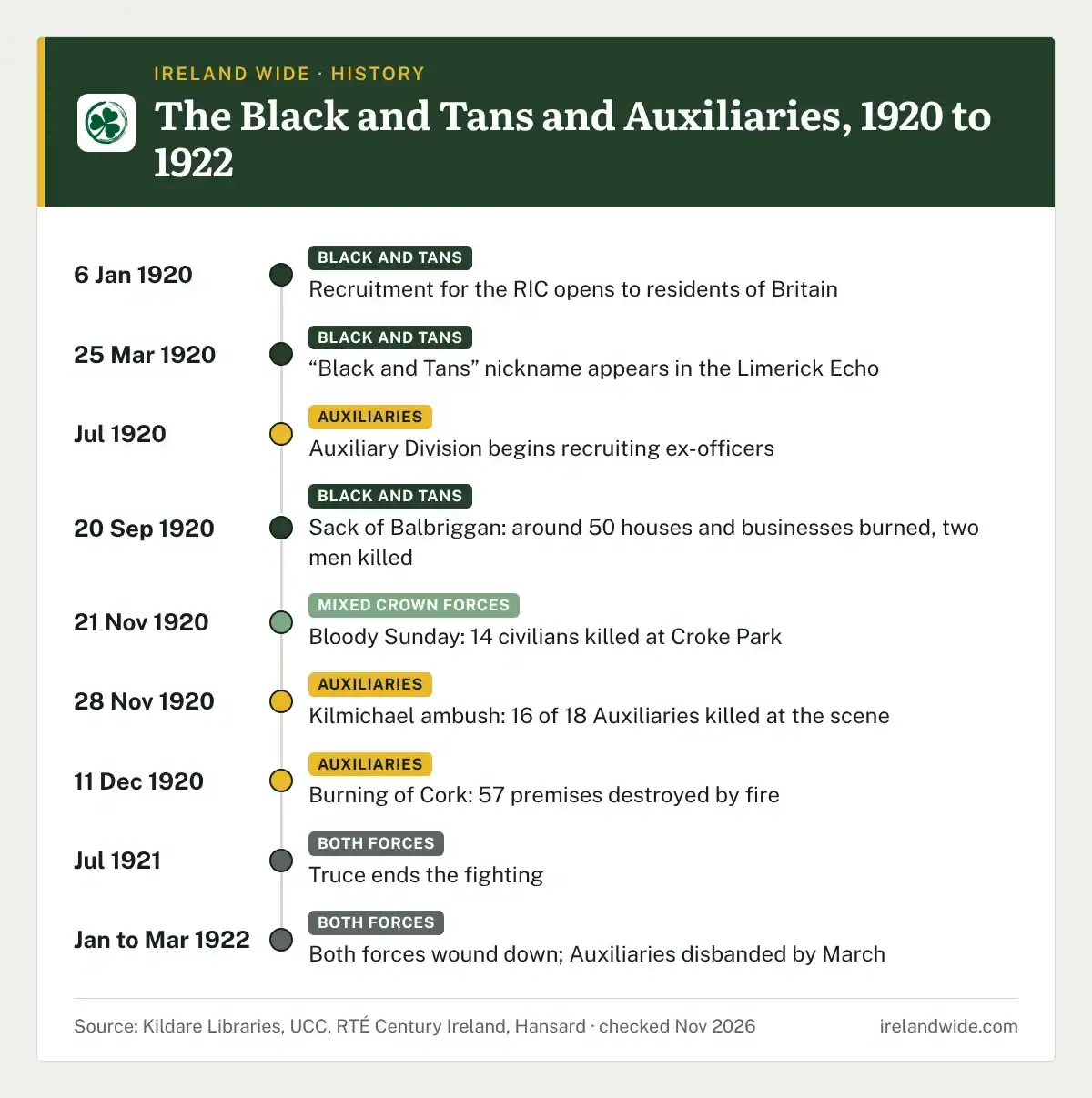
A handful of incidents in late 1920 fixed the Black and Tans’ reputation. Some were the work of the Tans, some of the Auxiliaries, and some of mixed Crown forces, so it helps to keep them straight.
Filter the main incidents of late 1920 by the force involved to see where the Black and Tans end and the Auxiliaries begin.
The Sack of Balbriggan, September 1920
On the night of 20 September 1920, Black and Tans from the training camp at Gormanston drove into Balbriggan, Co. Dublin, after the IRA shot dead RIC District Inspector Peter Burke and wounded his brother. They burned around 50 houses and businesses and killed two local men suspected of being republicans. It set the pattern for the reprisals that followed that autumn.
Bloody Sunday, November 1920
On the morning of 21 November 1920, Dublin IRA units shot dead 15 men across Dublin, most of them suspected British intelligence agents. That afternoon, a mixed force of soldiers and Auxiliaries surrounded Croke Park during a Gaelic football match between Dublin and Tipperary to search the crowd. When police entered the ground, some constables opened fire on the crowd without provocation. Fourteen civilians died, 11 shot and three crushed in the rush, including Tipperary player Michael Hogan, and about 64 more were wounded or injured.
Exactly who fired first, regular RIC, Black and Tans or Auxiliaries, has never been settled. The GAA’s Hogan Stand at Croke Park is named after Michael Hogan.
Kilmichael, November 1920
A week later, on 28 November 1920, Tom Barry’s IRA flying column ambushed a patrol of 18 Auxiliaries near Kilmichael, Co. Cork. Sixteen were killed at the scene, and one of the two who got away was later caught and executed. Three IRA volunteers also died.
The Burning of Cork, December 1920
After an IRA ambush on an Auxiliary patrol at Dillon’s Cross on 11 December 1920, Crown forces spent the night setting fire to the centre of Cork. 57 premises were destroyed by fire, including City Hall, the Carnegie Library and much of St Patrick’s Street, causing about £2.5 million in damage and putting over 2,000 people out of work. The official inquiry, led by Major General E.P. Strickland, found members of the Auxiliary Division responsible. The government quietly suppressed the report.
Killings of Civilians
Smaller incidents mattered just as much to the communities involved. On 1 November 1920, Ellen Quinn was shot dead outside her home in Kiltartan, Co. Galway, while holding her baby, a killing W.B. Yeats later wrote about in his poem Reprisals. Near Gort on 26 November 1920, brothers Patrick and Harry Loughnane were taken from their family farm by Crown forces and later found dead, their bodies showing signs of torture. On 15 December 1920, an Auxiliary cadet shot dead Fr Thomas Magner, a Catholic priest, at Dunmanway, Co. Cork.
Reports at the time were damning. A British Labour commission found the Auxiliaries “inspired terror” through reprisals planned with skill and forethought, and an American commission in 1921 compared the Black and Tans to lynch mobs. The violence also pushed many Irish people who had been lukewarm about the IRA firmly behind it, and added to pressure on London to settle. The Truce came in July 1921, followed by the Anglo-Irish Treaty negotiations that autumn.
What Happened to the Black and Tans After 1922?
Both forces were wound down from January 1922, after the Anglo-Irish Treaty was signed. By mid-March 1922, the Chief Secretary for Ireland told the House of Commons that the Auxiliary Division had been disbanded and paid to the end of the month, and that British recruits had been sent home with a pension of at least £46 16s a year. The rest of the RIC was disbanded later in 1922.
Many former Black and Tans and Auxiliaries went back to civilian jobs in Britain. Others stayed in uniform: some joined the new Royal Ulster Constabulary in Northern Ireland, and others served in the British Palestine Gendarmerie and other colonial police forces. Some of the younger men served again in the Second World War.
The Legacy of the Black and Tans in Ireland Today
The Black and Tans left Ireland more than a century ago, but the name hasn’t. The War of Independence is still often called “the Tan War”, and in Irish speech “Black and Tan” remains shorthand for brutality by a state force. It’s one of the reasons the period sits alongside the Easter Rising and partition among the events that shaped modern Ireland.
The name lives on in music too. “Come Out Ye Black and Tans”, the rebel song by Dominic Behan, is still sung in pubs and at matches, and turns up on lists of Irish drinking songs.
Historians today take a more careful line than the old stereotype of drunken ex-convicts. Very few recruits had criminal records, and historian Michael Hopkinson saw the Black and Tans as the effect of Lloyd George’s Irish policy more than its cause, a point Diarmaid Ferriter echoes in calling their record a poor reflection on their political creators. None of that undoes what happened in Balbriggan, Cork or Croke Park, and both sides in the war were capable of brutality.
Researching a Black and Tan or RIC Ancestor
Many Irish families have a relative who served in the RIC during this period, whether as a pre-war Irish constable, a Black and Tan or an Auxiliary. The most useful starting point for the Black and Tans is Jim Herlihy’s book The Black and Tans: A Complete Alphabetical List, Short History and Genealogical Guide (Four Courts Press, 2021), which lists every recruit.
Local libraries and archives have also published their own lists. Kildare Libraries, for example, lists the Black and Tans with links to the county, and its local studies and archive services take enquiries. If you want to see the places your family came from, our 7-day Irish ancestry itinerary is a practical way to plan the trip.
Frequently Asked Questions About the Black and Tans
Were the Black and Tans Part of the British Army?
No. The Black and Tans were police, sworn in as temporary constables of the Royal Irish Constabulary, although almost all of them were former British soldiers and they worked closely with the army during the War of Independence.
Did the Black and Tans Fight in the Irish Civil War?
No. The Black and Tans and Auxiliaries were sent home in early 1922, before the Irish Civil War began that summer, and the RIC itself was disbanded later in 1922.
How Long Were the Black and Tans in Ireland?
The Black and Tans were in Ireland for roughly two years, from the first arrivals in early 1920 until the force was wound down in the first months of 1922.
What Is the Difference Between the RIC and the Black and Tans?
The RIC was Ireland’s armed police force, recruited mainly from Irish Catholics, many of them farmers’ sons, while the Black and Tans were temporary British recruits added to the RIC from 1920 to reinforce it during the War of Independence.