
If you’re planning a trip, the Irish laws tourists need to know for 2027 start with which side of the border you’ll visit. The Republic of Ireland and Northern Ireland have separate entry systems. Under UK guidance, each traveller who needs an ETA must have their own, including babies and children.
Start with entry permission, then check driving arrangements, drinking and smoking rules, and anything restricted in your luggage. These checks also help you prepare for a journey across the border.
Quick answer: the rules that catch most visitors out
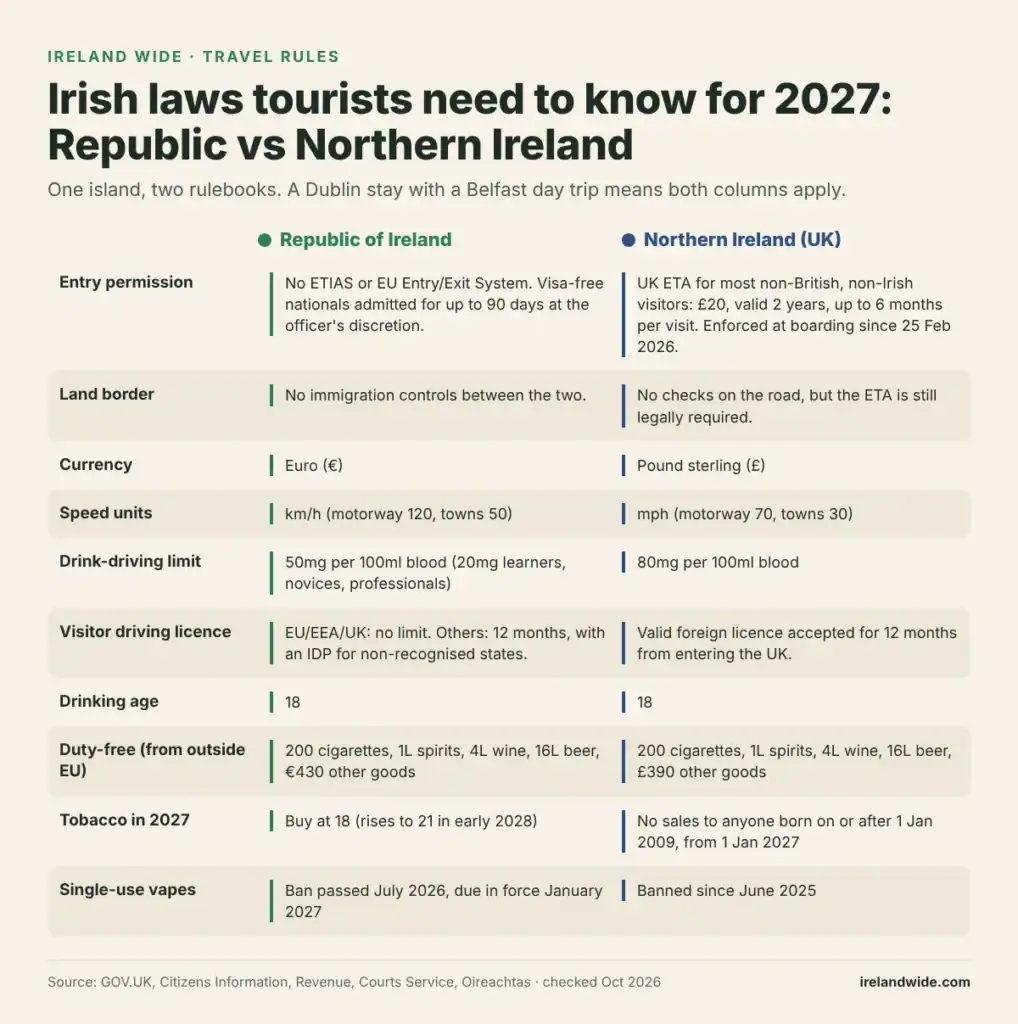
- Republic of Ireland entry: Ireland is not in the Schengen Area, so the EU’s ETIAS and Entry/Exit System don’t apply here. Visa-free nationals (including visitors from the US, Canada, Australia, the UK and the EU) can be admitted for up to 90 days, at the immigration officer’s discretion.
- Northern Ireland entry: Most visitors who aren’t British or Irish citizens need a UK ETA. It costs £20, lasts two years, and allows stays of up to six months per visit. Since 25 February 2026, carriers refuse boarding without one.
- Driving: Drive on the left in both jurisdictions. Speed limits are in km/h in the Republic and mph in Northern Ireland. The drink-driving limit is 50mg per 100ml of blood in the Republic and 80mg in Northern Ireland.
- Drinking and smoking: You must be 18 to buy alcohol, tobacco or vapes on either side of the border. Smoking is banned in enclosed workplaces, including pubs and restaurants.
- Customs: Arriving from outside the EU, you can bring 200 cigarettes, 1 litre of spirits and €430 of other goods into the Republic (£390 into Northern Ireland) duty-free. Cash of €10,000 or more (£10,000 in the UK) must be declared.
- Medicines: Visitors from outside the Schengen Area can bring up to a three-month personal supply of prescription medicine, in its original packaging, with the prescription or a doctor’s letter. Prescribed cannabis-based products are not permitted.
Irish Laws for a 2027 Trip: Start With Your Route
Write down every country you’ll enter, including airport connections and day trips. A holiday based in Dublin with a visit to Belfast needs checks for both Irish and UK entry requirements.
Before paying for non-refundable bookings, work through these decisions:
- Entry: Which passport will you use, and what permission does your nationality and route require?
- Driving: Can you use your licence, obtain suitable insurance and meet the rental company’s conditions?
- Luggage: Do your medicines, food, alcohol, tobacco or other purchases need a declaration or permission?
- Activities: Do the places you plan to visit have access restrictions, permit requirements or conduct rules?
- Border crossings: Have you checked the requirements for each jurisdiction you’ll enter?
For the wider geographical distinction, the guide to differences between Northern Ireland and the Republic of Ireland provides useful background. If you’re arriving from Britain, the comparison of flights and ferries from the UK to Ireland covers the practical side of that route, and the guide to which Irish airport to fly into helps if you haven’t booked yet.
Check Entry Permission for Each Destination
Entering the Republic of Ireland
Ireland sits outside the Schengen Area, so the EU’s new ETIAS travel authorisation and Entry/Exit System (EES) don’t apply to a trip here. What does apply is Irish immigration law: visa-free nationals are normally admitted for up to 90 days, but the length of stay is decided by the immigration officer at the airport or port, not by your ticket. Use the Irish Immigration Service’s nationality and travel-document guidance to check your proposed journey. Include your passport nationality, the purpose and length of your visit, and whether you’ll arrive directly or through another country.
Expect to be asked about your reason for travel, where you’re staying, how long you’ll stay and how you’ll support yourself. Travel insurance is a condition of an Irish visit visa, and immigration officers can ask visa-free visitors for proof of onward travel too. Americans will find the specifics in the guide to whether US citizens need a visa for Ireland. An Irish visa does not let you into the UK, including Northern Ireland. A UK visa works the other way only for nationals covered by Ireland’s Short Stay Visa Waiver Programme, which includes India, China, Türkiye, Saudi Arabia and the Gulf states.
Check the return journey too. If you plan to leave the Republic, visit Northern Ireland and return, include that full route when checking the permission you need. Keep the relevant travel documents accessible during the trip. British and Irish citizens don’t need a passport within the Common Travel Area, but carriers set their own rules: since September 2026, Ireland-Wales ferries require a passport and no longer accept a driving licence as ID.
Visiting Northern Ireland
Northern Ireland falls under the UK entry system. The UK government’s ETA guidance says most visitors need an ETA or a visa, depending on nationality and the reason for travel. Its guidance identifies visitors from Europe, the United States, Australia and Canada among those who usually need an ETA.
The ETA costs £20, is linked to the passport you apply with, and lasts two years or until that passport expires, whichever comes first. It covers multiple trips of up to six months each. A decision usually arrives by email within a day, but it can take up to three working days, so apply well before you travel. Since 25 February 2026 the scheme has been fully enforced: airlines, ferry operators and rail companies must refuse boarding to anyone who needs an ETA and doesn’t have one.
An ETA does not guarantee entry. Apply through the official government service, and check the requirements again before your 2027 departure. Airport connections also deserve attention: the UK guidance identifies passing through UK border control during a connection as a situation requiring an ETA for travellers subject to that requirement.
The land border is the part visitors get wrong. There are no immigration controls between the Republic and Northern Ireland, so nobody will stop your car on the road to Belfast or the Giant’s Causeway. The ETA is still a legal requirement for anyone who needs one, and Tourism Northern Ireland’s guidance is clear that it applies to arrivals from the Republic. Get it before the day trip, not after.
Who Is Exempt From a UK ETA?
British and Irish citizens are among those who do not need an ETA. Other exemptions include holding a UK visa or permission to live, work or study in the UK.
There is also an exemption for qualifying residents of Ireland entering the UK from Ireland, Guernsey, Jersey or the Isle of Man. A holiday stay in Ireland does not establish residence. Travellers relying on this exemption should check the official eligibility and documentary requirements.
Under that guidance, qualifying residents aged 16 or over must carry an accepted original, valid Irish government-issued document. Examples include an Irish Residence Permit, Irish driving licence or medical card. A person whose nationality requires a UK visa still needs to follow the visa requirements.
Before Renting a Car, Separate the Law From the Contract
Make two checks before booking: your eligibility to drive in each jurisdiction, and the rental company’s conditions for hiring its vehicle. Ask for written confirmation where your licence or proposed route needs clarification.
- Licence: Check whether your licence is accepted for a temporary visit and whether you need an international driving permit or translation.
- Insurance: Confirm the cover required for your journey, the cover included in the booking and your financial responsibility for damage.
- Rental conditions: Check age restrictions, how long you must have held your licence, payment-card requirements and additional-driver conditions.
- Cross-border use: Ask whether the booking permits travel into the other jurisdiction and whether you need to arrange anything in advance.
- Passengers: Check seat-belt and child-restraint requirements for everyone travelling.
The licence rules are simpler than most rental websites make them sound. EU, EEA and UK licence holders can drive in the Republic on their home licence. Visitors from the “recognised states”, which include Australia, New Zealand, Japan, South Africa, Switzerland and most Canadian provinces, can drive for up to a year. Everyone else, including US licence holders, can drive for up to 12 months as a visitor if they also carry an international driving permit from home. Northern Ireland accepts a valid foreign licence for up to 12 months from the date you enter the UK, but not an “international driving licence” sold online, which has no legal standing there.
Read Citizens Information’s guidance on foreign licences for driving in the Republic and the relevant Northern Ireland road-safety guidance for the northern part of your route. Check speed limits, mobile-phone restrictions and drink-driving rules separately.
| Driving rule | Republic of Ireland | Northern Ireland |
|---|---|---|
| Side of the road | Left | Left |
| Speed units | km/h | mph |
| Motorway limit | 120 km/h | 70 mph |
| National / dual carriageway | 100 km/h | 70 mph |
| Regional roads | 80 km/h | 60 mph (single carriageway) |
| Local rural roads | 60 km/h (since 7 February 2025) | 60 mph |
| Towns and cities | 50 km/h, with 30 km/h zones being rolled out through 31 March 2027 | 30 mph unless signed |
| Drink-driving limit | 50mg per 100ml blood (20mg for learner, novice and professional drivers) | 80mg per 100ml blood |
| Visitor licence rule | EU/EEA/UK: no limit. Recognised states: 1 year. Others: 12 months with an IDP | Valid foreign licence: 12 months from entering the UK |
As a practical safety choice, plan on no alcohol when driving and set navigation before moving. Pull over somewhere safe before handling your phone. Those recommendations keep your plan straightforward without relying on a calculation of how much alcohol might put you over a legal limit.
One Dublin-specific trap: the M50 toll between Junction 6 and Junction 7 has no barriers or booths. Cameras read your plate, and you must pay on eflow.ie by 8pm the following day or face penalties. Some rental companies bill tolls automatically and some leave it to you, so ask before you cross it. The rental-car packing mistake that trips up road-trippers is worth a look at the same time.
Drinking, Smoking and Public Conduct
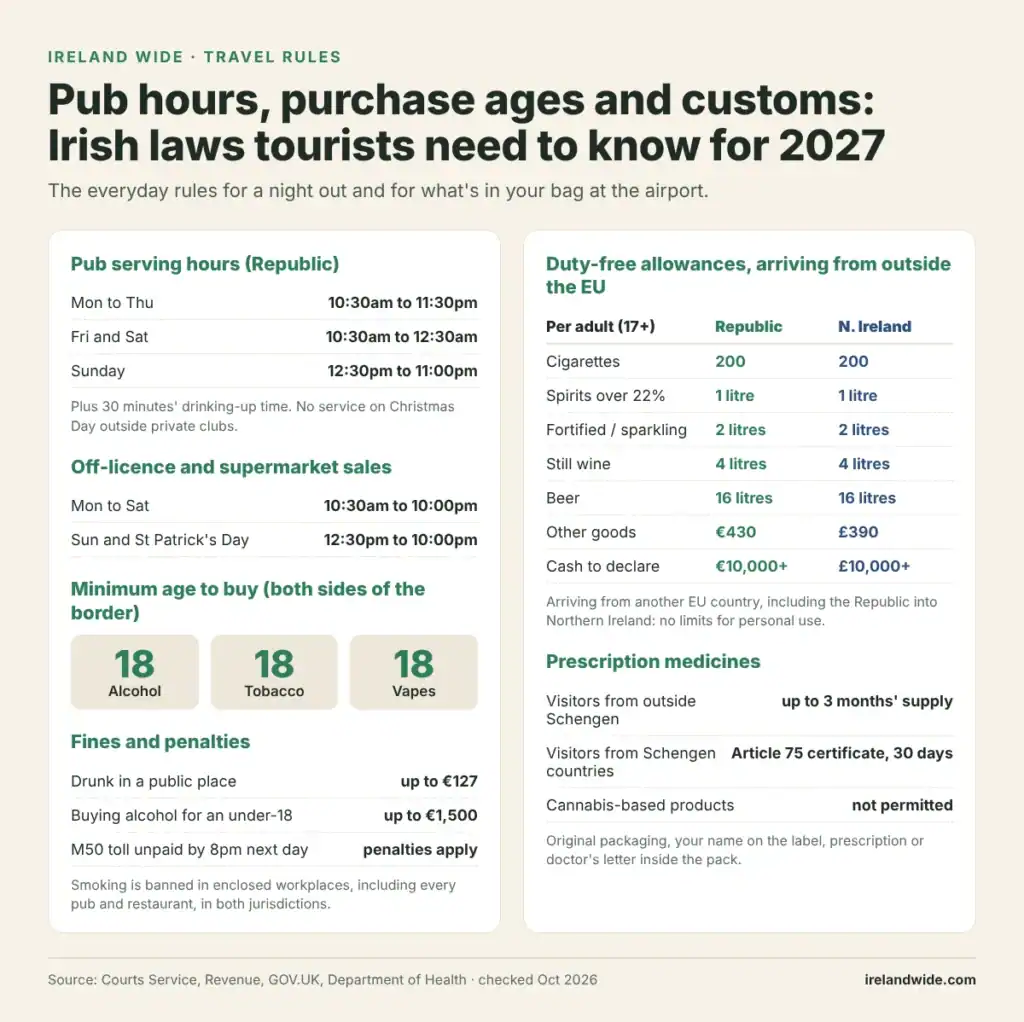
The legal drinking age in Ireland is 18 on both sides of the border, and it’s an offence for an adult to buy alcohol for someone younger. Pubs in the Republic can serve from 10:30am until 11:30pm Monday to Thursday, until 12:30am on Friday and Saturday, and from 12:30pm until 11pm on Sunday, with 30 minutes’ drinking-up time. Supermarkets and off-licences sell alcohol from 10:30am to 10pm Monday to Saturday and from 12:30pm to 10pm on Sundays and St Patrick’s Day. Nothing is served on Christmas Day outside private clubs. Before buying alcohol, check the applicable purchase-age rules, accepted proof of age and sales hours for your destination. For a pub, restaurant or distillery visit, also check its booking and admission conditions.
Keep legal rules and venue policies separate. An establishment’s conditions may affect admission, service or where you can use particular products. Ask staff when a notice is unclear.
- Alcohol outdoors: Check local restrictions before taking an open drink into a street, park or other public space. Being drunk in a public place is an offence in the Republic, with a fine of up to €127, and many councils ban street drinking under local bye-laws.
- Smoking and vaping: Check the applicable rules and signs for accommodation, transport, workplaces and visitor attractions. Ask specifically about vaping. Smoking has been banned in enclosed workplaces in the Republic since 2004 and in Northern Ireland since 2007, which includes every pub, restaurant and hotel bar. Vapes can’t be sold to under-18s anywhere on the island. Single-use vapes have been banned in Northern Ireland since June 2025, and the Republic’s own ban, passed by the Oireachtas in July 2026, is due to take full effect in January 2027.
- Public conduct: Follow access notices and instructions at heritage sites, private property and outdoor recreation areas.
- Restricted activities: Check permissions before planning activities such as drone flights, fishing or collecting material at a protected site. In the Republic, any drone with a camera or weighing more than 250g must be flown by a registered operator, and the Irish Aviation Authority has prosecuted pilots who skipped the rules.
Two tobacco changes land during 2027. In Northern Ireland, the UK’s Tobacco and Vapes Act 2026 bars the sale of tobacco to anyone born on or after 1 January 2009, starting on 1 January 2027. In the Republic, the minimum age for buying tobacco rises from 18 to 21, but not until early 2028, so 18 remains the rule for a 2027 trip. Read any stated commencement date carefully before assuming either applies to you.
For a night out, arrange your return transport before drinking. It’s a small planning job that becomes considerably less appealing at closing time. The guide to using taxis in Ireland covers booking, fares and card payments.
Check Medicines, Restricted Goods and Purchases Before Packing
Medicines and Controlled Substances
If you take prescription medicine, check its ingredients against the destination’s requirements before travelling. Give the relevant authority the medicine’s generic name, strength, quantity and length of stay when asking what documentation or permission you need.
The Department of Health’s position for visitors from outside the Schengen Area (which includes the UK and the US) is that you can bring up to a three-month supply for personal use, provided it’s in the original packaging with your name on it and you carry the prescription or a letter from your doctor or pharmacist. Visitors from Schengen countries need an Article 75 certificate for any medicine containing a Schedule 2 or 3 controlled drug, covering a 30-day supply. Prescribed cannabis-based products are not permitted into Ireland. Customs has the final say at the airport.
As practical preparation, keep medicine in its labelled packaging and carry a copy of the prescription. Ask your prescriber about a supporting letter, and confirm any additional requirements for controlled medicines in both jurisdictions on a cross-border trip.
Check cannabis, CBD and other potentially controlled products individually before packing them. A product’s availability where you bought it is not enough information to make that decision.
Alcohol, Tobacco, Food and Other Goods
Use Revenue Commissioners guidance for goods entering the Republic and UK government guidance for goods entering Northern Ireland. Check the rules against your departure country, route, product and quantity.
| Arriving from outside the EU | Republic of Ireland | Northern Ireland |
|---|---|---|
| Cigarettes | 200 (or 50 cigars / 250g tobacco) | 200 (or 50 cigars / 250g tobacco) |
| Spirits (over 22%) | 1 litre | 1 litre |
| Fortified or sparkling wine (up to 22%) | 2 litres | 2 litres |
| Still wine | 4 litres | 4 litres |
| Beer | 16 litres | 16 litres |
| Other goods | €430 (€215 if under 15) | £390 (£270 by private plane or boat) |
| Arriving from an EU country | No limits for personal use | No limits for personal use (guide level 800 cigarettes, 90 litres of wine) |
| Cash declaration | €10,000 or more | £10,000 or more |
- Check alcohol and tobacco allowances before shopping.
- Check food, plant and animal-product restrictions before packing gifts or snacks.
- Check declaration requirements for cash and valuable goods.
- Keep receipts and any permits with the items they concern.
- Check your home country’s import rules before buying goods to bring back.
Make these checks before purchasing. An airport shop receipt or a retailer’s willingness to sell an item does not answer the entry requirements for your next destination.
Recheck Official Requirements Before Departure
For a 2027 journey, check official requirements when planning and again shortly before departure. Read any stated commencement date carefully when a change is announced; an announcement alone should not determine your travel arrangements.
Use the Irish Immigration Service for Republic of Ireland entry questions, Revenue Commissioners for customs, the Road Safety Authority for driving, and An Garda Síochána for relevant public-safety guidance. For Northern Ireland, use UK government immigration and customs guidance alongside Northern Ireland’s official road-safety and public-information services.
Keep copies of your permissions, booking conditions and relevant documents together. Once those checks are done, the broader practical advice for first-time visitors to Ireland can help with the rest of your planning, and the Ireland trip planner pulls the itineraries, packing lists and money guides together in one place.
Frequently Asked Questions
Do I Need a UK ETA to Cross From Dublin to Belfast?
Yes, if your nationality needs one. There are no immigration checks on the land border, but the ETA is a legal requirement for entering Northern Ireland, including on a day trip by car, bus or train. British and Irish citizens, and legal residents of Ireland travelling from Ireland, are exempt.
Do Children Need Their Own UK ETA?
Each child who is subject to the UK ETA requirement needs an individual ETA, including babies. A parent or another person can apply on their behalf.
Can British or Irish Dual Citizens Apply for an ETA?
UK guidance says dual citizens with British or Irish citizenship cannot get an ETA. Check the official guidance on which passport or other accepted evidence to use when travelling.
Does Ireland Use ETIAS or the EU Entry/Exit System?
No. Ireland is in the EU but not in the Schengen Area, so neither ETIAS nor the Entry/Exit System applies to arrivals in the Republic. You’ll pass through ordinary Irish passport control instead. If you continue to France, Spain or another Schengen country, the EU rules apply from that point.
Can I Drive in Ireland With a US Licence?
Yes, for up to 12 months as a visitor, as long as you also carry an international driving permit from the US. Rental companies set their own conditions on top of that, so confirm the age limits and payment-card rules before you book.
What Is the Drink-Driving Limit in Ireland?
In the Republic the limit is 50mg of alcohol per 100ml of blood, and 20mg for learner, novice and professional drivers. In Northern Ireland it’s 80mg. Gardaí can breath-test drivers at checkpoints at any time, so the safe plan on a touring holiday is simply not to drink and drive.
Does a Rental Booking Confirm That I Meet Every Driving Requirement?
Check your legal driving eligibility and your rental contract separately. Before collecting the car, resolve any questions about your licence, insurance, passengers and cross-border route with the relevant authority and rental company.


