Swords Castle is worth visiting if you want a short, easy-to-reach medieval stop near Dublin Airport, north County Dublin, or central Swords. It suits day-trippers, families, history fans, and anyone building an itinerary around the best castles in Ireland, though people expecting a fully furnished interior or a full-day attraction should keep expectations sensible.
The big draw is the setting and survival of the complex itself. Swords Castle is a large medieval archiepiscopal residence in the middle of town, close to the Ward River and about a 10-minute drive from Dublin Airport, with a visit that usually fits comfortably into 1 to 2 hours.
If you are comparing castle stops around Dublin, this one works best as a practical half-day piece in a wider plan. It also fits neatly into a short Dublin break, a wider 7 day Ireland itinerary, or a broader look at things to do in Ireland.
Search by castle, county or nearby town, then click a marker to open the complete IrelandWide visitor guide.
| County | County Dublin, in Fingal |
|---|---|
| Jurisdiction | Republic of Ireland |
| Castle Type | Medieval archbishop’s palace / enclosed castle complex |
| Century / Built Dates | Construction began around 1200, after John Comyn became Archbishop of Dublin in 1181. Parts were added over later centuries. |
| Builder / Associated Figures | Associated with John Comyn, Archbishop of Dublin, and later archbishops of Dublin |
| Current Status | National monument; open to the public with ongoing long-term conservation and cultural-quarter works in the wider area |
| Interior Access | Some access is to the grounds and surviving structures rather than a fully fitted historic interior. Check official access details before visiting. |
| Typical Visit Time | 1 to 2 hours |
| Coordinates | Bridge Street, Swords, Co. Dublin, K67 X439 area reference supported by mapping listings |
| Parking | No parking inside the castle grounds. Paid parking is commonly used on Swords Main Street, at the Pavilions / Castle shopping area, and around St Colmcille’s Church. |
| Public Transport | Swords is well served by Dublin-area bus links and is close to Dublin Airport. Exact routes depend on your starting point. |
| Accessibility | Access can vary because this is a historic site with uneven surfaces. Check the official operator site for the latest access information. |
| Toilets | Not consistently documented in the material reviewed. Verify before travel. |
| Food Nearby | Yes, in Swords town centre rather than within the castle itself |
| Family Suitability | Good for families who want open space and a manageable visit length |
| Official URL | Swords Castle official site |
| Checked | July 2026. Opening details and access rules can change, so recheck before setting out. |
Swords Castle is not a fairytale turret-and-banquet-hall kind of place. It is better understood as a fortified residence of the Archbishops of Dublin, built as a substantial walled complex in the medieval town of Swords.
It is one of the best surviving examples of an archbishop’s palace in Ireland. That is the key point to carry into your visit. You are looking at a place designed for status, administration, and control as much as defense.
The site sits on the Ward River in the old town core, about 10 kilometres from Dublin city centre and very close to the airport. That combination makes it unusually easy to add to a short Dublin trip, an arrival day, or a final morning before a flight.
The most consistent published information says Swords Castle is open year round and that tours are available on request. Several listings also indicate routine public opening on Tuesday to Saturday or Tuesday to Sunday from 9:30 a.m., while some recent visitor comments mention occasional closures, gates shut during works, or confusion over when staff are actually on site.
Because those details do not line up perfectly, the safe advice is simple: check the official operator site on the day you plan to visit. That is especially important around public holidays, restoration works, and event days.
The reviewed material does not provide a confirmed general admission price, so this guide does not state one. If there is a charge for a specific tour or event, it should appear on the official site or event listing.
The history starts before the castle. Swords had an earlier monastic settlement dating back to at least the 6th century, traditionally linked with St Columba, also known as Colmcille. The settlement mattered because the area was productive, populated, and already important in religious terms.
In 1181, John Comyn became Archbishop of Dublin. Soon after, he chose Swords as a principal residence, and construction on the castle began around 1200. Sources describing the site agree that this was built over time, with later additions across centuries rather than as a single one-off project.
That long building history explains why the castle feels like a complex rather than one neat structure. Walls, towers, gate elements, and open yard areas speak to changing needs over roughly 400 years of development.
The name Swords is often connected with the Irish word Sord, usually explained in local interpretation as “pure,” in reference to a well. That story appears in local heritage material and is useful background for the town.
Still, it is best treated as tradition rather than hard documentary proof for the castle itself. The defensible history of the site is the ecclesiastical settlement, the archbishop’s residence, and the long medieval development of the walled complex.
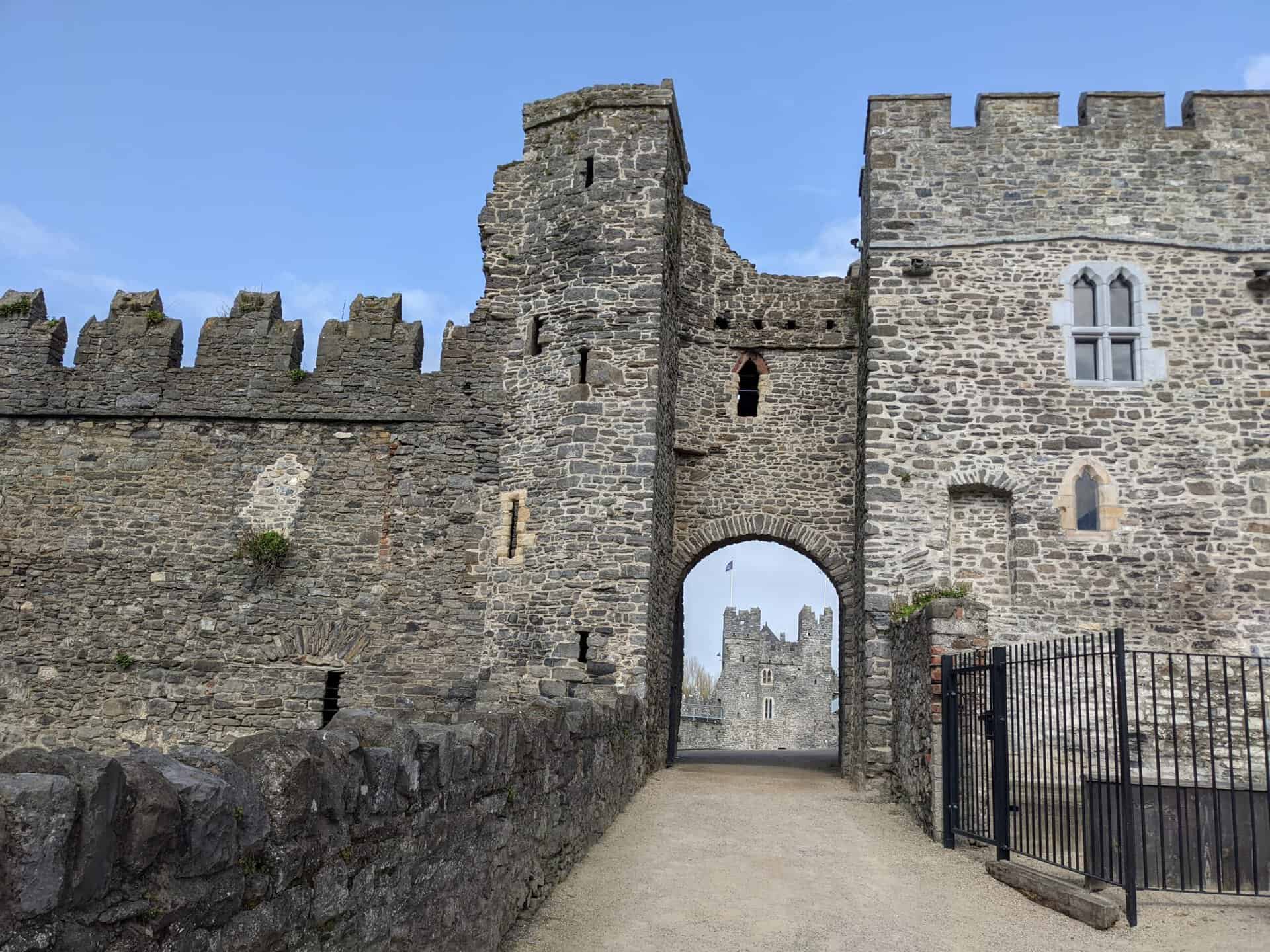
The main appeal is the scale of the surviving enclosure. You can still get a strong sense of the high curtain walls, the footprint of a substantial residence, and the unusual urban setting in which a medieval complex sits right inside a modern town.
Do not arrive expecting rooms dressed with period furniture. Swords Castle works as an architectural and atmospheric site. It is about walls, gateways, open courtyards, stonework, and the contrast between medieval fabric and everyday Swords around it.
That makes it particularly good for people who enjoy reading buildings in the open air. If you prefer highly curated interiors, Malahide Castle may suit you better. If you like ruins and layouts you can mentally reconstruct, Swords Castle is very rewarding, much like the appeal of a Dunluce Castle visitor guide stop or a wander through Ross Castle for its setting and structure.
Most people only need 60 to 120 minutes. That gives enough time to walk the perimeter, pause for photos, read any on-site interpretation, and combine the castle with coffee, shopping, or a riverside stroll in Swords.
If you have a strong interest in medieval ecclesiastical history, castle layouts, or urban heritage, allow the full two hours. If you are fitting it in before a flight, you can do a satisfying shorter visit in about an hour, assuming access is straightforward that day.
Swords Castle is a very easy drive from Dublin Airport, often quoted at around 10 minutes depending on traffic. There is no parking inside the castle grounds, so plan to use paid parking in town.
The most commonly mentioned options are Swords Main Street, the nearby shopping-centre parking area, and spaces around St Colmcille’s Church. If you are arriving at a busy time, give yourself a few extra minutes and be prepared to walk a short distance.
Swords is well connected by bus to Dublin and Dublin Airport, which makes the castle one of the easier county-town heritage stops to reach without a car. Exact routes vary, so the best practice is to plan through the relevant Dublin public transport tools before departure.
Once in central Swords, the castle is a straightforward town-centre stop rather than a remote rural site. That alone gives it an advantage over plenty of other castles.
Swords Castle rewards wide shots more than detail-chasing. The strong outer walls and open interior spaces read best when you step back a little and show the scale against the town.
For context photos, include parts of the surrounding streetscape. This is one of the few Irish medieval sites where the contrast between old stone and modern urban life is part of the point. Overcast weather often works well here because it keeps the wall textures even and cuts harsh shadows.
If you are shooting on a phone, the easiest win is to photograph the enclosure from several corners rather than standing in one spot and zooming. The site opens up as you move around it.
As with many historic sites, uneven ground and older surfaces may affect access. The reviewed material does not give a full verified accessibility breakdown, so anyone needing step-free access, adapted toilets, or detailed mobility information should confirm directly with the official operator before visiting.
Food is easy because the castle sits in Swords town centre. That is a practical advantage over more isolated heritage sites where you need to pack lunch or commit to a full excursion.
Malahide Castle is the obvious companion visit if you want a more furnished, estate-style castle experience. It also gives you a useful contrast with Swords, which feels more stripped back and medieval in its surviving fabric.
Ardgillan Castle works well if you are driving farther north through Fingal and want another heritage stop in the same county. It turns a short castle outing into a fuller north Dublin day.
Dublin Airport is not a sightseeing suggestion, but it matters here because Swords Castle is one of the few serious medieval sites you can realistically visit before or after a flight without turning the day into a logistical drama.
Yes, especially if you like medieval history, quick access, and low-fuss planning. It is one of the easiest castles near Dublin Airport, and the archbishop’s-palace angle makes it more distinctive than a generic ruined tower house.
It is less suitable for anyone wanting elaborate interiors, a long on-site program, or a major estate experience. For those trips, Malahide Castle usually offers more in the way of packaged attractions.
A general admission price was not consistently verified in the reviewed material, so check the official site before visiting. Some access periods may be free while specific tours or events may have separate arrangements.
One to two hours is enough for most people. That covers a full walk around the site and leaves time to combine it with central Swords.
No parking is permitted within the castle grounds. Use paid parking in Swords town, including Main Street and nearby shopping-centre options.
Yes. It is commonly described as being about a 10-minute drive from Dublin Airport, traffic allowing.
You can visit the site, but do not expect a fully furnished interior. Access arrangements can vary, so check the official operator for the latest details.
Yes, for families who want a short, manageable heritage stop with open space and easy town-centre access. It is better for a casual walk and look around than for a full child-focused day out.

Dan is the founder and editor of Ireland Wide. Born and raised in Ireland, he researches the country’s history, mythology and cultural traditions using museum collections, heritage authorities and historical sources. He leads the site’s editorial team, with a particular focus on distinguishing documented history from later folklore and modern interpretations.
At Ireland Wide, our aim is to bring authentically Irish insights to you, wherever you are.
Whether you have some feedback or would like to offer some of your own insights for everyone else to explore, don't hesitate to get in touch with us!