Byrne is usually an anglicized form of the Irish surname Ó Broin, meaning descendant of Bran. In Irish naming history, Bran is generally understood as a personal name associated with the word raven.
If you are tracing Byrne family roots, the name is most closely tied to Leinster, especially County Wicklow, County Dublin, and County Kildare. It is one of the best-known Irish surnames, and its story runs straight through medieval kingship, Norman pressure in Leinster, and the long resistance of Gaelic families in the Wicklow mountains.
For Americans digging into Irish ancestry, Byrne is a surname worth slowing down for. It looks simple on the page, but behind it sit multiple Gaelic forms, old regional identities, and a very specific Wicklow history. It also appears regularly on modern lists of common Irish surnames, which is helpful context before you start assuming every Byrne line connects neatly to one clan branch.
Meaning: Byrne usually comes from Ó Broin, meaning descendant of Bran.
Likely meaning of Bran: In this surname context, Bran is commonly linked to raven.
Main Irish homeland: Leinster, especially County Wicklow, with deep associations also in Dublin and older roots in Kildare.
Historic clan: The O’Byrnes, a major Gaelic family of Leinster.
Important note: Not every Byrne line comes from the same Gaelic original. Most derive from Ó Broin, but Byrne can also represent Ó Beirn or Ó Beirne in some cases.
The surname Byrne is best known as the English form of Ó Broin. In Irish, the prefix Ó means descendant of, so the name literally points to a male-line descendant of Broin or Bran, depending on how the older personal name is interpreted in anglicized form.
In standard surname guides and Irish family history writing, Byrne is usually explained as descending from Bran mac Máelmórda, a king of Leinster who died in 1052. That is why many accounts summarize the name as descendant of Bran.
The personal name Bran is widely connected with the Irish word for raven. That is the meaning most people are looking for when they ask what Byrne means. It is also the safest short answer for everyday genealogy use.
There is one complication worth knowing. Byrne is not always from Ó Broin. Some bearers of Byrne come from Ó Beirn or Ó Beirne, a separate Irish surname more often associated with the northwest. If your family story points to Sligo, Roscommon, Leitrim, or nearby counties, it is worth checking records carefully before assuming a Wicklow O’Byrne connection. If you are comparing naming patterns more broadly, that is where guides to Celtic Irish surnames can be useful for spotting regional differences.
Byrne is pronounced much like burn, with the same one-syllable sound: BERN.
Audio-style guide: BERN
Ó Broin is a bit less intuitive for American readers. You will usually hear it rendered approximately as oh BRO-in or oh BROHN, depending on dialect and how closely someone is following Irish pronunciation. If you are speaking with family historians or local guides in Wicklow, a slightly different vowel will not raise eyebrows. Irish surnames have been living double lives for centuries.
Older forms like O’Byrne are pronounced the same way as Byrne in modern English speech.
The Byrne story belongs to Leinster. The family is traditionally traced to Bran mac Máelmórda, King of Leinster, who died in 1052. Medieval genealogical tradition also links the line to earlier Leinster dynasties and to the broader political world of Gaelic kingship in eastern Ireland.
Before the Normans arrived, the family held territory in what is now County Kildare. After the Anglo-Norman invasion in the late 12th century, the O’Byrnes, along with the O’Tooles, were pushed east and south into more defensive ground in the Wicklow mountains. That move matters. It helped shape the family identity people still associate with the name.
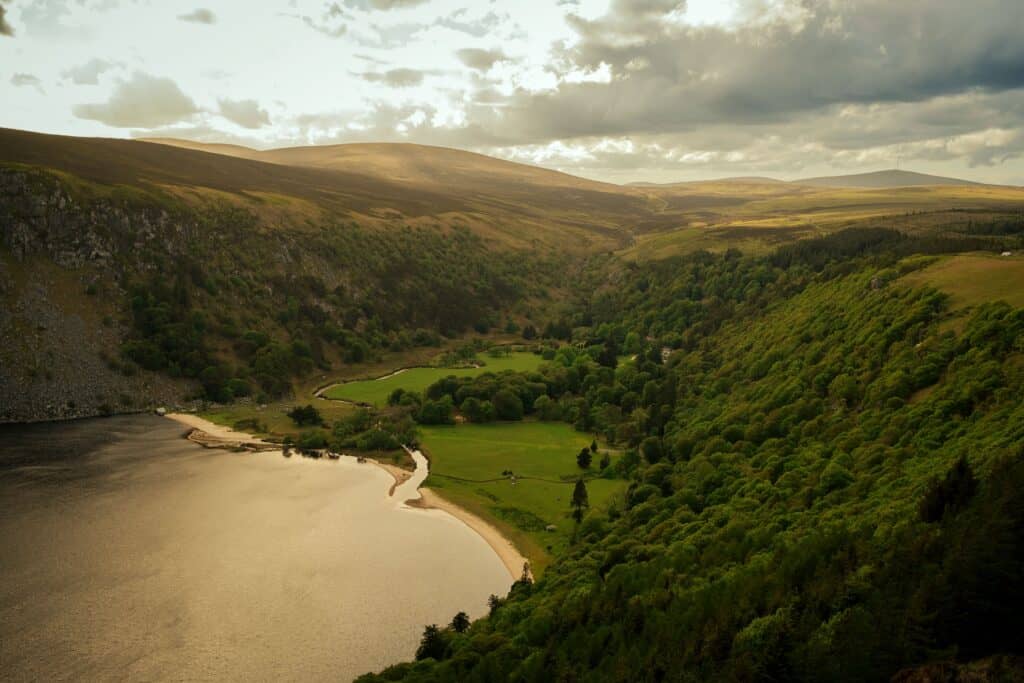
In Wicklow, the O’Byrnes became one of the strongest Gaelic powers in the region. Their lands were tied especially to the area between Rathdrum and Shillelagh, and to the old barony of Ballinacor. Mountain terrain made the district hard to control from Dublin, which gave local chiefs room to hold out against English authority for generations.
County Wicklow is the county most closely identified with the historic O’Byrnes. If your Byrne family has roots in Wicklow, there is a very good chance that the surname reflects that long-established Leinster line.
One of the most famous figures in the clan’s history is Feagh MacHugh O’Byrne, the 16th-century Wicklow leader often linked with resistance to English rule. He is associated with Glenmalure, one of the best-known valleys in Wicklow history. Even people who arrive in the area for hiking or scenery often stumble into Byrne history without planning to.
The family name gradually shifted in English records. The older O’Byrne form survived for a long time, but many branches dropped the prefix and became simply Byrne. That pattern was common across Ireland, especially from the 18th century onward.
If Murphy belongs to Cork in the popular imagination, Byrne belongs to Wicklow. Not every modern Byrne family comes from there, but Wicklow is the county that gives the name its strongest historical setting.
The O’Byrnes and O’Tooles used the uplands of Wicklow as a base of power after losing earlier lands in Kildare. That shift helps explain why the surname remains so strongly associated with south Dublin, north Wicklow, Rathdrum, Shillelagh, and Glenmalure.
For genealogy trips, Wicklow is often the right place to start once you have a parish, townland, or civil record pointing into the region. The practical challenge, of course, is that Byrne is a common surname. A County Wicklow connection is useful, but it is not enough on its own. You will want church records, civil registrations, land records, and immigration records working together.
If you are building a wider Irish surname list for your family tree, it also helps to compare Byrne with neighboring Leinster names such as O’Toole, which appears beside it again and again in regional history. The same wider pattern shows up in roundups of popular Irish surnames, where a few Leinster names turn up over and over.
Byrne is widely recognized as one of the more common surnames in Ireland. Modern surname summaries consistently place it among the country’s leading names, and it has especially strong representation in the east.
The counties most often linked with Byrne are:
That does not mean Byrne is only an east-coast name. Irish migration within the island, and then out of Ireland, spread it much more broadly. Still, if you are trying to identify the most likely historic core, Wicklow and Dublin come first.
For readers interested in surname clusters, Byrne often appears in records from parishes and districts that also show strong numbers of other Leinster families. If your ancestors left through Dublin, a Byrne surname in American records may reflect that wider east-Ireland corridor rather than one tiny village. In the United States, the name also sits comfortably among well-established American Irish surnames, especially in older Irish communities along the East Coast.
The most familiar variants are straightforward:
You may also run into related or potentially confusing forms:
In Irish, the correct modern spelling is Ó Broin. The fada in Ó matters. You may also see the surname written without it in older or simplified contexts, especially outside Ireland.
Ó Broin and O’Byrne are linked, but they are not identical on the page. Ó Broin is the Irish-language form. O’Byrne is the older anglicized form. Byrne is the shortened modern English form most people use now.
A surname gets easier to remember when it has a few recognizable faces attached to it. Byrne has plenty.
The historic standout is Feagh MacHugh O’Byrne, the Wicklow chief associated with resistance in the 16th century. He is one of the main reasons the surname still carries a strong martial and regional identity in Irish memory.
Miles Byrne, born in 1780 in County Wexford, fought in the 1798 rebellion and later served in continental Europe. His career turns up often in discussions of Irish soldiers abroad.
Andrew Byrne, born in 1802 in County Meath, became the first Catholic bishop of Little Rock. For American readers, he is a useful reminder that Irish surname history and U.S. church history overlap more than people expect.
The surname also appears across politics, sports, music, literature, and entertainment. David Byrne is globally famous, and Irish readers will know the name from many public figures in Dublin life, Gaelic games, soccer, and broadcasting. With a surname this common, the list gets long very quickly.
A Byrne surname can tell you something useful, but not everything.
It can suggest a likely Leinster connection. It can point you toward Wicklow, Dublin, or Kildare. It can signal an older family tradition linked to the O’Byrnes. But because Byrne is common, the surname alone will not identify one exact family line.
If you are researching Byrne ancestors from the United States, start with the records closest to home and work backward:
If the paper trail points to County Wicklow, that fits the strongest historical pattern for Byrne. If it points to the northwest, keep the Ó Beirne possibility in mind.
A practical warning: do not build a family tree from surname meaning alone. Plenty of unrelated Byrne families share the same English spelling.
Some surnames feel abstract. Byrne does not. It is tied to a specific landscape and a specific kind of Irish historical memory.
The old O’Byrne territory sits in the part of Ireland where mountain routes, glens, and defensive strongholds were not just scenery. They were political assets. That is why places like Glenmalure matter in the story. The name is not floating around in folklore by accident. It is anchored in a real contest over land and power in Leinster.
That also helps explain the family motto often attached to heraldic versions of the name, Certavi et Vici, usually translated as I have fought and conquered. As with many surname mottos, treat it as part of later heraldic tradition, not as a medieval everyday slogan someone was shouting across Wicklow.

Byrne usually comes from Ó Broin, meaning descendant of Bran. Bran is commonly linked with the word raven.
Yes. Byrne is a classic Irish surname, strongly associated with Leinster and especially with County Wicklow.
In most cases, yes. Byrne is the shortened anglicized form, while O’Byrne preserves the older prefix. Both are tied to the same main Gaelic surname, Ó Broin.
Byrne is pronounced BERN, like burn without stressing the u separately.
The strongest historic homeland is County Wicklow, with older roots in County Kildare and long-standing presence in County Dublin.
No. Many are linked to the O’Byrnes of Leinster, but not every Byrne line shares the same origin. Some may come from Ó Beirn or Ó Beirne, a different surname.
The main Irish spelling is Ó Broin.
The historic O’Byrnes were a powerful Gaelic family of Leinster and are traditionally traced to Bran mac Máelmórda, King of Leinster, who died in 1052.
If you want the shortest reliable answer, here it is: Byrne is usually the anglicized form of Ó Broin, meaning descendant of Bran, and the name is most strongly rooted in County Wicklow and the wider Leinster region.
If you want the more useful answer for family history, remember the details. Byrne is common. Wicklow matters. Kildare matters. Dublin matters. O’Byrne and Byrne are usually part of the same story. And if your ancestors came from farther northwest, another Gaelic origin may be hiding behind the same English spelling.
That is the charm and the headache of Irish surname research. A name can open the door, but you still have to walk through it.
The Irelandwide Editorial Team is a group of travel writers, researchers, and content creators dedicated to publishing accurate, up-to-date information about Ireland. Our content covers travel guides, castles, attractions, Irish culture, tourism news, and official data to help visitors and locals alike. We prioritize reliable research, clear writing, and trusted sources to create practical resources for exploring Ireland with confidence.
At Ireland Wide, our aim is to bring authentically Irish insights to you, wherever you are.
Whether you have some feedback or would like to offer some of your own insights for everyone else to explore, don't hesitate to get in touch with us!