Manannán mac Lir is the Irish sea god, a son of the sea god Lir and king of the Otherworld in Celtic mythology. He rides the waves in a boat that needs no oars, hides the Otherworld behind a cloak of mist, and gives magical gifts to heroes like Lugh and Cormac mac Airt.
Quick answer:
- Who he is: a sea god, trickster and Otherworld king of the Tuatha Dé Danann.
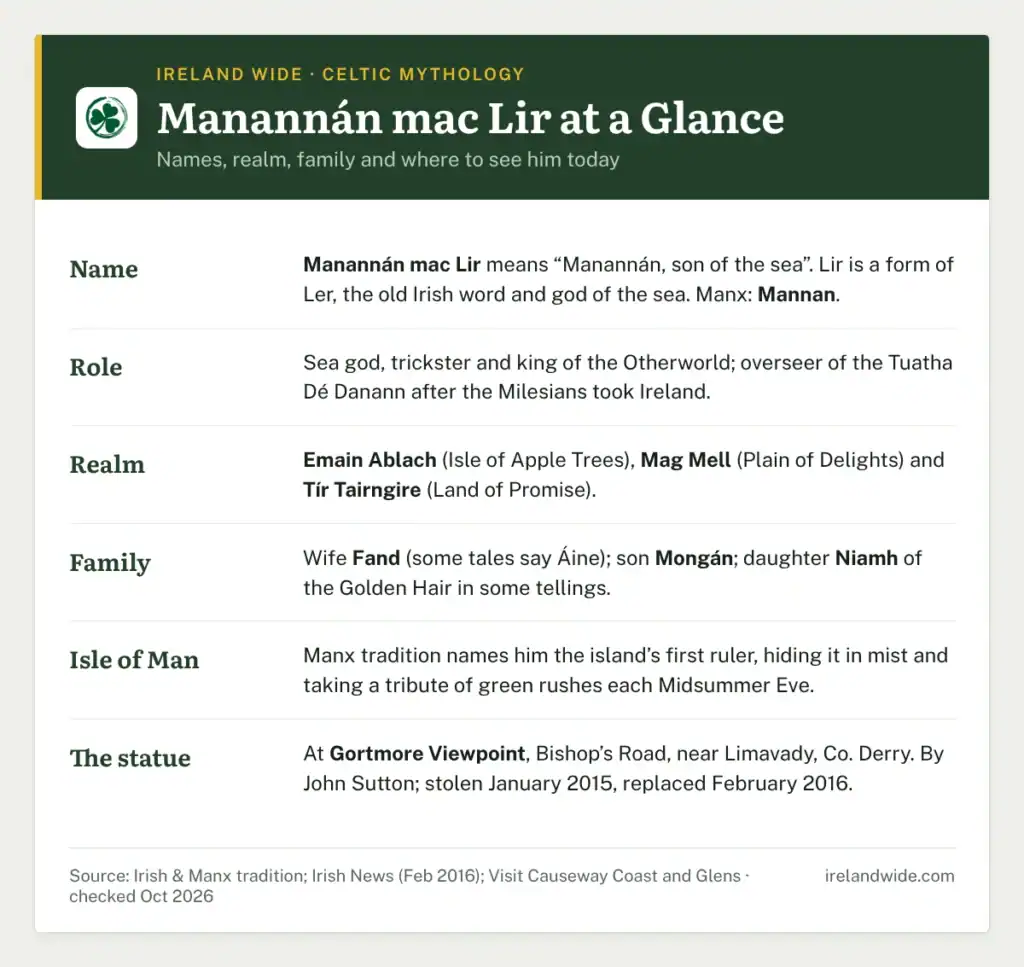
- Name: “mac Lir” means “son of the sea”; in Manx he is Mannan.
- Realm: Emain Ablach (Isle of Apple Trees), also called Mag Mell and Tír Tairngire.
- Treasures: the sword Fragarach, the horse Aonbharr, the boat Wave-Sweeper, the crane bag and a cloak of mists.
- Isle of Man: Manx tradition makes him the island’s first ruler.
- Statue: a John Sutton sculpture of him stands at Gortmore Viewpoint near Limavady, Co. Derry.
Manannán mac Lir, the enigmatic and powerful Celtic god of the sea, stands as one of the most enduring figures in Irish mythology. Renowned for his mastery of the ocean, otherworldly wisdom, and magical artefacts, he embodies the vast, mysterious, and untamed nature of the sea. As the son of Lir, the primordial god of the sea, Manannán’s legacy has transcended centuries, leaving an indelible mark on folklore, culture, and spirituality.
Who Was Manannán mac Lir?
Manannán mac Lir is best known as a protector of the seas, a guardian of the Otherworld, and a deity of weather and navigation. So what does Manannán mac Lir mean? His name, “mac Lir,” meaning “son of Lir,” connects him to the broader mythology of his father, the sea itself. Manannán’s domain extended not only over the physical seas but also over the mystical realms, serving as a bridge between the mortal world and the Otherworld.
In Irish mythology, he is often depicted as a shape-shifter and a cunning trickster, qualities that reflect the unpredictable nature of the sea. Manannán is a complex figure, simultaneously a benefactor to mortals and a formidable force capable of wielding great power.
The Role of Sea God Manannán mac Lir in Celtic Mythology

Manannán mac Lir features prominently in numerous Irish legends and tales. He is the gatekeeper of the Otherworld, safeguarding the boundaries between the mortal realm and the mystical lands of the gods. As a protector of the Tuatha Dé Danann after their retreat to the Otherworld, Manannán provided them with sanctuary and guidance.
When the Milesians defeated the Tuatha Dé, Bodb Derg became their king, while Manannán acted as their overseer. He gave each of them a sídh, one of the fairy mounds of Irish folklore, hid them behind the féth fíada, a mist of invisibility, and kept them young with the Feast of Goibniu and his magic pigs, which came back to life after every meal.
His Role in the Story of Cormac mac Airt
One of his most celebrated roles is in the story of Cormac mac Airt, a mortal king who sought Manannán’s wisdom. In this tale, Manannán tests Cormac’s character by offering him a magical silver branch in exchange for three wishes, then claiming his daughter, his son and his wife. Ultimately, Manannán’s trials reveal Cormac’s virtue, and he rewards him with the treasures of the Otherworld, including a magical cup that could detect lies. The cup broke into pieces when a lie was told over it and mended again at the truth, and when Cormac died, it was never seen in Ireland again.
His Role in the Fenian Cycle
Manannán also appears in the Fenian Cycle, where he crosses paths with legendary heroes like Fionn mac Cumhaill, sometimes in disguise as the trickster Gilla Decair, and where his treasure-filled crane bag ends up in Fionn’s hands. His involvement in these stories underscores his role as a divine protector and ally to mortals.
Symbols and Artefacts of Manannán mac Lir

Manannán mac Lir is closely associated with a range of celtic symbols and artefacts, each highlighting his connection to the sea and the mystical:
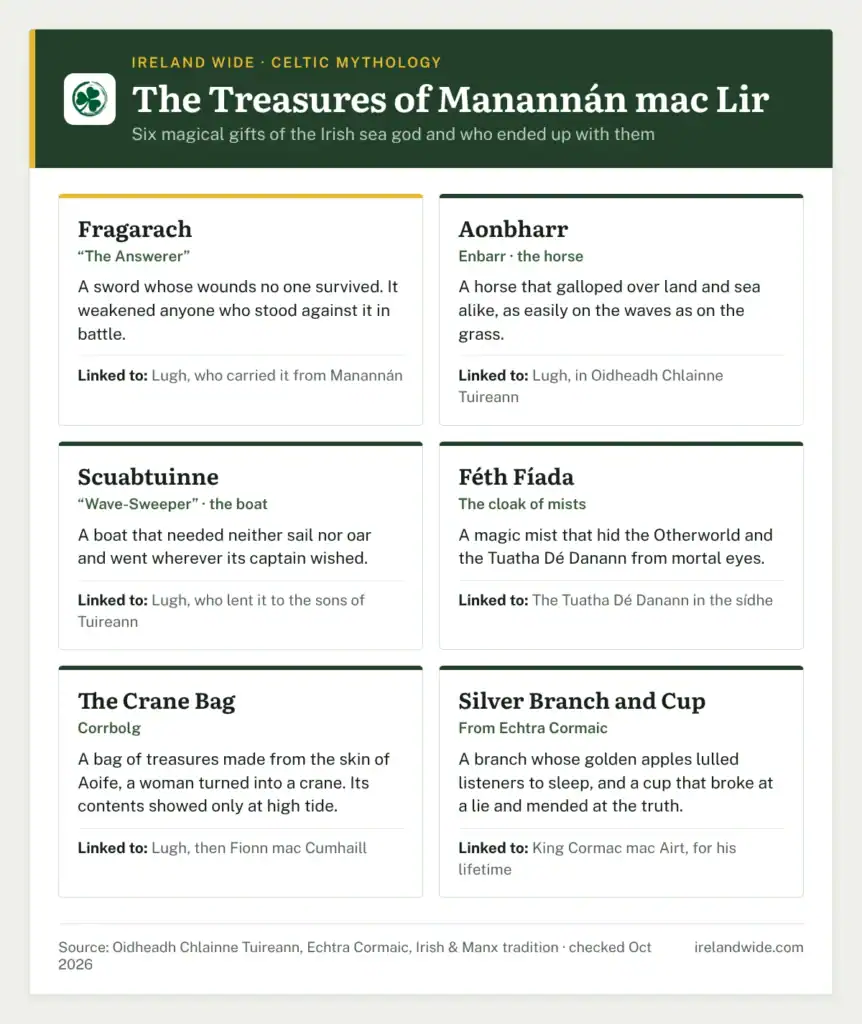
- Fragarach (The Answerer): A sword said to compel truth and ensure victory, often wielded by Manannán or gifted to worthy mortals.
- His Cloak of Mists: A magical cloak that allowed him to disappear or create illusions, symbolising the fog and mystery of the sea.
- Wave-Sweeper (Scuabtuinne): His magical boat that required neither sails nor oars, navigating effortlessly through the seas.
- Aonbharr (Enbarr): A magical horse capable of galloping over land and sea, representing Manannán’s dominion over all realms. It carried Lugh, the god of the sun and spear, who also bore Fragarach in the tale of the sons of Tuireann.
- The Crane Bag (Corrbolg): A bag of treasures made from the skin of Aoife, a woman turned into a crane, whose contents could only be seen at high tide. It passed from Lugh down the generations to Fionn mac Cumhaill.
- The Pigs of Manannán: Magic swine that could be killed and eaten each day and would return whole the next, feeding the Tuatha Dé Danann forever.
These artefacts not only demonstrate his divine status but also underline his role as a provider of gifts and wisdom to both gods and mortals.
Here are his six best-known treasures side by side, along with who ended up holding each one:
Manannán mac Lir’s Family and Otherworld Home
Manannán rules an Otherworld island known as Emain Ablach, the “Isle of Apple Trees”. The same blessed land is also called Mag Mell, the “Plain of Delights”, and Tír Tairngire, the “Land of Promise”, and it is here that he brings Cormac mac Airt in his most famous tale.
His wife is usually Fand, whose love affair with the Ulster hero Cú Chulainn ends when Manannán shakes his cloak between them so they forget each other. Some stories pair him with Áine, the goddess of summer instead. His best-known son is Mongán, a king raised in the Otherworld, and some tellings make Niamh of the Golden Hair his daughter.
Manannán mac Lir and the Isle of Man
Manannán is just as important across the Irish Sea. In Manx tradition he is Manannan beg mac y Leir, “little Manannan, son of the sea”, and he is remembered as the first ruler of the Isle of Man. The island is generally thought to take its name from him, although some scholars argue it was the other way round.
Manx legend says he kept the island hidden under a magic mist, and that in return the islanders paid him a tribute of green rushes every Midsummer Eve. Back in Ireland, Lough Corrib is said to take its name from another of his names, Oirbsen.
The Better-Known Son of Lir

While Lir, the Celtic god of the sea, is a foundational figure in Irish mythology, his son Manannán mac Lir has become the more prominent and widely celebrated deity. Where Lir is often portrayed as a symbolic and enigmatic personification of the ocean, Manannán takes on a more active and defined role in myths, embodying the sea’s tangible power and influence.
Manannán’s reputation surpasses his father’s through his extensive involvement in legendary tales and his interactions with mortals and other deities. His role as a guardian of the Otherworld, provider of magical gifts, and protector of sailors has made him a central figure amongst the Celtic Deities. Stories like those of Cormac mac Airt and the Fenian Cycle showcase his cunning, wisdom, and ability to navigate between worlds, elevating him to a status unmatched by Lir.
Additionally, Manannán’s associations with iconic artefacts such as the magical sword Fragarach, his cloak of invisibility, and the boat Wave-Sweeper further distinguish him. These items, along with his dynamic and vivid character, have solidified his place in myth and culture, while Lir remains a more abstract representation of the sea’s raw power.
Manannán mac Lir Statue: A Modern Tribute

The enduring legacy of Manannán mac Lir is celebrated in contemporary times through art and monuments, most notably the Manannán mac Lir statue in County Derry, Northern Ireland. This striking sculpture, perched on Binevenagh Mountain overlooking Lough Foyle, portrays the sea god in flowing robes, gazing out over the waters he commands.
Designed by artist John Sutton, the statue has become a symbol of Irish heritage and mythology. The figure’s commanding pose, standing in a small boat with his arms raised to the waves, evokes the power and mystery of the sea. The statue was cut from its plinth and stolen in January 2015, sparking public outcry and highlighting the strong cultural connection to Manannán. Walkers found it damaged in Binevenagh Forest a month later, and a new statue by Sutton was put in place in February 2016, solidifying its status as a beloved icon of the region.
Visiting the Manannán mac Lir Statue
The statue stands at Gortmore Viewpoint on Bishop’s Road, on the Binevenagh Loop above Magilligan near Limavady (postcode BT49 0HA). There is a free car park, and on a clear day you can see across Lough Foyle to Inishowen and as far as Islay and Jura in Scotland.
Gortmore is also the start of a short upland walk to Hell’s Hole on the North Sperrins Way, so bring boots, and note that dogs aren’t allowed because of grazing livestock. It is an easy add-on to a Causeway Coast drive, and our Dunluce Castle visitor guide covers another stop along the way.
The Legacy of the Sea God, Manannán mac Lir

Manannán mac Lir’s influence extends far beyond ancient myths. His stories and symbols continue to resonate, embodying themes of wisdom, protection, and the ever-changing nature of the sea. As the Celtic sea god, he represents a bridge between worlds, a guide through the unknown, and a reminder of the ocean’s beauty and power.
Modern interpretations of Manannán often emphasise his dual role as a trickster and protector, reflecting humanity’s relationship with the sea, both awe-inspiring and unpredictable. His presence in art, literature, and folklore ensures that his legacy remains vibrant, connecting the past to the present.
Through his magical artefacts, his guardianship of the Otherworld, and his enduring role in Irish mythology, Manannán mac Lir continues to inspire wonder and reverence, much like the vast oceans he commands.
Manannán mac Lir FAQs
What is Manannán mac Lir the god of?
Manannán mac Lir is the Irish god of the sea. He is also a guardian of the Otherworld, a weather and navigation god, and a trickster who protects the Tuatha Dé Danann.
What does mac Lir mean?
“Mac Lir” means “son of Lir”, and since Lir is a form of Ler, the old Irish word for the sea, his name can also be read as “son of the sea”.
Is the Isle of Man named after Manannán?
The Isle of Man is generally thought to be named after Manannán, who Manx tradition remembers as its first ruler. Some scholars argue the god was named after the island instead.
Who was Manannán mac Lir’s wife?
His wife is usually named as Fand, although some stories pair him with the goddess Áine instead.
Where is the Manannán mac Lir statue?
The statue is at Gortmore Viewpoint on Bishop’s Road, above Magilligan near Limavady in County Derry, Northern Ireland. It looks out over the mouth of Lough Foyle.
What happened to the Manannán mac Lir statue?
The original statue was cut down and stolen in January 2015, and walkers found it damaged a month later. Sculptor John Sutton made a replacement, which went back up in February 2016.
Checked against the medieval tales and Irish and Manx tradition, with statue details from Causeway Coast and Glens, in October 2026. Want to meet the rest of the family? Start with our guide to the Irish Celtic gods and goddesses.