There are 10 public holidays in the Republic of Ireland each year, including St Patrick’s Day, Easter Monday and Christmas Day. Some have fixed dates, while others fall on a particular Monday. A public holiday gives eligible employees a benefit, but it does not automatically mean everyone gets that day off.
Looking for dates to put in your diary? Use our Ireland bank holidays 2026 calendar. The guide below explains the annual pattern, holiday pay, weekend rules and what to check before making plans.
Public Holidays in Ireland: The Full Annual List
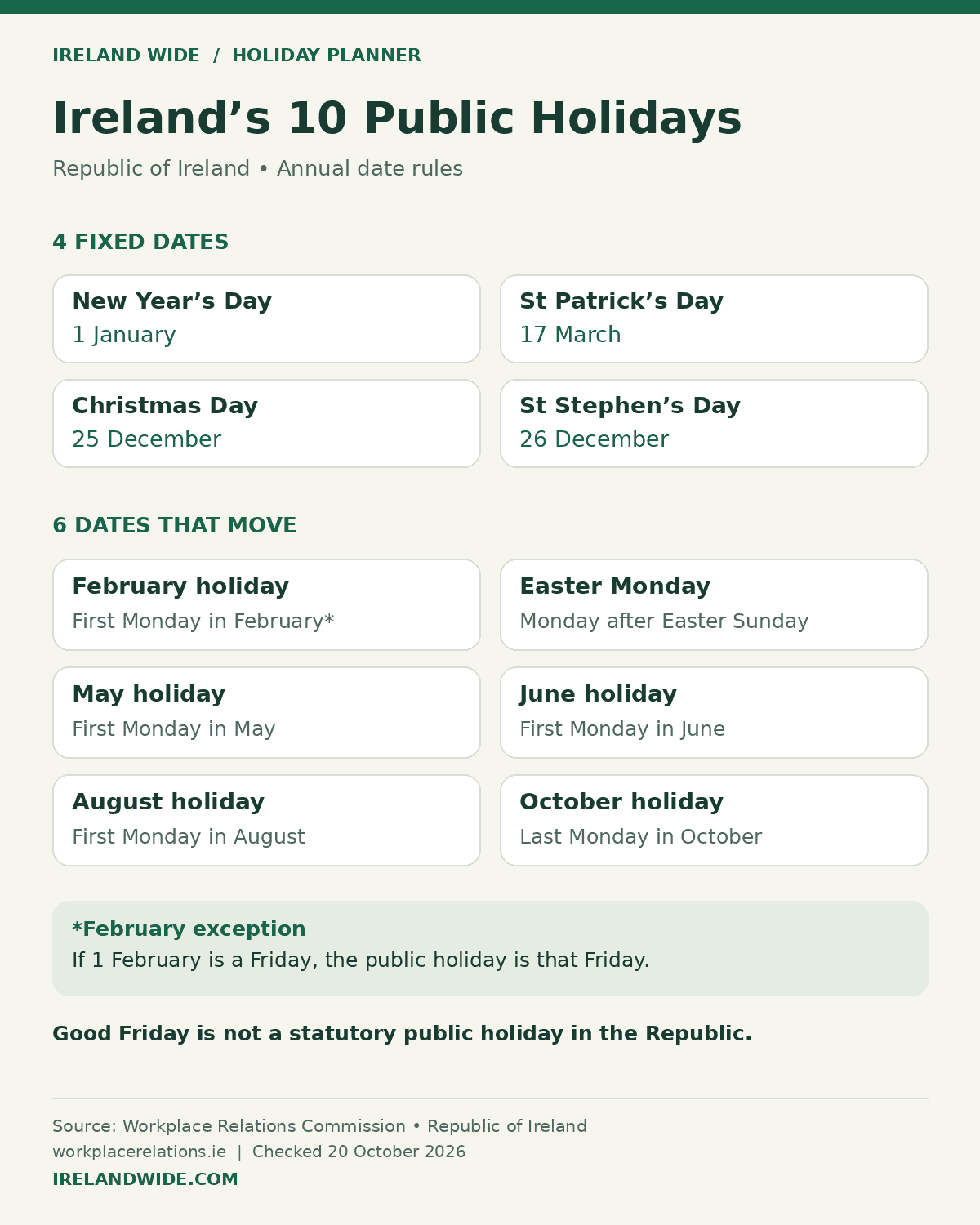
The Workplace Relations Commission’s public holiday list covers these 10 holidays. This calendar applies to the Republic of Ireland; Northern Ireland follows a separate calendar.
| Public holiday | When it falls |
|---|---|
| New Year’s Day | 1 January |
| February public holiday, commonly called St Brigid’s Day | First Monday in February, unless 1 February is a Friday, when the holiday falls on that Friday |
| St Patrick’s Day | 17 March |
| Easter Monday | The Monday after Easter Sunday; the date changes each year |
| May public holiday | First Monday in May |
| June public holiday | First Monday in June |
| August public holiday | First Monday in August |
| October public holiday | Last Monday in October |
| Christmas Day | 25 December |
| St Stephen’s Day | 26 December |
Does the St Brigid’s Day Holiday Always Fall on 1 February?
No. St Brigid’s feast day is 1 February, but the public holiday usually falls on the first Monday in February. The exception is a year when 1 February falls on a Friday: that Friday is the public holiday. The recurring February holiday has applied since 2023.
Are Bank Holidays and Public Holidays the Same Thing?
In everyday Irish conversation, “bank holiday” often means a public holiday, particularly a Monday long weekend. For employment rights, the statutory public holiday list is what matters.
A bank’s closure calendar can include other dates, and individual shops, offices and attractions set their own opening arrangements. A business being closed does not make that date an extra public holiday.
Is Good Friday a Public Holiday in Ireland?
Good Friday is not a statutory public holiday in the Republic of Ireland. Easter Monday is. Some employers give staff Good Friday off, and banks or other services may close, but those arrangements are separate from the national public holiday entitlement.
Good Friday is a bank holiday in Northern Ireland, which is one reason an all-island calendar can be confusing. Use the official Northern Ireland bank holiday calendar for plans north of the border.
What Are Employees Entitled to on a Public Holiday?
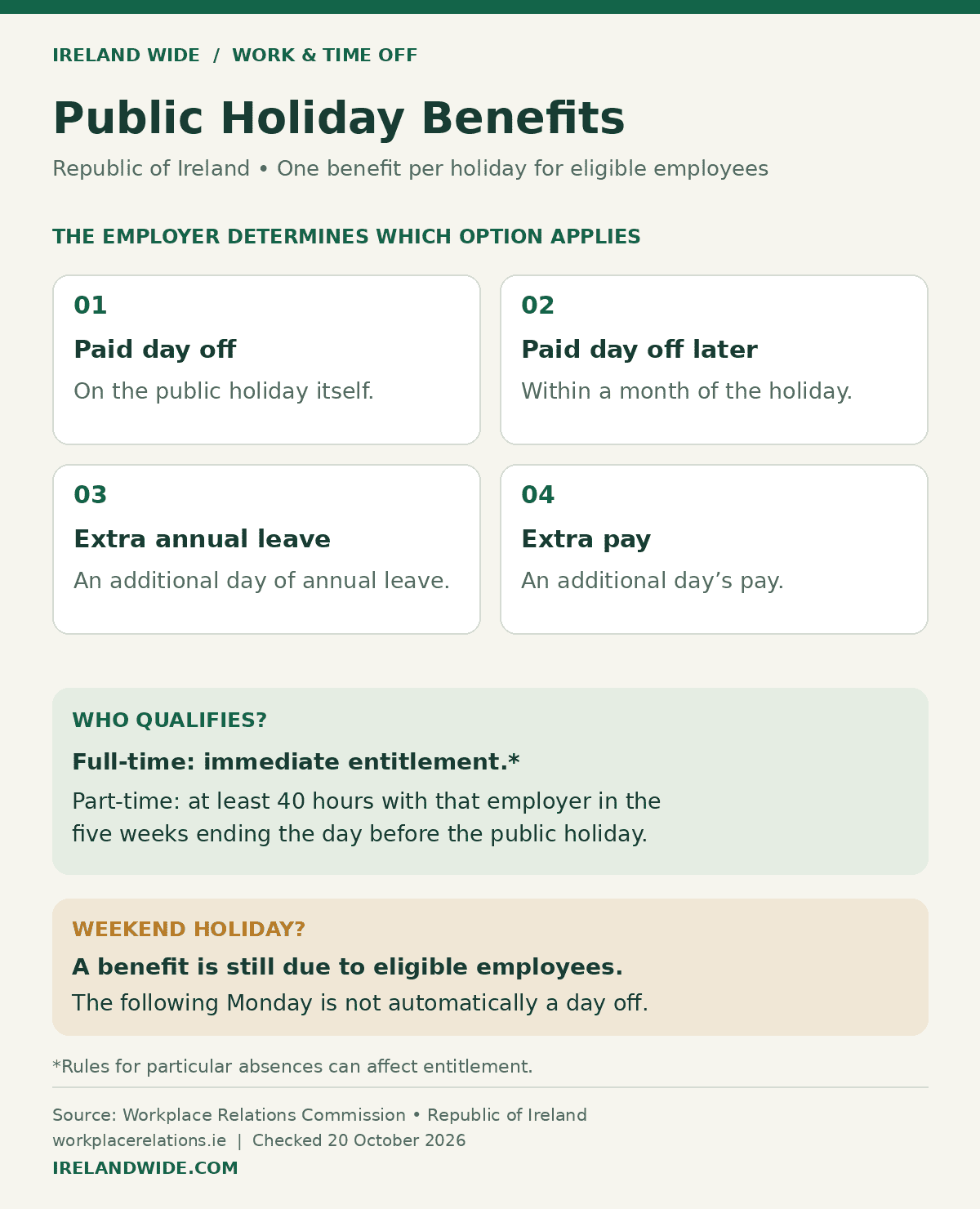
Under section 21 of the Organisation of Working Time Act 1997, eligible employees receive one of four benefits, with the employer determining which applies:
- A paid day off on the public holiday.
- A paid day off within a month of the public holiday.
- An additional day of annual leave.
- An additional day’s pay.
These are alternative benefits for each public holiday, rather than four benefits you receive together. Confirm your roster and the benefit with your employer before booking a break.
Do Part-Time Workers Get Public Holiday Pay?
Part-time employees qualify if they have worked at least 40 hours for that employer during the five weeks ending on the day before the public holiday. Full-time employees have immediate entitlement, subject to the rules governing particular absences.
You do not have to be scheduled to work on the holiday itself to qualify. If you work variable shifts, check the hours you worked during the qualifying period rather than assuming your usual weekly pattern settles it.
What If You Work on the Public Holiday?
You receive your agreed pay for the work you do, plus your public holiday benefit. The benefit may be paid time off or additional pay, depending on the arrangement that applies.
This does not create an automatic right to a particular hourly premium, such as time-and-a-half. Check your contract and payroll arrangements for any enhanced rates.
What If You Are Not Working That Day?
If the business closes and you would normally have been due to work, the WRC says you receive your normal day’s pay. For an eligible employee who is not normally rostered that day, its guidance describes a payment of one-fifth of the normal weekly wage. The benefit available also depends on the time-off arrangement chosen by the employer.
For example, someone who works Tuesday to Thursday should not assume a Monday holiday has no value to them. Once they meet the qualifying conditions, a public holiday benefit can still be due.
What Happens When a Public Holiday Falls on a Weekend?
A fixed-date public holiday keeps its calendar date when it falls on a Saturday or Sunday. Eligible employees still receive a benefit, but there is no automatic legal right to the following Monday off.
If the holiday falls on a day the business does not normally operate, the employer can provide a paid day off within a month, an additional day of annual leave or an additional day’s pay.
For example, St Stephen’s Day falls on Saturday, 26 December in 2026. Monday, 28 December is not automatically an additional statutory public holiday in the Republic. A workplace may close that Monday as part of its own arrangements, so check how it is handling the benefit.
Does Northern Ireland Have the Same Public Holidays?
No. Northern Ireland’s bank holiday calendar includes Good Friday and the July Battle of the Boyne holiday. Its spring and late-summer holidays also differ from the Republic’s June and August dates.
Weekend substitution rules and employment entitlements differ too. If you live on one side of the border and work on the other, check the rules applying to your employment. For travel planning, our guide to the differences between Northern Ireland and Ireland explains the wider practical distinctions.
Planning Time Off, Childcare or a Bank Holiday Trip
Start with the holiday date, then check the arrangements that affect your plans:
- Work: confirm your roster, the public holiday benefit and approval for any annual leave you want to add.
- Schools and childcare: compare the public holiday with the Irish school holidays and midterm dates, then check your own school or provider’s calendar. School breaks last longer than individual public holidays.
- Transport: check your operator’s timetable for the actual travel date, including the return journey.
- Shops, banks and attractions: check the specific branch or venue’s holiday hours. Ordinary Monday hours may not apply.
If you are using the break for a short trip, our three-day Ireland itinerary covering Dublin and Wicklow can help you plan a manageable route. Check opening times and book any must-do activities before committing to the rest of the trip.
Frequently Asked Questions
Is Easter Sunday a Public Holiday in Ireland?
No. Easter Monday is one of the Republic’s 10 public holidays; Easter Sunday is not. Sunday working arrangements are a separate employment matter.
Is Christmas Eve a Public Holiday in Ireland?
No. Christmas Eve and New Year’s Eve are not statutory public holidays in the Republic. Your employer may offer time off or shorter hours, so check your workplace’s Christmas arrangements.
Are Shops and Pubs Closed on Bank Holidays?
A public holiday does not mean every shop, pub or restaurant closes. Confirm the venue’s opening hours and booking availability directly, especially around Christmas.
Can I Ask Which Public Holiday Benefit I Will Receive?
Yes. Section 21 allows you to make this request at least 21 days before the public holiday and ask to be notified of the employer’s decision at least 14 days before it. This is useful if you need time to arrange childcare or travel.
Sources checked on 20 October 2026: the Workplace Relations Commission’s public holiday guidance, the Law Reform Commission’s revised section 21 of the Organisation of Working Time Act 1997, and GOV.UK’s Northern Ireland bank holiday calendar.