Yes, Ireland is safe for solo female travelers. It ranks 5th out of 163 countries on the 2026 Global Peace Index, violent crime against tourists is rare, and the main things to watch for are pickpockets in busy city centers and the usual late-night caution in pubs and on the way home.
Quick answer:
- Overall risk: low. Ireland is one of the most peaceful countries in the world and English is spoken everywhere.
- Biggest risk for visitors: petty theft. The CSO found 8% of adults had something stolen in 2025, rising to 11% in Dublin.
- At night: pre-book a taxi, stick to busy, well-lit streets and keep an eye on your drink.
- Emergency number: 112 or 999 in the Republic, 999 in Northern Ireland.
- Solo-friendly places: smaller towns and the west, such as Galway, Killarney and Westport, feel especially relaxed.
Ireland is a great place for solo travelers to visit. It’s small, easy to navigate, and the people are generally friendly and speak English. The crime rate in Ireland is low compared to other countries, although it does vary from region to region.
You’re also safe to travel as a solo woman. I spent ten days in Dublin and the surrounding area without any nasty incidents.
I felt a little intimidated a couple of times, especially when I wandered off down a quiet side road and encountered a crowd of drunks on the steps of an abandoned building. I quickly returned to the main street and thought nothing of it, except that I should be more careful about where I went exploring!
I would love to tell you that you can travel around Ireland as a solo female without experiencing any unpleasantness, but that wouldn’t be the complete truth.
According to a survey of Dublin residents conducted in 2018, “almost six in ten women (58%) often or sometimes feel unsafe taking the bus” and take extra safety precautions at night.
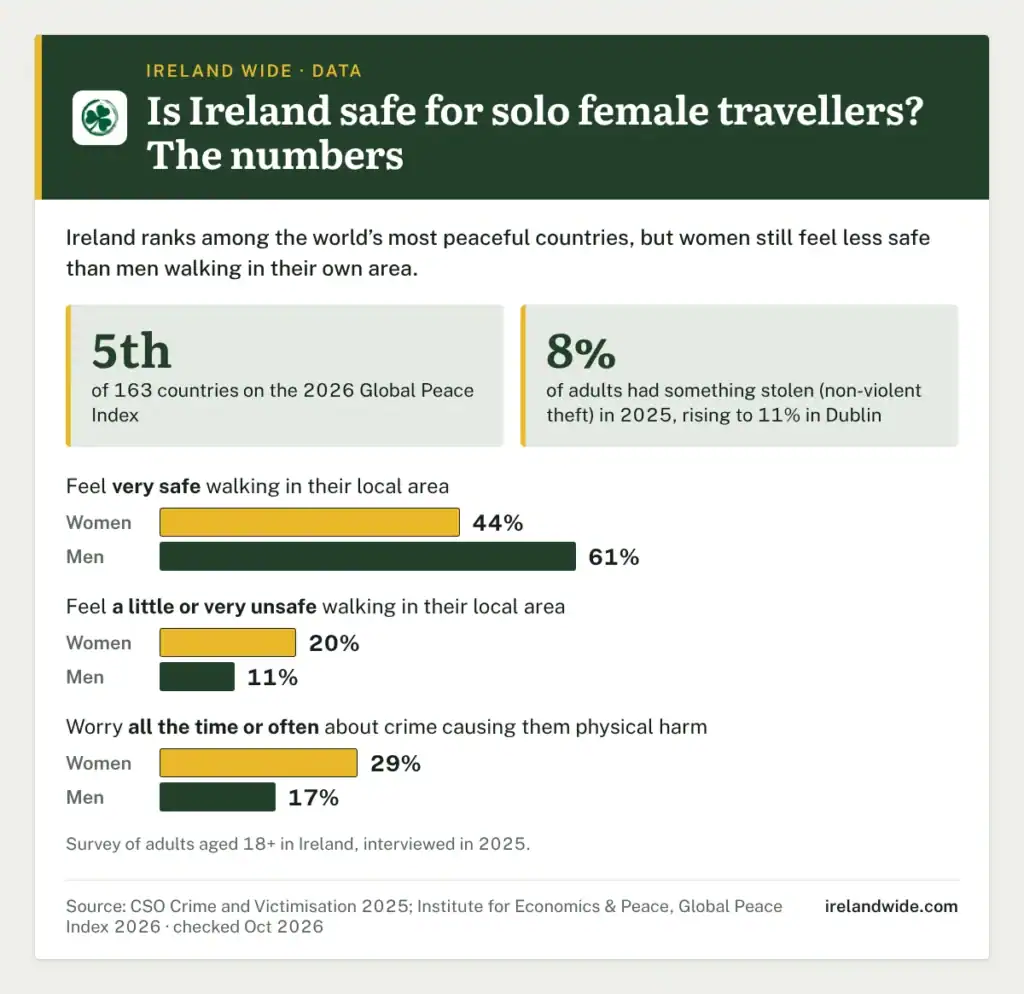
Newer figures tell a similar story. In the CSO’s Crime and Victimisation 2025 survey, published in September 2026, 44% of women said they felt very safe walking in their local area, compared with 61% of men, and 20% of women felt a little or very unsafe.
The same could be said of almost any city, and it doesn’t take much to avoid those situations. If you’re heading out at night, pre-book a taxi so you know you’ll get home safe, and don’t wander off into any quiet or poorly-lit streets.
Women living in Dublin also fear harassment, especially in bars and public spaces, but few travelers seem to encounter the problem, possibly because it happens outside the main tourist areas.
Ireland has strict laws in place to protect women and is, according to a study by the travel company, Bounce, one of the safest countries a solo female can visit.
What Makes Ireland a Safe Destination for Female Travelers?
According to the 2026 Global Peace Index, Ireland is the fifth most peaceful country in the world, behind Iceland, New Zealand, Switzerland and Slovenia. It also enjoys a comparatively low crime rate, although it does vary from region to region.
Violent crime towards tourists is uncommon, but petty theft occurs fairly regularly in tourist hotspots like Galway, Cork, and Dublin.
The CSO’s latest figures back that up: 8% of adults experienced non-violent theft in 2025, up from 4% in 2019, and Dublin was highest at 11%. Here’s how the numbers stack up:
That’s no reason to cancel your vacation – all you need to do is take some basic travel safety precautions, and you’ll be fine.
Reading Suggestion: 24 Things To Do in Dublin at Night
Simple things like securing your belongings, and keeping your phone somewhere safer than in your back pocket, will go a long way to making your trip stress-free.
Car and bike theft incidents have also risen in recent years, reaching a seven-year high in 2022. That makes hiring a vehicle more dangerous, especially if you opt for a popular make like a Volkswagen Golf, Volkswagen Passat, or Ford Focus.
The latest CSO survey found that 4% of vehicle owners or users experienced a theft or attempted theft in 2025, rising to 10% in Dublin, so it’s worth taking seriously in the capital.
To avoid issues with car theft, book accommodation with safe, off-road parking or, if that’s not an option, park in a well-lit area and ensure the car’s alarm system is engaged.
Women traveling solo will generally feel more comfortable traveling alone outside the major cities, where the crime rate is lower and there’s less chance of public harassment.
Is Ireland’s Public Transport Safe for Female Tourists?
I used Dublin’s tram network frequently during my stay in Ireland and felt completely safe at both the stops and on the tram itself. I never encountered any hostility or harassment. In fact, I traveled around so freely that I felt invisible.
Credit to Anne Burgess via CC Attribution-Share Alike 2.0
I rarely ventured out at night, however, which is when most Dubliners say they feel unsafe on public transport.
The Dublin Live news website ran a poll asking commuters if they feel safe on the city’s public transport, and the majority said that they did, but not after dark.
If something does make you uneasy, you can report it discreetly. On the Luas, text LUAS to 51444 with the tram number and where you are, and on trains and the DART, text TRAIN to 51444. Both are listed on Transport for Ireland’s security page, and there’s CCTV on buses, trams and the rail network. For anything serious, call 999 or 112.
Outside Dublin, trains are a relaxed way to get between cities, and our 10-day Ireland by train itinerary shows how to plan a whole trip around them.
Traveling Safely in Dublin After Dark
The answer would be to either miss out on Dublin’s nightlife altogether or find an alternative form of transport.
Taxis are one option, and Ireland now has more licensed taxi drivers than at any point in the last ten years, which should make them available and safe. I took a taxi while in Belfast and found it surprisingly economical. I was also lucky enough to have a charming and professional driver.
Unfortunately, the demand rises when the sun goes down, leaving many travelers frustrated. Some may even feel unsafe as they struggle to secure a ride home.
Part of the problem is that fewer drivers work late nights and weekends, according to the National Transport Authority’s own research, so a Saturday night queue at a taxi rank can be long.
To avoid such incidents, book a cab before you leave for the evening, and ask your accommodation provider for a recommendation. That way, you’ll get a trusted driver who knows the property and will get you there in record time!
Reading Suggestion: 8 Free Museums in Dublin
You can also use Transport for Ireland’s Driver Check App to check that the vehicle has been registered correctly and the driver has an appropriate license.
It also shows the driver’s photo and lets you share your journey details with a friend. Our guide to using taxis in Ireland covers booking, fares and paying by card.
Ride-sharing isn’t available in Ireland yet, and companies like Uber have been met with strong resistance. You can use the Uber app but only to book a taxi, which you can also do using apps like Lynk Taxis and FREE NOW Ireland.
That’s not changing any time soon. In February 2026, the Transport Minister said allowing private cars to carry paying passengers was not Government policy.
Tips on Car Hire Safety for Solo Female Travelers
If you’re planning on roaming further afield, hiring a car is the best way to see Ireland and is also very safe. Having your vehicle stolen is a concern in some major cities, but in more rural areas, even popular makes will be safe parked on the street.
Driving in Ireland is also safe, as long as you can come to terms with driving on the left! Ireland’s roads are well-maintained, and traffic flows relatively smoothly, even on major routes like the M50.
If you’re not used to driving with a stick shift, this is not the time to try it! Everything’s already on the wrong side, so don’t confuse yourself even more with a manual vehicle if you drive an automatic at home!
Brush up on the rules of the road before you go, too. Our rundown of Irish laws tourists need to know covers the essentials, including drink-driving limits.
Safety for Solo Women in their Home Away from Home
Whether you’re booking into a five-star hotel or a boutique hostel, you want to know that you and your belongings will be safe, which means doing some research before you book.
Make sure your chosen accommodation is in a safe area with a low crime rate and well-lit streets. Local news stories often shed light on an area’s safety, while apps like My Safetipin give you more detailed insights into an area’s street lighting and visibility.
Reading Suggestion: Stay Safely in these Stunning Castle Stays in Ireland
While I’ve stayed at many hostels, I’m always a little nervous about booking in. My biggest concerns are losing personal items, or having them stolen, which is very easy to avoid. These days, most hostels provide lockers for guests to stash their personal effects in, removing that fear altogether.
Staying in a shared house with strangers also triggers my anxiety, fearing I’ll end up with someone who makes me uncomfortable. Booking through Airbnb or a similar site puts me at ease, however. I read every review I can find, making sure the host is, well, hospitable. If there are no reviews or any hint of negativity about the host, I won’t book!
You can travel the whole of Ireland and Northern Ireland pretty safely, although there are areas in most of the main cities that you’re better off avoiding. Some of the safest destinations include Galway, Killarney, Westport, and Cork.
Galway and Westport are both on the west coast, and our travel guide to the west coast of Ireland is a good place to start planning.
Staying Safe While Venturing Out After Dark
Ireland might be one of the safest places in the world to travel as a solo female traveler, but when the sun goes down and the alcohol starts to flow, things can get a little out of hand.
Bear in mind that “after dark” comes early in winter. In late December, the sun sets in Dublin at around 4pm, while in late June it stays light until almost 10pm. If you’re visiting in winter, the weather in Ireland in December guide will help you plan your days.
Going out alone at night is always a little nerve-wracking for solo women, so you want to keep your wits about you. It might be tempting to try a fourth cocktail, but is it wise?
Women do sometimes complain about sexual harassment in pubs and bars across Ireland, so if you feel uncomfortable, let someone know. Tell one of the staff if something’s unsettled you, and ask them to help you call a taxi. It’s better to end the night early than take a risk.
A safer way to explore Ireland’s main cities at night is by joining a tour of some description. You could join an organized pub crawl, for instance, where you have safety in numbers and a tour guide looking after you all.
Just as there are some areas you should avoid when booking accommodation, there are others you should steer well clear of when out for the night. Pearse Street in the south of Dublin is often reported as having one of the highest numbers of crimes in the city, while Tallaght is also potentially dangerous.
Did You Know: Dingle Peninsula is definitely worth a visit when you are visiting Ireland
As a tourist, you’re unlikely to wander into these zones by mistake, but if anyone suggests moving onto a club somewhere you’re unfamiliar with, your safest bet is to say no.
Outside the cities, the pubs are smaller and usually accommodate a mixture of locals and tourists. These tend to have a friendlier vibe than the big inner-city pubs and are generally very friendly and sociable. Again, keep an eye on how much you’re drinking and stay alert.
How to Stay Safe by Respecting Irish Culture?
Women are equal in Irish society, just as they are in the US. That doesn’t mean they necessarily get the same job opportunities or pay scale, but there’s nothing in the Irish culture that disrespects or belittles women.
The Irish people are generally laidback and friendly, whatever your gender, but there are a few things that you may do or say as a tourist that won’t be well received.
Reading Suggestion: Ireland is Known for These 20 Typically Irish Things
Women wear similar clothes in Ireland as in the UK and the rest of Europe, although they tend to be a little more reserved. Dress according to the weather rather than fashion, and you’ll fit in just fine.
Drinking is a sociable event in Ireland, and people will happily offer to buy a round for whoever they sit with. If someone buys you a drink, be sure to return the favor. Not doing so is considered extremely rude. And make sure to remember some Irish drinking songs to sing along with the locals.
Voicing your opinions about politics or religion can get you in a lot of hot water, depending on the audience. In Northern Ireland, the shadow of the Troubles still lingers, making it a sore point for many, so it’s a subject best avoided unless you’re willing to ask questions and keep your opinions to yourself.
If you’re crossing the border, it helps to know the differences between Northern Ireland and Ireland, from the currency to the emergency numbers.
Emergency Numbers and Help for Solo Female Travelers in Ireland
I always save a few numbers to my phone before I land, just in case. Here are the ones worth having for Ireland and Northern Ireland:
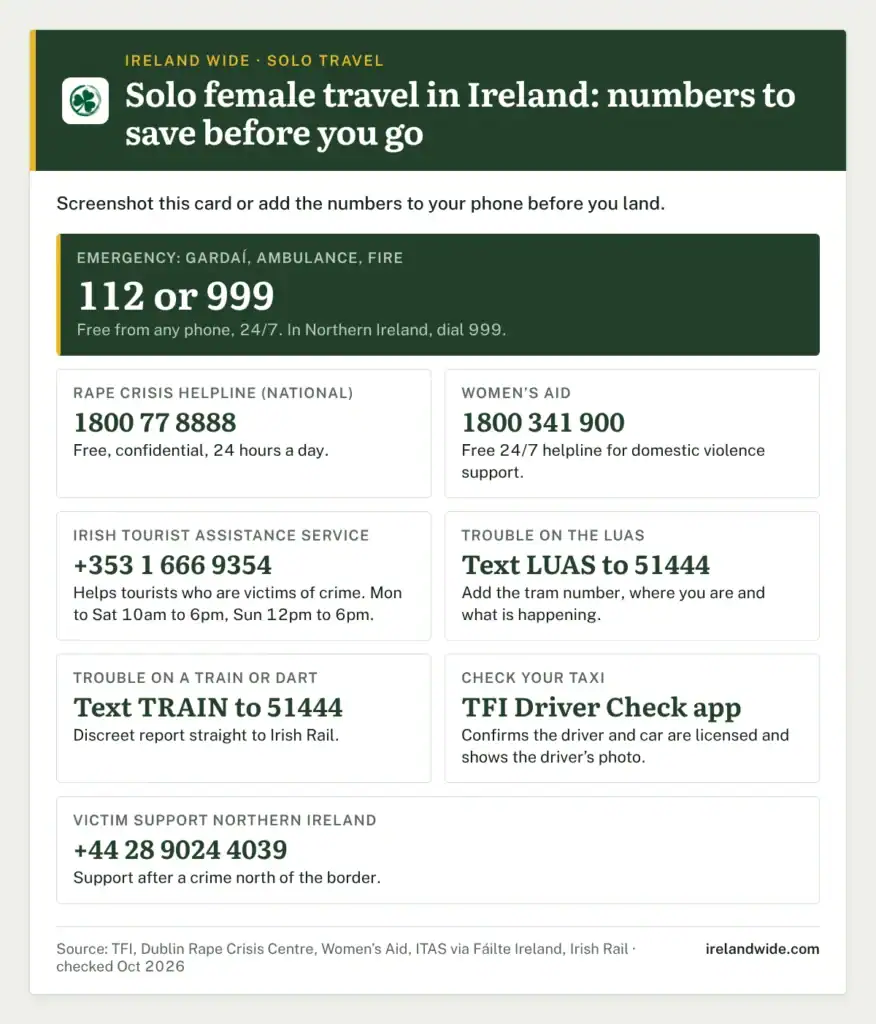
| Who | Number | When to use it |
|---|---|---|
| Gardaí, ambulance, fire (Republic of Ireland) | 112 or 999 | Any emergency, 24/7 |
| Police, ambulance, fire (Northern Ireland) | 999 | Any emergency, 24/7 |
| Rape Crisis Helpline | 1800 77 8888 | Free, confidential support, 24 hours a day |
| Women’s Aid | 1800 341 900 | Domestic violence support, 24/7 |
| Irish Tourist Assistance Service (ITAS) | +353 1 666 9354 | Help for tourists who are victims of crime |
| Luas anti-social behaviour | Text LUAS to 51444 | Report a problem on a tram |
| Irish Rail and DART | Text TRAIN to 51444 | Report a problem on a train |
| Victim Support Northern Ireland | +44 28 9024 4039 | Support after a crime in Northern Ireland |
If you’re the victim of a crime as a tourist, report it to the Gardaí first and then contact ITAS. Its staff speak several languages and are used to helping visitors.
General Safety Precautions for the Solo Traveller
- Don’t carry large sums of cash. Credit and debit cards are accepted almost everywhere in Ireland and can be tucked discreetly into a secure bag or money belt.
- Leave your valuables behind. When venturing out, leave valuables like your passport, extra money, and jewelry in your hotel safe, and only take what you need for the day.
- Make sure someone knows where you’re going and when you plan to return. You can notify the hotel staff or keep in touch with a friend or family member back home. That way, if you are delayed for any reason, someone will respond quickly and know where to start looking for you.
- Don’t drink too much, and make sure you can always see your drink.
- Tell someone if you feel uncomfortable or leave the situation altogether.
- Book accommodation in a safe area and avoid areas with high crime rates and poorly lit streets.
- Avoid public transport after dark and use an app to pre-book a taxi so you’re not left stranded
- Book an organized tour if you want to explore the city at night – you’ll be safer in a group and have a tour guide to look after you
- Save 112 and 999 in your phone, along with your accommodation’s address and Eircode, so you can tell the emergency services exactly where you are.
- Check your taxi with the TFI Driver Check app and share your journey with a friend.
FAQs About Solo Female Travel in Ireland
Is Ireland safe for solo female travellers?
Yes. Ireland ranks 5th of 163 countries on the 2026 Global Peace Index and violent crime against tourists is uncommon. Petty theft in busy city centers and late-night situations in pubs are the main things to watch for.
Is Dublin safe for a solo female traveller at night?
Central Dublin is generally safe at night if you stick to busy, well-lit streets and pre-book a taxi home. Most Dubliners say they feel safe on public transport during the day but less so after dark, so a taxi is the safer choice late at night.
What number do I call for the police in Ireland?
Call 112 or 999 in the Republic of Ireland and 999 in Northern Ireland. Both are free from any phone and connect you to the Gardaí or police, ambulance and fire services.
Can you use Uber in Ireland?
Only to book a licensed taxi. Private-car ride-hailing isn’t allowed in Ireland, so Uber, FREE NOW and Lynk all send a registered taxi.
Where is safest in Ireland for solo female travellers?
Smaller towns and rural areas tend to feel the most relaxed. Galway, Killarney, Westport and Cork are popular, easy places to base yourself, and you can travel the whole of Ireland and Northern Ireland with the usual precautions.
What should I do if I’m a victim of crime in Ireland?
Report it to the Gardaí first, then contact the Irish Tourist Assistance Service on +353 1 666 9354. For sexual violence, the Rape Crisis Helpline on 1800 77 8888 is free and open 24 hours a day.
Conclusion
Ireland is one of the safest countries you can visit as a solo female traveler. The crime rate is low, the people are friendly, and the roads are safe. I felt completely comfortable in Ireland even though I didn’t know a single person there, and I was well looked after by everyone I came into contact with.
I’d highly recommend traveling solo in Ireland, but only if you’re willing to take certain precautions, like booking accommodation in a safe location and avoiding areas with a bad reputation or high crime rate.
A bit of common sense and cultural awareness also go a long way to keeping you safe, especially when traveling solo.
Ready to start planning? Our Ireland trip planner brings everything together, from when to go to how to get around.
Continue Reading:
- Why Are The Irish Called Lucky?
- An Irish Blessing for Each Situation
- Impress the Locals With These Typical Irish Sayings