
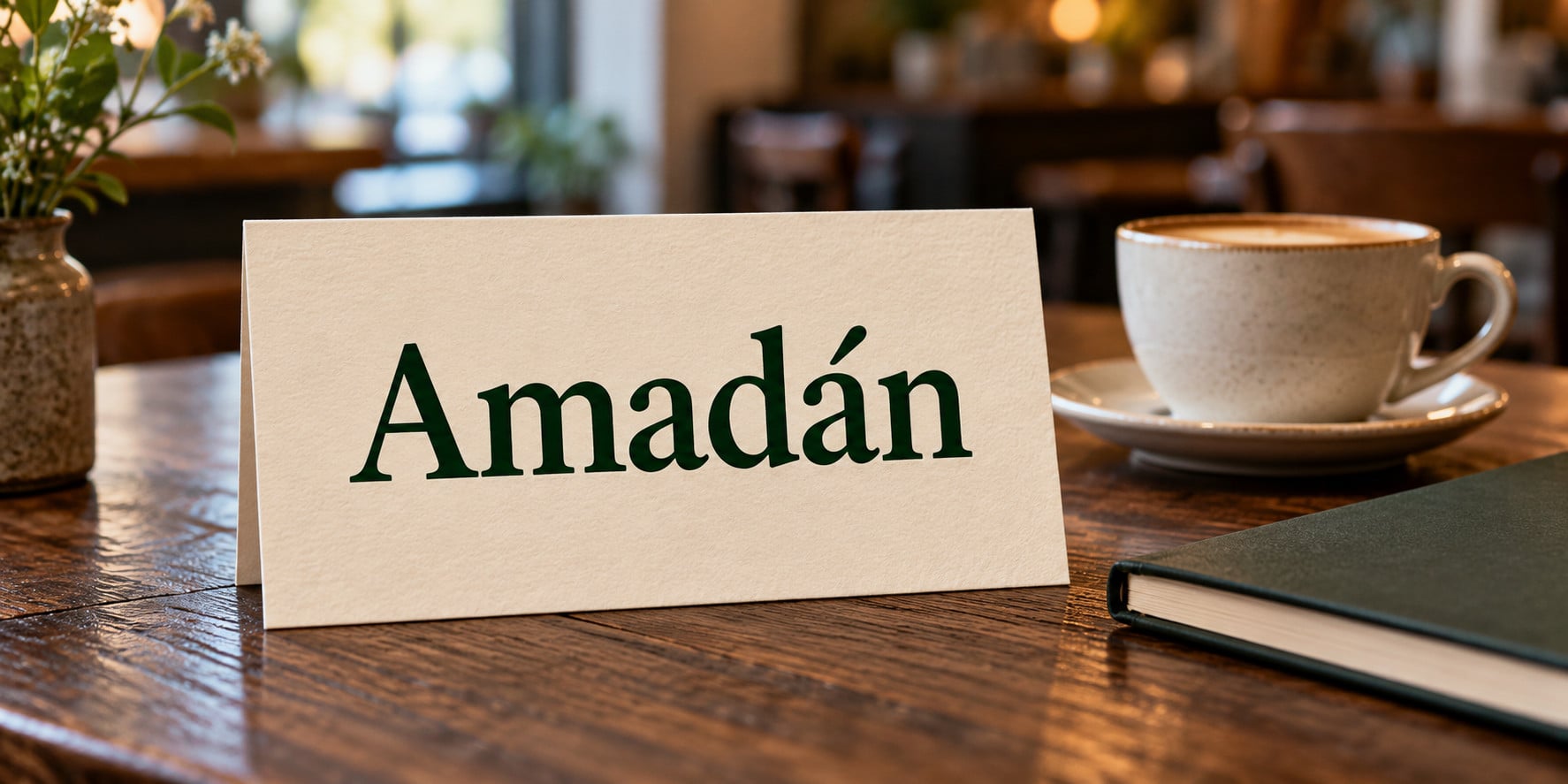
Amadán is an Irish word meaning “fool”; “idiot” can also be a suitable English translation in context. It can sound like teasing between close friends or a direct insult during an argument. The relationship and delivery do much of the work.
If you searched for “amadan,” the standard Irish spelling is amadán, with a fada over the final a. Knowing how to say it does not automatically make it a good greeting, though.
| Question | Answer |
|---|---|
| Main meaning | Fool; sometimes translated as idiot depending on the sentence |
| Correct spelling | Amadán, with the fada over the final a |
| Rough syllable guide | ah-muh-dahn; use dialect audio for sounds and stress |
| Grammar | Masculine noun of the first declension |
| Direct address | A amadáin! means “You fool!” |
| Tone | Potentially insulting; familiarity may make it playful |
The amadán entry in Teanglann’s Foclóir Gaeilge–Béarla gives “fool” as its ordinary person-related meaning. Foras na Gaeilge’s English–Irish entry for “idiot” also includes amadán among its translations.
The best translation depends on the whole remark. “Fool” is a useful starting point; “idiot” may better convey a sharper delivery. Neither English word captures the speaker’s tone on its own.
There is no separate dictionary meaning that guarantees affection. A familiar speaker might intend teasing, but a recipient can still hear an insult.
A rough English syllable guide is ah-muh-dahn. Use the Teanglann pronunciation recordings for amadán for a better model: the page offers recordings labelled Ulster, Connacht and Munster.
English respelling cannot reproduce every Irish sound or provide one reliable stress pattern for all dialects. Choose a recording and copy its rhythm as well as its individual sounds. If you are learning a particular dialect, use that model consistently.
The accent is the síneadh fada, usually shortened to “fada.” It marks the final á as a long vowel. Its precise sound depends on dialect.
Vowel length and stress are different things. The fada marks vowel length; it does not by itself tell you which syllable receives the strongest emphasis. Follow the audio for that.
Use amadán when writing Irish, even if an unaccented search finds the same page. Keep the fada in a message, language exercise or design. Small mark, worth keeping.
It can be insulting because it labels a person a fool. A light delivery among friends who already tease one another may soften it. Said sharply in a disagreement, it becomes a personal attack much more readily.
Written messages give the recipient less help with tone. If you are learning Irish, recognising the word is a useful first step before trying it out on people. The dictionary gives you a meaning, not permission to greet a new acquaintance as an idiot.
| Situation | Practical reading |
|---|---|
| Close friends teasing | Possibly playful if that relationship and style of joking are already established |
| Strangers or colleagues | A risky personal label; familiarity cannot be assumed |
| An argument | Likely to be heard as an insult |
| Talking about yourself | Can express self-criticism; its strength still depends on delivery |
If your aim is to point out an error, describe the mistake or action. You will usually get a clearer message across with a smaller chance of starting a second argument.

The first two sentences below are simple illustrative examples. The direct-address expression is also documented in Teanglann. Teasing or anger would come from the surrounding conversation.
| Irish | English | Grammar or use |
|---|---|---|
| Is amadán mé. | I am a fool. | The speaker applies the word to themselves |
| Is amadán é. | He is a fool. | A direct judgement about another person |
| A amadáin! | You fool! | Direct address, using the vocative |
The Teanglann grammar entry for amadán identifies a masculine first-declension noun. It lists amadáin as the genitive singular and nominative plural.
For direct address, the dictionary’s phrase examples give a amadáin. The initial a is the vocative particle. The added i before the final n signals a slender final consonant.
The fada stays on á. The extra i changes the written form and pronunciation; it is not simply an English “you” attached to an otherwise unchanged noun.
Amadán is an Irish-language word. When someone uses it in an otherwise English sentence, they are borrowing the Irish word. Our guide to Irish sayings and phrases gives wider conversational context.
The ordinary meaning is “fool.” Any affection comes from the relationship, situation and tone, rather than a separate guaranteed-friendly meaning.
Only if the person is comfortable with it. Since it labels someone a fool, do not assume it is a welcome nickname for a new acquaintance.
The standard Irish spelling is amadán. The unaccented form may appear in searches or systems that omit accents, but the fada belongs in correctly written Irish.

Matt Hook is a Canadian writer of Scottish and Irish heritage. He built his writing career creating detailed gaming guides, turning complex mechanics, history and lore into useful information for readers. Matt brings that same research-focused approach to Ireland Wide, where he writes about Irish travel, heritage, history and culture. He also holds CMA and CPA designations as a professional accountant, giving him a strong background in research, accuracy and attention to detail.
At Ireland Wide, our aim is to bring authentically Irish insights to you, wherever you are.
Whether you have some feedback or would like to offer some of your own insights for everyone else to explore, don't hesitate to get in touch with us!