If you want to know what people in Ireland actually go out and do at Christmas, the short answer is panto, concerts and a handful of old customs that still draw crowds. Pantomime is the big one: the Gaiety Theatre in Dublin is celebrating over 150 years of pantomime with this season’s Robin Hood, and most sizeable towns have a panto of their own running somewhere between late November and mid-January.
Around the panto sit the Christmas concerts (Handel’s Messiah has deep Dublin roots), carol services, the Christmas Eve busk on Grafton Street, the Christmas Day swim, Wren Day on 26 December and Nollaig na mBan on 6 January. This guide explains what each one involves, who it suits, what it typically costs, and how to find dates you can trust for the year you’re travelling.
Christmas Entertainment in Ireland at a Glance
The season has a fairly predictable shape, which makes planning easier than the sheer number of listings suggests. Use this table to see what falls when.
Pick who is going and the date you are free to see which Christmas outings fit.
| Entertainment | When it usually happens | Where | Typical cost | Best for |
|---|---|---|---|---|
| Pantomime | Late November until mid-January | Theatres, arenas and parish halls nationwide | From about €23 in Dublin; £17.50 to £43.50 in Belfast | Families with children aged 3 and up |
| Handel’s Messiah and choral concerts | Early to mid-December | Concert halls and cathedrals | €25 to €40 at the National Concert Hall | Adults, choral and classical fans |
| Carol services | December, peaking the week before Christmas | Cathedrals and parish churches | Often free or by donation | Everyone |
| Christmas Eve busk | 24 December, evening | Grafton Street area, Dublin | Free (donations to charity) | Music fans, anyone in Dublin city |
| Christmas Day swim | 25 December, morning | Coastal bathing spots | Free, often a charity fundraiser | Hardy swimmers and spectators |
| Wren Day | 26 December | Dingle and parts of Kerry, Limerick and Cork | Free to watch | Anyone curious about living folk custom |
| Nollaig na mBan | 6 January | Homes, pubs and restaurants | Varies | Groups of friends, women especially |
Pantomime: Ireland’s Favourite Christmas Show
A pantomime, or panto, is a loud, silly musical comedy built on a fairy tale such as Cinderella, Aladdin or Jack and the Beanstalk. For a lot of Irish children it’s their first trip to a theatre, and the tradition is strong enough that UCC folklore lecturer Dr Aoife Granville told RTÉ, “There has to be hundreds of them happening this season.”
Pantomime has nothing to do with the Christmas story, but it has become as much a part of the Irish season as the tree and the turkey. If you’re new to Irish Christmas traditions still celebrated today, panto is the one that confuses American visitors most, because it has no real equivalent in the United States.
What Happens at an Irish Panto
Every panto follows a loose set of rules. There’s a dame, a man in a huge frock and outrageous make-up, who plays the hero’s mother or nanny. There’s a comic hero who talks straight to the children, a villain to boo, and a love story nobody takes too seriously. The audience shouts “He’s behind you!”, argues “Oh no it isn’t!” and sings along when the lyrics are lowered on a board.
The jokes work on two levels: slapstick for the kids and topical, local digs for the adults. Irish pantos lean hard on local references, and many of the larger productions also cast well-known TV and music faces to sell tickets.
The Big Panto Houses and Their 2026/27 Shows
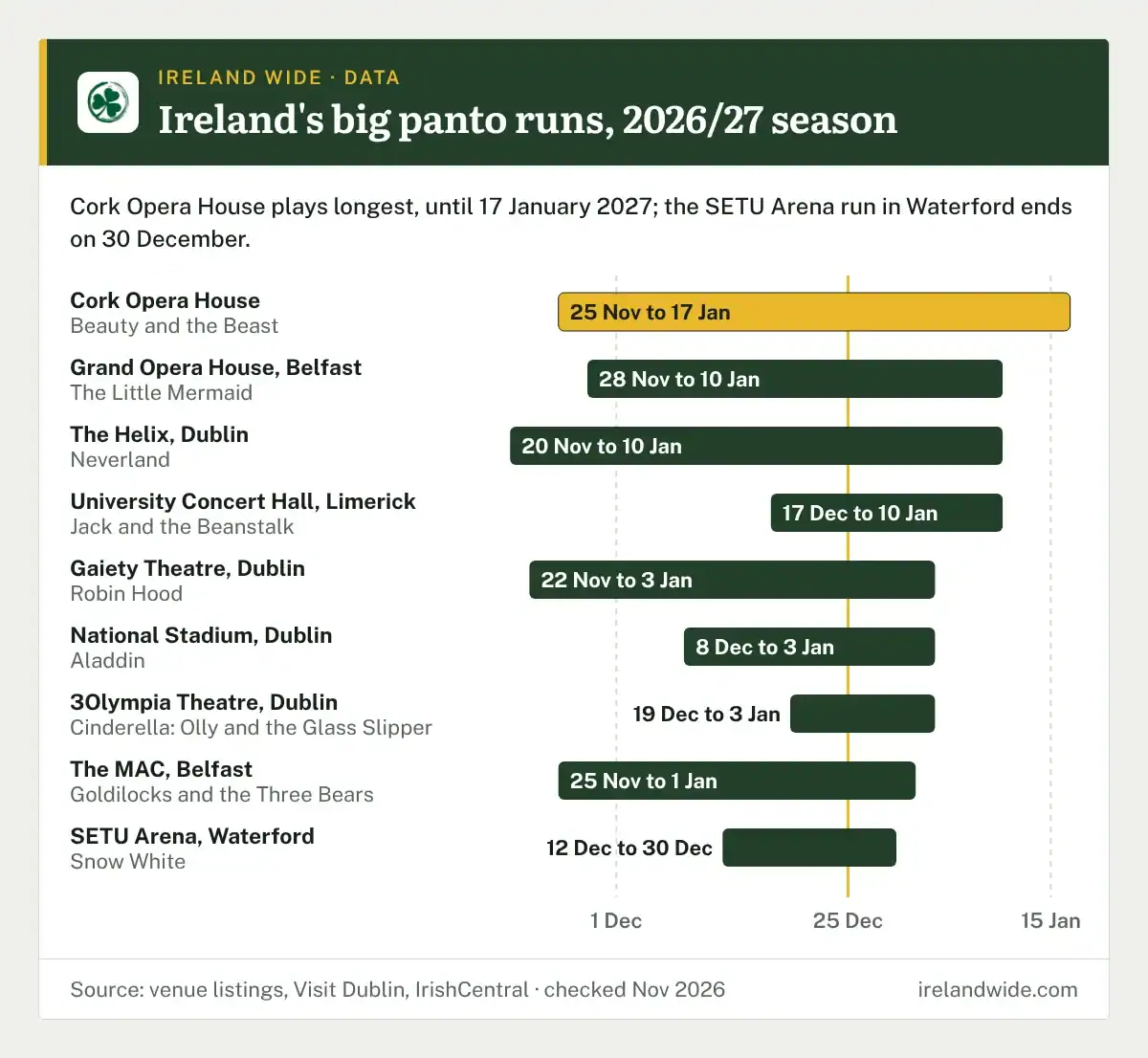
These are the longest-running and largest productions on the island this season. Dates and prices come from the venues’ own listings and change as shows sell out, so treat them as a guide for this season only.
| Venue | City | 2026/27 show | Run | Tickets |
|---|---|---|---|---|
| Gaiety Theatre | Dublin | Robin Hood | 22 Nov 2026 to 3 Jan 2027 | From €23 |
| Cork Opera House | Cork | Beauty and the Beast | 25 Nov 2026 to 17 Jan 2027 | €30, €35 or €45 plus fees; family pass from €165 |
| Grand Opera House | Belfast | The Little Mermaid | 28 Nov 2026 to 10 Jan 2027 | £17.50 to £43.50 including fees |
| 3Olympia Theatre | Dublin | Cinderella: Olly and the Glass Slipper | 19 Dec 2026 to 3 Jan 2027 | Check venue |
| The Helix | Dublin | Neverland | 20 Nov 2026 to 10 Jan 2027 | Check venue |
| National Stadium | Dublin | Aladdin | 8 Dec 2026 to 3 Jan 2027 | Check venue |
| University Concert Hall | Limerick | Jack and the Beanstalk | 17 Dec 2026 to 10 Jan 2027 | Check venue |
| SETU Arena | Waterford | Snow White | 12 to 30 Dec 2026 | Check venue |
| The MAC | Belfast | Goldilocks and the Three Bears | 25 Nov 2026 to 1 Jan 2027 | Check venue (£) |
The Gaiety is the historic home of Dublin panto, and the Grand Opera House in Belfast has a similar claim: the theatre opened with a pantomime in December 1895, and its dame, May McFettridge, is back this year for her 36th season there. In Cork, the Opera House runs one of the longest seasons of all, with Beauty and the Beast playing until 17 January 2027. The other shows in the table are part of the 2026 Christmas panto line-up, so check each venue’s own site for prices.
Local and Community Pantos
Outside the big houses, panto is a community affair. Drama societies, GAA clubs and parish groups stage their own versions in town halls and arts centres, often in January once the professional shows have filled the December diary. Dublin’s suburban theatres are a good example: the Civic Theatre in Tallaght, the Axis in Ballymun and Draíocht in Blanchardstown all run family pantos, and Draíocht’s Snow White panto lands in January.
These shows are cheaper, shorter on special effects and long on local jokes. If you’re staying in a small town over Christmas, the local panto is one of the most authentic nights out you’ll find, and the whole parish will be there.
Booking Tips for Panto
- Book early for December weekends. At Cork Opera House, many performances from early December through Christmas were already marked sold out by late November.
- Look for family passes and cheaper dates. Cork’s lowest €30 tickets are only offered on certain early-run and January dates, and its family pass starts at €165.
- Ask about relaxed and signed performances. Cork has a relaxed family performance on Wednesday 9 December at 4pm. Belfast’s Grand Opera House has a signed show on 16 December at 7pm and a relaxed show on 5 January 2027 at 6pm.
- Check the age guidance. The Belfast show is recommended for ages 3 and up and runs about two hours with an interval, and Cork requires under-16s to sit beside an adult aged 18 or over.
Christmas Concerts, Carols and Choirs
December is the busiest month of the year for Irish choirs. Expect cathedral carol services, big orchestral Christmas programmes, gospel choirs and film-with-orchestra concerts, plus plenty of smaller church performances that never make the national listings.
Handel’s Messiah, Dublin’s Own Christmas Classic
Messiah has a stronger claim on Dublin than on any other city. The first performance of Handel’s Messiah was given at the New Musick Hall, Fishamble Street on 13 April 1742, and annual charity performances there soon became a tradition. The hall is long gone, but the work became a Christmas fixture.
The best-known Christmas performance is Our Lady’s Choral Society with the RTÉ Concert Orchestra at the National Concert Hall. In 2026 it runs from 7 to 9 December at 8pm, with tickets at €25, €35 and €40. These nights usually sell out, so book as soon as you know your dates.
Carol Services and Cathedral Choirs
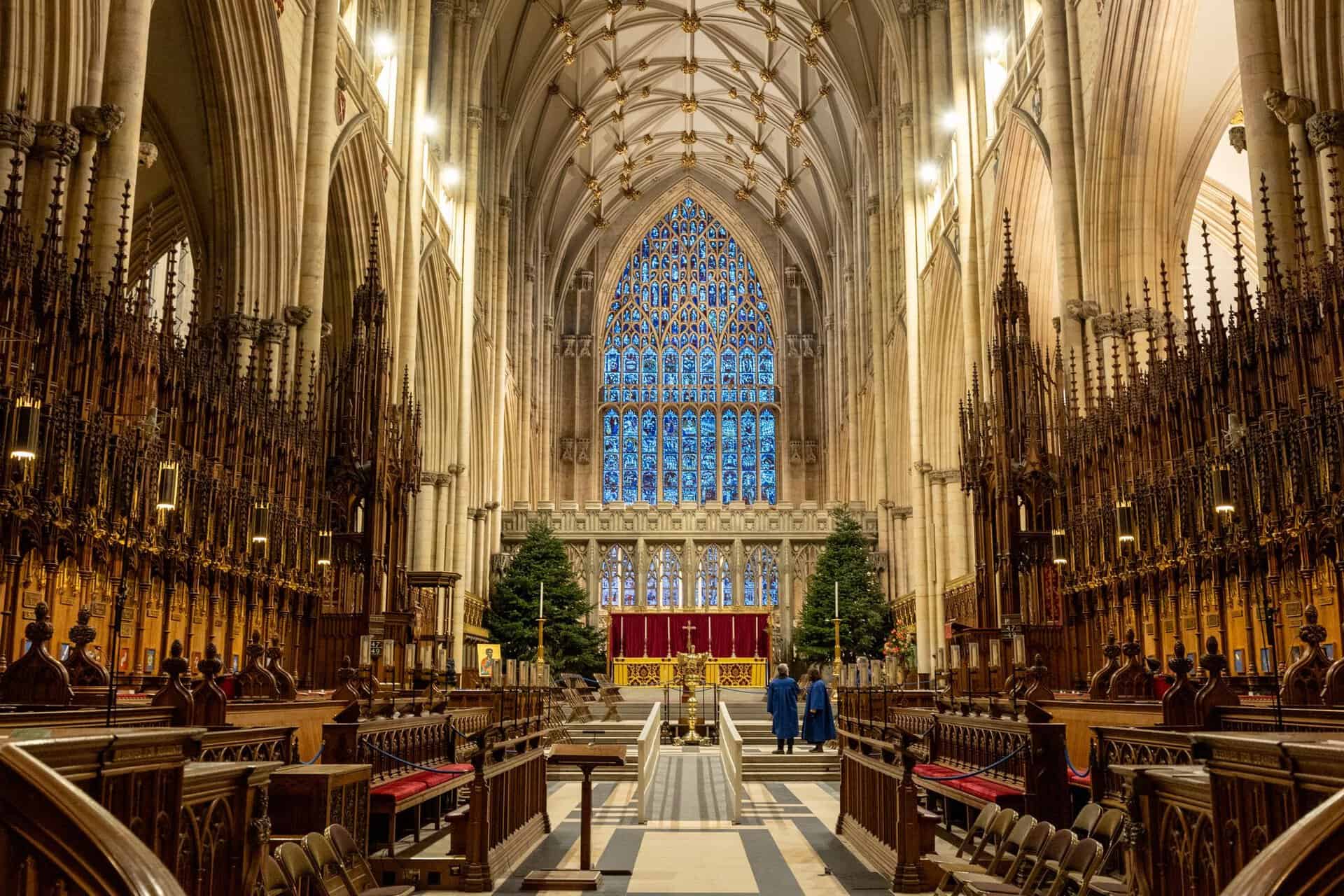
Carol services are the most affordable Christmas entertainment in the country, and many are free. Dublin’s two Church of Ireland cathedrals are the headline acts: St Patrick’s Cathedral choristers perform music from The Snowman on 23 December, and Christ Church Cathedral runs Christmas at Christ Church on 8 to 10 December. Smaller churches such as St Ann’s on Dawson Street and St Teresa’s on Clarendon Street host their own concerts.
Outside Dublin, cathedrals and parish churches hold their own carol services, and many parishes hold a midnight or vigil Mass with a choir on Christmas Eve. Check the parish or cathedral website the week before, as times change from year to year.
Film Concerts and Family Shows
Live orchestral screenings have become a seasonal staple. This year Home Alone in Concert plays the 3Arena on 20 and 21 December at 6pm with the RTÉ Concert Orchestra and the Dublin Gospel Choir (the Sunday show is already sold out), while the National Concert Hall’s programme includes The Snowman and the Dublin Choral Foundation’s Great Christmas Concert, marking its 30th anniversary. If you prefer a pint with your music, a trad session in a pub is the most Irish Christmas concert of all; our guide to things to do in Dublin at night lists pubs with live music.
Irish Seasonal Traditions You Can Watch or Join
Some of the best Christmas entertainment in Ireland costs nothing and needs no ticket. These are the customs that still pull crowds every year.
The Christmas Eve Busk on Grafton Street
On Christmas Eve, Glen Hansard leads a charity busk in Dublin city centre for the Dublin Simon Community. It started in 2010 as an impromptu sing-song on Grafton Street and is now an organised event outside the Gaiety Theatre. The 2025 edition marked its 15th anniversary, with Bono and Imelda May among the guests and a crowd sing-along to Fairytale of New York to close. Line-ups are never announced in full, so turn up early in the evening and bring some cash for the collection buckets.
The Christmas Day Swim
On Christmas morning thousands of people run into the sea around the island, many raising money for charity. Well-known spots include the Forty Foot in Sandycove, County Dublin, Guillamene Cove in County Waterford and the natural pool at Portnahapple in Portstewart, County Londonderry. The water in late December is cold enough to take your breath away, so go in briefly, never alone, and have warm clothes and a hot drink ready.
Wren Day on St Stephen’s Day
Wren Day (Lá an Dreoilín) falls on 26 December, St Stephen’s Day. Groups of wren boys in straw suits, masks and costumes go from house to house and pub to pub with music, collecting money. The custom has died out in most places, but Dingle in County Kerry keeps it going in style.
In Dingle, four main wran groups parade from midday until late: Sráid Eoin (John Street), Goat Street, The Quay and the Green and Gold. Each has a captain, a hobbyhorse, a banner, strawboys and a band, and the money goes to local charities. You can watch from the street for free; book Dingle accommodation early if you plan to stay over Christmas. Smaller wren groups still turn out in north Kerry, west Limerick and parts of Cork.
Racing on St Stephen’s Day
For many Irish families, St Stephen’s Day means a day at the races. Leopardstown in south Dublin hosts a four-day Christmas festival that starts on 26 December. It’s a good outing for adults who have had enough of the sofa; check the racecourse website for race times and tickets.
Nollaig na mBan on 6 January
The Irish Christmas season traditionally closes on 6 January, the Epiphany, known as Little Christmas or Women’s Christmas (Nollaig na mBan). Traditionally women took the day off and went out together while the men stayed home, and it’s still a popular night for women to book a meal or meet in the pub. Many households take the tree down the day after, and by then most pantos are heading into their final week.
Christmas at Home: The Toy Show, Candles and Songs
Some Irish Christmas entertainment happens on the sofa. RTÉ’s Late Late Toy Show, broadcast on a Friday night in late November or early December, is the unofficial start of the season for many families. On Christmas Eve, households light a candle in the window, and Fairytale of New York is played everywhere from pubs to petrol stations. If you’re asked to sing, our list of Irish drinking songs to sing in a pub will keep you covered.
Christmas Markets, Lights and Ice Rinks
Markets, light trails and skating rinks are newer additions, but they now fill the gaps between the shows. In Dublin this year, TwinkleTown at Smithfield Square and St Patrick’s Park combines an ice rink, fairground and alpine-style stalls, Everwinter runs at the RDS until 23 December, with its ice rink reopening from 26 December to 3 January, and Dublin Winter Lights continues through to St Brigid’s weekend in February. Dublin Zoo’s Wild Lights and the lights at Malahide Castle are the big ticketed trails.
Markets are not a long-standing Irish custom; the history of Christmas markets in Ireland is a relatively recent one. Many cities run seasonal markets through December, and smaller towns often hold one-day craft fairs at weekends.
How to Find Reliable Christmas Event Listings in Ireland
Christmas listings change fast, and plenty of pages online still show last year’s dates. These steps will save you a wasted trip.
- Go to the venue’s own website first. Theatres, concert halls and cathedrals publish the definitive dates, times and prices, including relaxed or signed performances that aggregator sites leave out.
- Use the tourism boards for an overview. Discover Ireland and Visit Dublin publish seasonal round-ups each year, and Visit Belfast covers Northern Ireland. Use them to find events, then confirm on the venue’s site.
- Check the year on every listing. Many event pages are recycled each December. If the weekday and date don’t match this year’s calendar, the page is out of date.
- Look local for community events. Parish newsletters, county council arts offices, local radio and the local newspaper carry community pantos, carol services and Christmas swims that never reach national sites.
- Check closures before you travel. Venues, shops and public transport run reduced hours on 24 to 26 December, so plan the swim or the wren around how you’ll get there and back.
Planning Around the Irish Christmas Holidays
Most Christmas entertainment in Ireland is timed around the school break and the public holidays. Panto matinees get busier once the Christmas school holidays in Ireland begin, and Christmas Day and St Stephen’s Day are both bank holidays in Ireland, when many businesses close.
The weather is the other factor. December brings short days and plenty of rain, so the outdoor customs need a waterproof and some flexibility. Our guide to the weather in Ireland in December covers temperatures, daylight and what to pack, and for the rest of the year’s events see our guide to festivals in Ireland in 2026.
Frequently Asked Questions
Is panto suitable for adults without children?
Yes. Irish pantos are written with jokes for adults alongside the slapstick, and evening performances at the bigger theatres draw plenty of adult groups and office parties.
Do pantos in Ireland run after Christmas?
Yes. Most professional pantos run into January, and the 2026/27 season at Cork Opera House continues until 17 January 2027, so you can still catch a show after the holidays.
What is the difference between St Stephen’s Day and Boxing Day?
They fall on the same date, 26 December. In the Republic of Ireland it is called St Stephen’s Day, while Boxing Day is the more common name in Northern Ireland and Britain; both are public holidays.
Can visitors join the Christmas Day swim?
Many swims are open to anyone who turns up, and charity swims often ask for a donation or advance registration. Only swim at a recognised bathing spot, stay close to shore and leave if conditions look rough.