If you have seen the Cailleach described as a Celtic winter goddess who built Ireland’s mountains, the folklore behind that picture is real, and so is a good deal of later embroidery. The Cailleach (pronounced roughly KAL-yukh) is the old woman of Irish tradition, best known as the Cailleach Bhéarra or Hag of Beara, and her name has been fixed to Irish hills, headlands and tombs for centuries. The earliest written trace of her is an Old Irish poem composed around 775 to 825 AD.
This guide explains who the Cailleach is in Irish folklore, how she became tied to winter, and which Irish landscapes carry her name. For each place, we separate what is documented (place names, folklore recorded from local people, early texts) from the modern retellings that have grown up around them, and add the practical details you need if you plan to visit.
Who Is the Cailleach in Irish Folklore?
In Irish, cailleach simply means an old woman or hag. The word goes back to Old Irish caillech, “veiled one”, built on caille, a veil, which was borrowed early from Latin pallium. The same word could mean a nun, which is worth keeping in mind when a story pits her against a monk or a saint.
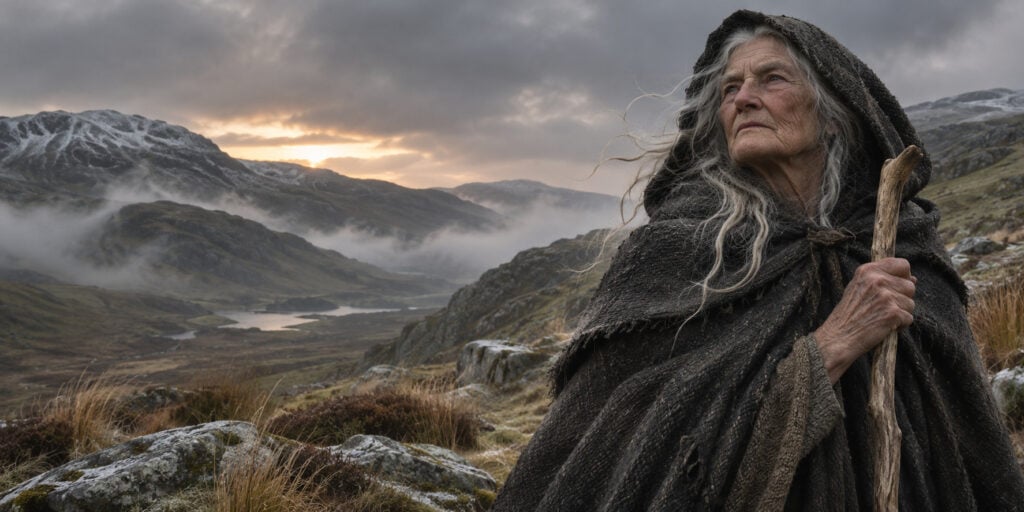
As a character, the Cailleach shows up in three broad forms. She is a very old, sometimes wicked woman in local stories; a giant who shapes the land by dropping stones or leaping between hills; and a figure of age and endurance who outlives husbands, children and whole generations. Folklorist Gearóid Ó Crualaoich of University College Cork places her among the wise woman, hag and Red Woman figures of an oral tradition with roots in pre-Christian Ireland, in stories about death, marriage, childbirth and healing.
She is often grouped with the gods and goddesses of Irish myth, and you will see her in lists alongside the Dagda and the Morrígan. The Cailleach sits a little apart from them: she belongs more to farmhouse storytelling and place names than to the medieval sagas, which is why she is so closely tied to specific spots on the map. Our overview of Irish gods and goddesses covers the better-documented deities, and the guide to Irish fairies and folklore covers the wider world of the otherworld and the old beliefs she shares space with.
The Lament of the Old Woman of Beare: Her Earliest Written Appearance
The oldest text linked to the Cailleach is a poem known in English as The Lament of the Old Woman of Beare (in Old Irish, Aithbe dam bés mora, “ebb-tide to me as to the sea”). The poem dates to around 775 to 825, from anonymous authors in Irish monastic scriptoria, and five manuscript copies survive in Trinity College Dublin and the National Library of Ireland.
The speaker is an old woman looking back on a youth of kings, feasting and fine clothes, now reduced to a veil and a nun’s life. Kuno Meyer published the first English translation in 1899, and Gerard Murphy’s edition followed in 1953. Scholars still debate how closely the poem’s speaker matches the folk Cailleach, but it is the reason the name “Beare” (Béarra, the Beara Peninsula on the Cork and Kerry border) is attached to her so firmly.
The poem also gives a clue to how her reputation as a figure of extreme old age developed: the speaker measures her life against the tide, which ebbs and never returns to her in the same way.
The Cailleach as Ireland’s Winter Figure
Most modern articles introduce the Cailleach as a winter goddess. That role is real in Gaelic tradition, though the clearest records of it come from Scotland and the Isle of Man, and it is worth knowing which details are Irish before you repeat them.
1 February and the Firewood Story
The best-known winter story is set on 1 February, the feast of St Brigid (Imbolc). The Cailleach goes out to gather firewood for the rest of the winter. If the day is bright, she has plenty of time to collect wood and winter will drag on; if it is wet and stormy, she is asleep and spring is near. The firewood tale recorded for St Bride’s day is recorded mainly in Scotland and the Isle of Man, so treat any claim that it is “the” Irish version with caution. It is often compared to Groundhog Day, which works for the weather logic, though no direct link between the two has been shown.
The pairing with Brigid gives the Cailleach her seasonal shape: she rules the dark half of the year and gives way to Brigid as the light returns. Our guide to Samhain, Imbolc and the other Celtic holidays explains where 1 February sits in the old calendar, and the piece on the St Brigid’s Cross covers the customs still kept on that day.
The Cailleach at the Harvest
The most firmly Irish winter custom involving her came at the end of the harvest. The last sheaf of corn standing in the field was known as the cailleach, and the spirit of the cailleach was said to be in that last sheaf. Harvesters threw their reaping hooks at it, and if she was not “slain”, hunger was feared in the year ahead. The cut sheaf was carried to the harvest feast and kept in the rafters or over the fire through the winter.
The link to the winter solstice is looser. Some modern accounts, including our own on the Celtic winter solstice in Ireland, describe her power fading as the sun returns; that reading belongs to the seasonal story told today and has less backing in recorded Irish folklore than the harvest custom.
Cailleach Landscapes in Ireland: Documented Tradition vs Modern Retelling
The Cailleach is tied to more places in Ireland than any single article can list, because “cailleach” also turns up as an ordinary place-name element. The six below are the best known, and each has at least one solid piece of evidence behind it. The table sums up what is documented and what is a later retelling.
Filter the six Cailleach sites by the kind of place you want to see, and sort them by their oldest dated record.
| Place | County | Documented evidence | Modern retelling to treat with care |
|---|---|---|---|
| Hag’s Head (Ceann Caillí) | Clare | Place name recorded as “Can Kalye” in 1571 | The rock is her face; the Mal of Malbay chase |
| Loughcrew (Sliabh na Caillí) | Meath | Apron-of-stones legend told locally before the 1860s | Wishes granted in the Hag’s Chair |
| Hag’s Glen (Com Caillí) | Kerry | Townland name recorded as “Comecally” in 1737; hag story collected in 1940 | Three quarrelling hags and footprints in the rock |
| Hag of Beara rock, Kilcatherine | Cork | Turned to stone in a story from the 1930s Schools’ Collection | Waiting for her husband Manannán mac Lir |
| Labbacallee wedge tomb | Cork | Known locally as the Hag’s Bed; excavated in 1934 | Precise details of her burial there |
| Slieve Gullion | Armagh | Cairn opened by locals searching for her in 1789 | Bathing in the lough turns your hair white |
1. Hag’s Head (Ceann Caillí), County Clare
Hag’s Head is the southern end of the Cliffs of Moher, and its Irish name, Ceann Caillí, means the hag’s headland. The name appears on Robert Lythe’s map of 1571 as “Can Kalye”, with the Irish form “Ceann Caillighe” in a text from 1749. That makes the name itself one of the best-dated Cailleach landmarks in the country.
The stories told about it are harder to pin down. Visitors are often told the rock profile looks like a woman’s head gazing out to sea, and a widely repeated tale has a sea witch, Mal of Malbay, chasing Cú Chulainn along the coast and falling to her death here. Both are better described as local and modern storytelling than as recorded tradition about the Cailleach herself.
2. Loughcrew (Sliabh na Caillí), County Meath
The Loughcrew hills in north-west Meath carry the Irish name Sliabh na Caillí, anglicised as Slieve na Calliagh, “the mountain of the hag”. The hilltops hold a cluster of Neolithic passage tombs, and the largest on Carnbane East is Cairn T. One of its kerbstones, a big stone worn into the shape of a seat, is known as the Hag’s Chair.
The local legend is that a hag dropped the cairns’ stones from her apron as she leapt between the hilltops. The antiquarian Eugene Conwell, who visited in 1863 and described the cairns to the Royal Irish Academy in 1864, later called it the wild legend that a witch had scattered these great heaps of stones out of her apron, told locally “from time immemorial”. That gives this story a better pedigree than most. The idea that sitting in the Hag’s Chair grants a wish is a modern addition.
Visiting: the OPW lists Loughcrew Cairns with free admission and access all year, with a car park. The climb to Cairn T is very steep, so wear proper footwear. At the time of writing the interior of Cairn T was closed for conservation works and guide presence had ended for the 2026 season. The chamber is aligned to sunrise at the spring and autumn equinoxes, which is when most people gather here.
3. The Hag’s Glen (Com Caillí), County Kerry
The Hag’s Glen is the valley most walkers use to approach Carrauntoohil in the MacGillycuddy’s Reeks. Its townland name is Com Caillí, “the hollow of the hag”, recorded as “Comecally” in 1737 and “Caumkally” in 1788. The Ordnance Survey Namebook of the 1830s describes it as rocky, cliff-covered mountain land.
Éamon Ó Céileachair’s 1940 book on the area records the forms “Cailleach an Chuma”, the hag of the hollow, and “Fiacal Chaillí”, the hag’s tooth. That fits the Hag’s Tooth, the sharp rock pinnacle in the glen beside the Eagle’s Nest corrie. Longer modern versions, with three hags quarrelling over a comb and footprints left in the rock, are harder to trace to recorded sources. The walk in through the glen is a serious mountain route, so plan it as you would any day in the Reeks, with a map and a weather check.
4. The Hag of Beara Rock, Kilcatherine, County Cork
On the Beara Peninsula, near Eyeries, a craggy boulder above Coulagh Bay at Kilcatherine is known as the Hag of Beara. This is the place most closely tied to the Cailleach Bhéarra, and the folklore behind it is well recorded. In a story collected from Bríghid Ní Néill of Coulagh for the Schools’ Collection, a monk from Cill na Manach followed the Cailleach Bhéara and turned her into a stone at Kilcatherine. The same story has her footprint on a rock in Coulagh and a large crab guarding her door.
Another local version credits the saint of Kilcatherine. A 4.5 km walking loop around Kilcatherine Point passes the rock, which is said to have been turned to stone by the local saint, with coins pushed into its cracks by modern visitors. The romantic version, where she is frozen in stone waiting for her husband, the sea god Manannán mac Lir, to come home, is the one you will read most often today, and it is the least documented of the three.
The rock is on Kilcatherine Point, a short drive from Eyeries village. Beara is a long drive from Cork city, which our day trips in Cork guide covers in its section on the Ring of Beara.
5. Labbacallee Wedge Tomb, County Cork
Labbacallee, near Glanworth in north Cork, takes its name from the Irish Leaba Chaillí, “the hag’s bed”. Local tradition makes it the Cailleach’s home and grave, and one version says she threw a boulder at her husband, pinning him by the River Funshion. The monument itself is the largest wedge tomb in Ireland, roofed by three huge capstones, the biggest weighing about ten tonnes.
Harold Leask and Liam Price excavated it in 1934 and found burials, pottery and bone. Labbacallee is free to visit. It is near Fermoy, so it makes a short detour from the M8, and it is the best place in Ireland to see how a “hag” name attached itself to a monument built thousands of years before anyone told the story.
6. Slieve Gullion, County Armagh
Slieve Gullion (573 m), in south County Armagh in Northern Ireland, has two Cailleach features near its summit. The South Cairn is known locally as Calliagh Berra’s House and is the highest surviving passage tomb in Ireland. In 1789 locals opened its chamber looking for “the old lady Cailleach Beara” and found only a few human bones, one of the earliest dated records of people acting on her legend.
The nearby lough is where the Calliagh Berra tricked Fionn mac Cumhaill into diving for a lost ring. He came out an old man, and although she was forced to restore his youth, his hair stayed white. The warning that anyone who bathes in the lough will go grey is the modern tail of that tale. Walks start from the Slieve Gullion Courtyard Centre car park; the South Cairn was listed as closed and routes through the working forest can be diverted, so check before you go.
How the Cailleach Was Written Down: A Timeline
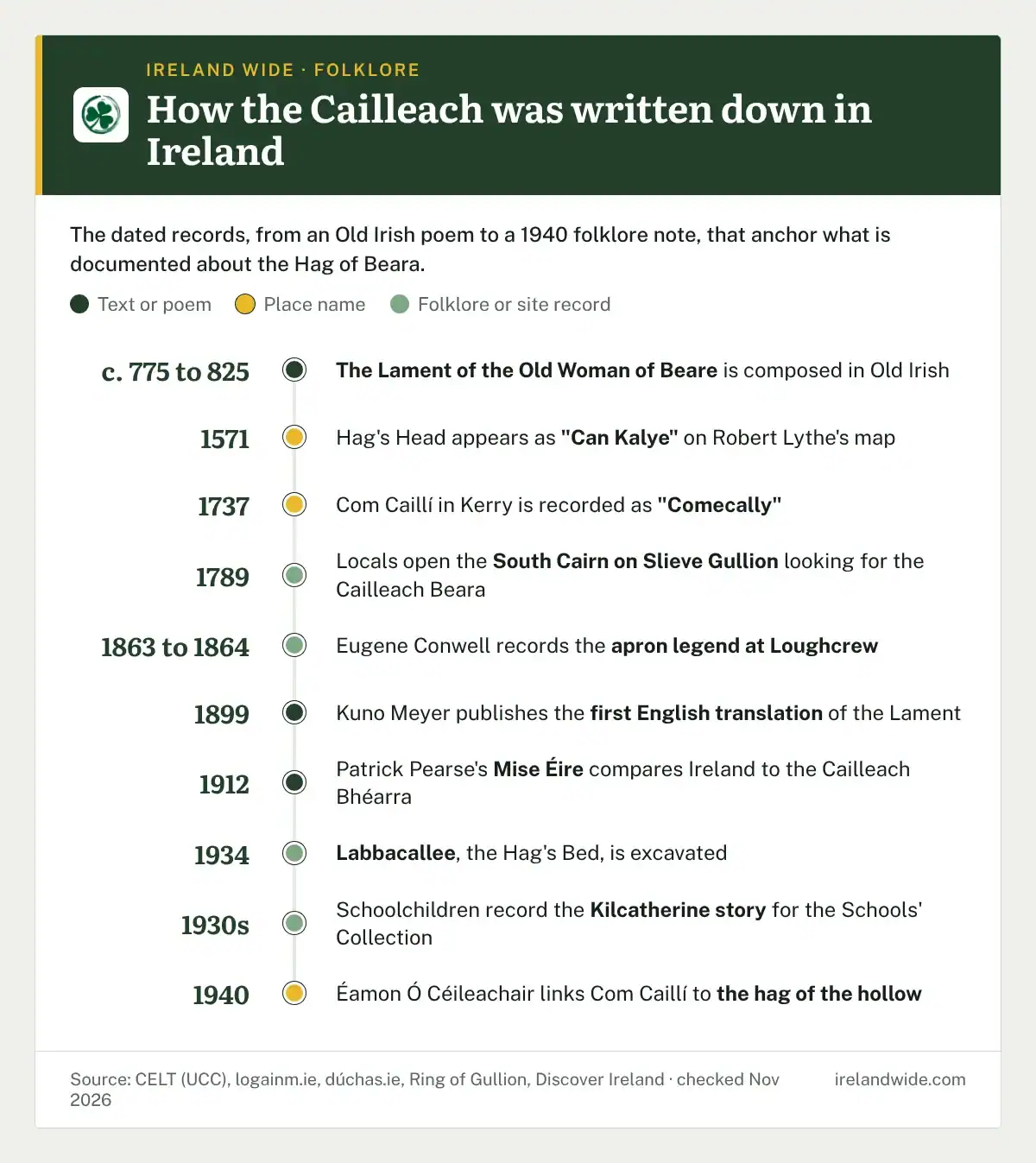
The dates below are the anchors for everything said about the Cailleach in Ireland. Anything that cannot be traced to one of these layers, or to a similar record, is more likely a modern interpretation.
- c. 775 to 825: The Lament of the Old Woman of Beare is composed in Old Irish.
- 1571: Hag’s Head appears as “Can Kalye” on Robert Lythe’s map.
- 1737: Com Caillí in Kerry is recorded as “Comecally”.
- 1789: Locals open the South Cairn on Slieve Gullion looking for the Cailleach Beara.
- 1863 to 1864: Eugene Conwell records the apron legend at Loughcrew.
- 1899: Kuno Meyer publishes the first English translation of the Lament.
- 1912: Patrick Pearse opens his poem Mise Éire by comparing Ireland to the Cailleach Bhéarra.
- 1934: Labbacallee, the Hag’s Bed, is excavated.
- 1930s: Schoolchildren record the Kilcatherine story for the Schools’ Collection.
- 1940: Éamon Ó Céileachair links Com Caillí to the hag of the hollow.
How To Tell Documented Cailleach Folklore From Modern Interpretation
A lot of what circulates online about the Cailleach blends Irish, Scottish and Manx material with neo-pagan writing from the last few decades. A few quick checks help sort it out.
- Look for a place name with a date. Logainm.ie records historical spellings for townlands and features; a name like Com Caillí with forms back to 1737 is solid ground.
- Look for a named storyteller. The Schools’ Collection on dúchas.ie gives the informant, school and parish, which is far stronger than an unattributed “legend says”.
- Check which country the story is from. Beira, Queen of Winter, and Ben Cruachan belong to Scotland; the St Bride’s day firewood tale is best recorded in Scotland and Man.
- Be wary of very tidy symbolism. Claims that she is the dark half of a single winter and spring goddess, or that a site was “her temple”, are modern readings. They can be meaningful to people today without being old.
This is the same approach our guide to Celtic symbols and their meanings takes with knots and designs, many of which are far younger than they are said to be.
Visiting Cailleach Sites in Winter
Most of these places are on exposed hills or coasts, and the Cailleach’s season is not the kindest time to visit them. The climb to Cairn T at Loughcrew is short but very steep, and Slieve Gullion means a walk to the summit on open hillside. The Hag’s Glen is a proper mountain walk. Hag’s Head and Kilcatherine sit on the Atlantic coast, where wind and low cloud can close in fast. Our guide to visiting Ireland in winter covers daylight hours and driving.
Our advice: if you only have time for one, pick Loughcrew for the tombs and the oldest recorded legend, or Kilcatherine for the clearest link to the Hag of Beara herself. Both are free, and both tell you more about the Cailleach when you know which parts of the story are old.
Frequently Asked Questions About the Cailleach
Is the Cailleach a Goddess?
The Cailleach is often called a goddess, but in Irish sources she appears mainly as a supernatural old woman in folklore and place names. Scholars disagree on how far she reflects a pre-Christian deity.
Is the Cailleach the Same as the Morrígan?
No. The Morrígan is a war and fate figure from the medieval Irish sagas, while the Cailleach belongs mostly to local folklore and landscape stories; both can appear as old women, which causes some confusion. Our page on the Morrígan, Irish goddess of war, fate and prophecy, covers her separately.
How Do You Say Cailleach Bhéarra?
Cailleach Bhéarra is said roughly as “KAL-yukh VAIR-uh”, though the vowels shift with the Irish dialect. Bhéarra refers to Béarra, the Beara Peninsula in Cork and Kerry.
Is There a Scottish Cailleach Too?
Yes. Scotland has its own strong Cailleach tradition, with mountains such as Ben Cruachan and the name Beira, Queen of Winter, which was popularised by the folklorist Donald Mackenzie in the 20th century.