
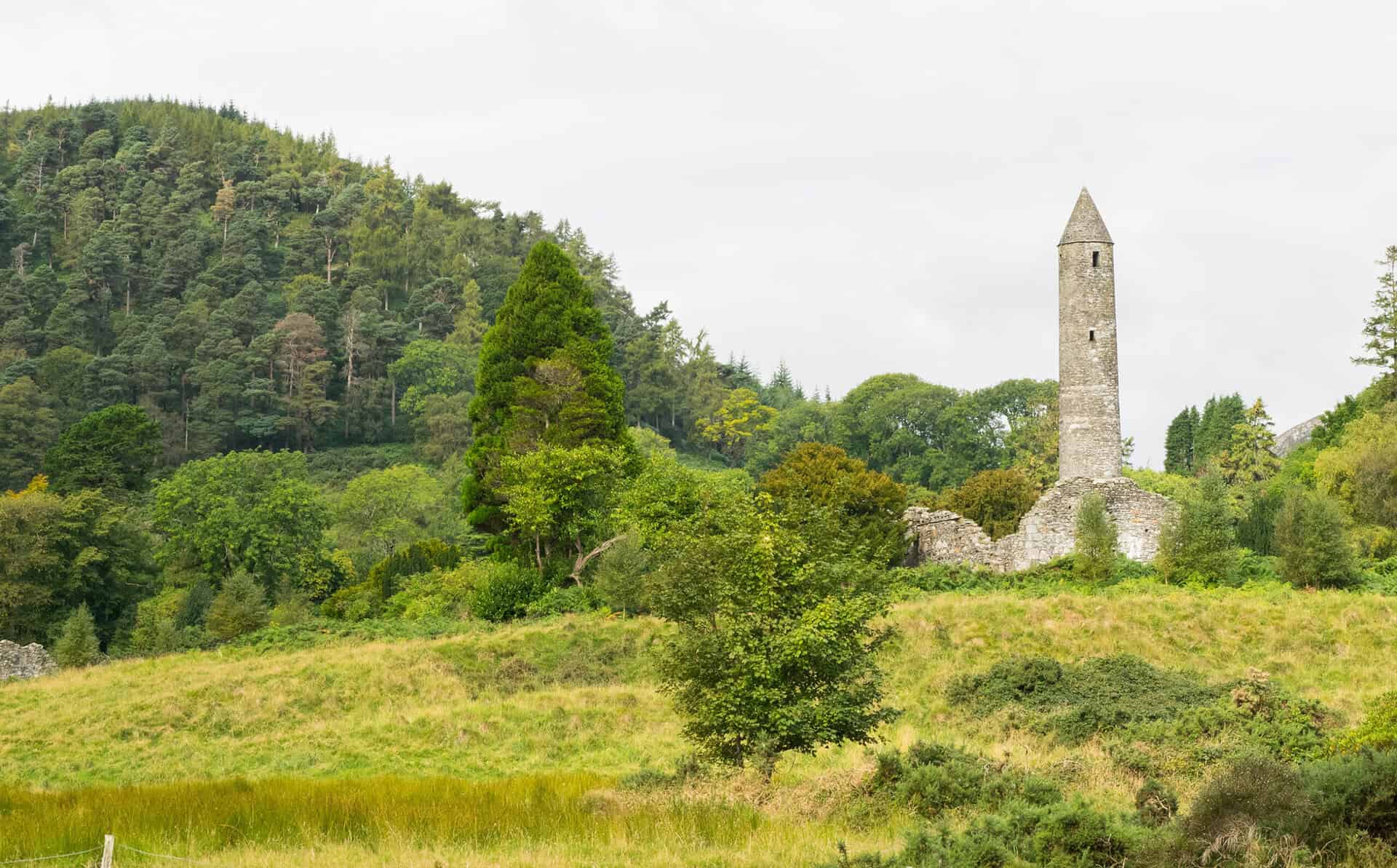
The Glendalough Round Tower was built by the monastic community of St. Kevin’s monastery, probably during the 11th century, chiefly as a bell tower for one of Ireland’s most important early Christian settlements. Its height, raised doorway and surviving stonework also explain why it became the unmistakable landmark of Glendalough.
The tower stands in the Monastic City in the Wicklow Mountains, close to the valley’s Lower Lake and on the route towards the Upper Lake. It has watched over a place of prayer, pilgrimage, raids, repairs and ordinary human curiosity for almost a millennium.
For most people, the first impression is simple: it is tall, narrow and remarkably intact. The closer look is better. Its details tell a story of medieval engineering built for a working religious settlement, not for postcard views.
Compare population, migration, age and projected growth across all 32 Scottish council areas.
The tower belongs to the monastic settlement at Glendalough, whose Irish name, Gleann Dá Loch, means “valley of two lakes.” St. Kevin founded a religious community in the valley during the 6th century, initially seeking a retreat from the outside world.
That quiet beginning did not last. Glendalough grew into a major centre of worship and pilgrimage, with churches, a cathedral, a gateway, burial grounds and other monastic buildings spread across the valley. It was considered such a sacred burial place that its importance was compared with Rome in medieval tradition.
St. Kevin is traditionally believed to have died around 618. The stone buildings people see in the Monastic City are mostly later than his lifetime, reflecting centuries in which the community expanded and rebuilt. The round tower is part of that later medieval landscape, not a solitary monument dropped into an empty valley.
The Glendalough Round Tower is generally dated to the 11th century. Irish round towers were built mainly between the 10th and 12th centuries, and Glendalough’s tower is among the finest surviving examples.
It rises roughly 30 metres above the ground, although some local descriptions give a slightly higher measurement. The difference can reflect how the roof and ground level are measured. What matters on site is its scale: a slim cylinder of carefully laid stone that still dominates the Monastic City.
The tower was built with mica schist, slate and granite. Look closely at the doorway and you can see one of its most impressive pieces of craftsmanship: the lintel above it is a single piece of granite. It is an understated detail, but hauling and placing that stone without modern machinery was no casual afternoon’s work.
The entrance is about 3.5 metres above ground level and was reached by a ladder. This was a standard feature of Irish round towers, and it makes the building look more defensive than a conventional church bell tower.
Round towers are known in Irish as cloigtheach, meaning bell tower. Ringing bells was likely their principal purpose, calling the community to worship and marking the rhythms of monastic life. Their height also made them useful visual markers for people approaching Glendalough through the valley.
The elevated doorway could help limit access and has long fed the idea of monks pulling up a ladder during an attack. Towers may indeed have been used as temporary refuges or for storage on some occasions, but they should not be treated as invincible fortresses. A wooden ladder, a narrow entrance and a tall stone shaft offered some protection, not a guarantee of safety during a determined raid.
The original structure had six internal levels. The four largest windows sit near the top and face the cardinal directions, a practical arrangement for a bell chamber that needed to carry sound across the settlement and valley.
At ground level, the tower is about 4.87 metres in diameter. Its walls taper as they rise, producing the familiar tall, slightly narrowing profile seen in Irish monastic towers. The simple shape is part of the reason it has survived so well: there are no sprawling wings, elaborate roofs or decorative façades to fail first.
Glendalough’s tower is one of a relatively small group of surviving Irish round towers that still has a conical stone roof. That roof, however, is not entirely medieval.
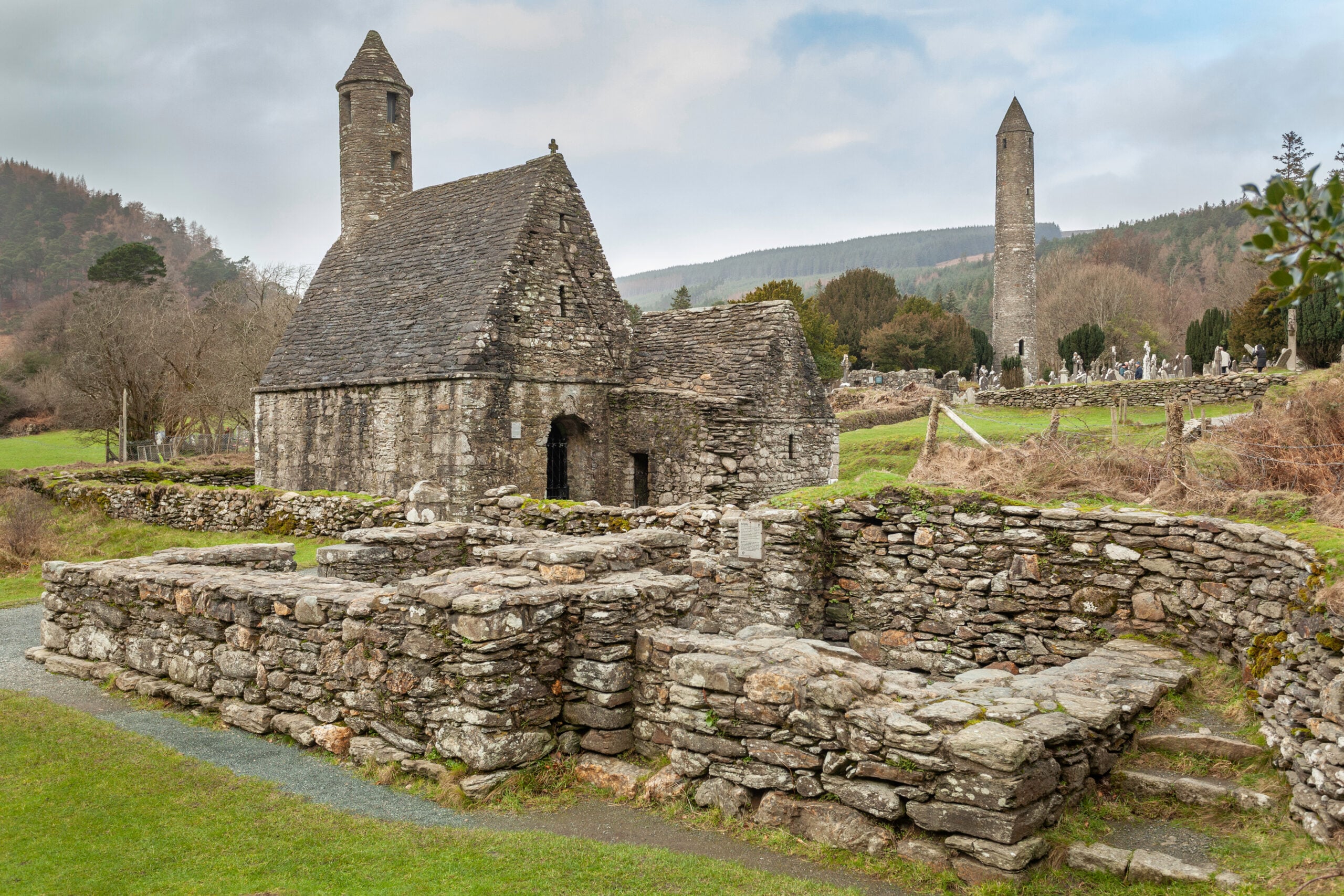
Lightning struck the tower’s conical top in the 19th century, damaging the roof. Wicklow County Tourism records that the roof was replaced in 1876, using stone gathered from within the tower after the collapse.
That repair matters because the tower’s sharp conical cap is central to the silhouette people recognise. The medieval shaft is authentic, while the visible roof represents careful Victorian-era restoration after a dramatic natural event. It is a useful reminder that historic places are often preserved through later interventions, not frozen untouched in time.
The rebuilt roof has also helped Glendalough remain one of the most complete-looking round towers in Ireland. Plenty of surviving towers are fragmentary; this one still reads clearly as the tall bell tower its builders intended.
Do not rush away after photographing the tower. It sits among the most substantial remains in the Glendalough Monastic City, where the buildings make more sense as a group than as isolated ruins.
The tower is between Laragh and Glendalough’s Upper Lake, a short drive from either direction. If you are navigating, use the Monastic City as your destination rather than searching only for the tower, since the surrounding ruins are part of the experience.
Bring footwear suited to uneven ground if you plan to continue beyond the monument area. The tower itself is viewed from outside, so there is no need to pack for an interior climb. The doorway is a useful clue as to why.
For photographs, step back enough to include the cathedral ruins or the enclosing hills. A close-up captures the stonework, but a wider frame explains the tower’s role as a marker in the valley. On a busy day, walking a little way towards the lakes can also provide a less crowded angle.
Conditions can change quickly in the Wicklow Mountains, so check the weather in Ireland before setting out and bring a waterproof layer for the walks around the lakes. Summer brings longer daylight, while weather in Ireland in October can make the woodland paths especially atmospheric, though wetter underfoot.
The tower survives because it was built with exceptional skill, but its appeal comes from context. It is a working piece of a much larger monastic story: St. Kevin’s retreat became a major religious community, and that community needed bells, landmarks, storage and durable buildings.
Its plainness is part of the appeal. No grand inscription explains every decision, and no one can claim every use with total certainty. Yet the high doorway, upper windows, stone lintel and restored cone offer unusually clear clues. The Glendalough Round Tower is medieval Ireland at human scale, apart from the bit where it rises above almost everything else.
The Glendalough Round Tower is generally believed to date from the 11th century, making it close to 1,000 years old. It was built centuries after St. Kevin founded the original monastery in the 6th century.
The tower stands at roughly 30 metres tall. Some published descriptions use a slightly higher figure, but all confirm that it is one of the tallest and best-preserved landmarks at the monastic site.
Its main role was likely as a bell tower, supported by the Irish term cloigtheach. It may also have served as a landmark, lookout, storehouse and occasional refuge during danger.
The Glendalough Round Tower’s door is about 3.5 metres above ground and was accessed by ladder. Raised entrances were typical of Irish round towers and made access more controlled.
The tower is viewed externally. Its elevated doorway and historic fabric mean it is not set up as a climbable public attraction.

Matt Hook is a Canadian writer of Scottish and Irish heritage. He built his writing career creating detailed gaming guides, turning complex mechanics, history and lore into useful information for readers. Matt brings that same research-focused approach to Ireland Wide, where he writes about Irish travel, heritage, history and culture. He also holds CMA and CPA designations as a professional accountant, giving him a strong background in research, accuracy and attention to detail.
At Ireland Wide, our aim is to bring authentically Irish insights to you, wherever you are.
Whether you have some feedback or would like to offer some of your own insights for everyone else to explore, don't hesitate to get in touch with us!