Athenry Castle is worth visiting if you want a compact, well-interpreted medieval stop in County Galway with real architectural detail and an easy town-centre location. It suits day-trippers, families, and anyone building an Ireland castle itinerary, especially if you prefer a one-hour visit that still feels substantial.
It also makes a good starting point for understanding Athenry itself, one of Ireland’s best-preserved medieval walled towns. If you are comparing sites before a road trip, our guide to the best castles in Ireland puts Athenry Castle in context alongside larger and more elaborate forts.
Opening times and admission change seasonally, so check the official operator before you go. The core experience is the restored 13th-century hall-keep, its decorated first-floor entrance, original battlements, and an on-site film that helps the stonework make sense once you are inside.
Search by castle, county or nearby town, then click a marker to open the complete IrelandWide visitor guide.
| Location | Athenry, County Galway, Ireland |
|---|---|
| County | Galway |
| Jurisdiction | Republic of Ireland |
| Castle Type | Norman hall-keep with outer defensive wall remains |
| Date | Mid-13th century, usually placed after the 1235 charter and completed by about 1250; some dating uncertainty remains |
| Builder | Meiler de Bermingham |
| Associated Families | de Bermingham family |
| Current Status | Restored state-managed monument open seasonally to the public |
| Interior Access | Yes, including basement, Great Hall level, and audio-visual room |
| Typical Visit Time | About 1 hour |
| Coordinates | 53.297° N, 8.744° W |
| Parking | Car park available |
| Public Transport | In the centre of Athenry town; rail and bus connections serve Athenry, then a short walk |
| Accessibility | Limited access overall; official operator notes limited access and uneven walkways, with handrails in places |
| Toilets | Yes |
| Food | No food service confirmed on site; use Athenry town for cafés and shops |
| Family Suitability | Good for families who can manage stairs and uneven surfaces; playground and picnic area listed on site |
| Official URL | Heritage Ireland: Athenry Castle checked July 2026 |
Athenry Castle works because the building is still legible. You are not staring at a few orphaned walls and trying to imagine the rest. The castle’s three-storey hall-keep survives in a form that lets you read how a fortified residence functioned, from storage below to the more ceremonial upper spaces.
The most memorable detail is the first-floor entrance to the Great Hall. According to Heritage Ireland, the doorway and some window openings carry floral carving in the local School of the West style, a decorative tradition rarely associated with Irish castles. That gives Athenry an identity beyond simple military bulk.
The setting helps too. The castle sits within historic Athenry, so the visit feels tied to a medieval town rather than stranded in open countryside. If you are planning a wider west-of-Ireland route, it fits neatly into a broader west coast of Ireland trip.
According to Heritage Ireland, Athenry Castle is open from 13 March to 5 November 2026. The published seasonal schedule lists daily opening from 9:30 to 18:00 between 13 March and 21 October, with last admission at 17:15. From 22 October to 5 November, it runs daily 9:30 to 17:00, with last admission at 16:15.
Heritage Ireland lists standard admission as Adult €5, Senior €4, Student/Child €3, and Family €13, checked July 2026. For a small state-run castle with interior access and interpretation, that is a fair price.
If you want the smoothest visit, arrive at least 45 minutes before last admission. The town-centre location makes it easy to underestimate timing, and this is not a place to rush past the architectural details.
The broad outline is clear even if the exact start date is debated. Discover Ireland states that Richard de Burgo granted a charter to Meiler de Bermingham in 1235, and construction followed shortly after. Most modern summaries place completion around 1250.
Some secondary accounts suggest work may have begun in 1238 or 1240 rather than immediately after the charter. For a visitor guide, the safest wording is that the castle is a mid-13th-century de Bermingham foundation built after the 1235 charter.
The castle guarded a strategic crossing on the Clareen River and formed part of the power structure behind medieval Athenry. Like many Irish castles, it later declined and stood ruinous for centuries before modern restoration and re-roofing made interior visits possible again.
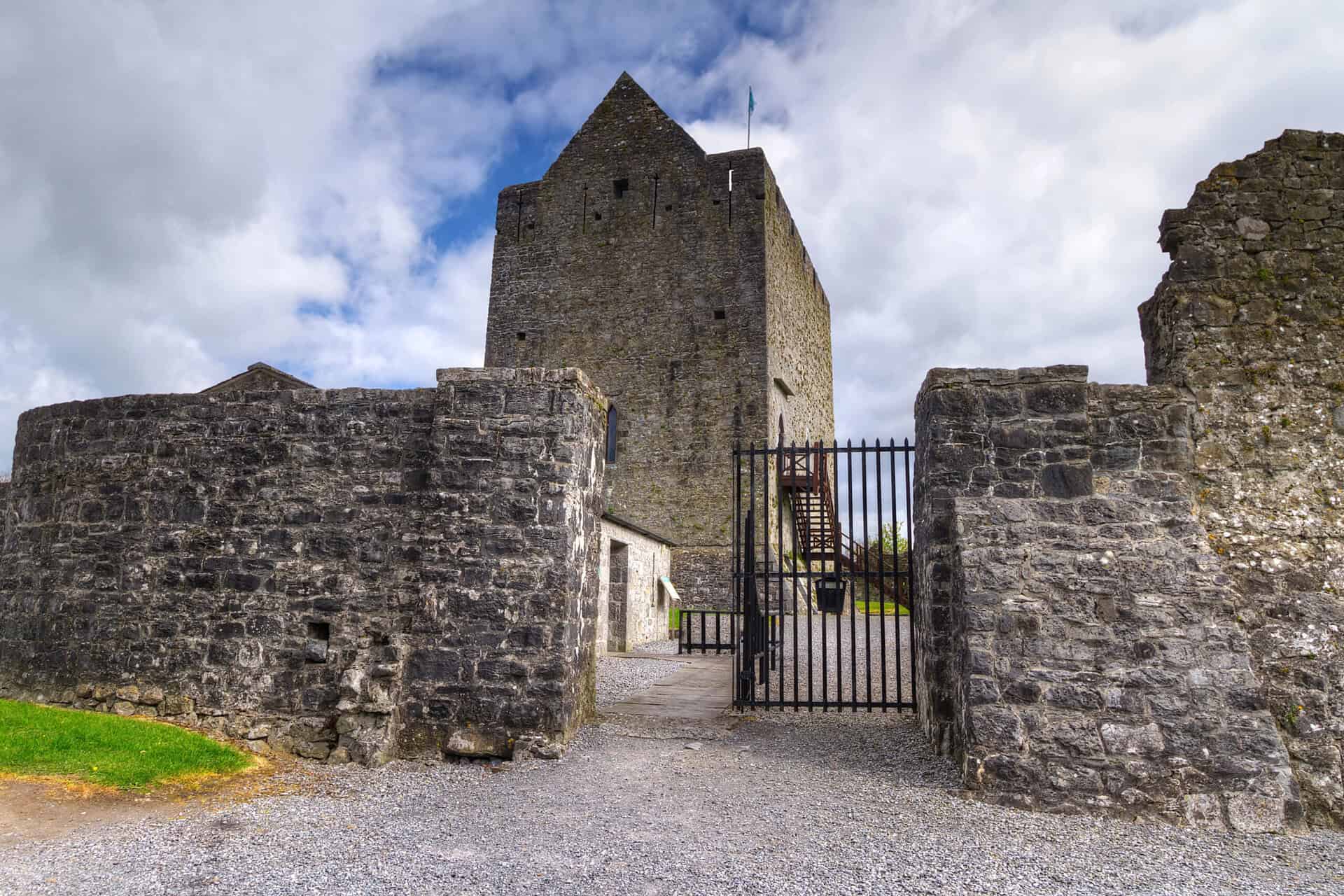
The exterior is the first good surprise. Athenry Castle still looks defensive rather than decorative, with original 13th-century battlements and deep cross-shaped arrow loops. Even people who normally get castle fatigue tend to perk up when the practical military details are this obvious.
Inside, the spaces are arranged in a way that tells the building’s story. Heritage Ireland describes a substantial basement, the Great Hall, and an upper area that includes the audio-visual room. The basement was used for storage, while the hall carried the symbolic weight of lordship.
The on-site film runs for about 20 minutes and is worth watching early in the visit. It gives you enough context to notice the carved doorway, the arrow loops, and the difference between service space and elite space without needing a specialist guide glued to your elbow.
This is a better fit for some groups than others. Families with school-age children usually do well here because the castle is compact, visual, and manageable in about an hour. The listed picnic area and playground also help if you are breaking up a longer County Galway drive.
Accessibility is more mixed. Heritage Ireland lists limited access, uneven walkways, handrails, and edge precautions. If step-free access is essential, contact the site directly before travelling and do not assume full access beyond the ground-level areas.
For people who love huge furnished castle interiors, Athenry may feel spare. For anyone interested in medieval architecture, fortification, and town history, it is a very satisfying stop.
The castle is in the centre of Athenry, County Galway, with the official address listed as H65 WP93. That central location is part of the appeal. You are not dealing with a long estate drive, shuttle system, or countryside hike before you reach the entrance.
If you are coming by car, Heritage Ireland lists car parking and coach parking. If you are using public transport, Athenry has rail connections and town bus links, and the castle is close enough to town services to work for a day trip without a car. It also works well as a stop on a 7 day Ireland itinerary if you are linking Galway with smaller heritage towns.
The best exterior shots usually come from a slight angle that includes both the keep and part of the surrounding grounds. Straight-on images can flatten the building, while a side view does a better job of showing height and wall thickness.
Inside, look for the carved first-floor entrance details and the contrast between darker lower spaces and brighter upper openings. Low light can be an issue, so steady hands help more than a heroic lens collection.
If the weather is grey, lean into it. Athenry Castle does not need sunshine to look convincing. Stone, battlements, and arrow loops are perfectly happy under an Irish sky that has opinions.
The most obvious companion stop is the Dominican Priory in Athenry, a 13th-century monastic ruin often paired with the castle in local visitor information. It adds a religious and urban layer to the same medieval story.
The Athenry Arts & Heritage Centre also offers guided heritage experiences, though access can vary with group bookings, so check directly before planning around it.
If you are building a wider castle route, Athenry pairs nicely with bigger-name stops and more scenic strongholds. Our Dunguaire Castle visitor guide is a good next pick if you are staying around Galway Bay, while the best castles in Ireland roundup helps if you are extending the trip beyond Galway.
Athenry Castle does not need embroidered legends to be interesting. The documented story is already strong: a de Bermingham stronghold in a strategically important medieval town, built in the 13th century and restored for public access after a long ruinous period.
If you hear dramatic local tales on a tour or in conversation, treat them as folklore unless they are tied to a named historical source. The site’s strongest appeal is the surviving architecture and well-supported history, not ghost stories pasted on afterwards.
Yes, especially if you like medieval sites that are easy to understand in under an hour. It is not Ireland’s largest castle and does not try to be. What it offers is clarity: a strong 13th-century shell, notable carved details, usable interpretation, and a location that connects directly to a historic town.
For people driving between Galway attractions, it is one of the easier worthwhile detours to justify. For castle enthusiasts, it is a strong supporting act on a wider itinerary and a reminder that smaller sites can still carry plenty of weight.
Heritage Ireland lists admission at Adult €5, Senior €4, Student/Child €3, and Family €13, checked July 2026. Seasonal or operational changes can happen, so confirm on the official site before travelling.
About one hour is enough for most people. That allows time for the interior, the film presentation, and a proper look at the exterior features.
Yes. Public access includes the interior spaces, including the basement, the Great Hall level, and the audio-visual area, subject to normal operational conditions.
Yes, for children who are comfortable with stairs and uneven surfaces. The visit is short enough to hold attention, and the defensive features are easy to spot without much explanation.
Yes. Heritage Ireland lists car parking, coach parking, and toilets among the site facilities.
Accessibility is limited rather than fully step-free. The official listing mentions limited access, handrails, and uneven walkways, so contact the site directly if you need detailed access information before visiting.

Dan is the founder and editor of Ireland Wide. Born and raised in Ireland, he researches the country’s history, mythology and cultural traditions using museum collections, heritage authorities and historical sources. He leads the site’s editorial team, with a particular focus on distinguishing documented history from later folklore and modern interpretations.
At Ireland Wide, our aim is to bring authentically Irish insights to you, wherever you are.
Whether you have some feedback or would like to offer some of your own insights for everyone else to explore, don't hesitate to get in touch with us!