Portumna Castle and Gardens is worth visiting if you want a substantial Irish castle stop that combines architecture, gardens, and an easy half-day plan. It suits families, history-minded day-trippers, and anyone already exploring east Galway, Lough Derg, or the River Shannon, though people expecting a fully furnished interior should know access is limited to the restored ground floor.
For a broader trip plan, it also fits neatly into an Ireland castle itinerary alongside our best castles in Ireland guide. Portumna gives you a Jacobean great house, formal grounds, a walled kitchen garden, and a location beside Portumna Forest Park, so it feels like more than a quick photo stop.
Search by castle, county or nearby town, then click a marker to open the complete IrelandWide visitor guide.
Portumna is not the classic medieval tower-house experience. The building is a transitional house from the early 17th century, with defensive features sitting alongside Renaissance and Jacobean ideas about symmetry, status, and comfort. That mix is the main reason to go.
The Office of Public Works states that the castle was built by the 4th Earl of Clanricarde and served as the de Burgo family power base for centuries. A major fire in 1826 left it roofless, and state restoration began in the 1960s. You are visiting a place that still shows both grandeur and damage, which gives it a different feel from a fully refurnished stately home.
If you are comparing options in the west, Portumna works best for people who like architecture and grounds together. It is also a good companion stop if you are building a longer route through the region, especially alongside a west coast of Ireland travel guide or a broader loop through the 32 counties of Ireland.
The official operator lists 5 March to 21 October: daily 10:00 to 18:00 with last admission at 17:15. From 22 October to 12 November, opening is daily 10:00 to 17:00 with last admission at 16:15. These details were checked July 2026 and should still be verified before you travel, especially outside the main season.
Admission listed by the official site is Adult €5, Group/Senior €4, Child/Student €3, and Family €13. For an Irish heritage site of this scale, that is a fairly easy yes.
| Visitor Information | Details |
|---|---|
| Standard season hours | 10:00 to 18:00 |
| Last admission | 17:15 |
| Late season hours | 10:00 to 17:00 |
| Late season last admission | 16:15 |
| Adult ticket | €5 |
| Group/Senior | €4 |
| Child/Student | €3 |
| Family ticket | €13 |
Portumna Castle belongs to the period when powerful Irish and Anglo-Irish families were building residences that still looked defensible but were also meant to impress. Richard Burke, 4th Earl of Clanricarde, built it in the early 1600s, usually dated around 1616 or 1618 depending on the source.
The house became the main seat of the Clanricarde Burkes for more than two centuries. In 1826, an accidental fire gutted the building and left it a shell. Official site material says restoration by the state began in the 1960s and continues.
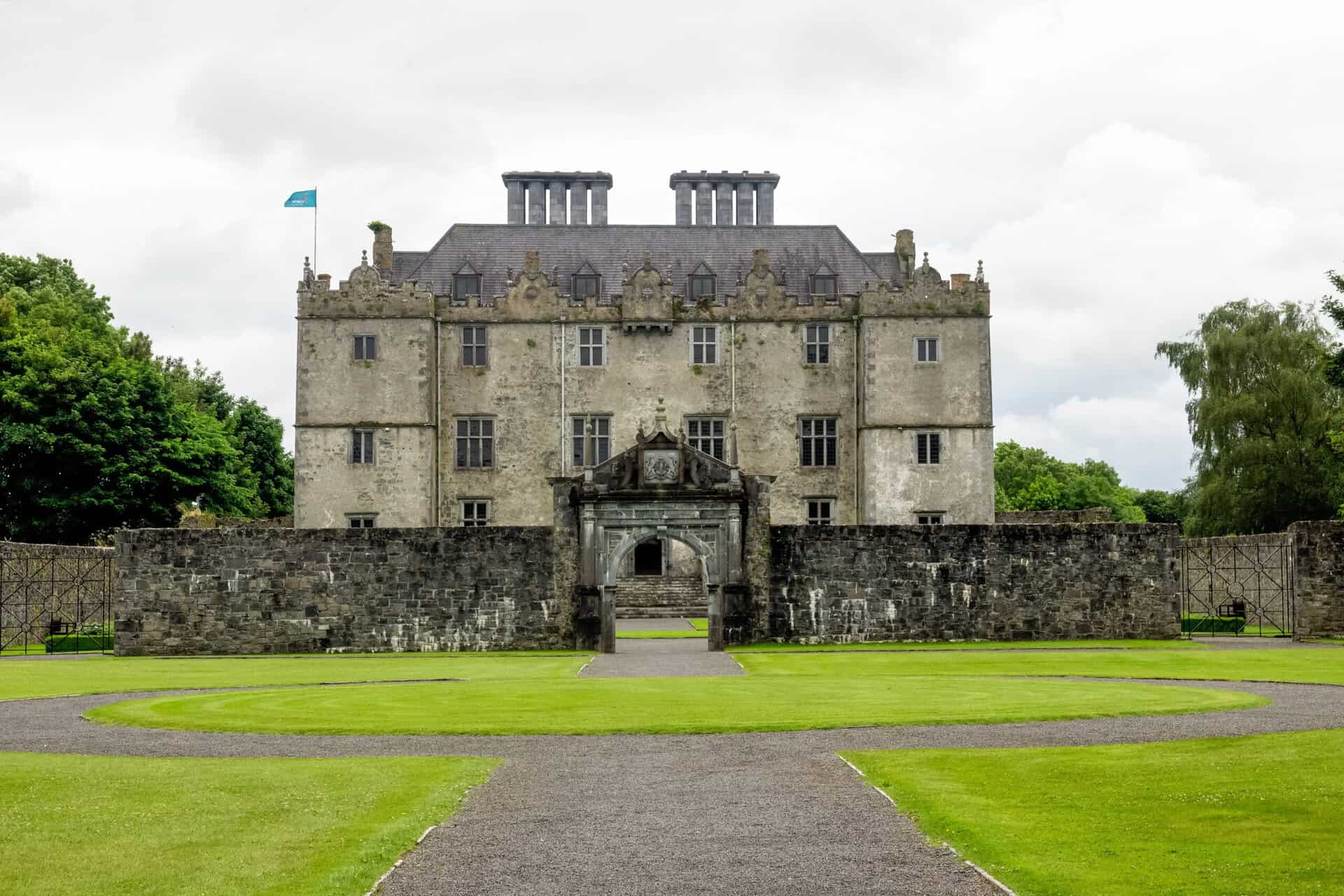
You are not seeing Portumna exactly as its first owners did, but enough survives to make the layout and ambition clear. The main block, corner towers, courtyard setting, and designed approach still communicate how imposing the place was meant to be.
The official description highlights the ground-floor exhibition, the formal gardens, and the walled kitchen garden. Discover Ireland also notes the restored willow maze and espalier fruit trees, along with a 17th-century-style potager layout. If gardens are your thing, do not rush this part.
Photographically, the contrast between the restored masonry, open sky above the ruined upper levels, and the geometry of the grounds is the appeal. This is a castle for people who like structure and setting more than rooms full of furniture.
The documented story is strong enough without adding extras. The supported facts are the builder, the early 17th-century construction, the Clanricarde connection, the 1826 fire, and the long restoration under state care.
I am not including local legends, hauntings, or dramatic siege tales here because they were not supported in the material checked for this guide. If a guide on site mentions folklore, treat it as local storytelling unless it is clearly backed by the historical record.
Families usually do well here because there is room to move around. Just keep an eye on children in the gardens and around historic structures. Discover Ireland says children should be supervised at all times.
The site lists limited access, while Discover Ireland describes partial wheelchair access. The official facilities list includes toilets, a wheelchair-accessible toilet, café, car park, picnic area, gift shop, and WiFi. That makes Portumna easier than many castle stops, but it is still a historic property with constraints.
There is also a downloadable social guide available from the official site, aimed at first-time visitors, families, and people with developmental or learning disabilities. That is worth checking before the trip if anyone in your group prefers to know the setting in advance.
For drivers, the site is in Portumna, Co. Galway, H53 YK27, close to Lough Derg, the River Shannon, and Portumna Forest Park. If you are relying on public transport, check local services into Portumna directly before travel rather than assuming frequent rural connections.
The easiest wide exterior shots come from the approach where the castle rises behind the grounds. Go for a slightly off-centre composition so the geometry of the gardens leads the eye toward the building.
Inside, the visual interest is more about texture than decorative rooms. Look for stonework, arches, and the contrast between restored spaces and the parts that still read as ruin. Soft weather can actually help here. Portumna does not need blazing sunshine to look good, and if you are planning around the seasons, our guide to weather in Ireland gives a decent sense of what the light and rain can do to a day out.
The most obvious add-on is Portumna Forest Park, right beside the castle grounds. Official site material specifically notes the castle’s position beside the park, Lough Derg, and the River Shannon, which is why this stop works well as more than a single-ticket attraction.
If you are building a castle-focused route, pair it with places that offer a very different feel, such as our Dunguaire Castle visitor guide or Ross Castle visitor guide. Portumna is more about a grand early-modern house and gardens than battlements and lake-boat drama, so the contrast works.
For food, the castle complex includes a café, and Discover Ireland mentions CaToCa Fine Food at Portumna Castle Tea Rooms nearby in the attraction listing context. Check opening independently before making it your whole lunch plan.
Yes, for most people it is. The ticket price is modest, the setting is attractive, and the combination of house, gardens, and nearby parkland gives you enough to do without padding the day.
The main caveat is simple. If your ideal castle visit means climbing battlements and wandering through fully furnished upper rooms, Portumna is not that. If you like architecture, designed landscapes, and Irish estate history, it is a very solid stop.
Official admission checked in July 2026 is €5 for adults, €4 for group or senior tickets, €3 for child or student tickets, and €13 for a family ticket.
Most people will want 1 to 2 hours. If you add the café and Portumna Forest Park, it can easily stretch into a half-day outing.
Yes, but only partly. The ground floor is open to the public and includes an exhibition, while the site is still a restored historic ruin rather than a fully open multi-floor house.
Yes. The formal gardens and restored walled kitchen garden are a major part of the appeal, and they help Portumna stand out from castle sites where the grounds feel like an afterthought.
Yes. The site has open space, toilets, a café, and family ticket pricing, though children need supervision around gardens and historic structures.
Partly. Official information describes limited access, and Discover Ireland notes partial wheelchair access, so it is best to check specific needs with the site before travel.

Dan is the founder and editor of Ireland Wide. Born and raised in Ireland, he researches the country’s history, mythology and cultural traditions using museum collections, heritage authorities and historical sources. He leads the site’s editorial team, with a particular focus on distinguishing documented history from later folklore and modern interpretations.
At Ireland Wide, our aim is to bring authentically Irish insights to you, wherever you are.
Whether you have some feedback or would like to offer some of your own insights for everyone else to explore, don't hesitate to get in touch with us!