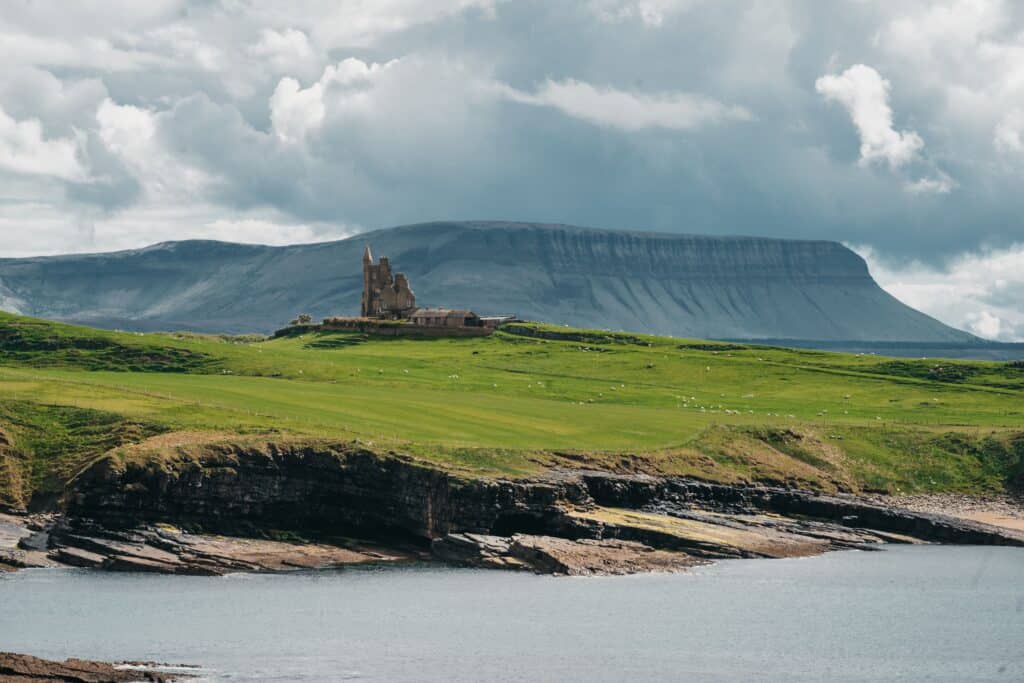
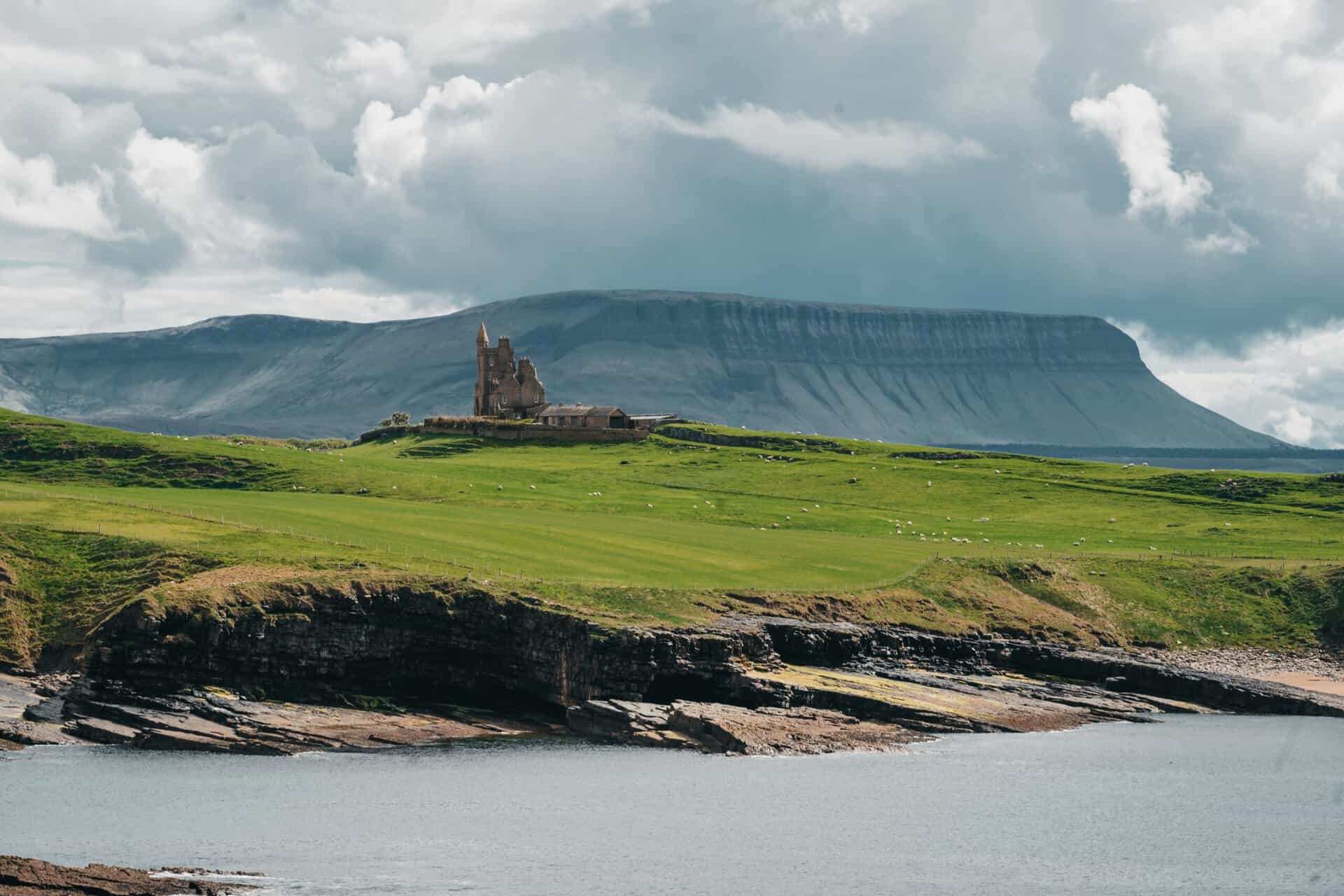
Classiebawn Castle is a 19th-century country house on the Mullaghmore Peninsula in County Sligo, best known for its turreted silhouette, views towards Benbulben and connection to Lord Louis Mountbatten. It was commissioned by Lord Palmerston and completed in 1874. Despite its name and appearance, it is a Victorian residence rather than a medieval fortress.
The castle is privately owned and closed to the public. You can still see it from the public roads around Mullaghmore Head, making it a worthwhile stop for a coastal walk or photographs. Come for the setting and the story, rather than an interior tour.
On this page: Quick facts · History and owners · How to see the castle · Walk and map · Common questions
Classiebawn Castle at a glance
| Question | Answer |
|---|---|
| Where is it? | Mullaghmore Peninsula, County Sligo, on Ireland’s northwest coast. |
| When was it built? | Completed in 1874, after being commissioned by Lord Palmerston. |
| Who designed it? | Architect Rawson Carroll, in the Scottish Baronial style. |
| Can you go inside? | No public access to the castle or estate. Views are from outside the property. |
| What is the Mountbatten connection? | Edwina Mountbatten inherited Classiebawn in 1939; it became a holiday home for the family. |
| How long should you allow? | As a planning estimate, 30–45 minutes for a short viewing stop and photos, once you have found suitable parking. Allow longer for a headland walk. |
Classiebawn Castle history: Palmerston, the Ashleys and the Mountbattens
A Victorian house with the look of a castle
Lord Palmerston, the British statesman who served twice as prime minister, commissioned Classiebawn. He died in 1865 before the house was finished. Local history records that his stepson, William Cowper-Temple, completed it in 1874.
The National Inventory of Architectural Heritage identifies Rawson Carroll as the architect and describes the building as Scottish Baronial. Its tower, projecting corner turret and steep roofs explain why it looks so different from Ireland’s ruined tower houses.
Those details were part of a grand domestic design. Classiebawn was built as a country house, with the sea and surrounding landscape as its setting, rather than as a defensive stronghold.
How Edwina and Louis Mountbatten came to Classiebawn
The property passed through the Ashley family. In 1939, Edwina Mountbatten inherited Classiebawn from her father, Wilfrid Ashley, along with Broadlands in Hampshire. The inheritance is documented by the University of Southampton, which holds the Broadlands Archives.
Classiebawn became associated with Edwina and her husband, Lord Louis Mountbatten, through the family’s holidays in Mullaghmore. That distinction matters: the connection did not begin with Louis buying or building the castle.
On 27 August 1979, Louis Mountbatten was killed in an IRA bombing of his boat off Mullaghmore. Three other people died as a result of the attack. The event is central to the castle’s modern history, although the attack happened at sea rather than inside the house.
Who owns Classiebawn Castle?
Businessman Hugh Tunney bought Classiebawn in 1991, having previously leased it. His purchase and death in 2011 are recorded in the Dictionary of Irish Biography.
A local history published by Scoil Naomh Molaise identifies the property as belonging to the estate of the late Hugh Tunney. That is an attributed account of ownership, rather than a current land-registry check. For visitors, the practical point is clear: Classiebawn remains private, with no public castle or estate access.
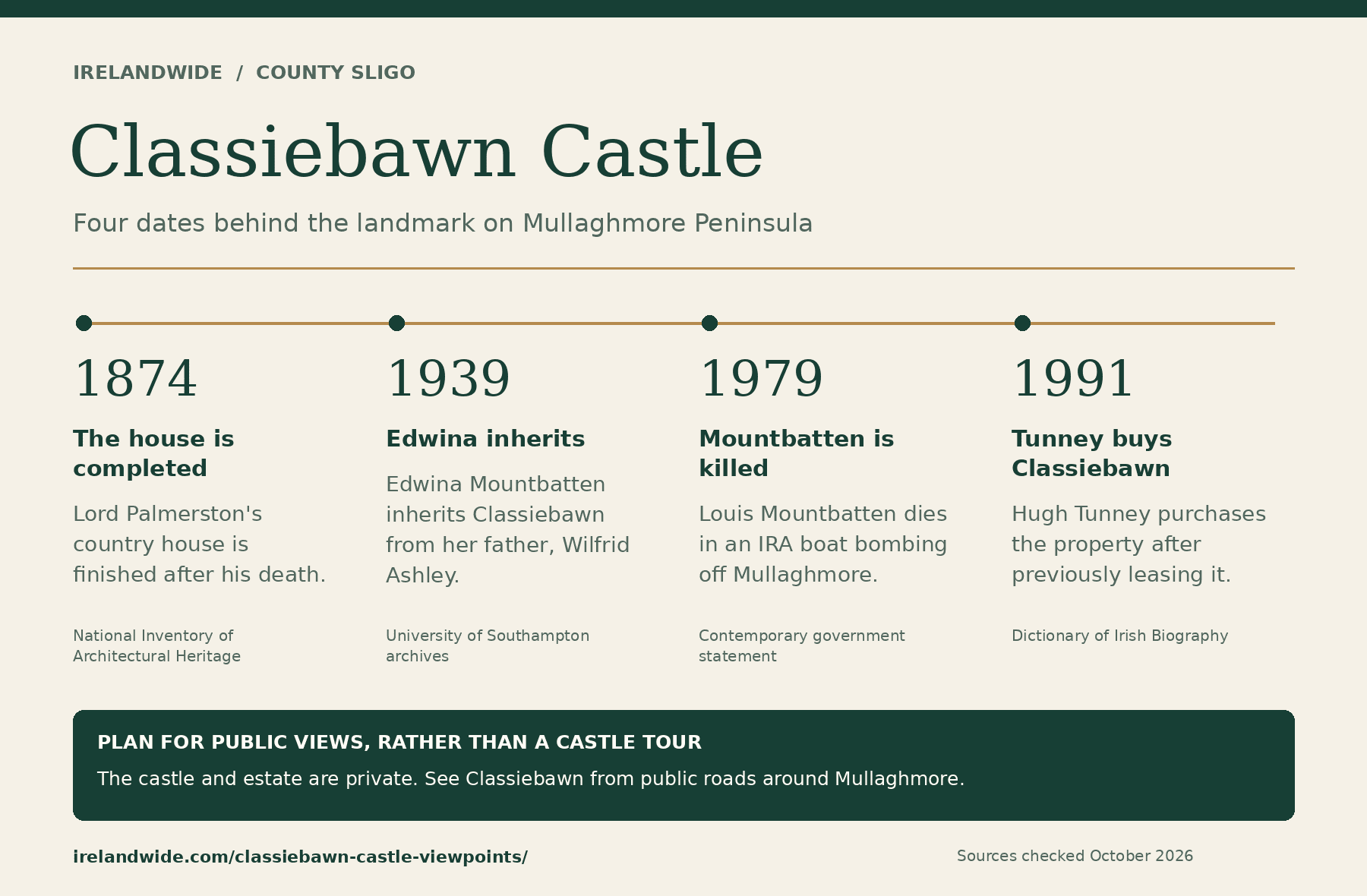
Four dates that explain Classiebawn
- 1874
The house is completed
Palmerston’s commission is finished after his death. - 1939
Edwina inherits
Classiebawn passes to Edwina Mountbatten from her father. - 1979
Mountbatten is killed
Louis Mountbatten dies in a boat bombing off Mullaghmore. - 1991
Tunney buys Classiebawn
Hugh Tunney purchases the property after leasing it.
How to see Classiebawn Castle from Mullaghmore
The public coastal roads around Mullaghmore Head are the place to see the castle. Tourism Ireland confirms that visitors can get views while walking or driving around the peninsula, while the castle itself is inaccessible to the public.
Use Mullaghmore village as your starting point. From there, explore the headland road and look inland towards Classiebawn. The appeal is the wider scene: the house above the fields, the Atlantic coast and, from a suitable angle in clear weather, Benbulben behind it.
A castle pin on a navigation app identifies the building, not a public entrance or a place to park. For an outing on foot, use the pier and the official loop described below. If you’re driving, stop only where parking is permitted and your vehicle is fully clear of the road and entrances.
What makes a good photo?
A wide composition gives the castle context, while a tighter frame picks out its tower and turret. Try both before moving on. You do not need to enter the fields or approach the house to make the landscape the subject.
Clear visibility matters more than a particular season if you want Benbulben in the background. Low cloud can hide the mountain; in that case, concentrate on the castle, fields and changing sky. A phone is useful for the wider scene, while an optical zoom gives more scope for distant architectural details.
Keep your camera work to places where you can stand without obstructing traffic. The roadside is shared with vehicles, so an uninterrupted photo is something to wait for, rather than step into the road to create.
Mullaghmore Head Loop: walk, map and starting point
For a longer visit, the Sport Ireland-listed Mullaghmore Head Loop starts and finishes at the pier in the village. It follows paths and local roads around the headland, so the coast becomes part of the outing rather than a backdrop to one photograph.
- Distance: 4.5 km, returning to the start.
- Official walking time: 1 hour 15 minutes, before extra photo or refreshment stops.
- Grade: easy, with 20 m of ascent.
- Waymarks: red arrows on a black background.
- Start and finish: Mullaghmore pier, coordinates 54.466549, -8.447458.
The map below marks the walk’s starting point, not a castle entrance or a guaranteed parking space. Open the official Mullaghmore Head Loop map for the route itself.https://www.openstreetmap.org/export/embed.html?bbox=-8.50%2C54.445%2C-8.425%2C54.485&layer=mapnik&marker=54.466549%2C-8.447458
Map © OpenStreetMap contributors. Open the pier starting point in Google Maps.
Bring a waterproof layer and footwear suited to the walk. The easy grade describes the route; weather and passing traffic still affect the experience. If conditions are poor, shorten the outing rather than committing to the full headland.
Is Classiebawn Castle worth a stop?
Yes, if you enjoy coastal scenery, castle photography or the history of the Mountbatten family. The combination of house, headland and mountain makes this more than a stop to look at a building. Add a harbour stroll or the loop and you have a reason to spend longer in Mullaghmore.
If your priority is furnished rooms, exhibitions or a guided castle tour, choose a public attraction instead. Our Parke’s Castle visitor guide covers a castle on Lough Gill that welcomes visitors during its opening season.
What to combine with your visit
- Mullaghmore village and harbour: the simplest addition, especially if you start the walk at the pier. Leave time to enjoy the waterfront before driving on.
- Knocknarea: for a separate Sligo walk with a very different landscape, use our Queen Maeve Trail guide to plan the route and parking.
- More castle stops: our guide to castles in Ireland helps you choose between ruins, scenic exteriors and places you can explore inside.
For a relaxed half-day, keep it simple: see Classiebawn from the headland, walk as much of the coast as conditions allow, then return to Mullaghmore. You can give another part of Sligo its own outing rather than fitting every landmark into the same afternoon.
Classiebawn Castle questions
Can you visit inside Classiebawn Castle?
No. Tourism Ireland describes it as privately owned and inaccessible to visitors. There is no public interior or grounds visit to add to your itinerary; plan to see it from outside the estate.
Was Classiebawn Castle used in The Crown?
Classiebawn features in the Mountbatten story, but the building used to portray it in season four was Ackergill Tower in Caithness, Scotland, according to STV’s reporting on the filming location. Seeing the real Classiebawn is different from visiting that stand-in.
Is Classiebawn a medieval castle?
No. It is a 19th-century country house completed in 1874. The Scottish Baronial design gives it a castle-like outline, but it was built as a residence rather than a medieval fortress.
Can you see Classiebawn without doing the full walk?
Yes. The public roads around the peninsula offer views, so you can make a shorter stop if you have a suitable place to park. Walking the full loop is an option, rather than a condition of seeing the castle.
Is Classiebawn Castle in Sligo or Donegal?
It is in County Sligo, on the Mullaghmore Peninsula near the county’s northern boundary. Include it in a Sligo itinerary even if you are approaching from Donegal.
Sources and visitor information checked on 19 October 2026. Access guidance: Tourism Ireland. Walking route: Sport Ireland, linked above. The 1979 attack is covered by RTÉ’s anniversary reporting. Historical sources are linked beside the relevant sections. The short-stop time is an editorial planning estimate, not an official visiting duration.