Irish fairies, according to folklore, are supernatural beings that live underground in a parallel universe.
They’re not ghosts, and nor are they human. Instead, the Irish believe they descended from the great tribe of the Tuatha de Danann. Also known as the ‘tribe of Danu’, they were a race of beings that possessed supernatural, almost God-like, powers.
The Tuatha de Danann once ruled Ireland but were defeated by invading tribes like the Milesians. Instead of fleeing the country, the Tuatha de Danann retreated underground, where they became the Daoine Sidhe.
You’ll also hear them called the aos sí (the people of the mounds), the Good People or the Fair Folk, and plenty of Irish people still prefer those polite names to the word “fairy”. Better safe than sorry!
Quick answer: what are Irish fairies?
- Irish fairies are supernatural beings of Irish folklore, said to live in an Otherworld reached through fairy forts, mounds and fairy trees.
- Legend says they descend from the Tuatha Dé Danann, who went underground after their defeat by the Milesians.
- The best-known types are the leprechaun, the banshee, the púca, the merrow (Irish mermaid), the selkie and the changeling.
- In Irish tradition, fairies are wingless and can be both kind and cruel, so you keep on their good side.
- Samhain (Halloween) is traditionally the night the Otherworld is closest to ours.
Types of Irish Fairies
Irish culture recognizes and celebrates many different types of fairies, each of which has a unique set of supernatural powers.
Irish fairies, also known as the little people, are generally referred to as ‘them,’ signifying “both their nameless power and their immanence.”
Some fairies make their presence felt more keenly than others and have become well-known both in Ireland and elsewhere.
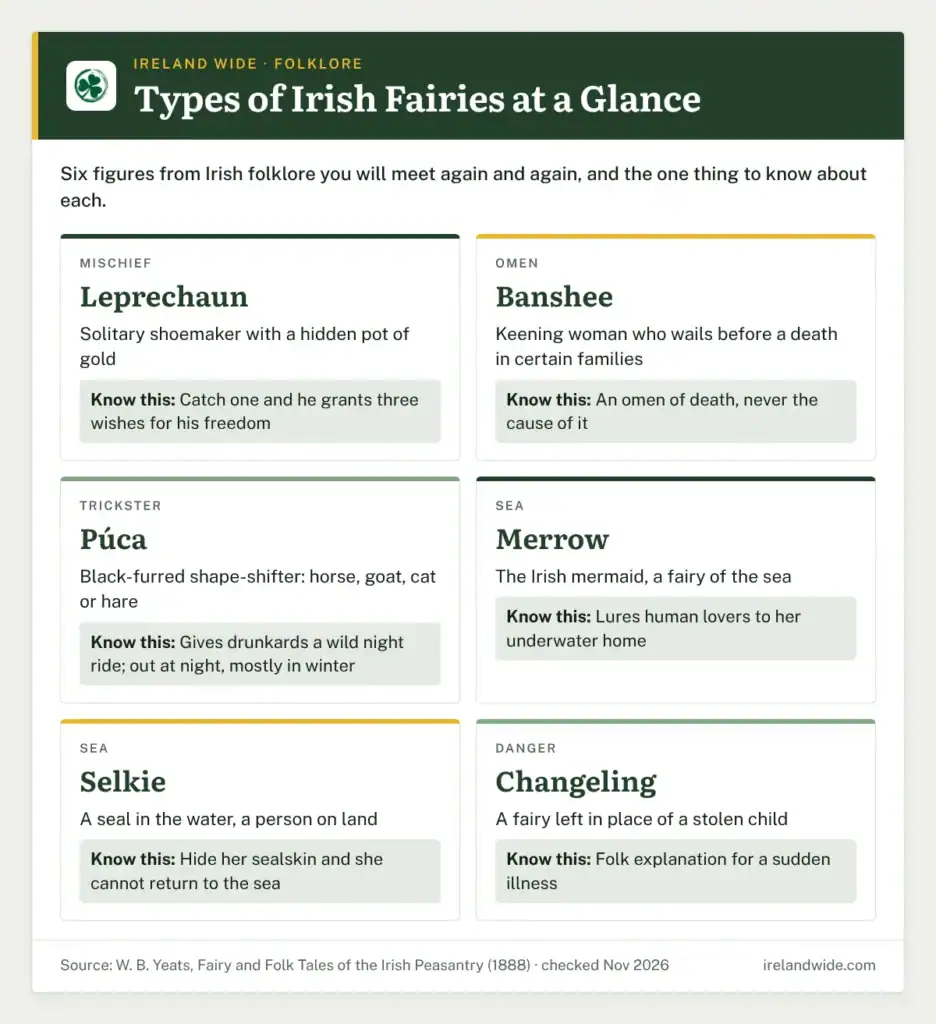
Here’s a quick cheat sheet to the fairy folk you’ll meet below:
Leprechauns
Arguably the most famous of all the Irish fairies, the leprechaun is usually depicted as a mischievous little man with a long beard and a talent for making shoes. In WB Yeats’ Fairy and Folk Tales of the Irish Peasantry, the Leprechaun is described as “a wrinkled, wizen’d, and bearded Elf.”
Unlike other Irish fairies, the leprechaun is a solitary figure and, as such, should be distinguished from the Daoine Sidhe. Although the roguish leprechaun engages in pranks, he doesn’t carry out menacing deeds like some true fairies.
In Irish myths, the leprechaun has great wealth in the form of a pot of gold which he hides at the end of a rainbow. Although humans may pursue the leprechaun to steal his riches, this mischievous Irish fairy always gets the upper hand, using trickery to escape.
Although the leprechaun first appeared in Irish literature in the 8th century, the leprechaun we know today bears little resemblance to the original water sprite. The modern-day version of the leprechaun began sometime during the 17th century and evolved into the character we know today.
That first appearance is in the medieval tale Echtra Fergusa maic Léti (The Adventure of Fergus son of Léti), where three tiny lúchorpáin drag the sleeping King Fergus into the sea. He captures them, and they buy their freedom with three wishes. Sound familiar?
The Irish believe that if you catch a leprechaun, he will grant you three wishes in return for his freedom.
Leprechauns are such an integral part of Irish mythology that they’re actually protected by law! In Carlingford, County Louth, an area known as The Sliabh Foy Loop is “a protected area for flora, fauna, wild animals, and leprechauns!”
The designation dates back to 2009, when Slieve Foy was declared a protected area under the EU Habitats Directive, with the backing of local councillors.
For the Irish people of Carlingford, leprechauns are alive and well, although not necessarily thriving. According to one local, “there are only 236 leprechauns still living in Ireland,” and one of those is running around with no clothes on! More about that a bit later.
Banshees
According to Irish myth, the banshee is a supernatural being who warns of the impending death of a family member with a piercing shriek.
In the 17th century, the banshee appeared in the text, Memoirs of Lady Fanshawe, where she was dressed in white, with red hair “and pale and ghastly complexion.”
It was believed that professional keeners, who attended funerals in ancient Ireland, became banshees when they died.
These keeners or criers were paid to perform at funerals, singing “a type of wailing song that lamented the dead.” When this custom died out, the ghosts of these professional mourners became banshees and continued to cry for certain families. According to fairy folklore, these families are “the O’Neil’s, the O’Brien’s, the O’Connor’s, the O’Grady’s and the Kavanagh’s.”
Although banshees are associated with death, to the Irish, they don’t cause it and only appear as an omen of death, sometimes wearing the blood-stained clothes of the one who is about to die.
Like the leprechaun, the banshee doesn’t really belong to the fairy folk but are the spirits of “women who died prematurely, tragically, or unjustly.”
Throughout history, only a handful of sightings of banshees have been reported. One of the most famous of these occurred in 1437 when a banshee approached King James I of Scotland and “foretold his murder at the instigation of the Earl of Atholl.”
In some parts of Ireland, the banshee is called the Bean-Chaointe, or the keening woman, whose cry is so piercing it can shatter glass. Other ancient legends maintain that the Banshee’s wail is more like “a thin, screeching sound,” or “a cross between a cat crying and a baby screaming.”
Púcas
William Butler Yeats took fairy tales very seriously, especially those about the Púcas, or Pookas. Like the leprechaun, the púca is a potentially mischievous fairy who can transform himself into a great black horse and take unsuspecting travelers on “a wild and terrible horseback ride through the night.”
Many a wayward husband is said to have fallen foul of the Púca and would find themselves “sore and bruised on the roadside at cock-crow in the morning.”
As William Butler Yeats pointed out, the Puca particularly liked to target those who’ve had a few drinks too many, stating, “Especially does [the púca] love to plague a drunkard.”
Púcas are capable of shape-shifting, sometimes taking on the appearance of a horse and at others the form of a goat, cat, or even hare. Regardless of what animal form the Púca chooses, the creature is always covered in jet-black fur.
Although the Púca is most commonly associated with bad luck, some folk tales tell of them “helping farmers with the crops” and even offering presents.
According to Irish folklore, Púcas only appear at night and primarily during the winter. However, a few years ago a group of paranormal investigators believed they captured an elusive Púca on camera in the height of summer.
The Púca was spotted at Lackeen Castle near Lorrha in County Tipperary, where there is a “significant amount of folklore and paranormal activity.”
Legend has it that this particular Púca defended some old hags that were stealing from a dead body. Unfortunately, he was captured by a member of the O’Kennedy family and taken to Lackeen Castle.
“After promising to never hurt any member of the O’Kennedy family, the Púca was released,” but locals maintain that “the Púca can still be seen roaming around the castle to this day.”
Mermaids
Many Irish fairy tales talk about the fairies of the sea, also known as merrows, a name that comes from the Irish murúch and is traditionally explained as ‘sea’ and ‘maid’.
Although there are male mermaids, they are said to be so ugly that the beautiful mermaids prefer to take human lovers, often dragging unwilling men into their underwater homes and keeping them there with magic and enchantments.
Sometimes, the mermaid lets the man go, but only after pledging to return some years later to claim him.
One myth describes how princess Líban, the daughter of Eochaidh, King of Ulster, was transformed into a mermaid after surviving a great flood. Líban went on to become the Mermaid Saint, whose life is commemorated on the 27th of January.
Selkies are often lumped in with mermaids, but rather than being half fish and half human, in the water, they are seals. When they come to land, they shed their seal skins and take on a human form.
Men who wanted to marry a selkie would, according to Irish folklore, find their selkie skin and hide it away to prevent her from returning to the sea.
Origins and Beliefs about Irish Fairies
Irish fairies are magical creatures descended from the supernatural race of the Tuatha de Danann. They live underground in the other world and move between that world and the mortal one using a variety of portals. These portals, or entrances, are located in fairy trees, barrows or burial mounds, caves, and fairy forts.
The so-called luck of the Irish is intrinsically linked to fairies, with the wee folk, or little people, influencing the health and prosperity of individuals and their families.
When Are Irish Fairies Most Active?
Timing matters with the fairies. Samhain, the festival on 31 October and 1 November that gave us Halloween, was traditionally the night when the doors between this world and the Otherworld stood open, and the fair folk were out in force. It’s one of the old Celtic festivals from Samhain to Beltane that marked the turning of the year.
Night-time, and especially the winter months, belongs to the púca too, as you’ve already seen. So if you’re walking past a fairy fort after dark in November, maybe keep your wits about you.
Fairies in Celtic Mythology
Fairy folklore dates back to the beliefs of the ancient Celts, who believed in various Gods and godlike beings, including the Tuatha de Danann. However, there is no linear path that traces the development of fairy lore in Ireland from its origin.
Fairies are neither gods nor humans, although they have numerous human traits and live in a similar, albeit parallel world. Irish fairies are wingless beings with a strong sense of community and a fervent desire to protect their land.
These fairies help to form a sense of national identity and character, while the “fear of spiritual reprisal” influences almost every sphere of life in rural Ireland.
Irish fairy tales gave its people a way of coping with economic risk and uncertainty, explaining upsets in life and “removing the possibility of random chance as a cause.”
If a child fell ill, for example, it was because a malevolent fairy had snatched her away, leaving a changeling in her place. Unfortunate without a doubt, but at least no one needed to take the blame.
The belief could have tragic consequences, though. In 1895, Bridget Cleary of Ballyvadlea, County Tipperary, was killed by her husband, Michael, who claimed she had been taken by the fairies and replaced with a changeling. He was convicted of manslaughter.
What Are Irish Fairies Known For?
Like the pagan gods of ancient times, Irish fairies have both good and bad traits and can bestow blessings as well as curses.
If you keep the fairies happy, you’ll live a long and prosperous life, but if you do something to upset them, you’ll be cursed for the rest of your days.
Irish fairies are an unforgiving bunch that demand humans perform certain ritual behaviors to keep them appeased.
In some households, the fire in the hearth hasn’t been “allowed to go out for over a century,” because to do so would displease the fairies.
Roads have even been diverted to avoid the removal of a fairy tree for fear that doing so would cause the fairies to wreak havoc in the mortal world.
The most famous case is the Latoon fairy bush in County Clare. In 1999, folklorist Eddie Lenihan campaigned to save this lone hawthorn from the new Ennis bypass, now the M18 motorway, and the council fenced it off rather than cut it down. It still stands beside the motorway today, though the county engineer later insisted the road was never actually rerouted for it!
Fairies in Irish Folklore
Irish fairies symbolize desirable traits in the Irish people and highlight the priorities of the Irish peasantry.
Fairies are good neighbors to those that are good to them but fierce enemies to those that do them wrong. Like the Tuatha de Danann, they are “alternately seen as benevolent and merciless.”
They are skilled, intelligent beings with supernatural powers that enable them to shape-shift, disappear, and fly, even though they lack the characteristic fairy wings.
The fairies are much like the ancient Irish and work, farm, and party just as hard!
Want to read fairy lore in ordinary people’s own words? Between 1937 and 1939, some 50,000 children in over 5,000 primary schools collected local stories for the Irish Folklore Commission. That Schools’ Collection is now held by the National Folklore Collection at University College Dublin, and much of it is free to browse online, fairy forts, changelings and all.
Irish Fairy Customs That Survive Today
Plenty of Irish fairy belief has outlived the people who first told it. You don’t have to believe a word of it to spot the habits that stuck.
- Leaving fairy forts alone. Somewhere between 45,000 and 60,000 old ringforts survive across Ireland, and the history of Irish fairy forts shows people still rarely interfere with them.
- Sparing the lone hawthorn. Plenty of people still won’t cut down a lone whitethorn (hawthorn) in a field, as the Latoon bush shows.
- The May bush. On May Eve, the start of Beltane, the Celtic May festival, families put up a decorated May bush outside to keep the fairies away from the house and the milk, and never brought it indoors. The Irish May bush tradition is still going in parts of the country.
- Keeping luck in the house on May Day. Old May Day lore said fire, salt, milk or eggs shouldn’t leave the house that day, a belief recorded in May Day food traditions and folklore from the Schools’ Collection.
Sightings and Encounters with Irish Fairies
There are hundreds of tales of encounters with Irish fairies, and not all of them take place in Ireland!
In 2006, crowds of people descended on Mobile in Alabama, hoping to catch a glimpse of a leprechaun people had reported seeing in a tree on Le Cren Street near Bay Shore Avenue.
Not everyone was convinced it was an Irish fairy they were seeing, with some saying it could be “a shadow from some of the branches being too close.”
Despite those misgivings, the footage went viral on YouTube and had passed 28 million views by 2023.
A more believable story is that of PJ O’Hare, who found what can only be described as a leprechaun suit. He came across the miniature green suit and hat, along with four gold coins and a collection of bones in 1989.
While he never saw the presumably naked leprechaun who previously owned the suit, the local people of Carlingford turned the find into the Carlingford National Leprechaun Hunt, and they’ve been on his trail ever since.
Where Do Fairies Live?
Carlingford is a hotspot for fairy spotting, especially around the protected area of The Sliabh Foy Loop. According to Kevin Woods, this is now “the only place in Ireland where Leprechauns live.”
Woods is something of a leprechaun whisperer, having met these magical creatures on several occasions, and regularly communicates with the Leprechaun’s chief elder, Corrig.
According to Woods, whether or not you see the leprechauns is up to you.
Other places you’re likely to see fairies include:
- Brigit’s Garden in Rosscahill, County Galway, a garden dedicated to Brigid and the Celtic calendar
- The Hill of Tara – an ancient royal site in County Meath
- Grianan of Aileach – an old stone ring fort in Donegal
- Knockainey Hill in County Limerick, linked in legend to Áine, goddess of summer
- Benbulbin – an ancient rock formation in County Sligo
What Should You Do if You See a Fairy?
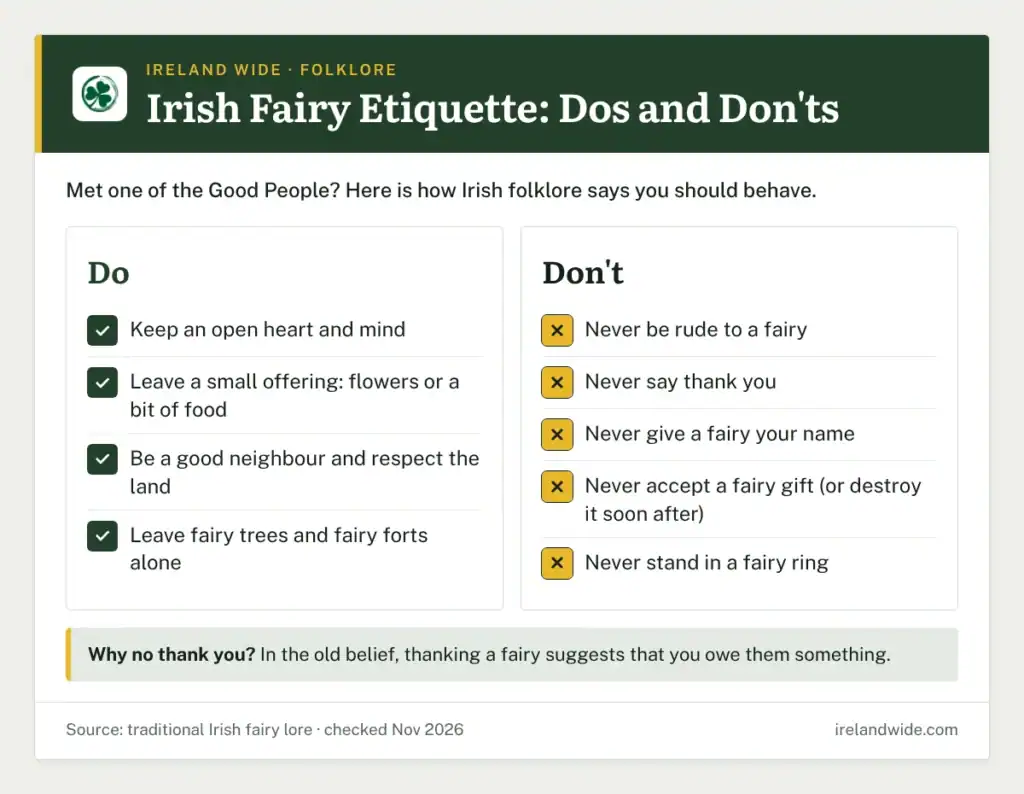
If you see a fairy, you should respond with an open heart and mind. Most fairies appreciate some kind of offering, be it some picked flowers or a small piece of food, and may send some good luck your way in response.
There are a few rules to encounters with fairies, however. Firstly, you should never be rude to a fairy, but at the same time, you should refuse any gifts or, if you feel you can’t refuse it, destroy it soon after. Never say thank you to the fairy as this suggests that you owe them something.
Never give a fairy your name as it gives them power over you, and be sure to avoid standing in a fairy ring as these are portals to the other world, and you could end up stuck there, unable to leave.
Here are the fairy rules in one place, so you can save them for your next walk in the countryside:
Irish Fairies FAQ
Are Irish fairies good or bad?
Both. Irish fairies can bring luck and prosperity to people who treat them well, and misfortune to anyone who insults them or damages their forts and trees.
What are Irish fairies called in Irish?
The usual Irish names are the aos sí or daoine sídhe, meaning the people of the fairy mounds. In English, people often say the Good People, the Fair Folk or the little people instead.
Is a leprechaun a fairy?
Yes, but a solitary one. The leprechaun is a lone shoemaker fairy and is usually kept separate from the aos sí who live together in the fairy mounds.
Do Irish fairies have wings?
No. In Irish tradition, fairies are wingless, even though they can fly, vanish and change shape.
Is it bad luck to cut down a fairy tree?
Irish folklore says yes, and plenty of people still won’t risk it. The Latoon fairy bush in County Clare was saved from a motorway in 1999 for exactly that reason.
What is a changeling?
A changeling is a fairy said to be left in place of a stolen child or adult. The belief was once used to explain sudden illness or changes in behavior.
Conclusion
The fair folk of Ireland are inextricably linked to the concept of the luck of the Irish. If you keep the fairies happy, you’ll be healthy and prosperous, but if you upset them, all kinds of bad fortune will come your way.
Like the Irish gods, Irish fairies are both good and bad. They symbolize important traits and help form a sense of national identity.
Whether you believe in fairies or not, living your life in a manner that will please is likely to bring great rewards. If you are a good neighbor, respectful of the environment, and kind to others, fairies are going to like you.
What fairies want more than anything, however, is for you to believe in them. According to Woods, Ireland’s leprechaun population started to dwindle when the Irish emigrated and “stopped believing in leprechauns.”