If you want to know what is actually known about Saint Patrick’s life, the honest answer is less than the legends suggest, but more than for almost anyone else in fifth-century Ireland. Patrick left two short Latin texts, the Confessio and a letter to the soldiers of a British ruler called Coroticus, and they are the earliest documents known to have been written in Ireland. Everything else, from the snakes to the shamrock, was written down centuries after he died.
Separating the two is the key to Saint Patrick’s life: historical evidence on one side, later legends on the other. This guide covers what Patrick says about himself, what historians can and cannot date, how the first biographies reshaped him in the late seventh century, and where each famous story first appears.
Quick answer: Patrick was a Briton, the son of a deacon, captured by raiders at about sixteen and enslaved in Ireland for six years. He escaped, went home, and later returned to Ireland as a bishop. He never mentions snakes, shamrocks, Rome, Armagh or a date, and his traditional dates of 432 to 461 come from annals compiled long after his time.
What Saint Patrick’s Own Writings Tell Us
Two texts are accepted by historians as Patrick’s own work. Both are short, both were written in Latin, and both survive only in medieval copies. The oldest copy sits in the Book of Armagh, a manuscript written around 807, and even there the Confessio is abbreviated with significant passages omitted while the letter is left out entirely.
The Confessio
The Confessio is an account of his life written late in his career to answer critics who had questioned his mission. It opens with the line most quoted about him: “My name is Patrick. I am a sinner, a simple country person”. He returns again and again to his poor education, calling himself “unlearned” and comparing his rough Latin with that of better-schooled churchmen.
It reads less like a biography and more like a defence. Patrick explains why he went to Ireland, insists he took nothing for himself, and thanks God for the converts he made. The personal details come almost by accident, which is part of why historians trust them.
The Letter to the Soldiers of Coroticus
The second text is angrier. A war band serving Coroticus raided Patrick’s converts in Ireland the day after a baptism. Patrick writes that the newly baptised were still dressed in white robes, with the anointing oil visible on their foreheads, when some were killed and others carried off to be sold. He calls the raiders allies of “the apostate Scots and Picts” and demands the captives be returned.
The letter also gives the clearest statement of his status: Patrick declares that he has been established as a bishop in Ireland. For a shorter overview of both texts and his feast day, see our five facts about Saint Patrick’s origins and writings.
What Historians Can Establish About Saint Patrick’s Life
Read together, the two texts give a short but solid outline. These points come from Patrick himself, in the order he tells them:
- Family: His father, Calpornius, was a deacon, and his grandfather, Potitus, was a priest. The family lived near a place he calls Bannavem Taburniae.
- Capture: He was about sixteen when he was taken to Ireland “along with thousands of others”, and he admits he did not believe in God at the time.
- Slavery: He spent six years as a captive, tending sheep every day, and says this was when his faith took hold.
- Escape: He fled to a ship that was “a good two hundred miles away”. After three days at sea, he and the crew travelled for twenty-eight days through a wilderness.
- Return home: A few years later he was back with his family in Britain.
- The call: In a dream, a man named Victoricus brought him letters headed “the voice of the Irish”, from people living beside the wood of Voclut, near the western sea.
- The mission: He went back to Ireland as a bishop and says he baptised “so many thousands of people”, including sons and daughters of Irish leaders who became monks and virgins of Christ.
- The controversy: Critics raised a sin he had confessed from when he was about fifteen and used it against his work as a bishop.
- His conduct: When converts left gifts and ornaments on the altar, he says he gave them back.
That is close to the full list of reliable biography. The wood of Voclut is also the only Irish place he names, and it puts at least some of his Irish connections on the western Atlantic coast, away from the north-east where later tradition centres him.
What Patrick’s Writings Leave Out
The gaps matter as much as the content. Patrick gives no dates at all, not even the year of his capture or his return. He never says who sent him to Ireland, and the Confessio makes no mention of Rome, a pope, Armagh, druids, miracles at Tara, snakes or a shamrock.
His birthplace is also a puzzle. Bannavem Taburniae has never been securely identified, so the most anyone can say is that he grew up in Roman Britain. Some popular accounts give it as Wales or Scotland, but nothing in his own words settles it.
He wrote in Latin, the language of the church, so his texts tell us little about the Irish he heard every day. Our guide to Irish language history and its Gaelic roots covers how the language itself developed.
When Did Saint Patrick Live? The Dating Problem
Patrick’s dates come from the Irish annals, which were compiled centuries later from earlier records, and they contradict each other. The firmest anchor is not Patrick at all. Under the year 431, the Annals of Ulster record that Palladius, consecrated by Pope Celestine, was sent to Ireland as a bishop, which tells us Christians were already living there.
The next year, the same annals state that Patrick arrived in Ireland in 432. That date sits suspiciously close to Palladius’s mission, and many historians think later writers folded Palladius’s work into Patrick’s story to make Patrick the first and only apostle of the Irish.
His death is even more confused. The traditional date is around 461, but the Annals of Ulster also give 492 and 493, and the 493 entry says Patrick, archbishop and apostle of the Irish, rested on the 16th of the Kalends of April, which is 17 March. The same entry puts him in the 120th year of his age, the same age the Bible gives Moses and a clear sign of legend at work. Most modern accounts settle for “the fifth century” and leave it there.
How the Later Legends Grew: Muirchú, Tírechán and the Book of Armagh
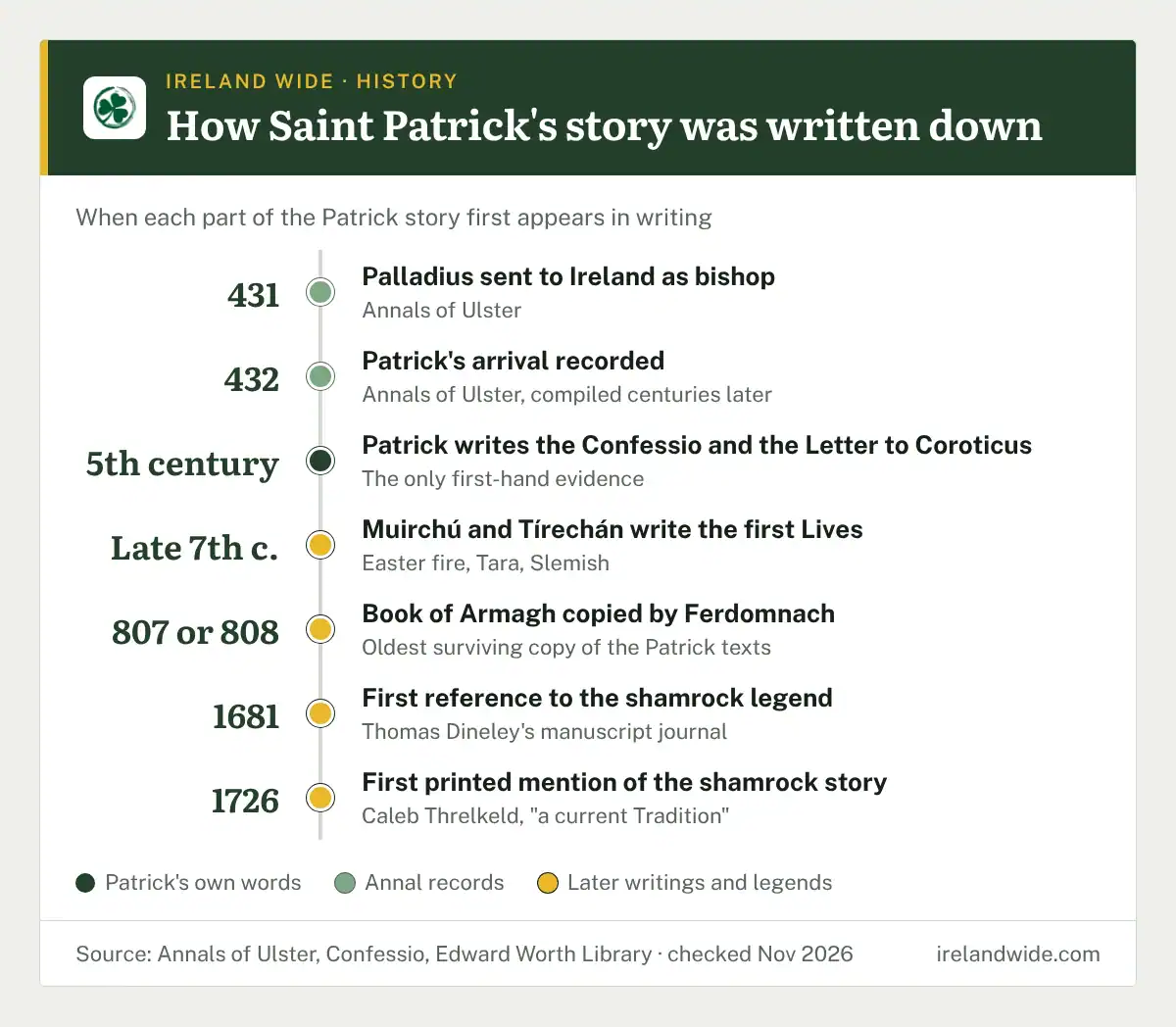
The Patrick most people know was built in the late seventh century, roughly two hundred years after his death. Two churchmen wrote the first accounts of his life, and both had reasons to make him larger.
Muirchú wrote a Life of Patrick for Áed, bishop of Sleaty. His version adds the dramatic scenes: Patrick lighting a fire that was seen from Tara, where King Lóegaire summoned his magicians, contests with druids, and a trip to Slemish to pay his old master, Miliucc, the price of his freedom.
Tírechán wrote at about the same time, producing a collection of notes on Patrick’s travels and the churches linked to him. It reads partly like a register of claims, helping churches attach themselves to Patrick’s name.
Both texts survive in the Book of Armagh, copied by the scribe Ferdomnach in 807 or 808 for Torbach, abbot of Armagh. Armagh had every reason to promote a powerful founding saint, since its leaders called themselves Patrick’s heirs. By the time the manuscript was finished, the slave-turned-bishop of the Confessio had become the national apostle who converted all of Ireland.
Saint Patrick’s Life: Historical Evidence and Later Legends Compared
This table sets each well-known claim against the earliest written source we could trace for it and when that source was written. The longer the gap, the less weight the claim can bear.
Pick a claim to see where it first appears in writing and how much weight it can bear.
| Claim | Earliest source | Written | Verdict |
|---|---|---|---|
| Captured at about 16 and enslaved for six years | Patrick’s Confessio | 5th century, by Patrick | Evidence |
| Son of a deacon, grandson of a priest | Patrick’s Confessio | 5th century, by Patrick | Evidence |
| Worked as a bishop in Ireland | Letter to Coroticus | 5th century, by Patrick | Evidence |
| Arrived in 432 | Annals of Ulster | Compiled centuries later | Uncertain |
| Died on 17 March | Annals of Ulster | Compiled centuries later | Tradition |
| Easter fire seen from Tara | Muirchú’s Life | Late 7th century | Legend |
| Enslaved at Slemish, Co. Antrim | Muirchú’s Life | Late 7th century | Legend |
| Fasted 40 days on Croagh Patrick | Later tradition | Medieval | Legend |
| Explained the Trinity with a shamrock | Thomas Dineley’s journal | 1681 | Legend |
| Drove the snakes out of Ireland | Medieval Lives | Centuries after Patrick | Legend |
The pattern is consistent. Everything marked as evidence comes from Patrick’s own pen, and the further a story sits from the fifth century, the more it tells you about the people who wrote it down.
The Best-Known Saint Patrick Legends Checked
Did Saint Patrick Drive the Snakes Out of Ireland?
No. There were none to drive out. Nigel Monaghan, keeper of natural history at the National Museum of Ireland, told National Geographic that “there was nothing for St. Patrick to banish”, because the fossil record shows no snakes in Ireland at any time. The island stayed too cold for reptiles until the last ice age ended, and by then the sea had cut it off. The only native reptile is the viviparous lizard. The snake story is usually read as an allegory for driving out paganism, and it may have been borrowed from the life of another saint.
Did Patrick Use the Shamrock To Explain the Trinity?
Not as far as any early source shows. Patrick never mentions it, and neither do Muirchú or Tírechán. The first reference to the shamrock legend comes in 1681, in the manuscript journal of the traveller Thomas Dineley, and the first printed mention came from the botanist Caleb Threlkeld in 1726, who called it “a current Tradition”. Threlkeld also recorded people wearing shamrock in their hats on 17 March, so the custom was well established by then, even if the story behind it was more than a thousand years younger than Patrick.
Did Patrick Light the Easter Fire at Slane?
The fire story is Muirchú’s, written around two centuries after the event it describes. In his version Patrick lights an Easter fire within sight of Tara and then confronts King Lóegaire’s magicians. Tradition places the fire on the Hill of Slane in County Meath, which you can read about in our guide to famous landmarks in Ireland. As history, it is best treated as a story about Christianity overcoming royal paganism, told by a seventh-century monk.
Was Patrick Enslaved on Slemish Mountain?
Slemish, in County Antrim, is Muirchú’s location, and it is where he sends Patrick back to find his old master Miliucc. Patrick himself only names the wood of Voclut “near the western sea”, which points to the Atlantic coast. Historians cannot be sure where he spent his captivity, and it is possible the north-eastern setting grew from Armagh’s influence over his story.
Did Patrick Fast on Croagh Patrick?
Tradition says Patrick fasted for 40 days during Lent in 441 on the 764m mountain in County Mayo, and pilgrims still climb it on Reek Sunday, the last Sunday in July. The fast is not in his writings, and the date is traditional. If you plan to climb it, our guide on how to hike Croagh Patrick covers the route, parking and kit.
Is Patrick Even an Official Saint?
Not in the formal sense. Patrick lived long before the Catholic Church had a canonisation process, and he was never actually canonized. Like most early Irish saints, he was recognised by popular acclaim and local devotion.
Where To See Saint Patrick’s Story in Ireland
Many of the places tied to Patrick belong to the legends, which does not make them less worth visiting. It just helps to know which layer you are standing in.
- Croagh Patrick, Co. Mayo: The mountain pilgrimage linked to the 40-day fast. A hard climb on loose stone, so plan ahead for the weather.
- Hill of Slane, Co. Meath: The traditional site of the Easter fire, a short drive from the Hill of Tara.
- Downpatrick, Co. Down: Long-standing tradition places Patrick’s grave beside Down Cathedral, though the burial site cannot be proven.
- Slemish, Co. Antrim: Muirchú’s setting for Patrick’s years as a shepherd.
- The Rock of Cashel, Co. Tipperary: Tradition connects Patrick to the site, though the surviving buildings are much later. See our Rock of Cashel visitor guide for tickets and parking.
Our advice: if you only do one thing, read the Confessio itself. It is short enough to finish in an evening, free online in English and Irish, and it gives you Patrick in his own voice before anyone else got hold of him.
Frequently Asked Questions
Was Saint Patrick Irish?
No. Saint Patrick was a Briton from Roman Britain who was brought to Ireland as a captive at about sixteen. He later returned by choice as a bishop.
Was Saint Patrick the First Christian Missionary in Ireland?
No. The Annals of Ulster record that Palladius was sent to Ireland as a bishop in 431, which implies Christian communities already existed there before Patrick’s mission.
Why Is Saint Patrick’s Day on 17 March?
Saint Patrick’s Day falls on 17 March because Irish annals record that date as the day Patrick died. The year is disputed, with entries pointing to both 461 and 493. Heading over for the celebrations? Our Saint Patrick’s Day packing list deals with the March weather.
What Language Did Saint Patrick Write In?
Saint Patrick wrote both the Confessio and the Letter to the Soldiers of Coroticus in Latin. He was self-conscious about his Latin and repeatedly describes himself as unlearned.