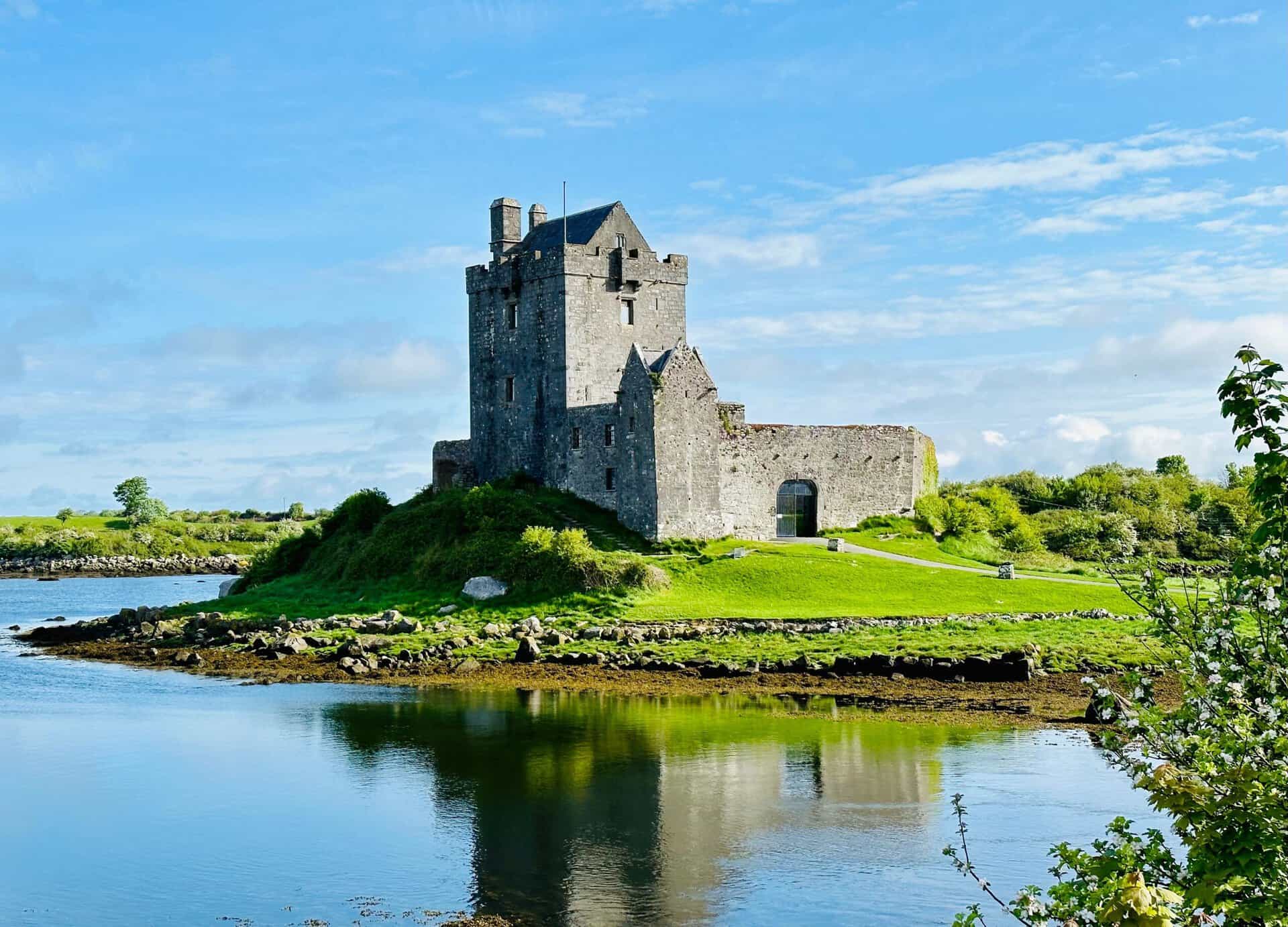

Dunluce Castle is worth visiting if you want one of the most dramatic castle stops on the Causeway Coast without committing half a day to it. It suits road-trippers, families with older children, photographers, and anyone pairing Portrush, Bushmills, or the Giant’s Causeway in the same outing.
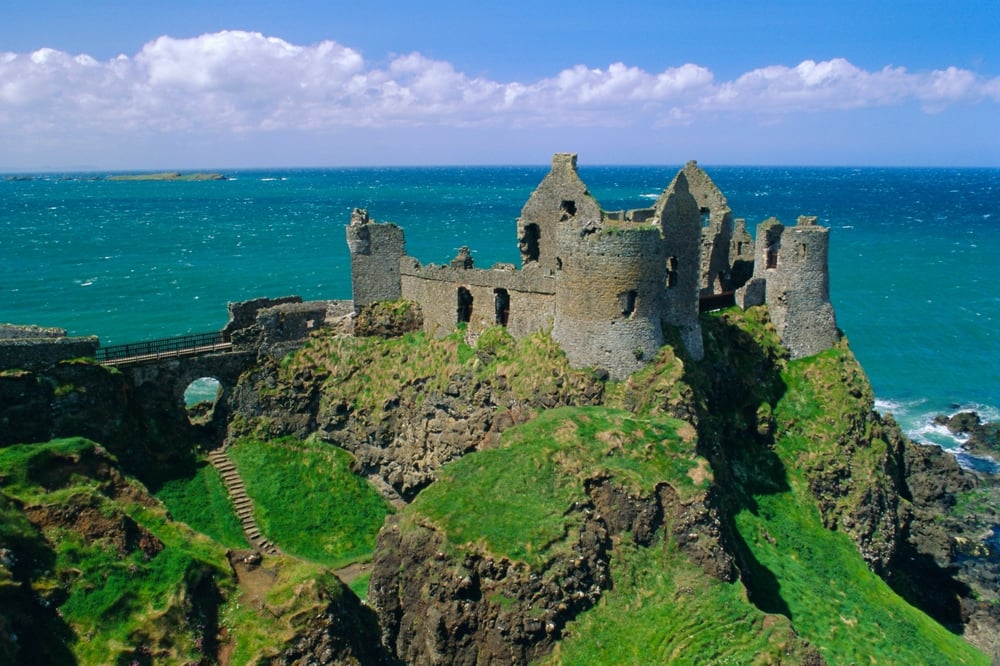
The ruins sit on a rocky headland east of Portrush, linked to the mainland by a bridge and surrounded by sea cliffs. If you are planning a wider castle trip, our best castles in Ireland guide is the right starting point.
This Dunluce Castle Visitor Guide focuses on the practical questions first, then the history, layout, and nearby stops that make the visit work well as part of a County Antrim day. If this is part of a bigger first trip, it also fits neatly into an 7 day Ireland itinerary or a longer swing around the coast.
Search by castle, county or nearby town, then click a marker to open the complete IrelandWide visitor guide.
Dunluce Castle is generally a simple pay-on-arrival stop. Multiple current listings agree that tickets are bought at the castle, not through a standard pre-book system.
Pricing widely matches the official and near-official listings surfaced for this guide: adult £6, child aged 5 to 17 £4, and under 5s free. Family tickets are commonly listed at £18, and concession pricing appears on some operator pages. Because fees can change, confirm on the official Department for Communities page before setting out.
The most consistently reported opening pattern is 9:30 a.m. to 5:00 p.m. from February to November and a shorter winter day in December and January. One detail that catches people out: the lower shore area below the castle may close about an hour before the main closing time. Last admission is also typically before the posted closing hour, so arriving at 4:50 p.m. is not a clever loophole.
You will find Dunluce Castle on the Causeway Coastal Route between Portrush and Bushmills. It is about 2 miles east of Portrush, around a 12-minute drive from the Giant’s Causeway, and roughly 6 minutes from Old Bushmills Distillery.
Driving is by far the easiest option. The approach is straightforward on the A2, and the castle is one of the easiest major ruins in Northern Ireland to fit into a coastal road trip.
Public transport is less neat. If you are not driving, the realistic plan is usually to base yourself in Portrush or Bushmills and connect by taxi or local bus where schedules line up. For broader trip planning around the coast, this stop also works well within a 10 day Ireland itinerary if you are linking the north coast with the rest of the island.
The main practical issue at Dunluce Castle is not the ticket line. It is the tiny on-site car park. Several guides describe it as very small, and that tracks with the castle’s popularity and roadside setting.
If the main parking area is full, Magheracross Car Park is the usual fallback, with about a 10-minute walk back toward the castle. If you want quieter conditions and a better chance of parking close, go earlier in the day. Midday in summer is when the quick-photo crowd, tour traffic, and full-paying visitors all seem to converge at once.
Dunluce is not a furnished castle with room-after-room interiors. It is a roofless ruin, and that is the appeal. You are coming for the site itself: the headland, the bridge approach, the surviving walls and courtyards, and the Atlantic backdrop.
The main ruins you see now date from the 15th to 17th centuries. The castle includes the upper enclosure, bridge crossing, and the main domestic and defensive remains on the rocky outcrop. Interpretation boards and a short video presentation are often mentioned as part of the visit, which helps the place make sense beyond the silhouette.
Below the castle, there is also a lower shore area that some people visit for a different angle on the site. Access there is separate and conditions are rougher, with steps and uneven ground. If weather has turned blustery, this is usually the part people skip first.
The documented history is stronger than the legends, and it is worth keeping the two separate. The earliest castle at Dunluce is generally linked to Richard Óg de Burgh, 2nd Earl of Ulster, in the 13th century. The standing ruins are later.
By the early 1500s, Dunluce was the seat of the McQuillans. In the 1550s, the castle was taken by the MacDonnells, the family most strongly associated with Dunluce in popular history. The official Department for Communities history also highlights the role of Sorley Boy MacDonnell during this period.
In the early 17th century, Dunluce was more than a castle. Archaeology identified a planned settlement often called the lost town of Dunluce, associated with MacDonnell ambitions in the area. That town was destroyed during the 1641 uprising, and the wider site later declined. It is one reason the place feels larger in historical terms than the footprint you walk around today.
In 1588, a ship from the Spanish Armada called the Girona was caught in a storm near Dunluce and wrecked on the rocks below the castle. The loss of life was severe, and the wreck became one of the most significant Armada disasters recorded on the Irish coast.
Sir James MacDonnell recovered material from the wreck, including cannon, and used them to strengthen the castle’s defences at the gatehouses. The rest of the recovered cargo was sold, and the proceeds reportedly went toward repairs and improvements at Dunluce, which is part of why the castle looked stronger and more established through the following decades.
The wreck itself has a life beyond the castle. Divers rediscovered the Girona in the 1960s, and the recovered treasure, including gold, jewellery, and coins, is now held at the Ulster Museum in Belfast. If you visit Dunluce and want to follow the story further, pairing it with a stop at the Ulster Museum turns a coastal ruin into a fuller piece of Armada history.
The tale of the Dunluce Banshee centres on Maeve Roe, said to be the daughter of Lord MacQuillan. According to the legend, she fell in love with a suitor her father refused to accept, and rather than allow the match, he had her locked away in one of the castle’s turrets. Her lover eventually broke her out, and the pair fled by boat toward Portrush. A storm caught them on the crossing, and neither survived.
Locals have long claimed that on stormy nights, screams can still be heard coming from the turret where Maeve was held, and this is where the site’s reputation as home to a banshee comes from. It is a legend rather than a documented event, but it has stuck to Dunluce for generations and is part of why the ruins carry such a heavy atmosphere after dark.
A second more physical legend involves the collapse of the castle kitchen into the sea during a storm in 1639, supposedly taking several servants with it and leaving only one corner intact where a kitchen boy happened to be standing. It is a dramatic image, but it does not entirely hold up. Paintings from the early 1800s still show that section of the castle standing, which suggests the story grew and hardened over time rather than reflecting exactly what happened that night.
Neither tale is confirmed history in the way the MacDonnell or Armada timeline is, but both are part of what makes Dunluce feel like more than a set of walls on a cliff, and visitors ask about them often enough that they deserve a proper telling rather than a passing mention.
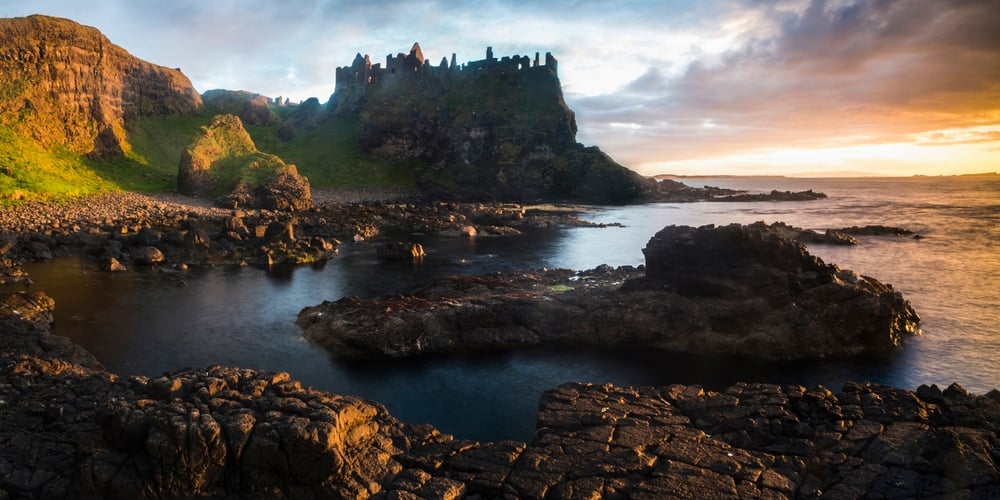
The classic view is the broadside angle that shows the ruins isolated on the headland. That is why so many people stop even without going in. If you want the castle to look properly dramatic, a little distance helps more than getting right up against the walls.
For detail shots, the bridge approach and broken stonework are stronger than trying to force every frame into a full-castle panorama. Cloud, sea spray, and fast-moving weather often do half the work for you on this stretch of coast.
A waterproof layer for your phone or camera is not a bad idea on windy days. Clifftop Atlantic weather has a habit of making sensible people look underprepared in about ten minutes. Early morning and late afternoon usually give the stonework more shape, while flat midday light can make the whole place look slightly grumpier than it deserves.
Dunluce is manageable for many people, but it is not an easy-access heritage site. Expect slopes, steps, uneven surfaces, and exposed edges. Anyone using a wheelchair or anyone unsteady on rough ground should check the official operator guidance in advance.
For families, the visit is short enough to hold attention and dramatic enough that children usually do not need much persuading. The trade-off is obvious: this is a cliffside ruin, so close supervision matters throughout. Pushchairs are possible only in a limited sense around the easier approach areas; for the ruin itself, a carrier is often the less stressful option.
Giant’s Causeway is the obvious companion stop, about a 12-minute drive away according to several current guides. It turns a short castle stop into a fuller coastal day.
Old Bushmills Distillery is only about 6 minutes away by car, which makes Dunluce easy to combine with a distillery visit and lunch in Bushmills.
Portrush is the simplest base if you want the castle without a full rural overnight. The town gives you easier access to food and accommodation than relying on the immediate roadside area around the ruins.
If you are building a wider itinerary, pair this stop with broader planning guides such as advice for first time visitors to Ireland and a look at the 32 counties of Ireland if you are mapping out a longer trip.
Yes. Dunluce Castle works especially well as a 45-minute stop because the payoff is immediate. You do not need a long hike, long shuttle ride, or half-day commitment to get the best of it.
If you only want one medieval ruin on the Causeway Coast, Dunluce is the one most people remember. The setting does a lot of heavy lifting, and the history gives it more substance than a quick roadside photo might suggest. The most common complaint is not disappointment with the castle itself, but the small car park and the feeling that the visit is over quickly for the ticket price.
Standard admission widely listed for Dunluce Castle is £6 for adults and £4 for children aged 5 to 17, with under 5s free. Family and concession tickets are also commonly listed, but check the official operator page before you go.
No standard pre-booking system is commonly listed for regular visits. Most people buy tickets on arrival at the castle ticket office.
Most people need 45 to 75 minutes. Add extra time if you want to linger for photos or explore the lower shore area.
Yes, but the main car park is small and fills quickly. If it is full, Magheracross Car Park is a common backup option with a walk back to the site.
Yes, but it is less convenient. The easiest non-driving plan is usually to stay in Portrush or Bushmills and arrange onward transport locally.
Yes. Dunluce Castle was used as the visual basis for House Greyjoy’s Pyke, with CGI added for the screen version.
Yes, especially for children who like ruins and dramatic coastal settings. Parents should expect steps, uneven ground, and exposed cliff edges.

Dan is the founder and editor of Ireland Wide. Born and raised in Ireland, he researches the country’s history, mythology and cultural traditions using museum collections, heritage authorities and historical sources. He leads the site’s editorial team, with a particular focus on distinguishing documented history from later folklore and modern interpretations.
At Ireland Wide, our aim is to bring authentically Irish insights to you, wherever you are.
Whether you have some feedback or would like to offer some of your own insights for everyone else to explore, don't hesitate to get in touch with us!