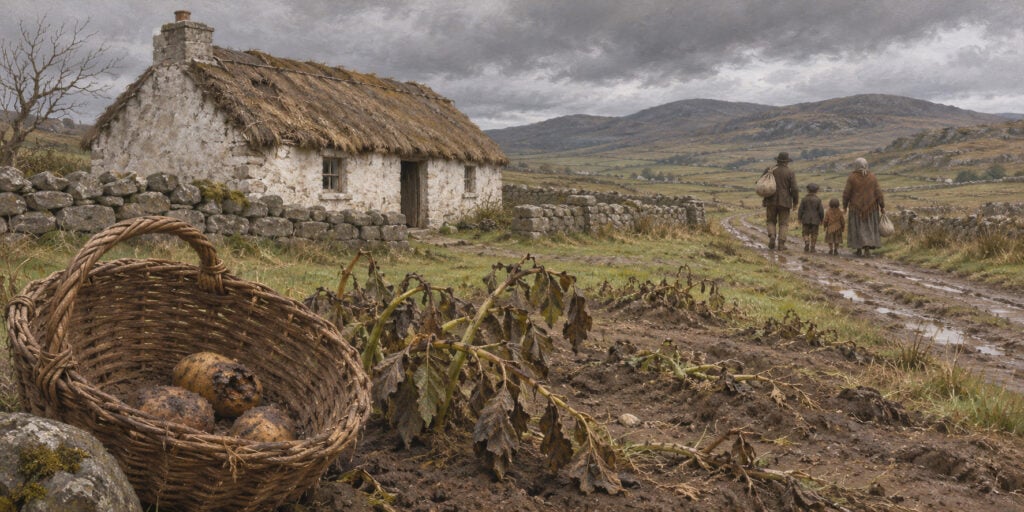
The Great Irish Famine ran from 1845 to 1852, and in those seven years Ireland lost roughly a quarter of its people. A potato disease called blight wrecked the crop that about three million people lived on, and the way the government, landlords and the relief system responded turned a crop failure into a catastrophe. Most historians put the death toll at at least one million, and more than a million more emigrated.
The numbers on paper are stark. The 1841 census counted 8,175,124 people on the island; the 1851 census returned 6.55 million, a fall of 1.62 million in a decade. Below, we cover the causes, a year-by-year timeline of An Gorta Mór (the Great Hunger), how many died and why the estimates differ, where the emigrants went, and the lasting effects you can still trace in Irish family history today.
- Dates: 1845 to 1852, with the worst mortality in 1847, remembered as “Black ’47”.
- Trigger: the water mould Phytophthora infestans, first noticed in Ireland in early September 1845.
- Deaths: about one million excess deaths, from hunger and from diseases such as typhus, relapsing fever and dysentery.
- Emigration: over a million people reached North American ports between 1846 and 1851 alone.
What Caused the Great Irish Famine?
The famine had one trigger and several deeper causes. The blight destroyed the food supply, but poverty, the land system and the government’s economic thinking decided who starved.
The Potato Blight Arrives in 1845
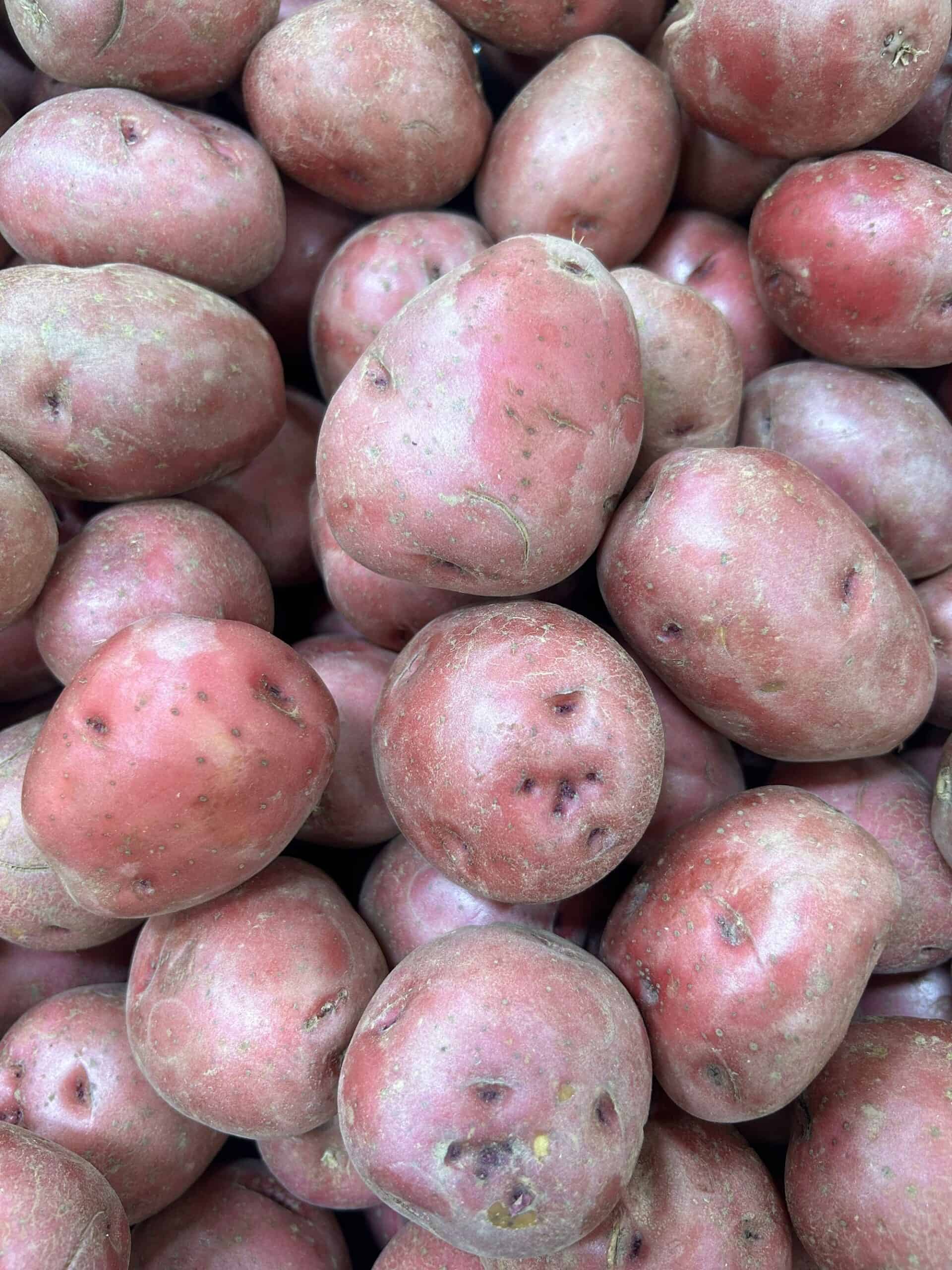
The first signs of Phytophthora infestans were noted in early September 1845. The disease thrives in damp, mild weather, turns the potato stalk black and rots the tuber in the ground or in storage. It originated in the Andes, appeared in the eastern United States in 1843 and reached mainland Europe in 1845, and Holland, Belgium, parts of Scandinavia and Scotland all lost potato crops in the mid-1840s before it reached Ireland.
What made Ireland different was how completely so many people depended on one crop. By the mid-19th century, more than three million people in Ireland lived almost entirely on potatoes. The potato grew well on poor soil and fed a family from a small patch, but when it failed there was nothing behind it.
A Fast-Growing, Very Poor Population
Ireland’s population rose from 6.8 million to 8.2 million between the 1821 and 1841 censuses. Much of the land was rented to middlemen on long leases, and tenants and sub-tenants divided holdings again and again until many families farmed scraps. By the early 1840s around three million landless labourers and cottiers had no regular employment, and the poorest lived in one-roomed mud cabins with a patch of potato ground.
A cottier rented a small plot year to year, usually paying in labour, and grew potatoes on it to feed the family. This class had no savings, no stored grain and no cash to buy food at famine prices, which is why it was all but wiped out.
Laissez-Faire Policy and a Harsh Relief System
Government policy made the crisis worse. Leading politicians of both main British parties believed in laissez-faire, keeping the state out of trade and markets, and many saw Irish poverty as a moral failing to be corrected. Some, known as providentialists, read the blight as an act of God.
The main safety net was the Irish Poor Law of 1838, which split the country into 130 Poor Law Unions, each with a workhouse paid for by local rates. Only people inside a workhouse could get relief under the original law. Charles Trevelyan, the Treasury official who ran famine relief, kept spending tight and state intervention to a minimum, and in January 1848 he described the crisis as a chance at “creating a permanent good out of a transient evil”.
Was Food Exported From Ireland During the Famine?
Yes. Ireland continued to export large quantities of food, mainly to Great Britain, during the blight, and peas, beans, rabbits, fish and honey left Irish ports in 1847. Historians still argue about how much difference stopping exports would have made, since the potato shortfall was enormous, but the sight of loaded ships leaving hungry ports caused riots at the time and remains one of the most bitter memories of the famine.
Great Irish Famine Timeline, 1845 to 1852
The famine was not one bad harvest. The blight struck, eased, and struck again, and relief policy changed almost every year.
Pick a year to see what happened to the potato crop and how the government responded.
| Year | Potato harvest | Main government response | What it meant |
|---|---|---|---|
| 1845 | Partial failure | Relief Commission set up; £100,000 of Indian corn bought from America | Hardship, but few deaths |
| 1846 | Near-total failure | Public works on a piece-work system | Starvation and fever on work sites by winter |
| 1847 | Little blight, but tiny crop | Soup kitchens, then the Poor Law Extension Act | “Black ’47”, the worst year for deaths |
| 1848 | Blight returns | Relief left to bankrupt Poor Law Unions | Workhouses overrun; cholera by year’s end |
| 1849 | Small harvest | Rate-in-Aid Act; Encumbered Estates Act | Over a million people on relief |
| 1850 to 1852 | Better, mostly blight-free | Poor Law relief continues | Famine conditions linger in parts of the south-west and west |
1845: Peel’s Indian Corn
The Conservative Prime Minister, Sir Robert Peel, set out relief plans at an emergency cabinet meeting on 31 October 1845. A Relief Commission was set up to coordinate local relief committees, and in November Peel arranged the purchase of £100,000 worth of Indian corn (yellow maize) from America to hold food prices down. The corn was hard to mill and people nicknamed it “Peel’s Brimstone”, but it worked well enough: few people died in the partial failure of 1845 to 1846.
1846: Total Failure and the Public Works
John Russell’s Whig government took office on 29 June 1846, just before the second, far worse failure. The 1846 crop was so badly blighted that the total yield would have fed the population for about one month. Russell’s government made public works (breaking stones, building roads) the main form of relief and paid by the piece, so the weakest workers earned least. In October 1846 the Board of Works registered 772,994 applications, and through the winter people died of starvation and fever on frozen work sites.
1847: Black ’47
By March 1847 more than 700,000 people were employed on public works, and the government began winding them down. The Temporary Relief Act of February 1847, known as the Soup Kitchen Act, replaced them with state soup kitchens, though delays left many families with nothing in between. By July 1847 around three million people a day were living on soup kitchen rations. The kitchens were shut in August and September.
The Poor Law Extension Act of June 1847 then moved the whole cost of relief onto local ratepayers. It allowed limited outdoor relief, but its Gregory Clause refused help to anyone holding more than a quarter of an acre. Families had to give up their land to get food, and many landlords used the clause to clear their estates.
1848 to 1852: The Blight Returns
Blight hit the crop again in 1848. Poor Law Unions ran out of money, the Quakers could no longer fund soup kitchens, and by the end of the year cholera had broken out. The number on relief passed one million and more than fifty unions were insolvent, so the Rate-in-Aid Act of March 1849 taxed better-off unions to support the poorest. Harvests improved in much of Ireland after 1849, but blight in some south-western counties kept famine conditions going in parts of the country until 1852.
How Many People Died in the Great Famine?
The most widely accepted figure is about one million excess deaths, meaning deaths over and above what normal years would have produced. Nobody counted the dead properly at the time, so every figure is an estimate built from census returns, and the range is wide:
- 1,361,051 deaths between the 1841 and 1851 censuses, the estimate of census commissioner William Wilde, who put 73 percent of them in the five famine years.
- Just over 800,000 excess deaths in 1846 to 1850, a 1960s estimate by Cousens, which later work suggests was about 200,000 too low.
- About 1.4 million when births that never happened because of the famine are added in.
The west suffered most. Connacht accounted for 40.4 percent of all excess deaths, almost 437,000 people, while Leinster accounted for 8.6 percent. Cavan, Clare and Cork were also among the worst-hit counties. Disease killed more people than starvation itself: typhus and relapsing fever, spread by lice in crowded workhouses, prisons and work sites, were the “famine fever” of the period, and over 200,000 people died inside the workhouses.
The deaths fell hardest on the poorest. Almost 300,000 holdings of under five acres disappeared between 1841 and 1851, and the cottier class with less than an acre was close to eliminated.
Famine Emigration: Where Did the Irish Go?
Emigration changed character during the famine. From 1831 to 1845 an average of 26,250 people a year left for North America, mostly families with some means, younger sons and tradespeople. Between 1846 and 1851, over 1,000,000 Irish people arrived at North American ports, around 200,000 a year, and this time most came from the poorest classes, with young single women making up an unusually large share.
About a quarter of a million people left Ireland in 1847, and 200,000 or more left every year for the next five. The main destinations were:
- Britain: by 1851 about three-quarters of a million Irish-born people lived in Britain, making up 22 percent of Liverpool’s population, 15 percent of Glasgow’s and 13 percent of Manchester’s, with as many as 108,000 in London.
- New York: over 900,000 Irish people arrived in New York between 1845 and 1855. Our guide to the Irish in New York follows how those arrivals built the city’s Irish neighbourhoods and institutions.
- Boston: by 1850 roughly 35,000 Irish people had settled in the city, about a quarter of its population; we cover their story in the Irish in Boston, Massachusetts.
- Canada: many sailed to Quebec, the cheaper route to North America.
The crossing itself killed thousands. In 1847 more than 100,000 immigrants arrived through the quarantine station at Grosse Île, near Quebec City, against 25,000 to 30,000 in a normal year. Over 5,000 people died at sea and 5,424 were buried at Grosse Île that year, most of them victims of typhus.
Evictions pushed many onto the ships. Over 100,000 families, roughly half a million people, were evicted during the famine years, and their cabins were often knocked down so they could not return. Some landlords paid their tenants’ fares to clear the land.
Lasting Effects of the Great Irish Famine
The famine did not end with the last bad harvest. Its effects on population, land, language and politics ran for a century and still shape how Ireland sees itself, which is why it appears among the important events in Irish history that shaped modern Ireland.
A Population That Kept Falling
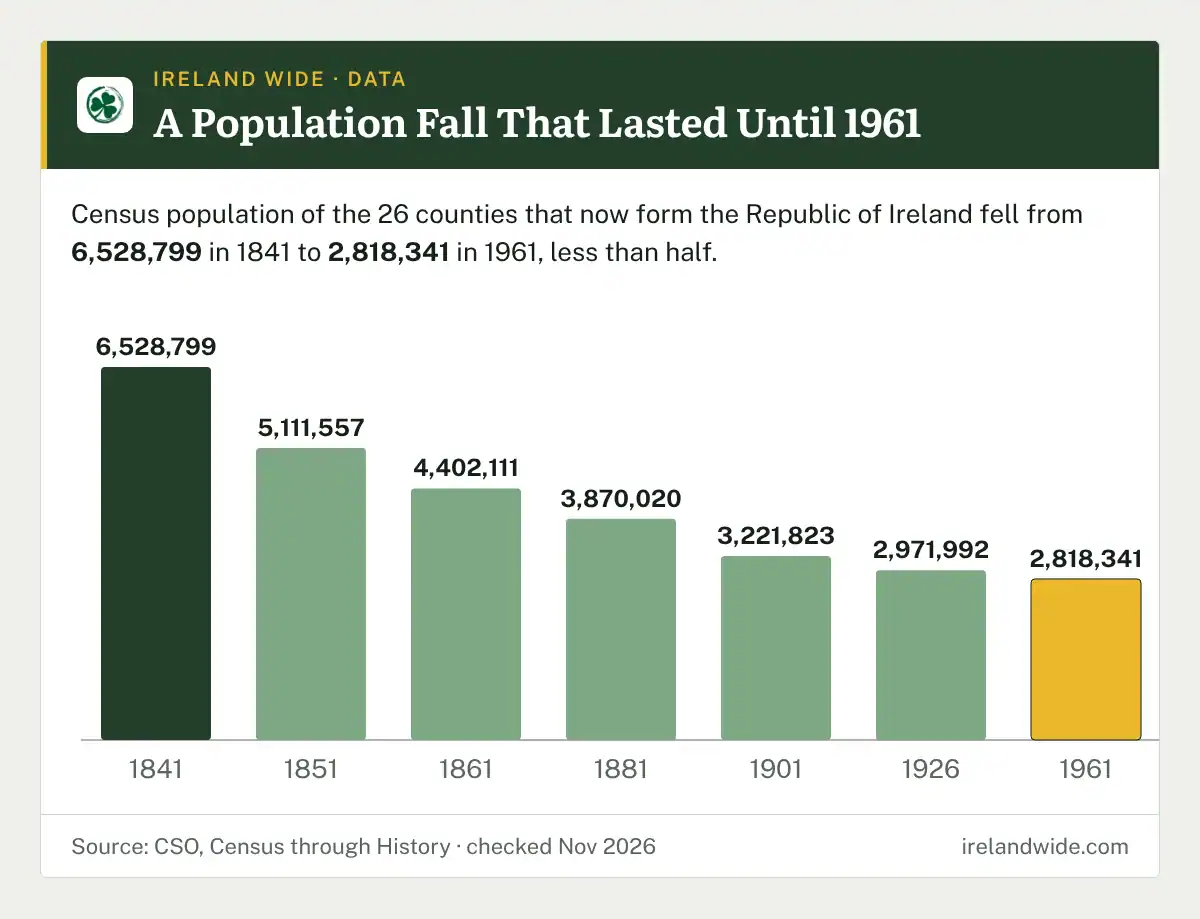
After earlier famines, Ireland’s population had bounced back and kept growing. This time it did not. Emigration became a normal part of life, and in the area that is now the Republic of Ireland the population fell at almost every census from 1841 to 1961:
| Census year | Population (26 counties) |
|---|---|
| 1841 | 6,528,799 |
| 1851 | 5,111,557 |
| 1861 | 4,402,111 |
| 1881 | 3,870,020 |
| 1901 | 3,221,823 |
| 1926 | 2,971,992 |
| 1961 | 2,818,341 |
The 1961 figure was the lowest ever recorded for the State, less than half the 1841 total. Only after that did the population begin to grow again.
Land, Farming and Marriage
With the cottiers gone, small plots were swept into bigger farms. Farms over 50 acres increased sharply by 1851, and cattle and sheep took over land that had been dug for potatoes. Many landlords were ruined too: after the Encumbered Estates Act of 1849, more than 25 percent of the land of Ireland changed hands in the early 1850s.
Families changed with the land. Before the famine, the poorest married young and had large families. Afterwards, the average age at first marriage for women rose to 27, families got smaller, and far more people never married at all. Those patterns lasted well into the 20th century.
The Irish Language
The famine hit hardest in the rural west and south, where Irish was still the everyday language, so a large share of those who died or emigrated were Irish speakers. The language was already in decline before 1845, and the famine sped that decline up sharply. Our guide to Irish language history and its Gaelic roots covers that decline and the later revival.
Politics, Memory and the Diaspora
The clearances left a bitterness that flared again in the Land League agitation of the 1880s, and the emigrant communities abroad gave the Fenian movement and later Irish revolutionaries money and support. For many Irish families in America, Britain and Australia, the famine is the point where their story outside Ireland begins, and you can follow that thread in our piece on the Irish in the USA.
The British government’s role is still debated. In June 1997, a statement from Prime Minister Tony Blair read at a famine event in Millstreet, County Cork, said that “those who governed in London at the time failed their people”. Ireland now holds an annual National Famine Commemoration, and famine memorials stand in Dublin, New York, Boston, Quebec and many smaller towns.
Tracing Famine-Era Ancestors
If your family left Ireland in the late 1840s, the famine is usually the context for their departure, and a handful of record sets cover these years well:
- Relief Commission papers: letters, police returns and inspectors’ reports sent in by local relief committees, catalogued as RLFC/2 in 788 entries arranged by date at the National Archives of Ireland.
- Griffith’s Valuation: a survey of who occupied which land, carried out between 1848 and 1864, just after the famine. Comparing it with the valuation records of the 1830s shows which families disappeared from a townland.
- Board of Guardians records: workhouse admission and discharge registers, birth and death registers, and minutes noting assisted emigration. The Public Record Office of Northern Ireland holds these for the northern unions.
- Emigrant letters and newspapers: letters home frequently mention the famine, and local papers reported relief efforts, deaths and market prices.
Surnames are often the first hurdle, because many were recorded in English forms that shifted over time. Our explainer on why Irish families dropped the O’ from their surnames helps with spelling variants, and our 7-day Irish ancestry itinerary is a good option if you want to research your roots on the ground in Ireland.
Great Irish Famine FAQ
Why Is It Called An Gorta Mór?
An Gorta Mór is Irish for “the Great Hunger”, the name most used in Ireland for the famine of 1845 to 1852. It is also called the Great Famine or, in older and American writing, the Irish Potato Famine.
Was the Great Famine Ireland’s Only Famine?
No. Ireland had several earlier famines, including local ones in the early 1800s, and proportionally more people died in the famine of the 1740s. The Great Famine of the 1840s stands apart for its length, the failure of relief, and the permanent fall in population that followed.
Did the Blight Affect Other Countries?
Yes. Holland, Belgium, parts of Scandinavia and Scotland all suffered potato failures in the mid-1840s. None of them lost anything like Ireland’s share of its population, because none depended on the potato so completely.
Who Helped During the Famine?
Private charities raised money and ran relief alongside the government, and the Quakers (the Society of Friends) were among the best known for running soup kitchens. By 1848 their resources were exhausted and they could not reopen them when the blight returned. Help also came from far afield: in 1847 the Choctaw and Cherokee Nations together raised more than $800 for famine relief.