

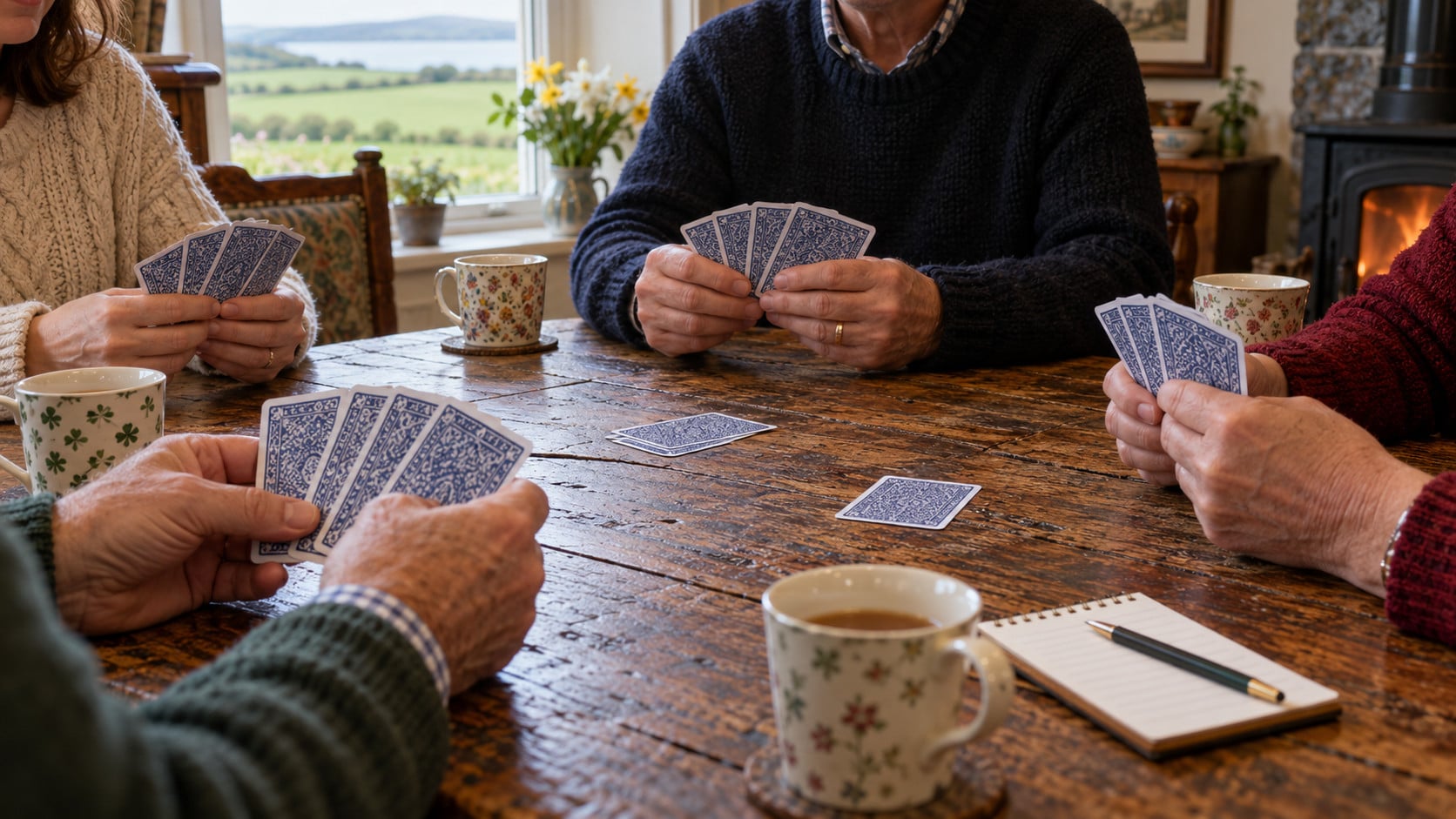
Twenty-Five, Forty-Five and Spoil Five belong to a distinctive family of Irish trick-taking card games. Their unusual rankings are the first thing to learn: the five of trumps outranks the jack, and the ace of hearts is always a trump.
This guide gives a starting ruleset for Twenty-Five and explains how the other names fit. House rules vary, so agree the version before dealing. Learning a local rule halfway through a hand is rarely the peaceful option.
| Game | Basic idea | Before playing |
|---|---|---|
| Twenty-Five | Five-card hands; win tricks to reach 25 points | Agree individual or partnership play and local robbing rules |
| Forty-Five / Forty-Fives | Related games with different scoring and bidding traditions | Ask whether it is a non-bidding game to 45 or an auction version |
| Spoil Five | Older member of the family, associated with winning a majority of five tricks | Use a specific ruleset; do not assume Twenty-Five scoring |
These are related games, not three interchangeable names for one set of rules. Pagat’s Spoil Five family overview explains their shared background and distinctive trump system.
A trick is a round in which each player contributes one card. The first card is the lead. The winner takes the trick and leads the next one. A trump belongs to the special suit chosen for that hand and beats a card from an ordinary suit.
There are five tricks in a complete five-card hand. You are trying to win the right rounds, not collect the largest number printed on a card. If poker is your usual reference point, leave the pairs and flushes out of this one.
The following setup follows Pagat’s documented Twenty-Five rules:
In this ruleset, choosing not to rob does not demote your concealed ace. Other versions handle that differently. Confirm the rule your table uses instead of combining two accounts.
The three strongest trumps are the trump five, trump jack and ace of hearts, in that order. If hearts are not trumps, the ace of the trump suit follows them. Number cards run downwards in red suits and upwards in black suits.
| Suit and role | Ranking |
|---|---|
| Hearts are trumps | 5♥, J♥, A♥, K♥, Q♥, 10♥, 9♥, 8♥, 7♥, 6♥, 4♥, 3♥, 2♥ |
| Diamonds are trumps | 5♦, J♦, A♥, A♦, K♦, Q♦, 10♦, 9♦, 8♦, 7♦, 6♦, 4♦, 3♦, 2♦ |
| Clubs or spades are trumps | 5, J, A♥, ace of trumps, K, Q, 2, 3, 4, 6, 7, 8, 9, 10 |
| Hearts are not trumps | K, Q, J, 10, 9, 8, 7, 6, 5, 4, 3, 2; A♥ remains a trump |
| Diamonds are not trumps | K, Q, J, 10, 9, 8, 7, 6, 5, 4, 3, 2, A |
| Clubs or spades are not trumps | K, Q, J, A, 2, 3, 4, 5, 6, 7, 8, 9, 10 |
These rankings are also documented in Bicycle’s Forty-Five rules. The ace of hearts counts as a trump for following suit as well as for winning tricks. Cats at Cards also provides a ranking chart.
On a non-trump lead, follow that suit or play a trump. You may trump even when you hold the led suit. If you cannot follow, you may play any card.
On a trump lead, you must play a trump if you hold one, subject to the top three cards’ reneging privileges. You may discard another suit only when every trump you hold is a protected top-three card stronger than the trump led. Holding an ordinary trump means you must play a trump, although you may choose a protected one.
The highest trump wins; otherwise the highest card of the led suit wins. For the full exceptions, use the linked rules and ask an experienced player to demonstrate a hand.
Forty-Fives is not always a bidding game with a target of 45. Pagat’s Forty-Fives guide distinguishes older play without bidding from Auction Forty-Fives, popular in parts of North America, where the target is commonly 120.
For an auction version, settle the bids, trump selection, discards, scoring and winning target first. A bid is a commitment under that version’s rules, not simply a prediction that your cards look promising. Start with the specific local rules rather than a name on its own.
Family card nights can be part of holiday gatherings, alongside the customs covered in our guide to Irish Christmas traditions. You do not need to play for money to enjoy the game.
Twenty-Five is a useful starting point because it introduces the shared rankings without an auction. Begin with a practice hand and the exact rules your group intends to use.
No. The trump five and jack outrank the ace of hearts. Non-trump aces also rank differently in red and black suits; use the table above.
They belong to the same family, but the name alone does not establish scoring or bidding. Check the version before playing.

Matt Hook is a Canadian writer of Scottish and Irish heritage. He built his writing career creating detailed gaming guides, turning complex mechanics, history and lore into useful information for readers. Matt brings that same research-focused approach to Ireland Wide, where he writes about Irish travel, heritage, history and culture. He also holds CMA and CPA designations as a professional accountant, giving him a strong background in research, accuracy and attention to detail.
At Ireland Wide, our aim is to bring authentically Irish insights to you, wherever you are.
Whether you have some feedback or would like to offer some of your own insights for everyone else to explore, don't hesitate to get in touch with us!