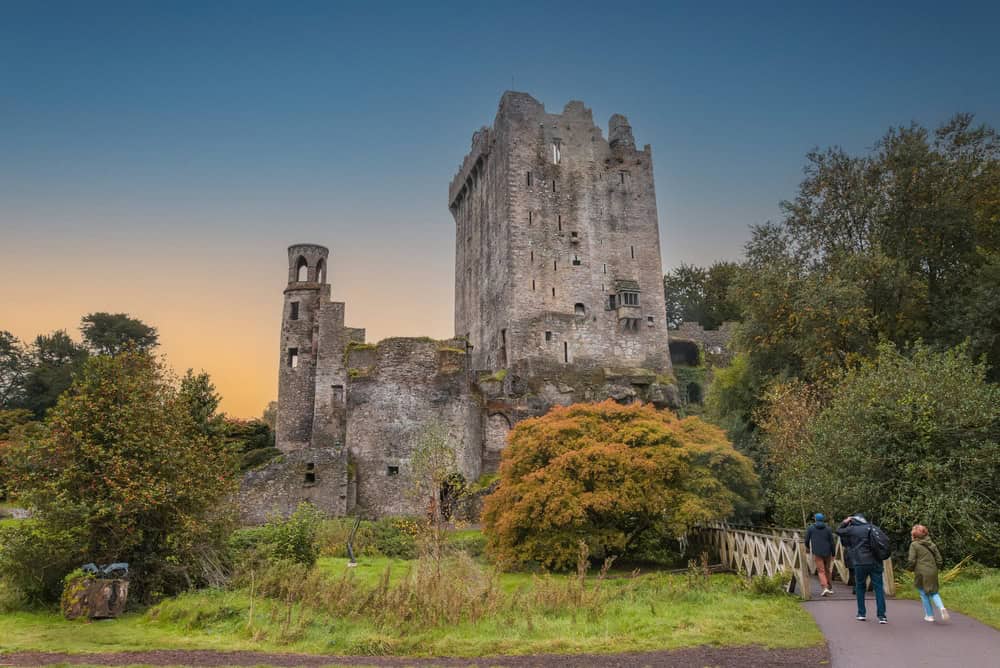


Knappogue Castle is worth visiting for people who want a compact, well-restored medieval tower house with a long County Clare history, especially if guided interior access or a banquet is available for their dates. It suits history-minded day-trippers, couples and families who are happy to plan ahead, since access arrangements can be more limited than at Ireland’s larger castle attractions.
Built in 1467, Knappogue Castle stands outside Quin in County Clare. Its tall, squared profile is the work of a late-medieval Gaelic lordship, while several prominent additions date to the 19th century. The result is a building with more than one architectural chapter, and no shortage of stone stairs.
Check out our Best Castles in Ireland where Knappogue Castle makes the list!
| Detail | Information |
|---|---|
| County and jurisdiction | County Clare, Republic of Ireland |
| Location | Near Quin village, in the parish of Quin |
| Castle type | Late medieval tower house |
| Built | 1467, according to the established historical record |
| Original builder | Seán Mac Conmara, also rendered MacNamara |
| Associated families | MacNamara, Scott and Dunboyne families |
| Later works | Major restoration and extensions in the 19th century |
| Public status | Has operated as a public heritage attraction through Shannon Heritage arrangements |
| Interior access | Guided access and event access have been offered; confirm the available format before travelling |
| Gardens | A restored walled garden dating to 1817 |
| Coordinates | 52.793919° N, 8.831597° W |
| Parking | Visitor guidance identifies parking near the entrance and a larger area behind the castle; confirm arrangements when booking |
| Public transport | No direct public-transport service information is confirmed here; a car or pre-arranged local transport is the practical option |
| Accessibility | Detailed accessibility information should be requested from the operator before booking, particularly for interior routes |
| Toilets and food | Confirm facilities with the operator. Medieval-style banquet experiences have been associated with the castle |
| Family suitability | Suitable for families able to manage a historic tower-house setting, subject to the access format offered |
| Official information | knappoguecastle.ie |
| Operational details | Checked July 2026: booking and visiting arrangements should be reconfirmed directly with Knappogue Castle before departure |
Knappogue is not a vast fortress with acres of battlements to roam. It is a 15th-century tower house, the vertically built defensive residence associated with powerful Gaelic families in late medieval Ireland. That scale makes the place easier to understand: rooms stack upward, thick walls dominate the structure, and the castle reads as a home built with security very much in mind.
The original builder, Seán Mac Conmara, was the son of Síoda Mac Conmara, who is associated with Bunratty Castle. In 1571, Knappogue became the seat of the MacNamara sept, the Earls of West Clancullen. The castle name is commonly translated as referring to a place with many small hills, which fits the gently rolling Clare setting.
Its later history is unusually visible in the building itself. The Scott family acquired the castle in 1800 and undertook restoration and extension work. After Theobold Fitzwalter Butler, the 14th Baron Dunboyne, acquired it in 1855, further alterations included the drawing room, long room, west wing, clock tower and gateway. The Pain brothers, James and George Richard Pain, were responsible for the remodelling.
The central tower house remains the essential reason to go. Its restoration allows you to read the medieval form clearly, even though the castle is not frozen in 1467. The 19th-century rooms, west wing, gateway and clock tower are part of its story, not distractions from it.
The grounds also include a restored walled garden dating from 1817. The high walls, climbing roses, grapevines and clematis give the site a gentler counterpoint to the defensive stone building. If your visit includes time outdoors, do not treat the garden as an afterthought.
Knappogue Castle also lends its name to a single malt Irish whiskey brand. The whiskey and the castle share a name, but they are different experiences. The brand describes its whiskey as triple distilled and offers 12-, 14- and 16-year-old expressions. A castle visit should be planned around the heritage attraction’s own booking arrangements, not around whiskey availability.
The best exterior photographs usually come from giving the tower some space. The castle’s height and strong vertical lines work better from the grounds than from immediately beside the walls. A wider view can also include the Clare landscape that explains the castle’s hill-country name.
For garden pictures, look for the contrast between planted borders and the high enclosing walls. Keep photography rules in mind during guided interiors or events. Historic rooms can have low light, and flash restrictions may apply, so ask your guide before taking photos.
Quin is the natural first stop because Knappogue Castle sits just outside the village. It is useful for orienting yourself in this part of County Clare before continuing to larger attractions.
Bunratty Castle makes a meaningful companion visit for anyone following the MacNamara connection. Síoda Mac Conmara, father of Knappogue’s builder Seán, is associated with Bunratty Castle, linking the two sites through the same powerful family network. Plan each attraction separately, as they have different operators and access arrangements.
For another medieval tower-house experience with a more substantial riverside setting, Cahir Castle makes a useful stop on a longer Ireland castle itinerary. People building a broader route can also compare Knappogue’s intimate scale with the larger Norman keep in this Trim Castle visitor guide.
Shannon and Ennis are both practical bases for a Knappogue outing, each about a 25-minute drive away in the available visitor guidance. Limerick City is also reachable by road in roughly 30 minutes, which makes the castle a workable addition to a wider west-of-Ireland itinerary. If you are planning an overnight castle break as well as a day visit, these castles to stay in Ireland offer a very different kind of experience.
Knappogue Castle has enough recorded political and family history that there is no need to dress it up with unverified tales. The documented record covers its MacNamara foundation, Cromwellian confiscation, 19th-century rebuilding and its use during the War of Independence.
If you encounter ghost stories or dramatic anecdotes in casual conversation, treat them as local storytelling unless the operator identifies a historical source. The castle’s real history is already complicated, contested and far more useful than a made-up legend.
Knappogue Castle has offered guided and event-based interior access. Check the official booking information before travelling because the available access format can vary.
Knappogue Castle was built in 1467 by Seán Mac Conmara. It was substantially restored and expanded during the 19th century.
Knappogue Castle is near Quin village in County Clare, Republic of Ireland. Its coordinates are 52.793919° N, 8.831597° W.
It can suit families interested in castles and gardens, but parents should confirm the specific tour or event format and ask about stairs, access and facilities before booking.
The operator does not publish a universal visit length in the information available here. Allow enough time for your booked activity and the walled garden, and confirm the expected duration when reserving.

Matt Hook is a Canadian writer of Scottish and Irish heritage. He built his writing career creating detailed gaming guides, turning complex mechanics, history and lore into useful information for readers. Matt brings that same research-focused approach to Ireland Wide, where he writes about Irish travel, heritage, history and culture. He also holds CMA and CPA designations as a professional accountant, giving him a strong background in research, accuracy and attention to detail.
At Ireland Wide, our aim is to bring authentically Irish insights to you, wherever you are.
Whether you have some feedback or would like to offer some of your own insights for everyone else to explore, don't hesitate to get in touch with us!


