

Yes, St Brigid’s Day 2027 is a public holiday in the Republic of Ireland. Put Monday 1 February 2027 in your calendar if you’re sorting out work or school arrangements. In 2027, the statutory February holiday falls on the same date as St Brigid’s feast day. One less date to keep track of.
This guide explains how the bank holiday date is decided, what eligible employees are entitled to and what families should check on their school calendar. There’s also a brief look at the traditions behind the day.
Quick answer:
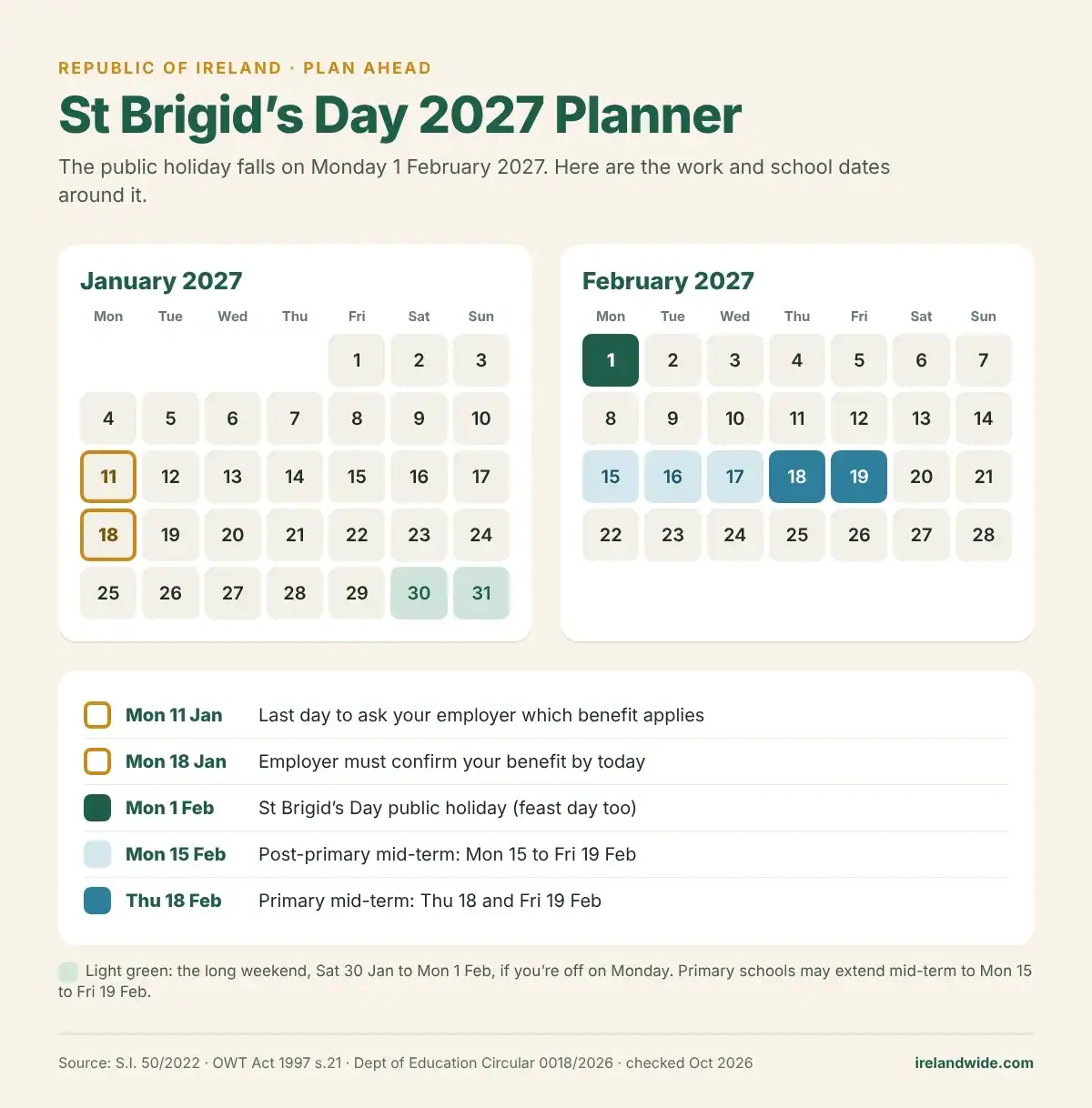
Here’s January and February 2027 on one page, with every date worth knowing marked in.
| Calendar Detail | 2027 Date or Location |
|---|---|
| Jurisdiction covered | Republic of Ireland |
| St Brigid’s feast day | Monday 1 February 2027 |
| St Brigid’s Day public holiday | Monday 1 February 2027 |
| Long weekend (if you’re off on Monday) | Saturday 30 January to Monday 1 February 2027 |
| Next ordinary Monday-to-Friday working day | Tuesday 2 February 2027 |
| Latest date to ask which benefit applies | Monday 11 January 2027 |
| Northern Ireland | Not a bank holiday |
Checked against S.I. No. 50/2022, the Organisation of Working Time Act 1997 and GOV.UK in October 2026.
The legal term is public holiday, though you’ll commonly hear “St Brigid’s Day bank holiday”. If your workplace closes for the holiday and you normally have weekends off, it gives you a three-day weekend ending on Monday 1 February.
Heading away for it? Pack for February weather in Ireland, which usually means short days, cool temperatures and plenty of wind and rain.
The statutory rule puts the holiday on the first Monday in February, with a Friday exception. If 1 February falls on a Friday, that Friday is the public holiday instead. This rule has applied since 2023. It comes from S.I. No. 50/2022, the Organisation of Working Time (Covid-19 Commemoration) Regulations 2022.
Here’s how it works for every possible weekday:
| Weekday of 1 February | Public Holiday Date |
|---|---|
| Monday | Monday 1 February |
| Tuesday | The following Monday, 7 February |
| Wednesday | The following Monday, 6 February |
| Thursday | The following Monday, 5 February |
| Friday | Friday 1 February |
| Saturday | The following Monday, 3 February |
| Sunday | The following Monday, 2 February |
In 2027, 1 February is a Monday, so the feast day and public holiday coincide. St Brigid’s cultural and religious feast day stays on 1 February, even in years when the statutory holiday falls later.
Planning further ahead? Here’s how the rule plays out from the first holiday in 2023 through to 2030.
| Year | Weekday of 1 February | St Brigid’s Day Public Holiday |
|---|---|---|
| 2023 | Wednesday | Monday 6 February 2023 |
| 2024 | Thursday | Monday 5 February 2024 |
| 2025 | Saturday | Monday 3 February 2025 |
| 2026 | Sunday | Monday 2 February 2026 |
| 2027 | Monday | Monday 1 February 2027 |
| 2028 | Tuesday | Monday 7 February 2028 |
| 2029 | Thursday | Monday 5 February 2029 |
| 2030 | Friday | Friday 1 February 2030 |
Dates calculated from S.I. No. 50/2022. Checked October 2026.
The next Friday exception comes in 2030, when the holiday lands on Friday 1 February. If you’re comparing with last year, St Brigid’s Day fell on Monday 2 February 2026, and you’ll find it in the full list of Ireland’s 2026 bank holidays.
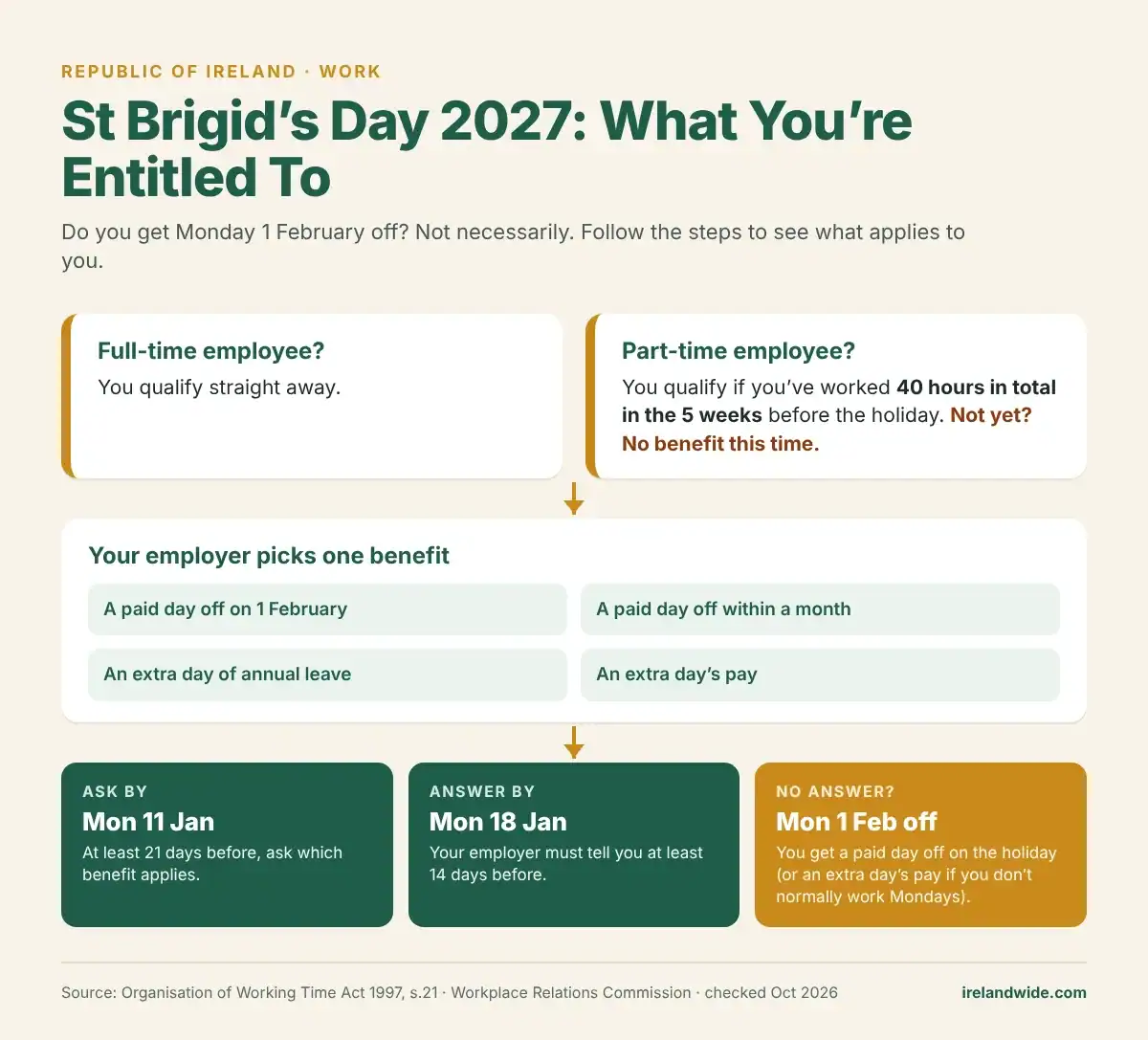
Eligible employees have a right to a public-holiday benefit. There’s a catch, though: it does not automatically mean everyone gets Monday off. The Workplace Relations Commission lists four options, with the employer determining which applies:
Full-time employees have immediate entitlement to a public-holiday benefit. Part-time employees qualify when they’ve worked a total of 40 hours in the previous five weeks.
If you work on Monday 1 February, you’re entitled to payment at your agreed rate for that work, plus the applicable public-holiday benefit. If your workplace closes and you’d normally work that day, you receive your normal day’s pay.
Before requesting annual leave or arranging childcare, check your roster and ask which benefit applies. The calendar can tell you when the holiday falls. Your employer needs to confirm what that means for your working arrangements.
Want an answer in good time? Under section 21 of the Organisation of Working Time Act 1997, you can ask your employer to decide which benefit applies. Ask by Monday 11 January 2027 (at least 21 days before the holiday), and your employer must tell you by Monday 18 January 2027 (at least 14 days before). If they don’t reply in time, you’re entitled to a paid day off on 1 February itself. If Monday isn’t one of your normal working days, the default is an extra day’s pay instead.
Here’s the whole process in one picture:
St Brigid of Kildare is one of Ireland’s patron saints. Her feast day is associated with the traditional beginning of spring and Imbolc, and making crosses from rushes or straw remains a familiar custom.
In Irish, the day is Lá Fhéile Bríde. Imbolc is one of the old Celtic seasonal festivals, and you can see how it sits alongside Samhain and Beltane in this guide to ancient Celtic holidays.
St Brigid’s crosses have traditionally been placed in homes as symbols of protection and blessing. Craft activities, storytelling and community gatherings are ways to mark the occasion. If you’re planning around a particular 2027 event, though, check the details with its organiser before you go.
The public holiday itself is much newer. The Government announced it on 19 January 2022, alongside a once-off holiday on 18 March 2022 that recognised the public’s efforts during the Covid-19 pandemic. The first St Brigid’s Day holiday followed on Monday 6 February 2023, and the Government described it as the first Irish public holiday named after a woman.
You may be rostered to work on Monday 1 February 2027. Eligible employees are entitled to a public-holiday benefit, but that can mean additional pay or leave rather than the day itself off. Check before making plans.
No. Northern Ireland has no bank holiday in February 2027, so 1 February is an ordinary working day there. The next Northern Ireland bank holiday is St Patrick’s Day, Wednesday 17 March 2027.
Start with the school’s own 2026/2027 calendar and any notices sent to parents about arrangements around Monday 1 February. Check the surrounding dates individually before booking childcare or a longer break. The bank holiday alone doesn’t establish an extended school holiday.
February mid-term is a separate break. Under Department of Education Circular 0018/2026, post-primary schools close from Monday 15 to Friday 19 February 2027. Primary schools close on Thursday 18 and Friday 19 February, and can use three discretionary days to take the full week from Monday 15 February.
Tuesday 2 February 2027 is the next ordinary working day for a Monday-to-Friday schedule. Your actual next shift, or your child’s return-to-school date, depends on the relevant roster or school calendar.
Monday 7 February 2028. In 2028, 1 February falls on a Tuesday, so the holiday moves to the following Monday.
For wider family planning, consult the Ireland school holiday calendar for 2026/2027 alongside your child’s own school dates.

Matt Hook is a Canadian writer of Scottish and Irish heritage. He built his writing career creating detailed gaming guides, turning complex mechanics, history and lore into useful information for readers. Matt brings that same research-focused approach to Ireland Wide, where he writes about Irish travel, heritage, history and culture. He also holds CMA and CPA designations as a professional accountant, giving him a strong background in research, accuracy and attention to detail.
At Ireland Wide, our aim is to bring authentically Irish insights to you, wherever you are.
Whether you have some feedback or would like to offer some of your own insights for everyone else to explore, don't hesitate to get in touch with us!