
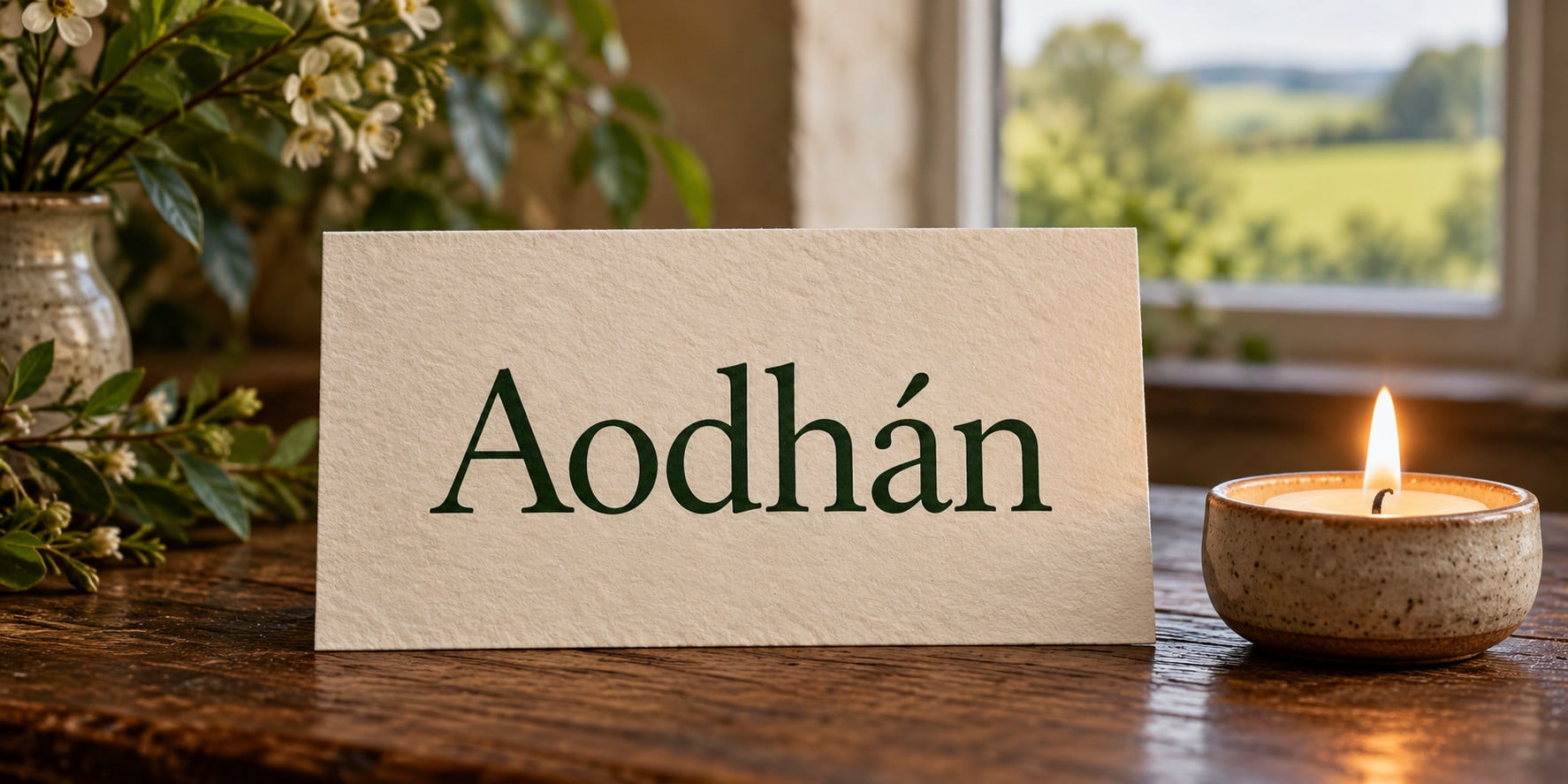
Aodhan means “little fire” and is the spelling of the Irish name Aodhán without the accent. Aodhán is a diminutive of Aodh, an older Irish name associated with fire. Aidan is its established English form; Aiden is a related English spelling.
If the name is on your shortlist, the main decisions are the spelling you want and how you intend to say it. The history is shared, but a familiar English pronunciation and an Irish written form do not always line up neatly.
| Detail | Answer |
|---|---|
| Traditional meaning | Little fire |
| Language and origin | Irish; a diminutive of Aodh |
| Irish spelling | Aodhán, with the fada over the second a |
| Spelling without the fada | Aodhan |
| Related English forms | Aidan and Aiden |
| Traditional use | Masculine given name |
Patrick Woulfe’s Irish Names and Surnames, published in 1923, records Aodhán as a diminutive of Aodh and lists Aidan among its English forms. His separate entry for Aodh connects the older root with fire.
The familiar explanation combines Aodh with the diminutive ending -án. A diminutive can convey smallness or affection, giving the conventional meaning “little fire.” The older Irish form Áedán also appears in accounts of the name’s history.
That meaning describes the name’s formation. It does not establish that a child will have a fiery temperament, special talents or a particular personality. Names carry enough expectations without being asked to predict a career.
The fire connection is historical. In everyday modern Irish, tine is the ordinary word for fire; the personal name preserves an older root.
Rough Irish-oriented guides include AY-awn and EE-awn; you may also hear AY-dən, like Aidan. Pronunciation varies with dialect and the person using the name. These English respellings are approximations, not exact phonetic transcriptions or a rule for every bearer.
For an Irish-language pronunciation, do not automatically sound out dh as an ordinary English “d.” Irish spelling follows its own sound patterns. Listen to the whole name rather than trying to assemble it one English letter at a time.
Forvo has a user-contributed Irish recording of Aodhán. It is a useful listening example, not an official pronunciation standard. For wider Irish vocabulary and dialect recordings, use Foras na Gaeilge’s Teanglann pronunciation database; that general resource should not be mistaken for a recording of this particular name.
For someone you meet, use the pronunciation they give you. If you are choosing the name, say your intended version aloud with the surname and check it with an Irish speaker if retaining Irish pronunciation is a priority.
| Spelling | Relationship | Practical consideration |
|---|---|---|
| Aodhán | Irish diminutive of Aodh | Retains the fada and Irish written form |
| Aodhan | Aodhán written without its fada | Keep the chosen spelling consistent; pronunciation may need explaining |
| Aodh | The underlying Irish name | A separate given name, without the diminutive ending |
| Aidan | Established English form of Aodhán | Usually pronounced AY-dən in English |
| Aiden | English spelling variant of Aidan | Usually shares Aidan’s English pronunciation |
Aodhán is the choice that preserves the Irish spelling. Aidan may be easier for English speakers to recognise and pronounce. Aodhan keeps the Irish letter sequence without the accent, but dropping the mark does not automatically remove pronunciation questions.
The fada goes over the second a: Aodhán. The accent is called the síneadh fada, usually shortened to “fada.” Teanglann’s dictionary entry for síneadh identifies it as the mark used for a long vowel.
It carries linguistic information in Irish. Aodhan is often used as a chosen spelling or where a system omits accented characters, but that does not create a new traditional meaning for every person using it.
Woulfe records Aodhán as a traditional Irish personal name with numerous saintly associations. Families interested in that history can explore our guide to Irish Catholic names, although choosing Aodhán does not require a religious reason.
Two public examples show how the spellings appear in practice:
Preserve each person’s own spelling when writing about them. Adding or removing the accent for visual consistency would change how their name is represented.
Write the full name as you intend to use it, then say it aloud with the surname. Decide whether the Irish spelling, the pronunciation or familiarity in an English-speaking setting matters most to you. That small choice is one you will repeat quite often.
If trends influence your decision, our guide to popular baby names in Ireland offers a separate comparison. Check the underlying registration year before comparing rankings, and do not assume that a dataset combines accented and unaccented spellings.
Yes. Aodhan is an unaccented spelling of the Irish given name Aodhán, a diminutive of Aodh. Its conventional meaning is “little fire.”
Aodhán is traditionally masculine, as recorded in Woulfe’s names reference. Individual families make their own naming choices.
“Little fire” is the conventional explanation. “Little flame” is a looser paraphrase of the same association, rather than a separate derivation.
Aodhán is the Irish name from which the English form Aidan derives. Aiden is an English spelling variant of Aidan.
Aodhan is normally understood as an unaccented rendering of Aodhán, so the traditional name explanation remains “little fire.” Removing the fada loses information preserved by Irish spelling.

Matt Hook is a Canadian writer of Scottish and Irish heritage. He built his writing career creating detailed gaming guides, turning complex mechanics, history and lore into useful information for readers. Matt brings that same research-focused approach to Ireland Wide, where he writes about Irish travel, heritage, history and culture. He also holds CMA and CPA designations as a professional accountant, giving him a strong background in research, accuracy and attention to detail.
At Ireland Wide, our aim is to bring authentically Irish insights to you, wherever you are.
Whether you have some feedback or would like to offer some of your own insights for everyone else to explore, don't hesitate to get in touch with us!