
Ballynahinch Castle is worth visiting for people staying at the hotel, dining on the estate or seeking a scenic Connemara stop with real historical depth. One of the best castles in Ireland, it is best suited to couples, walkers, anglers and road-trippers who appreciate woodland, water and mountain views, though it is not operated as a conventional ticketed castle attraction.
The building stands beside Ballynahinch Lake and the Ballynahinch River, close to the N59 between Galway and Clifden. Its appeal is as much about the setting as the house itself: mature woodland, fishing water and the Twelve Bens rising behind it. It makes a particularly atmospheric choice among castles to stay in Ireland, especially for anyone who prefers wild Connemara scenery to a grand urban-style estate.
If you are planning a special stop, treat Ballynahinch Castle as a working hotel estate. Confirm dining, parking and access arrangements directly with the property before setting out, especially if you are not an overnight guest.
| Location | County Galway, Republic of Ireland, in Connemara |
|---|---|
| Castle type | Historic Irish country house on the site of an earlier castle, now a luxury hotel |
| Building date | The present house is commonly dated to 1754, though hotel history material places its construction broadly between the late 18th century and early 19th century |
| Associated families and figures | Ó Flaithbheartaigh or O’Flaherty family; Richard “Humanity Dick” Martin; Maharaja Ranjitsinhji, known as Ranji |
| Current status | Hotel accommodation, dining and estate-based outdoor activities |
| Interior access | Hotel interiors are primarily for residents and diners. Independent public sightseeing access is not published as a standard visitor offering. |
| Typical visit time | No standalone public-tour duration is published. Allow time for an arranged meal, an overnight stay or an estate activity. |
| Coordinates | 53.460200, -9.862700 |
| Parking | Parking arrangements for non-resident callers are not published. Contact the hotel before arrival. |
| Public transport | No dedicated public-transport stop or timetable is confirmed here. A car is the most straightforward way to reach the estate from the N59. |
| Accessibility | Detailed accessibility information for day visitors is not published. Ask the hotel about step-free routes and accessible facilities before booking. |
| Toilets | Facilities are expected within hotel areas for guests and diners, but public-use arrangements should be confirmed in advance. |
| Food and drink | The Owenmore Restaurant and Fisherman’s Pub are named dining venues at the property. Reservations and service times should be checked directly. |
| Family suitability | Best for calm, supervised family visits connected to a stay, meal or arranged activity. Family facilities and age policies should be confirmed with the hotel. |
| Official website | www.ballynahinch-castle.com |
| Information status | Official operator information referenced July 2026. Operational details can change, so reconfirm before travel. |
Ballynahinch Castle is a three-storey historic house that operates as a hotel on a private Connemara estate. It sits on the southern side of Ballynahinch Lake, beside the river, with Benlettery and the wider Twelve Bens range forming the dramatic backdrop.
The estate is often described as covering about 700 acres in the hotel’s own material, with woodland, river and lake scenery at its core. The property is associated with guided walks, fishing and other outdoor pursuits, although individual activities and their availability need to be arranged with the hotel.
This distinction helps set expectations. You do not arrive at a staffed gatehouse, buy a heritage admission ticket and follow a museum route through furnished rooms. Ballynahinch is a hospitality property with a historic building at its centre. For many people, that makes an overnight stay or reserved meal the most natural way to experience it. For comparison, Ashford Castle’s practical guide gives a useful sense of how another west-of-Ireland castle hotel handles the stay-focused experience.
The land at Ballynahinch was held by the O’Flaherty family from at least the 14th century. The O’Flahertys controlled a large area of western Connacht, and their name remains closely tied to the political history of Connemara.
The present house is widely dated to 1754, although accounts differ over its exact construction period. The discrepancy is worth keeping in view: the building has been altered over centuries, and a precise single-date origin can flatten a more complicated architectural story.
One of its best-known residents was Richard Martin, 1754–1834, the County Galway MP remembered as “Humanity Dick.” He helped found the Society for the Prevention of Cruelty to Animals and became associated with early animal-welfare legislation. His connection gives Ballynahinch a place in social and political history well beyond the usual country-house narrative.
The estate later belonged to Maharaja Ranjitsinhji of Nawanagar, the celebrated cricketer usually known as Ranji. Historical accounts record that he bought the house, estate and salmon and sea-trout fisheries from the Berridge family in 1924.
Grace O’Malley, often called the Pirate Queen of Connacht, is regularly associated with Ballynahinch in local heritage descriptions. That association is part of the castle’s storytelling appeal, but visitors should keep it separate from the better-documented ownership and residency record. A good rule at historic sites is simple: enjoy the legend, then ask what the surviving record can firmly show.
The principal survivor is the historic three-storey house itself, whose long life has included alterations without erasing its country-house character. Inside, the hotel is known for formal shared rooms, fireplaces, antique-style furnishings and views across the water and woodland.
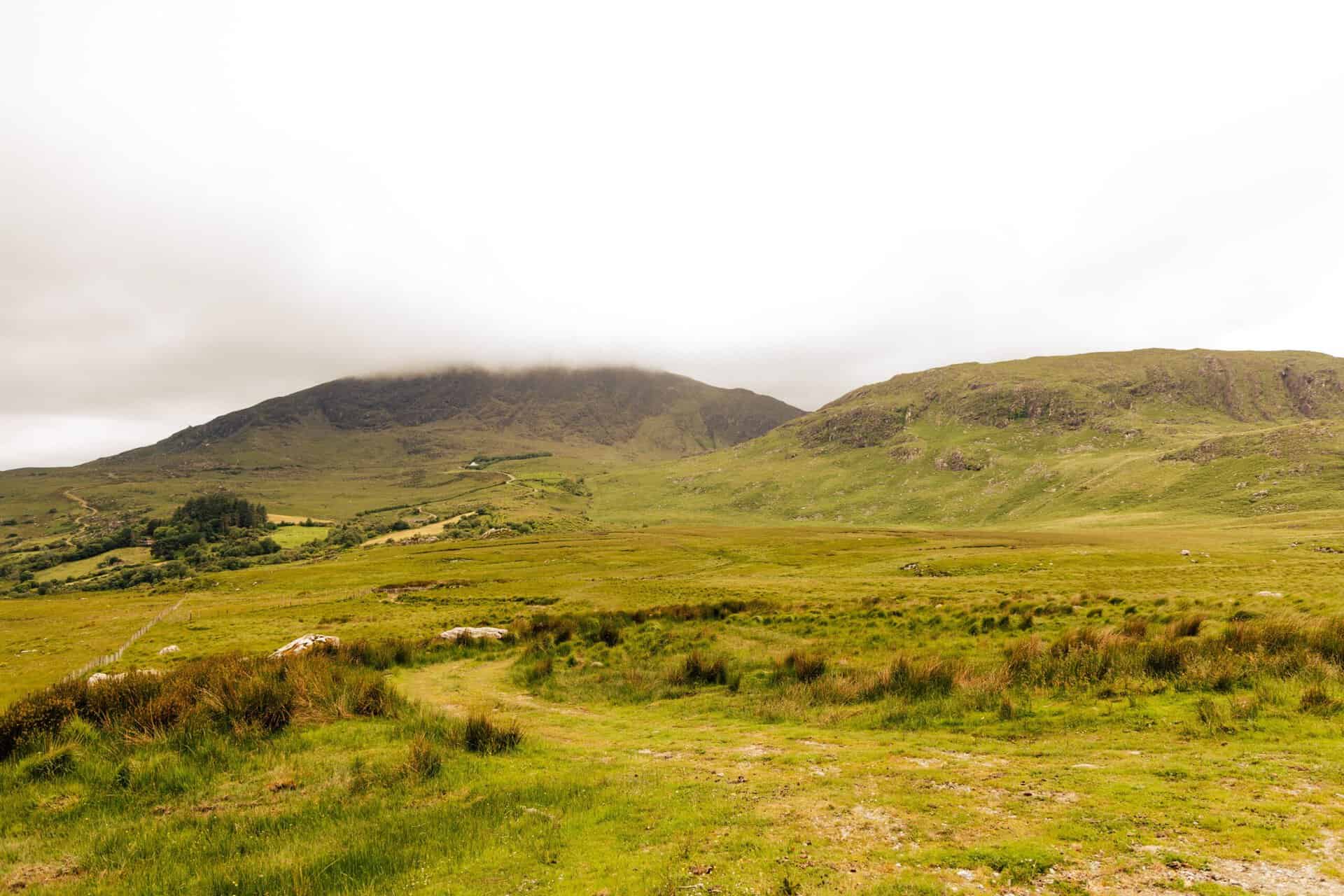
Outside, the setting does much of the talking. Ballynahinch River and Lake are central to the experience, while the wooded approach gives the estate a sense of separation from the busier N59. The Twelve Bens are visible from the grounds, putting the building in a distinctly Connemara landscape of rock, bog, mountain and water.
Do not assume all paths, banks or estate areas are freely open to casual callers. Private land needs private-land manners: stay on routes you have permission to use, avoid fishing areas unless booked, and do not wander into hotel-only spaces.
The most useful photographs here combine the house with its setting. Look for a composition that includes the river or lake in the foreground and the Twelve Bens behind the building. This gives the image a clearer sense of place than a close-up of stonework alone.
Soft overcast conditions can work well in Connemara, where cloud often brings out the greens of the woodland and reduces harsh contrast on the water. Keep clear of guest windows and private spaces, and ask before using a tripod in or around hotel areas.
Clifden is the obvious nearby town for supplies, cafés and a wider choice of services. It also makes a practical point to begin or end a drive along the N59 through Connemara.
The Twelve Bens are the defining mountain range behind Ballynahinch. They suit experienced hillwalkers who have planned a route, checked conditions and carry proper navigation equipment. The views from the estate offer a gentler way to appreciate the range without committing to a mountain day.
The Atlantic coast lies about five miles from Ballynahinch Castle, according to property descriptions. Pairing a castle stop with the coast makes sense on a west Connemara driving day, though road conditions and weather should dictate the pace.
Ballynahinch Castle is a hotel, not a standard ticketed heritage attraction. Non-resident access may depend on a dining reservation, an arranged activity or permission from the property, so contact the hotel before travelling.
The present building is a historic country house built on the site of an earlier castle. It is commonly called a castle and has a long estate history, but its visible form is a three-storey country house rather than a medieval fortress.
Ballynahinch Castle is in Connemara, County Galway, close to the N59 between Galway and Clifden. Its coordinates are 53.460200, -9.862700.
It can suit families who have a confirmed stay, meal or supervised outdoor plan. Check directly about room configurations, children’s dining arrangements, activity age limits and accessible routes before booking.
The Ballynahinch estate is associated with salmon and sea-trout fisheries and has a longstanding angling reputation. Fishing access, permits, seasons, guiding and catch rules should be confirmed with the hotel before making plans.
Ballynahinch Castle rewards people who approach it as a historic hotel in an exceptional Connemara setting. Book the part of the experience you want, allow time for the landscape and keep access expectations realistic. The river, lake, woodland and mountains provide plenty of atmosphere without the need to manufacture a castle-tour experience that the property does not claim to offer.

Matt Hook is a Canadian writer of Scottish and Irish heritage. He built his writing career creating detailed gaming guides, turning complex mechanics, history and lore into useful information for readers. Matt brings that same research-focused approach to Ireland Wide, where he writes about Irish travel, heritage, history and culture. He also holds CMA and CPA designations as a professional accountant, giving him a strong background in research, accuracy and attention to detail.
At Ireland Wide, our aim is to bring authentically Irish insights to you, wherever you are.
Whether you have some feedback or would like to offer some of your own insights for everyone else to explore, don't hesitate to get in touch with us!