McDermott’s Castle is worth visiting if you like Irish castles, lake scenery, and places with a long, messy history. It suits day-trippers exploring Roscommon and Sligo best, especially people happy to admire a site from the water or shore, because public access to the monument itself is restricted.
The castle sits on Castle Island in Lough Key, a few kilometres northeast of Boyle in County Roscommon, and it is one of the more memorable stops in the west of Ireland. If you are mapping out a wider castle trip, start with our guide to the best castles in Ireland for context before narrowing in on this one, or pair it with a broader west coast of Ireland road trip.
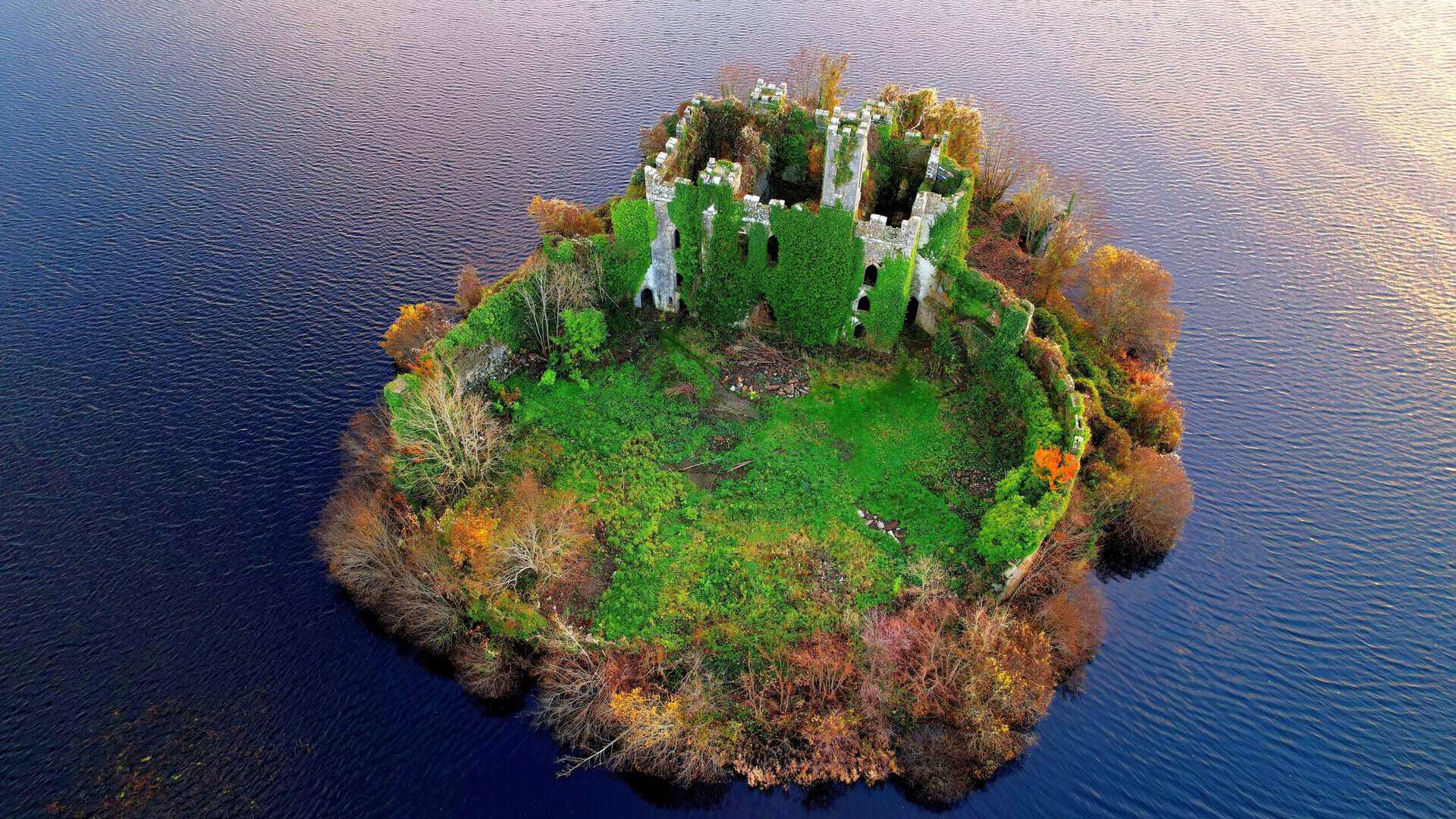
What makes this place stand out is simple. It is a ruined tower house on a tiny wooded island, with medieval roots, later rebuilding, and a folklore trail that has grown almost as large as the stonework itself.
McDermott’s Castle stands on Castle Island in the southeast part of Lough Key, around 3 km northeast of Boyle. Lough Key itself is a large lake with more than 30 islands, which helps explain why the castle looks isolated even though it is close to shore in travel terms.
For most people, the practical base is Lough Key Forest Park. It gives you the easiest orientation point, nearby facilities, and access to lake-based sightseeing. For a broader base in the county, our County Roscommon guide is the natural next stop.
You can see McDermott’s Castle, but you should not assume you can freely land on or enter it. Heritage Ireland states that the monument has no public access, and that is the most important practical detail to know before planning your day.
That does not make the trip pointless. It just changes the expectation. This is a castle that works best as a viewing experience, either from the lakeshore, from parts of Lough Key Forest Park, or from a boat operator working on the lake.
If you are hoping for staircases, furnished rooms, and self-guided interior wandering, this is the wrong castle. If you like dramatic ruins and are happy with a strong exterior view, it delivers.
Lough Key Forest Park is the easiest way to build a half-day around the castle. The park covers roughly 800 hectares of woodland and parkland and is the main hub for the area. You are not just turning up for one ruin in isolation. You also get trails, lake views, and family-friendly extras.
Other well-known park features include the Moylurg Tower, the Wishing Chair, underground tunnels, Trinity Bridge, a bog garden, and a visitor centre area. That variety matters, because the castle itself is a short visual stop while the park can fill much longer.
If you want the best angles, a boat tour is the obvious move. Operators on the lake offer trips around the islands and views toward Castle Island. Access policies can change, so treat any landing claims cautiously and check the operator details before paying.
Boat-based viewing gives you the classic perspective of the ruin rising from the trees. It is also the easiest way to understand how defensive the setting once was.
Because the castle is so close to Boyle, it works well with other historic stops. That is the better plan than trying to make McDermott’s Castle your only destination for a full day.
The island has held a fortification since at least the medieval period, and the ruling family behind it was the Mac Diarmada dynasty of Moylurg. Heritage Ireland and the monument record agree on the broad outline: an early fortified residence stood here long before the later tower house took shape.
One of the clearest early events comes from the Annals of Loch Cé, which record that in 1184 the residence on the rock was struck by lightning and burned, causing a major loss of life. Heritage Ireland says more than one hundred people died in the fire or by drowning during the panic.
The island remained strategically important through the 13th and 14th centuries. Heritage Ireland records episodes involving Maurice Fitzgerald, Conor McDermott, Richard de Burgh, and later Cathal O’Connor, with capture, plunder, and burning all featuring in the story. In plain terms, this was not a peaceful lakeside retreat.
The visible tower house is generally dated later. According to the national monument record, the tower may be 16th century, while many of the present external features, including parts of the silhouette people notice from photographs, reflect 19th-century rebuilding and alteration.
After the Cromwellian period, the property passed out of McDermott hands and was later linked with the King family. In the 19th century, the tower house was rebuilt as a folly, with work associated with John Nash also noted in the site history.
The best-known local legend is separate from the documented record. Folklore tells of Úna Bhán, daughter of a McDermott chief, who fell in love with a young man her father rejected. In the story, he swam across Lough Key to meet her and drowned on one of the crossings.
The tale ends badly, as these stories tend to do. Úna is said to have died of grief, and local tradition links the pair to two intertwined trees on the island.
It is a powerful story, but it should be treated as legend rather than verified history. The castle has enough real sieges, fires, dynastic disputes, and rebuilding phases without borrowing certainty from folklore.
What you see now is a mix of periods. Archaeological work described by Heritage Ireland identified earlier occupation beneath later building phases, including a cashel and high medieval structures, followed by the later tower house.
Visible features tied to the medieval tower include arrow slits, a garderobe chute, and a blocked window with an external chamfer. The 19th-century rebuilding then reshaped the appearance again, which is why the ruin can look older and more storybook-like at the same time.
That layered look is part of the appeal. It is not a pristine medieval shell. It is a monument with several lives showing at once.
The best images usually come from the lake, where you can frame the castle with water and tree cover rather than flattening it from the shore. A boat trip also makes the scale of the island much clearer.
If you are shooting from land, aim for broader compositions that place the ruin within Lough Key’s wooded setting. Tight zoom shots can make it look like an ordinary ruin and lose the whole point of the location.
For phone photography, a waterproof pouch is sensible on boat trips and near wet landings. It is not glamorous kit, but neither is dropping your phone into Lough Key.
This is the obvious companion stop. It is not just a car park for the castle. The park gives you trails, family-friendly features, water views, and heritage layers in one place.
If you want another serious historic site nearby, Boyle Abbey is the best contrast. It swaps island-romance visuals for monastic stonework and grounds the day in a different part of medieval Roscommon. For more detail, see our Boyle Abbey guide.
King House adds a later architectural and social-history angle in Boyle. It pairs well with McDermott’s Castle because the castle’s story also passes through the King family in the post-medieval period.
If you are building a county-wide castle route, Roscommon Castle gives you a larger mainland ruin with a very different presence. It is a good counterpoint to the small-island drama of McDermott’s Castle, much like Ross Castle in Killarney offers a more traditional lakeside castle experience.
Yes, with the right expectations. It is worth the detour for people interested in castle history, unusual settings, and photography. It is less satisfying for anyone expecting a fully open heritage attraction with rooms to explore and lots of on-site interpretation.
In practice, McDermott’s Castle works best as part of a Lough Key and Boyle day. Treated that way, it feels distinctive rather than slight. If you are comparing castle stops across the country, it makes the most sense alongside other scenic ruins rather than polished estate experiences such as Ashford Castle.
No public interior access is listed by Heritage Ireland, checked July 2026. Plan to view the monument from outside rather than entering it.
It is on Castle Island in Lough Key, County Roscommon, around 3 km northeast of Boyle.
The site is associated with the Mac Diarmada or McDermott ruling family of Moylurg. The visible structure includes later rebuilding, so what stands now is not all from one original campaign.
A fortification on the island is documented from at least the 12th to 13th century. The surviving tower house may date to the 16th century, with major 19th-century alterations.
It sits within the wider Lough Key setting and is commonly visited alongside Lough Key Forest Park. The park is the practical base for most visits.
The best-known story is the legend of Úna Bhán and her drowned lover. It is part of local folklore and should be treated as legend, not documented history.

Dan is the founder and editor of Ireland Wide. Born and raised in Ireland, he researches the country’s history, mythology and cultural traditions using museum collections, heritage authorities and historical sources. He leads the site’s editorial team, with a particular focus on distinguishing documented history from later folklore and modern interpretations.
At Ireland Wide, our aim is to bring authentically Irish insights to you, wherever you are.
Whether you have some feedback or would like to offer some of your own insights for everyone else to explore, don't hesitate to get in touch with us!