

The 32 counties of Ireland are one of those subjects that sounds simple until you start planning a trip. Then you realise county lines shape almost everything: road trips, local identity, Gaelic games, family history searches, and the very practical question of where to base yourself.
Ireland has 32 traditional counties across four provinces: Leinster, Munster, Connacht, and Ulster. Of those, 26 are in the Republic of Ireland and 6 are in Northern Ireland. Those county names still matter deeply, even though local government structures are not always a neat one-county, one-council setup.
This guide keeps it useful. You will find the full county list, what each province feels like on the ground, and where to focus if you are choosing between cliff drives, city breaks, old monastic sites, beaches, lakes, or a pub session that turns into your whole evening.
The traditional county map divides the island into four provinces. Ulster has nine counties, Munster has six, Leinster has twelve, and Connacht has five. Ulster is the odd one politically, because six of its counties are in Northern Ireland while three are in the Republic.
County identity is still very real in daily life. You see it in GAA county teams, county colours, road signs, accents, and the way people introduce themselves. Ask someone where they are from and you will often get the county before the town.
If you are using counties for trip planning, they work best as cultural and geographic markers. They tell you roughly what sort of coast, landscape, food culture, or local pace you are getting, even before you choose a specific town.
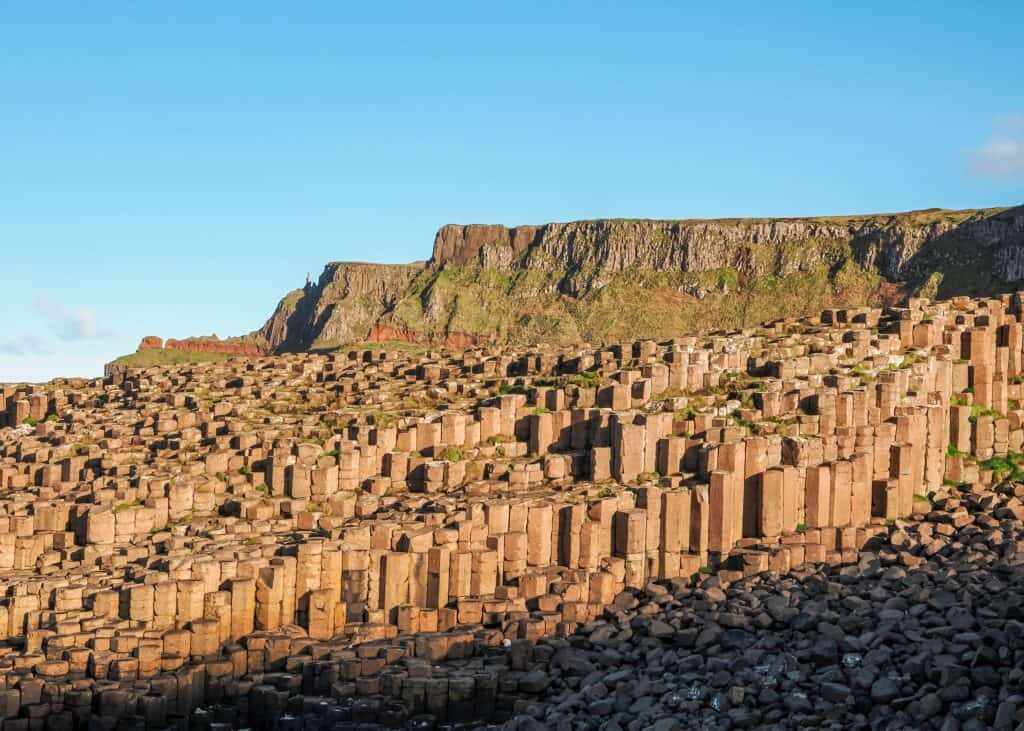
Ulster is where many first-time visitors get properly hooked. County Antrim packs in Giant’s Causeway, Carrick-a-Rede Rope Bridge, and the Glens of Antrim, which is a fairly unfair concentration of famous scenery for one county. Belfast, the main city in Antrim, also gives you Titanic Belfast and easy access to the Causeway Coastal Route. If you are building a northern loop, the county sits naturally alongside famous landmarks in Northern Ireland without forcing huge driving days.
County Armagh is often called the Orchard County. It is also closely tied to St Patrick and to Navan Fort, an ancient ceremonial site linked with early kingship and myth. If you like history that feels older than the road you arrived on, Armagh does that well.
Fermanagh is the county for lakes and slow travel. Donegal is the county for Atlantic weather, long drives, and coastlines that can make a carefully planned timetable fall apart in the best possible way. On clear dark nights, parts of Donegal are also among the better spots for seeing the northern lights in Ireland, though cloud cover still gets the final say. Derry combines a compact city with a county landscape that still feels underexplored compared with busier parts of the island.
Tyrone, whose main town is Omagh, is the largest county in Northern Ireland by area. Cavan and Monaghan sit on that useful borderland where routes between Dublin, Ulster, and the northwest start to make sense on a map.
Munster tends to do very well with people who want their Ireland trip to feel unmistakably Irish without staying still for long. County Cork is the largest county by area on the island, and it earns that scale. Cork city has the urban energy, while West Cork and the south coast pull you toward peninsulas, market towns, and detours you did not budget enough time for.
Kerry is the county people talk about for good reason. It is one of the anchors of the southwest, and it sits naturally beside Cork on many itineraries. Clare brings in the west coast with the Burren and Atlantic access. Waterford gives you the southeast coast and one of Ireland’s oldest urban centres. Tipperary and Limerick fill in the interior with castles, market towns, and practical road connections.
If you are trying to keep a trip compact, Cork and Kerry make an easy pair. If you want a wider loop, add Clare for the west and Waterford for the southeast. Anyone leaning hard into Atlantic scenery will usually end up drifting toward the west coast of Ireland sooner or later.
Leinster is where many trips start because Dublin is the most populous county and the main air gateway for a lot of arrivals. It is also the county with the highest disposable income in one recent national snapshot, which tells you something about its economic pull even if you are only there for museums, pubs, and a walk through Georgian streets.
Dublin works well as a base if you want day trips, but Leinster is much broader than the capital. Wicklow gives you mountain scenery close to the city. Meath is central to early Irish history. Kilkenny is a reliable favourite for a short break. Wexford is a classic call for the southeast coast. Louth is the smallest county by area, so it is easy to fold into a route through the northeast and Boyne Valley.
Offaly and Westmeath often get ignored by people charging from one coast to another, which is a pity. Offaly’s bogland landscapes and Westmeath’s lake country add a different pace. Carlow, Kildare, Laois, and Longford reward people who like quieter county towns and less traffic-heavy touring.
Connacht has five counties, and each gives you a distinct version of the west. Galway is the obvious headline act for many people, with city life, music, and routes into Connemara. Mayo is bigger and wilder in feel. Sligo mixes surfing country with literary associations. Roscommon is inland and often overlooked, which can be a selling point if you want a slower pace. Leitrim is the least populous county, and you feel that in the amount of space around you.
If your idea of a good trip includes a lot of weather, changing skies, and roads that keep pulling you onward, Connacht delivers. It is also one of the best areas for people who would rather spend extra time in fewer places than race across the whole island. For anyone planning hikes in Mayo, Galway, or Sligo, a look at the best hiking holidays across Europe, the UK and Ireland gives a useful sense of how Ireland’s west compares for walking days.
If you only have a few days, trying to “do all 32” is how you end up seeing mostly fuel stations and roundabouts. A smarter plan is to choose three to five counties that fit one travel style.
The county system is also handy for tracing family history. Parish and townland matter more once you get deep into records, but starting with the right county saves a lot of guesswork.
| Fact | Answer |
|---|---|
| Total traditional counties | 32 |
| Counties in the Republic of Ireland | 26 |
| Counties in Northern Ireland | 6 |
| Provinces | Leinster, Munster, Connacht, Ulster |
| Largest county by area | Cork |
| Smallest county by area | Louth |
| Most populous county | Dublin |
| Least populous county | Leitrim |
Use provinces to shape the route, not the daily schedule. Counties are culturally useful, but travel times are better planned by road conditions and where you actually want to sleep.
Do not underestimate Donegal, Kerry, or Cork. They look manageable on a map until you start adding scenic stops, narrow roads, and weather delays. Summer daylight helps, but even then an “easy” cross-county day can turn into a long one when you keep pulling over for viewpoints, sheep traffic, or a beach that was meant to be a five-minute stop.
Dublin does not have to dominate the trip. It is a strong arrival or departure city, but many of the most memorable county experiences happen well outside the capital.
Keep an eye on the border if you are driving. The island is easy to move around, but practical details can differ between the Republic and Northern Ireland. Speed limits switch between kilometres per hour and miles per hour, and mobile roaming or car hire terms can catch people out if they never checked the small print.

Yes, but not in a quiz-night way. Knowing the counties helps you understand how Ireland is mentally mapped by the people who live there. It also helps you build a better route. Saying you are heading to Kerry, Donegal, or Wicklow carries a lot more real information than just saying west, north, or near Dublin.
If you are planning one trip, start with a province and narrow down from there. If you are planning several trips, the county map becomes addictive. One weekend you are in Kilkenny for a compact city break. The next you are chasing the coast in Antrim or looping through Fermanagh lakes. That is the charm of the 32 counties. The island is not huge, but it keeps changing on you.
For most people, the best approach is simple: pick fewer counties, stay longer in each, and let the county character do the work. Ireland rarely rewards rushing.

Dan is the founder and editor of Ireland Wide. Born and raised in Ireland, he researches the country’s history, mythology and cultural traditions using museum collections, heritage authorities and historical sources. He leads the site’s editorial team, with a particular focus on distinguishing documented history from later folklore and modern interpretations.
At Ireland Wide, our aim is to bring authentically Irish insights to you, wherever you are.
Whether you have some feedback or would like to offer some of your own insights for everyone else to explore, don't hesitate to get in touch with us!