Yes, it does snow in Ireland, but not very often. Most lowland weather stations record somewhere between 4 and 20 days of snow or sleet a year, snow usually lies on the ground for only a day or two, and January and February are the snowiest months, according to Met Éireann.
Quick answer: snow in Ireland at a glance
- How often: about 4 days of snow or sleet a year at Valentia, Co. Kerry, up to about 20 at Malin Head, Co. Donegal and Claremorris, Co. Mayo (Met Éireann 30-year averages).
- Snow on the ground: usually less than a week a year, from under 1 day on the southwest coast to about 6 days at Clones, Co. Monaghan.
- When: mostly December to March, peaking in January and February. Snow has been reported as early as September and as late as May.
- Where: the north Midlands, the northwest and high ground such as the Wicklow and Mourne mountains get the most. The southwest coast gets the least.
- Big falls are rare: 10cm or more lands in the Midlands about once every 7 to 18 years. The worst recent spells were December 2010 and Storm Emma in March 2018.
- Travel: a light fall usually means slower, slippier roads rather than closures. Heavy snow is rarer but can shut roads, airports, public transport and schools, as it did during Storm Emma.
If visiting Ireland is something you have had on your bucket list, you are probably wondering when is the best time to go to get the very best weather. Having a rough idea of the Irish climate month by month can help you decide whether you want to experience the beauty of the Emerald Isle during the winter months or the summer months.
Because, quite honestly, each season has something stunning and unique to offer its visitors.
One big weather question we hear is whether Ireland has snow and if it does, when is the best time to visit Ireland if you want to see snowy mountains.
So, let’s get to it.
Does it Snow in Ireland?
Yes, Ireland does see snow but not as much as you might expect. Honestly, if you are looking for a snow-laden holiday, Ireland can’t guarantee a single flake, regardless of what month you go.
But it is not out of the realm of possibility.
Ireland is a small island located smack bang in the Atlantic Ocean. Its position along the North Atlantic drift and gulf stream influence Ireland’s average temperatures. The size of this luscious place also has a massive effect on the potential for snowfall and it sticking around long enough to snow angel your way over the hills.
Ireland is surrounded by water, and if you didn’t know already, snow likes to fall heavier in more inland parts of the world. Coastal areas naturally have Milder climates which is not the best weather for snow.
However, some parts of Ireland are more likely to have snow. Our less than favourable snow conditions mean that, when we do see the white stuff, it is usually light and gone within a day or two. The flip side is that the country isn’t geared up for it, so on the rare occasions that heavy snow does fall, Met Éireann notes it can disrupt traffic, close airports and bring down power lines.
The Climate in Ireland
Although Ireland doesn’t see a massive amount of snow, this little Island does show off some varied climate conditions that can make every time of the year special for your travels.
It is far cheaper to visit Ireland during the winter months, so it can be helpful to know what to expect if you choose to see our beautiful Island outside of the usual high season.
How Cold Does Ireland Get?
Ireland’s positioning in the north Atlantic ocean gives us the pleasure of a temperate oceanic climate. This means we experience damp, humid weather that rarely gets far below freezing temperatures, even in the depths of winter.
On average, winter temperatures fall somewhere around 7-8c (45-46f) in more inland counties, and around 8-10c (46/50f) along the Irish coast. Those are daytime highs: winter nights average about 1.5-3c inland and 3-5c on the coast, so frost is common even when snow isn’t.
It is not tropical, although our regular mixture of prevailing winds and abundant rainfall can make it feel like a tropical rainy season during the late summer months and early fall.
What Are Winters Like in Ireland?
The normal winters in Ireland are hard to pin down but it’s generally considered that December, January, and February are their winter months.
Ireland sees anywhere from about 2 inches (50mm) of rain a month in Dublin to almost 7 inches (174mm) at Valentia in Kerry, and an average temperature during the day of 7-10c. Ireland is lucky to experience such mild winter weather, even if there is a lot of wet weather, and even if a cold snap does cover the country, it does not usually last too long thanks to the western winds.
Reading Suggestions:
- What is Ireland Known For?
- 14 Famous Landmarks in Ireland You Have To Visit
- Typical Irish Traits that Makes Them So Special
- How Did the Celts Celebrate Winter Solstice?
Although snow is unlikely in most places, many of Ireland’s beautiful mountains, like the Mourne mountains, are often capped with snow during the winter. Even if it can be difficult to get to, it is still beautiful to see.
February tends to be one of the coldest months in Ireland, along with January (see our guides to the weather in January and weather in February). You may even find visiting in December still blesses you with some mild and even temperatures. The further north you travel on the emerald isle, the colder it will get as you travel further away from the equator.
What Months Does it Snow in Ireland?
You are likelier to see snowfall in Ireland from December to March, and January and February are the snowiest months of all. It’s not unusual to see snow in November or April, and Met Éireann has records of snow falling in May and September, though it melted quickly.
However, on rare occasions such as the big freeze of December 2010, when Ireland saw an extended cold snap that reached as low as -15.7c (about 4f) at Casement Aerodrome on the western outskirts of Dublin and a record -17.5c (0.5f) at Straide in County Mayo, Ireland can find itself covered in a blanket of snow. There was 27cm of snow lying at Casement on Christmas Day that year.
If Ireland does see real snow, it is most likely to happen in either January or February. Met Éireann’s snowfall analysis puts the yearly average at about 5 days of snow in the South west and anywhere up to a cracking 24 days of snow in the north Midlands.
Use the chart below to see how many snow days each part of the country gets in every month, and switch between days when snow falls and days when it actually lies on the ground.
Ireland Wide · Data
How many snow days each part of Ireland gets, month by month
Snow or sleet falls on fewer than 21 days a year at every Met Éireann station, and January and February are the peak months everywhere.
Darker squares mean more days. Each figure is a 30-year monthly average from a Met Éireann station. “Latest averages” use each station’s most recent published window (1971-2000 for Claremorris and Roches Point, 1978-2007 or 1979-2008 for Birr, Clones, Kilkenny, Mullingar and Rosslare, 1981-2010 for the rest). “Snow lying” counts mornings with snow on the ground at the 9am observation.
Source: Met Éireann 30-year station averages and Snowfall in Ireland
As of October 2026 · irelandwide.com
How Often Does it Snow in Ireland?
Snow in Ireland doesn’t happen very often. Even the snowiest lowland weather stations only average around 20 days of snow or sleet a year, and the higher reaches of the Wicklow mountains average up to 30 days of lying snow, so most of the real snow happens in the mountainous regions. Even then, a lot of snowfall doesn’t last very long. Up to a day or two at most.
That being said there are many winters where snow doesn’t fall at all or may just fall and not actually set on the ground.
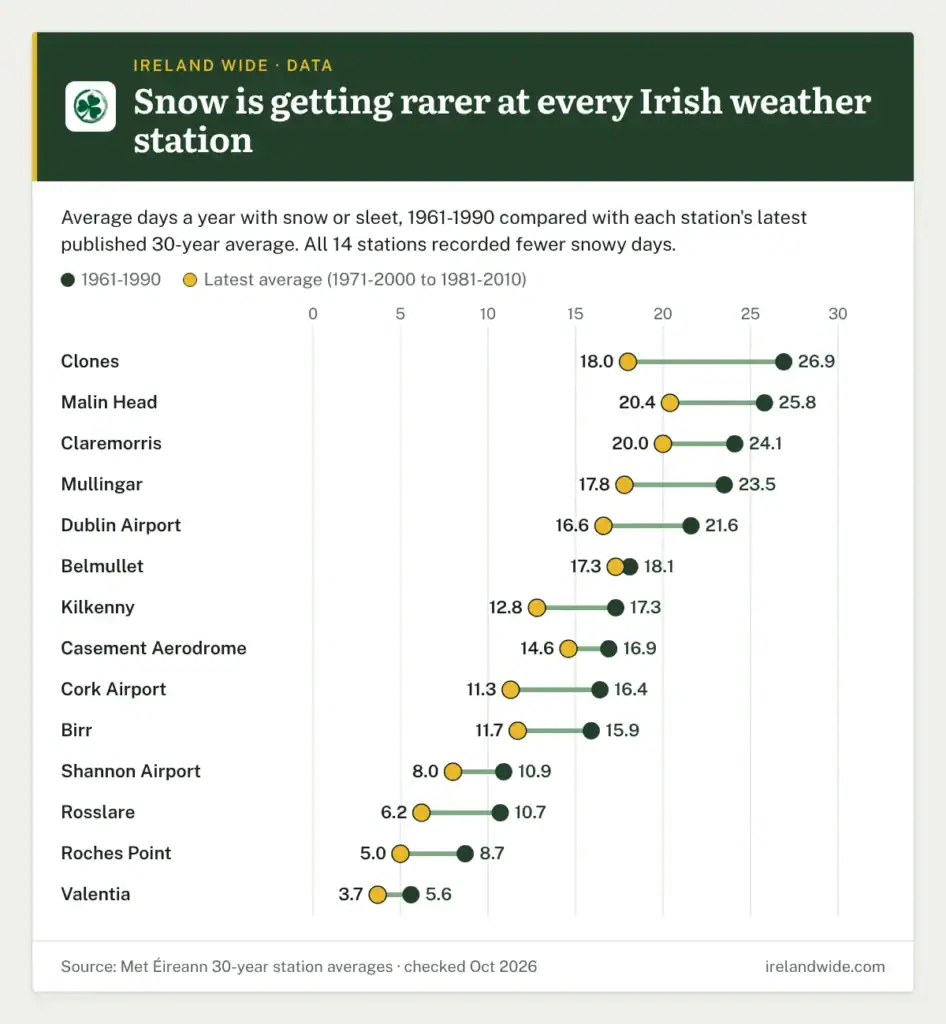
It’s also getting rarer. Every one of Met Éireann’s main weather stations recorded fewer days of snow or sleet in its latest 30-year averages than in 1961 to 1990. Clones dropped from about 27 days a year to 18, and Dublin Airport from about 22 to 17.
How Much Snow Does Ireland Get?
Although Ireland’s snowfall level varies from year to year, it can be good to get an idea of how much snow they get on average so you can plan the perfect winter trip to Ireland.
Average Snow in Ireland
Ireland is a rarity. Many of the other countries that share the same latitude as this country experience a lot more snowfall. However, you’ve had a good snow day in Ireland if you’ve reached just 1-2cm of lying snow. The higher up you go into more mountainous regions the deeper the snow will be.
Lower land levels will see anywhere from 4 days of snowfall to 20 days, with the east coast experiencing more heavy snowfall. However, if you want to know about actual snow cover, you know the snow that lies on the ground begging to be built into a snowman, the numbers reduce dramatically.
Snow cover in Ireland on average, has only been recorded from as little as 0 days to a maximum of 6. A fall of at least 2cm happens in most places about every two years, while 10cm or more turns up in the Midlands only every 7 to 18 years.
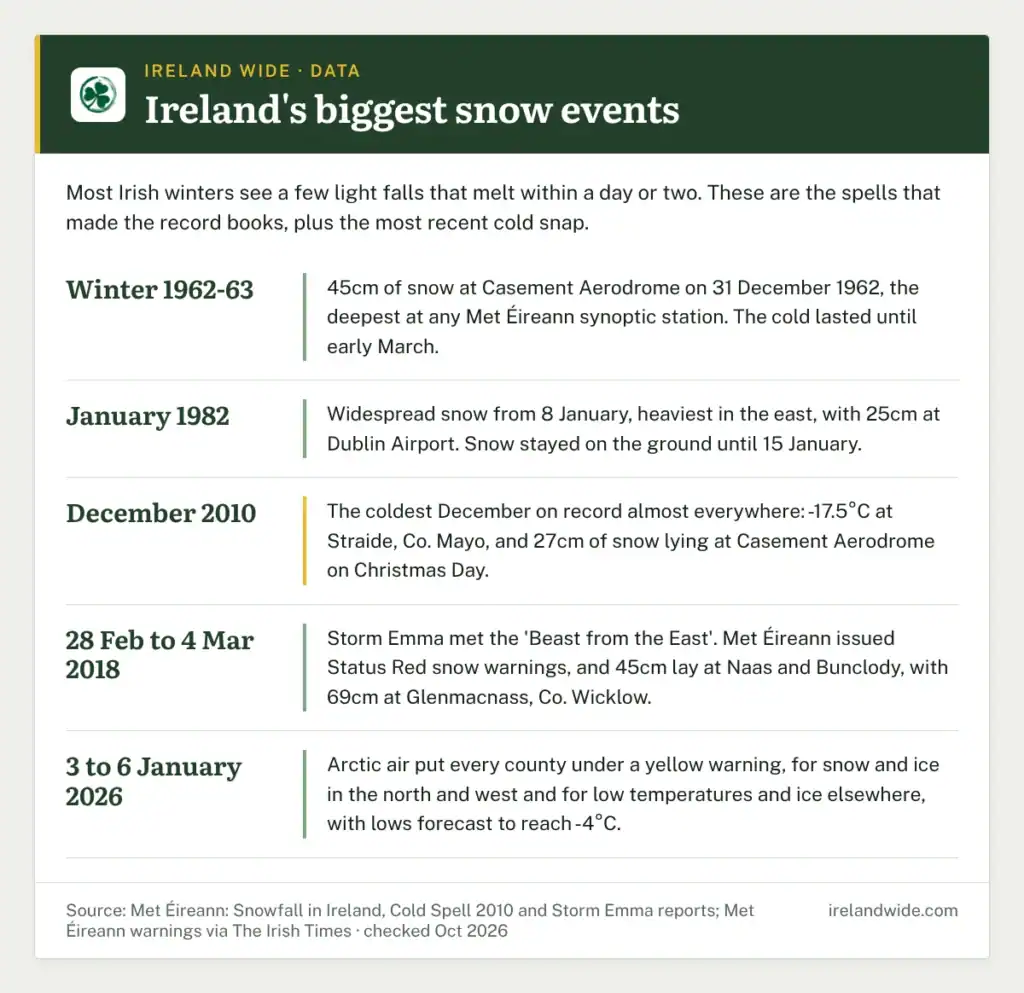
Yet, Ireland has had its fair share of unexpected blizzards. As recent as 2018, they saw the arrival of Storm Emma, which collided with a bitterly cold air mass from Siberia. This storm covered Ireland in a thick blanket of snow from the 28th of February to the 4th of March and, along with that cold air nicknamed ‘the beast from the east’, it caused major disruptions with much of the East and Dublin having to shut down. Met Éireann issued Status Red snow warnings, and 45cm of snow lay at Naas and Bunclody, with 69cm at Glenmacnass in Wicklow.
More recently, Arctic air put the whole country under yellow weather warnings from the 3rd to the 6th of January 2026, with snow and ice warnings for the north and west and lows forecast to reach -4c. In the end, Met Éireann’s January 2026 climate statement recorded only limited snow, mostly in the north and northwest, with the coldest night at -5.3c in Athenry, Co. Galway, on the 4th. Here’s how the big ones stack up:
Where Does it Snow in Ireland?
It might seem a bit of a lost cause when it comes to experiencing a snowy white Ireland but there are some places around the country where your chances of a snow-filled trip are a little higher.
Here’s how it breaks down by region, using the nearest Met Éireann weather station. Read across a row and the pattern is hard to miss: the further north and the further from the Atlantic’s mild southwest corner, the more snow.
| Region | Weather station | Days of snow or sleet a year | Of which December to February | Mornings with snow lying |
|---|---|---|---|---|
| Northwest coast | Malin Head (Donegal) / Belmullet (Mayo) | 20.4 / 17.3 | 14.1 / 11.7 | 2.3 / 1.6 |
| West inland (Mayo) | Claremorris (Mayo) | 20.0 | 13.2 | 4.6 |
| North Midlands and border | Clones (Monaghan) / Mullingar (Westmeath) | 18.0 / 17.8 | 12.2 / 12.1 | 6.2 / 5.7 |
| Dublin and the east | Dublin Airport (Dublin) / Casement Aerodrome (Dublin) | 16.6 / 14.6 | 11.7 / 10.3 | 3.4 / 4.1 |
| South Midlands and Kilkenny | Kilkenny (Kilkenny) / Birr (Offaly) | 12.8 / 11.7 | 9.2 / 8.0 | 3.2 / 3.7 |
| Cork | Cork Airport (Cork) / Roches Point (Cork) | 11.3 / 5.0 | 8.4 / 3.9 | 2.0 / 0.9 |
| Mid-west (Shannon) | Shannon Airport (Clare) | 8.0 | 5.9 | 0.9 |
| Southeast coast | Rosslare (Wexford) | 6.2 | 4.6 | 1.2 |
| Southwest coast | Valentia (Kerry) | 3.7 | 2.5 | 0.5 |
Does All of Ireland Get Snow?
Not really. The further you reach Ireland’s northern coast, the likelier it is that snow will fall and even stick around for a day or two. Most low-lying areas also experience snowfall a lot less, and Met Éireann notes the number of days with snow cover increases northwards through the Midlands.
Places like the North Midlands, the Eastern coast, especially County Wicklow, and the very north of County Donegal see more snowfall than other areas of Ireland.
If you have your heart set on seeing snow in Ireland we suggest hitting the Mourne mountains in mid-January to late February. Not only are the Mourne mountains in County Down one of the most beautiful places in Ireland but the smaller summit of Slievenaglogh is easier to scale and gives you the perfect view of these mountains. According to Met Éireann, 75cm of snow was measured up in the Mournes in February 2001.
In the small town of Clones, County Monaghan there is a weather station that has been dubbed the snowiest weather station in Ireland. This quiet rural town sits right on the western border between the Republic of Ireland and Northern Ireland and used to see around 27 days of snow or sleet every year (1961 to 1990). That has dropped to about 18 in its latest averages, but Clones still has the most mornings with snow lying on the ground of any station, at about 6 a year. So, quite the rarity in Ireland.
On the opposite end of the snowy in Ireland spectrum is Valentia Island, which sees the least amount of snow in Ireland. Located in County Kerry, this island that is connected to the mainland by a bridge sees just 3.7 days of snow or sleet a year on average, and snow lies on the ground there on fewer than one morning a year.
Does it Snow in Dublin?
Dublin is one area of Ireland that is more likely to experience snowfall. Falling along one of the most upland regions of Ireland, including the Wicklow mountains, Dublin is more prone to snow during the winter months. Dublin Airport averages about 17 days of snow or sleet and 3 to 4 days of lying snow a year, and the Dublin area holds the deepest snow on record at a Met Éireann station: 45cm at Casement Aerodrome on New Year’s Eve 1962.
The temperate oceanic climate of the area may dampen the chances of snow a little but the low-lying mountains of this area are more welcoming to snowy climates.
Does it Snow at Christmas in Ireland?
A white Christmas is a long shot, but it does happen. Between 1961 and 2010, snow fell on Christmas Day at one or more of Met Éireann’s main stations in 17 years, and there was snow lying on the ground on Christmas morning in 9 of them, including both 2009 and 2010. If you’re planning a festive trip, our guide to the weather in Ireland in December covers what to really expect.
What Does Snow Mean for Travel in Ireland?
Usually not much. A typical snowy day in Ireland means slower, slushier journeys rather than a shutdown, and it’s often gone by the next afternoon. There’s a catch, of course: heavy snow is rare enough that the country isn’t really built for it, so a big fall causes more disruption than it would in Norway or Canada.
Roads and Driving
Ice is the bigger everyday problem than snow. The RSA’s advice on treacherous road conditions is to slow down, leave extra space, use the highest gear you can to avoid wheel spin, and watch for black ice in shaded spots, under trees and beside high walls. Footpaths may not be treated at all, so mind yourself on foot too.
If you’ve a rental car (car hire), give yourself more time than the sat nav says and avoid mountain roads and minor back roads in a cold snap. Short daylight makes it trickier still, and our guide to visiting Ireland in winter: weather, daylight and travel covers sunrise and sunset times for planning your driving.
Flights and Airports
Flights usually cope with a light dusting, but heavy snow can ground them. During Storm Emma in March 2018, more than 70,000 air passengers were stranded by cancellations and airport closures, according to Met Éireann’s Storm Emma report. If snow is forecast around your travel day, check your flight status with your airline before you leave for the airport.
Public Transport and Closures
Buses, trains and the Luas run reduced services or stop in heavy snow, and in 2018 they stopped almost completely in most places, while schools, colleges, ferries and many businesses closed too. Transport for Ireland’s winter weather travel advice is to check your operator’s service updates before setting out and allow extra time.
Checking Snow Warnings
Met Éireann issues snow-ice warnings at three levels. Status Yellow is the common one in a cold snap and means localised danger. Status Orange means infrequent, dangerous conditions, so delay or cancel plans where you can, and Status Red is rare and very dangerous (the whole country was under one during Storm Emma). The Met Éireann weather warnings explained page has the details. In Northern Ireland, warnings come from the Met Office instead.
Five Best Things in Ireland to Do When it Snows
It comes as no surprise that when the Irish people are lucky enough to get a decent amount of snow they make the most of it and so should you. Here are five things you should do if it snows in Ireland.
See the Aurora Borealis
When you think of the northern lights, Ireland might be one of the last countries that come to mind. However, County Donegal is the place to be to enjoy this night sky spectacle during the winter months.
Of course, you’ll want to be as far away from excess light pollution to experience this beauty of nature and Donegal has all the remote places you need to really see the northern lights properly.
Here are some areas in Donegal where you can see the aurora borealis in all its glory.
- Malin Head
- Dunree Head
- Fanad Head
- Glencolmcille
- The Sliabh Liag Cliffs
- The Rosguill Peninsula
Not sure when the lights will be visible. We have got you covered. This website gives live updates for optimal light viewing so you won’t miss an opportunity while you visit Ireland.
However, watch out for Irelands abundant rain and prevailing winds. Make sure you are wrapped up warm with plenty of good-quality raincoats and maybe even somewhere to run to if the rain gets too heavy.
Visit the Newgrange Passage Tomb
The jewel of Ireland, the passage tomb at Newgrange is the place to be during the winter solstice. This 5,200-year-old tomb perfectly aligns with the rising winter solstice sun giving the lucky few who get to be inside the tomb for this event, a first-hand view of how it illuminates the entire tomb.
It is a complete mystery as to why or how stone age farmers built the Newgrange tomb. However, if you are lucky to be there on a clear winter solstice morning the view and experience are worth their weight in gold.
Go Mountain Hiking
Even though Ireland’s winter days are short, this time of year is perfect to hike the mountains and enjoy the snowy scenery. Mountainous locations like the Mourne mountains and MacGillycuddy’s Reeks are some of the most awe-inspiring locations in Ireland. It’s said they even inspired C.S Lewis as he wrote Narnia.
However, air temperatures can drop fast in the mountains as the sun sets, and it sets fast during the winter. So, you will want to ensure you are properly prepared in case of any unexpected circumstances and have someone with you who has a decent amount of hiking experience. Check Met Éireann’s mountain forecast before you set off, as snow on the summits can be far deeper than anything you’ll see in the valleys.
Enjoy a Cosy Pub
If climbing mountains isn’t your thing, then going for a chilly walk in the snow, followed by a cozy drink or two in a traditional Irish pub, might be just what you’re after.
There’s nothing quite like warming your frosty fingers by an open peat fire in a quaint and cosy pub. Perhaps you’ll even stumble across one that has traditional musicians playing to give you the true Irish pub experience.
Snow Angels and Snowmen
Snow is a rare occurrence in many parts of Ireland so it’s hard not to join in the delight when it does fall and stay put.
Get in touch with your inner child, head to the center of wherever you are and build a snowman, complete with a carrot nose and coal eyes, and create a snow angel or two.
At the very least, you’ll give a passing child an absolute thrill seeing a rarely seen Irish snowman.
Snow in Ireland FAQs
Does it snow in Ireland every year?
Usually, yes, somewhere. Most winters bring at least a few days of snow or sleet, mainly in January and February, but in some winters many lowland areas see no lying snow at all.
What is the snowiest place in Ireland?
The high ground of the Wicklow mountains, which averages up to 30 days of lying snow a year. Among weather stations, Malin Head and Claremorris record the most days of snow or sleet (about 20), while Clones has the most mornings with snow on the ground (about 6).
Which part of Ireland gets the least snow?
The southwest coast. Valentia in County Kerry averages just 3.7 days of snow or sleet a year.
What month is snow most likely in Ireland?
January and February. Snow is also fairly common in December and March, possible in November and April, and very rare outside those months.
How long does snow last in Ireland?
Usually a day or two. Met Éireann says some of the more notable falls have lain on the ground for 10 to 12 days.
What was the worst snow in Ireland?
The winter of 1962-63 holds the record depth, 45cm at Casement Aerodrome. In recent memory, December 2010 brought record cold and Storm Emma in March 2018 left drifts of up to 7 metres in Wicklow and Wexford.
Does it snow in Northern Ireland?
Yes. High ground such as the Mourne mountains in County Down often sees snow, with 75cm measured there in February 2001, and it’s a good bet for a snowy hike from mid-January to late February.
Can you drive in Ireland when it snows?
Usually, yes. Light snow tends to mean slower, slushier roads rather than closures, and black ice in shaded spots is the real hazard. When Met Éireann issues an orange or red snow-ice warning (or the Met Office does in Northern Ireland), ask whether the trip can wait.
Do flights get cancelled because of snow in Ireland?
Sometimes, in the bigger snow events. Storm Emma in March 2018 left more than 70,000 air passengers stranded by cancellations and airport closures. If snow is forecast around your travel day, check with your airline before you head to the airport.
Snow figures checked against Met Éireann climate averages and reports in November 2026.