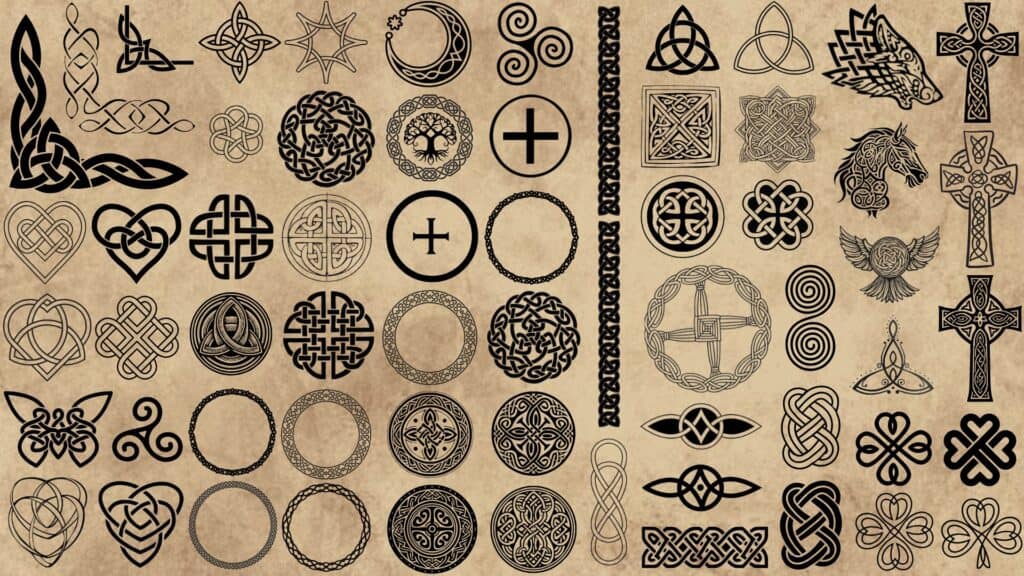
Celtic symbols include prehistoric motifs, Iron Age religious imagery, early medieval Christian artwork and modern Celtic-inspired designs. The triskelion, Celtic cross, triquetra and interlace are among the best-known examples, but many symbols marketed as ancient, including several family and love knots, are modern creations.
However, did you know that some famous Celtic symbols aren’t technically Celtic? They are rather symbols that came later but hold an important place in the hearts and minds of the Irish people, such as the Shamrock and the Irish Harp.
Now, although these symbols aren’t technically Celtic, they are still symbols of the island of Ireland. We’ve included them here because they are integral to understanding Irish culture on a deeper level.
The familiar knotwork, spirals, crosses, animals, and Irish emblems grouped under the word Celtic do not all come from the same period or tradition. Some motifs are prehistoric, some belong to early medieval Christian Ireland and Scotland, and some are modern creations that have acquired meaning through use.
This guide separates those strands as clearly as possible. It covers widely recognised Celtic designs, later Irish symbols, and animal figures rooted in Irish myth, without pretending that every internet tattoo chart is an archaeological record.
| Symbol or Motif | Popular Meaning | Historical Period | Status | Best-Known Evidence or Context |
|---|---|---|---|---|
| Triskelion | Motion, cycles, and groups of three | Prehistoric, with later Celtic use | Ancient motif; original meaning uncertain | Triple spiral at Newgrange |
| Celtic Cross | Christian faith and sacred landscape | Early medieval | Documented Christian monument | High crosses at Monasterboice and Kells |
| Triquetra or Trinity Knot | Threefold ideas and continuity | Early medieval | Documented decorative motif; many meanings are later | Insular manuscript and stone decoration |
| Single Spiral | Growth, movement, and continuity | Prehistoric onward | Widespread ancient motif | Irish megalithic art and later ornament |
| Wheel of Taranis | Thunder, sky, and divine power | Iron Age and Roman-era Celtic contexts | Documented religious association | Continental votive wheels and Roman accounts |
| Tree of Life | Connection, ancestry, and renewal | Modern design with older tree symbolism | Celtic-inspired, not a fixed ancient emblem | Modern circular tree designs |
| Awen | Poetic and spiritual inspiration | Welsh literary tradition and later revival | The word is old; the familiar emblem is modern | Welsh bardic tradition and modern Druid use |
| Ailm | Strength and healing in modern use | Early Irish writing; later symbolism | Ogham letter, not a proven ancient strength emblem | Ogham alphabet and later tree associations |
| Dara Knot | Strength and endurance | Modern | Modern name for Celtic-style knotwork | No single fixed ancient example |
| Shield Knot | Protection | Later and modern decorative use | Popular interpretation; ancient claims uncertain | Compact four-cornered interlace |
| Love or Eternity Knot | Love, union, and commitment | Modern | Romantic interpretation of continuous knotwork | Modern jewellery and artwork |
| Serch Bythol | Everlasting love | Modern or historically uncertain | No securely documented ancient origin | Modern paired-triquetra design |
| Motherhood Knot | Bond between mother and child | Modern | Celtic-inspired family design | Modern jewellery and tattoos |
| Sailor’s Knot | Love across distance and endurance | Modern or historically uncertain | Popular maritime interpretation | Modern decorative knotwork |
| Shamrock | Ireland and Christian teaching | Later Irish tradition | Irish, not an ancient Celtic emblem | St Patrick tradition and national identity |
| Irish Harp | Ireland, music, and sovereignty | Medieval onward | Irish national emblem | Historic Irish harping tradition |
| Claddagh | Love, loyalty, and friendship | Later Irish tradition | Irish ring design | Galway and the Claddagh ring tradition |
| St Brigid’s Cross | Household protection and faith | Irish Christian folk tradition | Irish, not an Iron Age Celtic emblem | Woven rush crosses for St Brigid’s Day |
| Salmon of Knowledge | Wisdom | Medieval Irish literary tradition | Mythological motif, not a fixed graphic symbol | The tale of Fionn mac Cumhaill |
| Raven | Conflict, prophecy, and sovereignty | Irish mythological tradition | Animal association, not one standard emblem | Stories associated with the Morrigan |
| Horse and Epona | Travel, status, and sovereignty | Iron Age and Roman-era Celtic contexts | Documented religious and social association | Inscriptions and carved images of Epona |
| Swan | Transformation, grief, and family bonds | Medieval Irish literary tradition | Mythological motif | The Children of Lir |
The word Celtic covers several peoples, places, languages, artistic traditions, and historical periods. In this guide, documented means that a motif or association is supported by surviving objects, inscriptions, manuscripts, or historical sources. Later tradition describes an Irish, Scottish, or Welsh symbol that developed after the Iron Age. Modern Celtic-inspired describes a meaningful contemporary design whose claimed ancient meaning cannot be securely demonstrated.
Animals, gods, festivals, alphabets, and graphic emblems are also identified separately. They can all carry cultural meaning, but they are not the same kind of evidence and should not be treated as interchangeable symbols.
The triskelion is a three armed spiral motif associated with movement, change, and threefold ideas. A famous triple spiral appears at Newgrange in County Meath, on the entrance stone of a passage tomb built long before Celtic culture arrived in Ireland.
Its later Celtic meanings are interpretations, not a surviving instruction manual from the people who carved it. Life, death, and rebirth, as well as land, sea, and sky, are common modern readings. The turning form is why it still feels more active than a static emblem.
The Celtic cross is a Christian cross with a ring around the intersection of its arms, strongly associated with early medieval Ireland and Scotland. Monumental examples survive at Monasterboice in County Louth and at Kells in County Meath, where carved stone crosses combine biblical scenes with interlace decoration.
The ring has been linked to the sun in popular explanations, but no single explanation fits every cross. In practical historical terms, these monuments marked Christian communities, commemorated patrons, and displayed exceptionally skilled carving.
The triquetra, also called the Trinity Knot, is a three-pointed interlaced design used in early medieval manuscript and stone decoration. It appears among the elaborate visual vocabulary associated with Insular art, including the tradition represented by the Book of Kells.
Christians have used it for the Trinity, while modern users may connect it with three life stages or family bonds. Those meanings can be sincere without being provable as its original universal purpose.
The single spiral is an ancient motif commonly read as growth, unfolding life, or a journey through time. Spirals are found in prehistoric art in Ireland and elsewhere in Europe, so it is safer to call the design ancient than to assign it solely to the Celts.
A spiral has no obvious beginning or finish when used in ornament. That visual quality helps explain why it remains popular in jewellery, carved wood, and tattoos.
The Wheel of Taranis is a wheel motif linked with Taranis, a thunder god identified in Roman-era accounts of continental Celtic religion. Small wheel-shaped votive objects have been found in areas once inhabited by Celtic-speaking peoples on the European mainland.
The wheel may suggest thunder, the sky, divine force, or the turning order of the cosmos. It is a more defensible ancient Celtic religious association than many symbols sold as Celtic, though interpretation still requires care.
These designs are meaningful in modern Celtic culture, but they are not all fixed emblems inherited directly from the Iron Age. Some reuse older motifs, while others acquired their familiar names and meanings much later.

The Celtic Tree of Life is a modern emblem of connection between earth, sky, ancestry, and renewal. Trees mattered deeply in Irish and wider Celtic tradition, but the familiar circular tree design with mirrored roots and branches is not a single documented ancient Celtic symbol.
Its appeal is easy to understand. Roots suggest continuity with place and family, while the crown suggests growth and future possibility. The familiar Celtic Tree of Life knot belongs to this modern artistic tradition, not to one recovered Iron Age badge.

Awen is a Welsh word for poetic and spiritual inspiration, often shown as three rays within three arcs. The symbol is closely associated with later Welsh cultural revival and modern Druid traditions.
It is often marketed as ancient Celtic, although the familiar graphic form is much later than Iron Age Celtic art. It remains a useful symbol for writers, musicians, and people drawn to Welsh cultural traditions.
Ailm is the name of an Ogham letter that is commonly presented today as a Celtic symbol of strength, endurance, and healing. Ogham is an early writing system, and surviving inscriptions mainly record names rather than a coded set of spiritual meanings.
The familiar equal-armed Ailm emblem and its connection with a fir or conifer belong largely to later interpretations of Ogham. It can be used as a modern symbol of resilience, but it should not be presented as a proven Iron Age badge for strength.
The solar cross is a circle divided by a cross, often interpreted as a sun sign or a four direction symbol. Versions of the motif occur across many ancient cultures and cannot be claimed as exclusively Celtic.
People often connect its four sections with the seasons, elements, or compass points. Those are useful symbolic readings, but the design has a much broader history than Celtic art alone.
The Celtic Sun Knot is a related modern Celtic-style design, but it should not be treated as another name for every ancient circle-and-cross motif.
The Celtic labyrinth is a modern spiritual design that uses a single winding path to represent reflection and personal journeying. Ancient labyrinth patterns exist in Europe, but there is no agreed evidence for a distinct standard Celtic labyrinth symbol.
It is best approached as contemporary Celtic inspired art. A labyrinth can still be used thoughtfully in a garden, meditation space, or artwork without being presented as a confirmed ancient Irish design.
Solomon’s Knot is an interlaced looping motif that commonly represents continuity and interconnectedness. The design existed in Roman and Mediterranean decorative traditions and later appeared in medieval art, including the broader visual world of Insular decoration.
The name does not prove a direct connection to the biblical Solomon or to ancient Celtic religion. Its lasting power comes from the closed, balanced line, which gives the design no obvious endpoint.
The quaternary knot is a four part interlace design commonly used to express balance among four connected ideas. The term is a modern description, not the recorded ancient name of one specific Celtic symbol.
It is often linked with the four seasons, four provinces of Ireland, or four directions. Use it as a flexible contemporary design rather than a precise archaeological label.
Gods and supernatural figures are often included in online Celtic symbol lists, but a deity is not the same thing as a fixed graphic emblem. The objects and animals associated with a figure can evoke that mythology without becoming a universally accepted ancient symbol.
The Dagda is a major figure in Irish mythology associated with abundance, protection, kingship, and powerful magical objects. He is not represented by one universally accepted ancient symbol in the way a modern icon chart may suggest.
Stories describe the Dagda with a great club, a cauldron that leaves no one unsatisfied, and a harp connected with order and the seasons. Images of a club, cauldron, or harp may therefore evoke him, but each also has meanings beyond the Dagda. He is one of the most prominent figures among Ireland’s Celtic gods and goddesses.
Cernunnos is the modern name commonly applied to an antlered deity depicted in parts of the ancient Celtic world. His imagery is associated with animals, torcs, fertility, and wild nature, but the surviving evidence does not give him one simple universal meaning.
The Green Man is a separate leafy-face motif found particularly in medieval architecture. The two are sometimes combined in modern artwork, but the Green Man should not be described as merely another name for Cernunnos.
Celtic knots are interlaced line patterns whose visible continuity makes them natural symbols of connection, endurance, and continuity. The most famous examples belong to early medieval Insular art, not to a single uniform ancient Celtic religion.
The Book of Kells, created around the turn of the ninth century, is among the best known surviving sources for this visual language. Its pages show interlace alongside animals, initials, portraits, and Christian narrative scenes. Knotwork was art with immense skill behind it, not a neat one meaning per pattern code.

The Dara Knot is a modern name for a Celtic-style interlace design associated with strength and the roots of an oak tree. The word dara is often connected with the Irish word for oak, a tree long associated with endurance.
There is no single ancient object that confirms one fixed Dara Knot design. It works well as a present day symbol of resilience, especially when its modern naming is acknowledged plainly.

The shield knot is a compact interlaced design commonly used as a sign of protection. It appears in Celtic-style ornament and is frequently placed in the corners of artworks, jewellery, and decorative panels.
Claims that every shield knot protected a household or warrior in antiquity go beyond the evidence. The design’s closed shape nevertheless makes protection an understandable modern interpretation.
The Celtic love knot, sometimes called an eternity knot, is an interlaced design used to represent lasting affection, partnership, and commitment. Its connection with romantic love is largely a later interpretation of knotwork’s unbroken lines.
That does not make it less appropriate for a wedding gift or anniversary piece. It simply separates personal meaning from claims about an ancient marriage custom.
Serch Bythol is a modern or historically uncertain design made by placing two triquetra-like forms together. It is commonly interpreted as everlasting love between two people.
No securely dated ancient object has established Serch Bythol as a standard symbol used by the historical Celts. It is best described as a modern Celtic-inspired love symbol rather than an authenticated ancient marriage emblem.
The Celtic Motherhood Knot is a modern design used to represent the bond between a mother and child. Variations often adapt the triquetra or use heart-like continuous lines, sometimes adding dots or smaller loops for children.
It can carry genuine personal meaning, but there is no single documented ancient motherhood knot with one historically fixed form.
The Celtic Sailor’s Knot is commonly used to represent love across distance, endurance, and a safe return home. Its seafaring story is popular, but firm evidence for one standard knot made by ancient Celtic sailors is lacking.
It is safest to describe the design as modern Celtic-style knotwork with maritime symbolism rather than as a documented Iron Age custom.
The five fold symbol places one central point or shape among four surrounding forms, suggesting a centre held within a wider whole. Modern interpretations often connect it with the four directions and a central self, home, or spiritual focus.
Patterns arranged around five points occur in many decorative traditions. It should not be treated as proof of one shared Celtic doctrine.
Interlace panels are repeating woven patterns used extensively in Irish and Scottish early medieval manuscripts, metalwork, and stone carving. They are best understood as a major artistic tradition rather than one single symbol with one translation.
The finest panels can look almost impossible to follow, which is part of the point. They reward close looking, much like the detailed ornament around major initials in the Book of Kells.
For a tangible reference while comparing modern designs with manuscript art, a facsimile or illustrated edition of the Book of Kells is more useful than a generic symbol chart. Our guide to Celtic knots and their meanings explains the main modern named designs in more detail.
Several beloved Irish symbols are not ancient Celtic emblems, even though they are regularly sold and shared as Celtic designs. Ireland’s Christian, medieval, political, and folk traditions have their own history, and mixing them into one vague ancient category loses the interesting parts.

The shamrock is a small three leaf plant that represents Ireland and is traditionally linked with St Patrick’s teaching about the Trinity. It is an Irish national and cultural symbol, not a known emblem from pre Christian Celtic religion.
Its three leaves make it easy to pair with Celtic themes of triplicity, which is likely why confusion persists. The shamrock’s actual importance lies in Irish history, St Patrick’s Day traditions, and national identity. The Celtic Clover Knot is a separate modern knotwork design inspired by the clover shape.
The Irish harp is a national emblem of Ireland associated with music, sovereignty, and cultural identity. Harps have a long medieval history in Ireland, and the instrument appears on official Irish imagery.
The harp can also bring the Dagda to mind because mythological tales give him a powerful harp. Still, an Irish harp is not automatically an ancient Celtic religious symbol.
The Claddagh is an Irish ring design showing two hands holding a heart topped by a crown, representing friendship, love, and loyalty. It is associated with Galway and belongs to a later Irish tradition.
The usual reading is clear: hands for friendship, heart for love, and crown for loyalty. Its Irish identity is strong enough without stretching it into an Iron Age origin story.
St Brigid’s Cross is a woven rush or straw cross associated with St Brigid and household protection in Irish folk tradition. It is traditionally placed in Irish homes, often near a door or in the kitchen.
The cross may draw on older seasonal customs, but its familiar meaning is closely tied to St Brigid’s feast and Irish Christian practice. It should be described as an Irish folk and Christian symbol.
Animals in Celtic art and Irish mythology often express wisdom, sovereignty, transformation, warfare, hunting, and the border between the ordinary world and the Otherworld. These are mythological and artistic associations rather than a fixed alphabet in which every animal has one universal translation. The surviving Irish myths were also recorded in medieval manuscripts and cannot be treated as untouched transcripts of Iron Age belief.
The Salmon of Knowledge is an Irish mythological figure that represents wisdom gained through insight and experience. In the tale of Fionn mac Cumhaill, the young Fionn gains extraordinary knowledge after tasting the salmon while preparing it for the poet Finn Eces.
The story is closely associated with the River Boyne, which also runs near Newgrange. The salmon remains a strong emblem for learning, sharp judgment, and the consequences of paying attention at exactly the wrong or right moment.
The raven is associated in Irish myth with the Morrigan, a powerful figure connected with conflict, fate, and sovereignty. The Morrigan is often linked with a crow or raven form in medieval Irish narrative.
Ravens are not simply symbols of death. Their intelligence, presence on battlefields, and ability to move between sky and ground made them fitting figures for prophecy and the uncertainty of war.
The Celtic Raven Knot is a modern knotwork treatment of this older mythological association, not one standardized emblem preserved from antiquity.
The stag is a symbol of wild nature, nobility, and passage toward the Otherworld in Celtic and Irish storytelling. Deer regularly appear as creatures that lead people away from settled ground and into encounters that change the course of a tale.
Stag imagery also appears in Celtic art beyond Ireland. The horned figure on the Gundestrup Cauldron is often discussed in connection with wild animals and religious imagery, though certainty about its identity remains elusive.
The wolf represents wildness, alertness, and the dangerous edge of the human world in Celtic inspired symbolism. Wolves were known in historic Ireland and appear in Irish place names, stories, and later folklore.
There is no single universally accepted ancient Celtic wolf meaning. Modern designs often use the animal for loyalty, instinct, family protection, or independence, all of which reflect the wolf’s social and formidable reputation.
Modern artists also combine the animal with interlace in designs commonly called the Celtic Wolf Knot.
The horse is associated with travel, status, fertility, and sovereignty, while Epona was a horse goddess worshipped in parts of the Celtic world under Roman rule. Evidence for Epona includes inscriptions and carved images from continental Europe and Roman Britain.
Her name is linked with the Celtic word for horse. The horse was valuable in warfare, transport, display, and myth, so it carried more social weight than a decorative animal motif might suggest.
The Celtic Horse Knot is a modern artistic combination of horse imagery and interlace rather than one fixed ancient symbol of Epona.
The serpent is commonly associated with renewal, healing, hidden knowledge, and the cycles suggested by shedding skin. Serpents occur in ancient European art, and snake forms also appear in Celtic visual contexts.
Interpretations need restraint because serpents have broad meanings across many cultures. In Celtic inspired artwork, the coiling body pairs naturally with spirals and interlace, making it a common image of continuity and transformation.
The swan represents transformation, grief, loyalty, and beauty in Irish mythology, especially in the tale of the Children of Lir. In that story, four children are transformed into swans and endure centuries of separation and exile.
The tale gives the swan an emotional force beyond its graceful appearance. Swan imagery often suits themes of family bonds, endurance, and change that cannot be hurried along. Lir’s wider role in Irish tradition also connects him with the sea and storms in accounts of Lir, Celtic god of sea and storms.
The hound represents loyalty, hunting skill, guardianship, and warrior identity in Irish myth. Cú Chulainn, one of the great heroes of the Ulster Cycle, receives his name after killing the guard dog of Culann and promising to take its place.
The story makes the hound more than a pet or hunting companion. It becomes a symbol of duty, fierce protection, and the weight of a promise made too quickly.
The best choice depends on whether you want a documented historical connection, a later Irish tradition, or a modern Celtic-inspired design. There is no single authenticated ancient symbol for every modern idea.
| Meaning | Good Options | Historical Caveat |
|---|---|---|
| Strength | Dara Knot or Ailm | Both meanings are largely modern interpretations rather than fixed ancient translations. |
| Protection | St Brigid’s Cross or Shield Knot | St Brigid’s Cross belongs to Irish Christian folk tradition; the Shield Knot’s protective meaning is later and popular. |
| Family | Motherhood Knot, Tree of Life, or Triquetra | No single historically documented Celtic symbol translates directly as family. |
| Love | Claddagh, Serch Bythol, or Eternity Knot | The Claddagh is later Irish; the two knots are modern or historically uncertain love symbols. |
| Wisdom | Salmon of Knowledge | This comes from Irish mythology rather than a standardized ancient graphic emblem. |
| Inspiration | Awen | The Welsh word has old literary roots, but the familiar three-ray emblem is much later. |
| Nature and Wildness | Cernunnos, stag, or Wolf Knot | Cernunnos is a deity and the animals are motifs; they are not one interchangeable ancient symbol. |
| Love Across Distance | Sailor’s Knot | The meaning is popular today, but a standard ancient Celtic sailor-knot tradition is not securely documented. |
Choose a symbol for the meaning you personally connect with, but describe its history accurately when that history matters. A triskelion, Claddagh, St Brigid’s Cross, and modern Tree of Life can all be meaningful choices, yet they belong to different cultural and historical categories.
A little accuracy makes a gift, tattoo, or piece of art feel more considered. It also prevents the common mistake of flattening thousands of years of Irish, Scottish, Welsh, British, and continental European history into one decorative label. Knowing the difference between Celtic and Gaelic also helps keep those cultural terms in their proper context.
These answers separate established history from popular modern interpretation, since both appear constantly in searches for Celtic symbols and meanings.
The triple spiral at Newgrange dates to long before Celtic culture reached Ireland, so it is older than Celtic art even though it was later adopted into Celtic symbolism. It is one of the oldest symbols commonly described as Celtic today.
The shamrock is an Irish symbol, not a confirmed ancient Celtic symbol. It is strongly associated with St Patrick, the Trinity, and Irish national identity.
The triskelion generally represents motion, cycles, and ideas grouped in threes. Common interpretations include life, death, and rebirth, or land, sea, and sky, but no single ancient explanation survives.
Celtic symbols can be Irish, Scottish, Welsh, British, or continental European, depending on the design and period. The Celtic cross and Insular knotwork are particularly associated with early medieval Ireland and Scotland, while Taranis and Epona belong to continental Celtic religious contexts.
There is no single historically documented Celtic symbol for family. The triquetra and Tree of Life are popular modern choices because they can suggest connection across generations.
No authoritative list identifies one rarest Celtic symbol. Lesser known motifs such as the Wheel of Taranis have clearer links to specific continental Celtic religious evidence than many mass marketed modern knot designs.
The familiar high Celtic cross is a Christian monument from the early medieval period. The ring may have older visual associations, but the surviving Irish high crosses at places such as Monasterboice are Christian works.
Interlace has ancient roots, but the knotwork most people call Celtic is especially associated with early medieval Insular manuscripts, stone carving, and metalwork. Individual modern names such as Dara Knot are often much newer than the visual style itself.
The Claddagh represents friendship, love, and loyalty through its hands, heart, and crown. It is an Irish symbol associated with Galway, not an ancient Celtic emblem.
The Salmon of Knowledge is the best-known Irish mythological animal associated with wisdom. Fionn mac Cumhaill gains special knowledge after tasting the salmon in the traditional tale.
Celtic symbols do not share one universal translation. Common modern themes include continuity, connection, protection, faith, sovereignty, transformation, and the natural world. The meaning of any individual design depends on its period, location, surviving evidence, and later use.
The Celtic cross and the triquetra are among the most widely recognized Celtic designs. The triquetra is prominent in modern jewellery and popular culture, while monumental Celtic crosses remain among the clearest surviving symbols of early medieval Christian Ireland and Scotland.
This guide separates surviving historical evidence from later tradition and modern interpretation. Meanings are described as documented, associated, uncertain, or modern rather than assigning every design a fixed ancient translation. The page was reviewed and substantially updated in July 2026.
Dan is the founder and editor of Ireland Wide. Born and raised in Ireland, he researches the country’s history, mythology and cultural traditions using museum collections, heritage authorities and historical sources. He leads the site’s editorial team, with a particular focus on distinguishing documented history from later folklore and modern interpretations.
At Ireland Wide, our aim is to bring authentically Irish insights to you, wherever you are.
Whether you have some feedback or would like to offer some of your own insights for everyone else to explore, don't hesitate to get in touch with us!